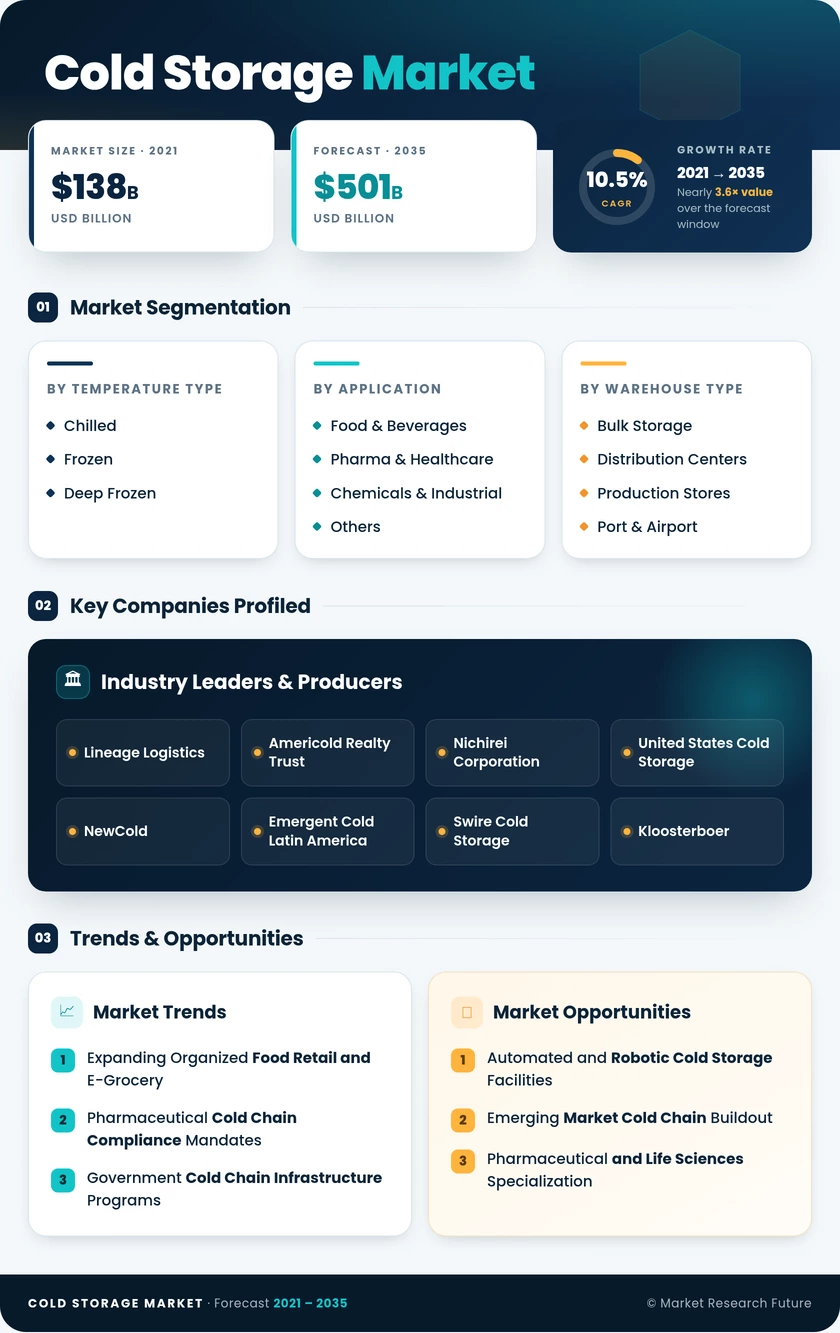
Segmentation Quick Reference
| Dimension | Sub-Segments | Dominant Segment | Fastest Growing Segment |
| By Temperature Type | Chilled; Frozen; Deep Frozen | Frozen (42% share) | Deep Frozen (13.1% CAGR) |
| By Application | Food & Beverages; Pharma & Healthcare; Chemicals & Industrial; Others | Food & Beverages (68% share) | Pharma & Healthcare (14.8% CAGR) |
| By Warehouse Type | Bulk Storage; Distribution Centers; Production Stores; Port & Airport | Bulk Storage (45% share) | Distribution Centers (12.3% CAGR) |
Market Segmentation Overview
By Temperature Type
| Sub-Segment | Key Trend |
| Chilled (0°C to 5°C) | Growth driven by fresh produce e-commerce and organized dairy retail in emerging markets |
| Frozen (−18°C to 0°C) | Sustained demand from frozen food trade; multi-temperature facilities replacing single-temp warehouses |
| Deep Frozen (below −18°C) | Biopharmaceutical storage requirements and premium frozen goods creating high-margin capacity demand |
Temperature stratification is becoming a defining design characteristic of new cold storage facilities, with multi-temperature configurations now comprising over 50% of greenfield builds globally as operators seek to serve diverse tenant requirements from a single asset footprint.
By Application
| Sub-Segment | Key Trend |
| Food & Beverages | Meat, seafood, and dairy lead; e-grocery and frozen meal categories expanding fastest |
| Pharmaceuticals & Healthcare | GxP-validated storage for biologics and cell therapies driving premium pricing power |
| Chemicals & Industrial | Specialty chemicals, reagents, and temperature-sensitive industrial materials requiring controlled environments |
| Others | Floriculture and cosmetics requiring chilled conditions for shelf-life extension |
The application mix within the cold storage industry is shifting progressively toward higher-value segments. Pharmaceutical tenants command 2.5–3.5× the revenue per pallet position compared to food-grade storage, incentivizing operators to invest in GDP-compliant upgrades and validation capabilities.
By Warehouse Type
| Sub-Segment | Key Trend |
| Bulk Storage Warehouses | Scale-driven economics serving exporters and food processors; high-density racking proliferating |
| Distribution Centers | E-commerce and last-mile delivery models driving demand for smaller, faster-turn urban and peri-urban facilities |
| Production Stores | On-site cold storage at manufacturing plants for just-in-time production integration |
| Port & Airport Facilities | International perishable trade growth sustaining demand at major cargo gateways |
The warehouse type mix reflects a broader industry evolution from static storage toward dynamic distribution. Traditional bulk warehouses continue to dominate by total capacity, but distribution centers are gaining share as supply chains fragment into smaller, more frequent shipment profiles driven by direct-to-consumer food and pharmaceutical delivery models.