Request Free Sample ×

Kindly complete the form below to receive a free sample of this Report

* Please use a valid business email

Leading companies partner with us for data-driven Insights

clients tt-cursor
Hero Background

Confectionery Ingredients Market

ID: MRFR/FnB/3145-HCR
110 Pages
Varsha More
Last Updated: May 28, 2026
Confectionery Ingredients Market Size, Share, Industry Trend & Analysis Research Report Information By Ingredient Type (Cocoa & Chocolate Ingredients, Sugar & Sweetener Ingredients, Dairy Ingredients, Fats & Oils, Texture & Gelling Agents, Flavoring Agents, Colors & Coatings, Functional Additives), By Application (Chocolate Confectionery, Sugar-Boiled & Gummy Confectionery, Bakery Confectionery, Chewing Gum & Bubble Gum, Seasonal & Novelty Confectionery), By End User (Large-Scale Confectionery Manufacturers, Mid-Size & Regional Manufacturers, Artisan & Craft Confectioners, Foodservice & HoReCa) – Forecast Till 2035
Download PDF ×

We do not share your information with anyone. However, we may send you emails based on your report interest from time to time. You may contact us at any time to opt-out.


Confectionery Ingredients Market Summary

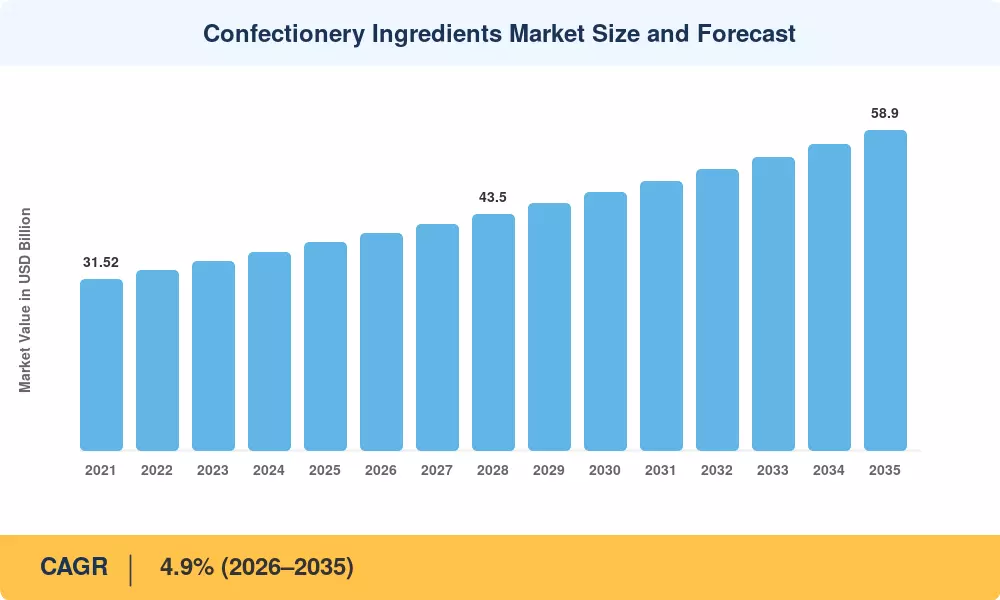
The global Confectionery Ingredients Market reached an estimated USD 38.2 billion in 2025, with forecast-period revenues starting at USD 40.1 billion in 2026 and climbing to USD 58.9 billion by 2035 at a compound annual growth rate of 4.9%. Two catalysts anchor this trajectory: rising per-capita chocolate and sugar confectionery consumption across emerging economies and an accelerating reformulation wave driven by clean-label regulations in the EU and North America [2]. Governments in more than 30 countries have now implemented or proposed sugar-reduction levies, pushing confectionery manufacturers toward functional confectionery additive solutions and next-generation sweetener blends that maintain indulgence while meeting new nutritional thresholds [3].

The ingredient supply chain itself is undergoing a quiet transformation. Traditional commodity-grade cocoa butter chocolate couverture is steadily giving way to traceable, single-origin couverture systems backed by blockchain provenance platforms. Barry Callebaut's USD 125 million "Generation Cocoa" program and Cargill's sustainable-sourcing pledge illustrate how upstream investment is reshaping what downstream confectioners can offer [4]. Sugar confectionery texture agents — hydrocolloids, modified starches, and pectin — are also seeing reformulation, as manufacturers pursue vegan-friendly gelling systems to replace gelatin in gummies and jellies [5].

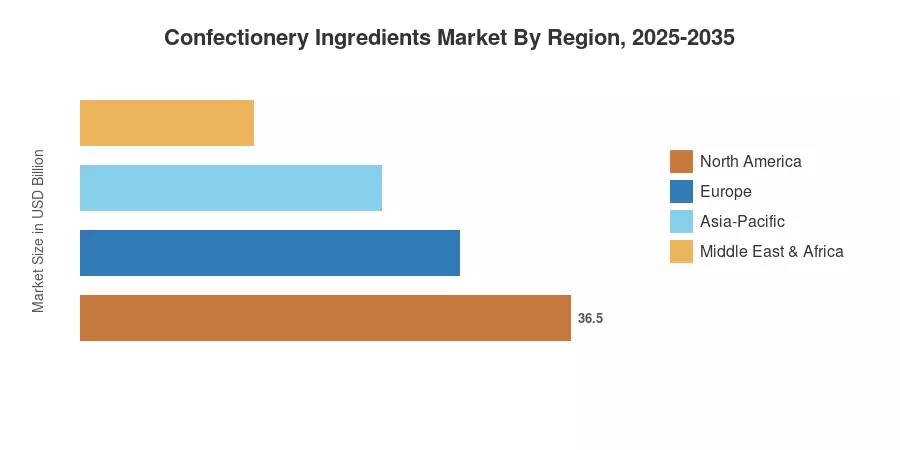
Europe commands the largest slice of the Confectionery Ingredients Market, holding roughly 33% of 2025 revenues, anchored by Switzerland, Germany, and Belgium's concentration of premium chocolate production. Asia-Pacific is the fastest-growing region at a 6.3% CAGR, fueled by expanding middle-class demand in China and India for branded chocolate and sugar confectionery. North America accounts for approximately 28% of the global market, with the United States driving demand for confectionery flavor ingredient innovation in seasonal and limited-edition product lines. The decade ahead will reward suppliers that can simultaneously deliver indulgence, transparency, and nutritional optimization.


Key Report Takeaways

• By Ingredient Type

  • Cocoa and chocolate ingredients (including cocoa butter chocolate couverture and cocoa powder) held the largest revenue share at ~38% in 2025, driven by premiumization and bean-to-bar trends
  • Sugar confectionery texture agents are forecast to grow at a 5.4% CAGR through 2035, reflecting accelerated demand for plant-based gelling agents in gummy and marshmallow formats
  • Confectionery flavor ingredient revenues surpassed USD 4.8 billion in 2025 as limited-edition and exotic flavor profiles proliferated across global product launches

• By Application

  • Chocolate confectionery applications represent USD 15.6 billion in ingredient demand, anchored by Western European and North American consumption
  • Sugar-boiled and gummy confectionery applications are expanding at 5.7% CAGR, the fastest among application segments in the Confectionery Ingredients Market

• By Region

  • Europe dominates at ~33% market share, with Germany alone accounting for over 9% of global ingredient consumption
  • Asia-Pacific's 6.3% CAGR makes it the fastest-growing region in the Confectionery Ingredients Market, with China and India as the primary engines
  • North America holds ~28% share, underpinned by strong private-label confectionery growth and functional confectionery additive adoption


Market Size and Forecast (2021–2035)

MRFR's market-sizing methodology triangulates top-down revenue estimates from ingredient-supplier financials with bottom-up demand modeling across 12 confectionery sub-categories in 45 countries. Historical data (2021–2024) derives from trade databases, customs records, and disclosed company revenues; forecast values (2026–2035) apply a blended econometric-demand model calibrated to GDP per-capita growth, sugar-levy adoption rates, and cocoa commodity price projections[7].
Market Size Chart
Our Impact
Enabled $4.3B Revenue Impact for Fortune 500 and Leading Multinationals
Partnering with 2000+ Global Organizations Each Year
30K+ Citations by Top-Tier Firms in the Industry
 

Driver Impact Analysis

Driver ~% Impact on CAGR Geographic Relevance Impact Timeline
Rising per-capita confectionery consumption in emerging markets +1.2% Asia-Pacific, South America Long-term (≥4 yr)
Clean-label & sugar-reduction regulation +0.9% Europe, North America Short-term (≤2 yr)
Premiumization of chocolate (bean-to-bar, single-origin) +0.8% Europe, North America Medium-term (2–4 yr)
Plant-based confectionery reformulation +0.6% Global Medium-term (2–4 yr)
Functional confectionery additive innovation (fortification, probiotics) +0.5% North America, Asia-Pacific Long-term (≥4 yr)
E-commerce & D2C confectionery channel expansion +0.4% Global Short-term (≤2 yr)
AI-enabled flavor and formulation discovery +0.3% North America, Europe Long-term (≥4 yr)


Emerging-Market Consumption Growth

Per-capita chocolate consumption in India sits below 200 grams annually — a fraction of Switzerland's 9.9 kg. As disposable incomes rise across South and Southeast Asia, branded confectionery volumes are expanding at double-digit rates in select metros. India's organized confectionery retail expanded 14% year-on-year in 2024, pulling ingredient demand for cocoa butter chocolate couverture and fondant gum base ingredient upstream[10]. This structural consumption gap represents the single largest volume driver for the Confectionery Ingredients Market through 2035.

Clean-Label and Sugar-Reduction Mandates

The UK Soft Drinks Industry Levy, France's taxe soda, and similar instruments in Mexico, South Africa, and the Philippines have already reshaped reformulation agendas. In 2024, the EU proposed extending sugar-content labeling to confectionery, which would require front-of-pack nutrient scoring on all chocolate bars and sugar-boiled sweets by 2028 [3]. Ingredient suppliers that offer sugar confectionery texture agents compatible with reduced-sugar matrices — such as polydextrose blends and chicory-root fibre — stand to capture outsized share.

Premiumization and Traceability in Cocoa

Bean-to-bar craft chocolate grew at 12% CAGR from 2020 to 2024, and the premium segment now represents over 18% of total chocolate sales in Western Europe [4]. This shift demands traceable, high-quality cocoa butter chocolate couverture with single-origin documentation. Barry Callebaut, Cargill, and Olam have each committed more than USD 100 million to farmer-level traceability programs, embedding blockchain and satellite monitoring into cocoa supply chains [4][9].

Plant-Based and Vegan Confectionery Reformulation

The global plant-based confectionery segment crossed USD 1.4 billion in retail sales in 2024, with gelatin-free gummies growing fastest [5]. This trend creates demand for alternative sugar confectionery texture agents — pectin, agar, carrageenan, and starch-based systems — as well as dairy-free chocolate formulations using oat, rice, or coconut bases. Confectionery flavor ingredient suppliers are also adapting, developing masking agents for the off-notes associated with plant-protein inclusions [5][15].


Restraints Impact Analysis

The restraint-impact percentages below are directional estimates and should not be subtracted directly from the headline CAGR.

Restraint ~% Impact on CAGR Geographic Relevance Impact Timeline
Cocoa price volatility and supply disruption –0.7% Global Short-term (≤2 yr)
Tightening sugar and additive regulations –0.5% Europe, North America Medium-term (2–4 yr)
Raw-material supply-chain concentration (West Africa) –0.4% Global Long-term (≥4 yr)
Consumer shift toward health-focused snacking –0.3% North America, Europe Long-term (≥4 yr)
Inflationary pressure on discretionary food spending –0.2% Global Short-term (≤2 yr)


Cocoa Price Volatility

Cocoa futures spiked above USD 10,000 per metric ton in early 2024 — more than double the five-year average — after adverse weather and disease outbreaks in Côte d'Ivoire and Ghana slashed production by an estimated 11% [8]. Because cocoa butter chocolate couverture accounts for roughly 20–25% of a typical chocolate bar's ingredient cost, these swings compress manufacturer margins and delay new-product launches. Hedging costs rose 35% for mid-size confectioners in 2023–2024, creating a measurable drag on the Confectionery Ingredients Market [8][17].

Regulatory Complexity Around Sugar and Additives

While sugar-reduction mandates drive reformulation (a driver), the compliance burden itself acts as a restraint. Ingredient suppliers must navigate divergent regulations: the EU's Novel Food framework, the US FDA's GRAS process, and FSSAI's approval pathways in India each impose different timelines and data requirements for new functional confectionery additive ingredients [3][10]. Small and mid-size confectionery flavor ingredient producers face disproportionate costs, potentially slowing innovation cycles.

Supply-Chain Concentration in West Africa

Côte d'Ivoire and Ghana together produce approximately 60% of the world's cocoa [9]. The EU Deforestation Regulation (EUDR), fully enforceable from December 2025, requires importers to prove that cocoa was not grown on deforested land. Compliance costs could add USD 150–300 per ton to procurement, particularly affecting small-holder supply chains that lack digital traceability [9][4].


Opportunities

Functional and Fortified Confectionery

Confectionery products fortified with vitamins, minerals, probiotics, and adaptogens represent a USD 2.1 billion addressable niche globally [13]. Brands like Wellmade, Hershey's "Better-for-You" range, and Mondelez's CocoaVia are blurring the line between indulgence and wellness. Functional confectionery additive suppliers that offer pre-blended fortification systems — shelf-stable probiotics encapsulated for sugar-boiling temperatures, for instance — can command 15–20% price premiums over commodity ingredients

Emerging-Market Chocolate Penetration

Organized chocolate retail penetration in Africa remains below 5% in most Sub-Saharan markets. As urbanization accelerates and cold-chain infrastructure improves, countries like Nigeria, Kenya, and Ethiopia offer greenfield opportunities for confectionery ingredient suppliers. Localized cocoa processing facilities (origin grinding) in Côte d'Ivoire and Ghana are growing at 8% annually, creating new demand for fondant gum base ingredient and compound-chocolate systems tailored to tropical-stable formats

AI-Driven Flavor and Formulation Platforms

Machine-learning platforms from companies like Givaudan's "CARTO" and IFF's "Foresight" can compress confectionery flavor ingredient development timelines from 12–18 months to under 6 months [11]. These platforms analyze consumer preference data, regulatory constraints, and raw-material availability simultaneously. Ingredient suppliers that license or build such platforms gain a strategic moat in the Confectionery Ingredients Market, especially for limited-edition and regional flavor launches

Sustainable and Upcycled Ingredients

Cocoa-pod husk fibre, upcycled fruit pulp, and spent-grain sweeteners are entering confectionery formulations. The upcycled-food ingredient segment is growing at roughly 9% annually, and certification programs like the Upcycled Food Association's mark are gaining retailer acceptance [15]. Sugar confectionery texture agents derived from upcycled citrus pectin or apple pomace offer both cost and sustainability advantages

Direct-to-Consumer and Personalized Confectionery

D2C confectionery brands grew 22% in 2024 across North America and Europe. These brands demand smaller-batch, customizable ingredient kits — personalized confectionery flavor ingredient blends, single-origin couverture drops, and color-matched sugar confectionery texture agents. Ingredient suppliers can capture higher margins through "ingredient-as-a-service" subscription models targeting artisan and micro-batch confectioners


Future Outlook

Precision Fermentation and Cocoa Alternatives

Cell-cultured cocoa fat and precision-fermented cocoa flavor compounds are transitioning from lab to pilot scale. Companies like California Cultured and QOA raised a combined USD 75 million in 2023–2024 to develop cocoa-free chocolate ingredients [11]. If these technologies achieve price parity by 2030, they could disrupt the traditional cocoa butter chocolate couverture supply chain while opening new formulation possibilities for the Confectionery Ingredients Market.

Digital Supply-Chain Integration

Blockchain-based traceability, IoT-enabled warehouse monitoring, and AI-powered demand forecasting are converging to create end-to-end digital supply chains for confectionery ingredients. Barry Callebaut's "Forever Chocolate" platform now tracks over 190,000 farmers digitally [4]. By 2030, MRFR estimates that over 60% of global cocoa trade will carry digital provenance documentation, reducing fraud and enabling real-time sugar confectionery texture agents inventory optimization [9].

Personalized Nutrition and Functional Confectionery

The convergence of nutrigenomics, wearable health data, and modular ingredient platforms will enable mass-personalized confectionery by the early 2030s [13]. Functional confectionery additive suppliers are already developing vitamin-D-fortified chocolate, probiotic gummies, and collagen-infused sugar confectionery. The addressable opportunity could reach USD 5 billion by 2035 if clinical validation and consumer trust keep pace.

Sustainability Reporting and Scope 3 Transparency

ESG reporting frameworks — the EU's CSRD, the ISSB standards, and the SEC's climate-disclosure rules — will increasingly require confectionery companies to report Scope 3 emissions from ingredient procurement [9][17]. Ingredient suppliers that can provide verified carbon-footprint data per ton of cocoa butter chocolate couverture or confectionery flavor ingredient will gain preferred-supplier status. This dynamic creates a competitive wedge favoring vertically integrated and digitally enabled Confectionery Ingredients Market participants.


Market Segmentation

By Ingredient Type

Segment Key Metric Primary Demand Driver
Cocoa & Chocolate Ingredients ~38% market share Premiumization; bean-to-bar growth
Sugar & Sweetener Ingredients USD 9.1 B (2025) Volume confectionery; reformulation for sugar reduction
Dairy Ingredients (milk powders, whey) 4.2% CAGR Milk chocolate and caramel formulations
Fats & Oils (non-cocoa) ~9% market share Compound chocolate; tropical-stable formulations
Texture & Gelling Agents 5.4% CAGR Plant-based gummy growth; sugar confectionery texture agents
Flavoring Agents USD 4.8 B (2025) Limited-edition launches; confectionery flavor ingredient diversity
Colors & Coatings ~5% market share Natural-color transition; clean-label demand
Functional Additives 6.1% CAGR Fortification; functional confectionery additive innovation


Cocoa and chocolate ingredients remain the backbone of the Confectionery Ingredients Market, commanding over a third of total revenues. Within this segment, cocoa butter chocolate couverture is the highest-value sub-category, with single-origin and certified-sustainable variants growing at roughly double the segment average. Barry Callebaut, Cargill, and Olam collectively control an estimated 55–60% of global couverture supply [4].

Sugar confectionery texture agents constitute one of the most technically dynamic segments, as the industry transitions away from gelatin toward pectin, starch, and agar-based systems. The segment is closely linked to the plant-based confectionery trend: gelatin-free gummy launches in Europe rose 40% year-on-year in 2024, creating a pull-through effect for texture-agent innovation [5]. Fondant gum base ingredient demand is also evolving, with chicle alternatives and synthetic gum bases gaining share in bubble gum and chewing gum formulations.

By Application

Segment Key Metric Primary Demand Driver
Chocolate Confectionery ~41% market share Premium chocolate growth; gifting culture
Sugar-Boiled & Gummy Confectionery 5.7% CAGR Plant-based reformulation; health gummies
Bakery Confectionery (cakes, pastries) USD 5.3 B (2025) Foodservice recovery; patisserie trend
Chewing Gum & Bubble Gum ~7% market share Fondant gum base ingredient demand
Seasonal & Novelty Confectionery 5.1% CAGR Limited-edition confectionery flavor ingredient cycles


Chocolate confectionery applications dominate the Confectionery Ingredients Market by application, reflecting chocolate's position as the largest confectionery sub-category globally. Ingredient demand here spans the full spectrum — from commodity compound coatings to artisanal cocoa butter chocolate couverture for single-origin bars.

By End User

Segment Key Metric Primary Demand Driver
Large-Scale Confectionery Manufacturers ~52% market share Volume procurement; supply-chain integration
Mid-Size & Regional Manufacturers USD 10.4 B (2025) Local flavor adaptation; fondant gum base ingredient customization
Artisan & Craft Confectioners 7.3% CAGR Bean-to-bar; D2C channel; premium ingredient sourcing
Foodservice & HoReCa ~12% market share Patisserie and dessert menu innovation


Regional Market Share Analysis

Region Key Metric Primary Investment Themes
Europe ~33% market share (2025) Premium chocolate, clean-label reformulation, EUDR compliance
North America ~28% market share (2025) Functional confectionery additive, limited-edition flavors, D2C
Asia-Pacific 6.3% CAGR (2026–2035) Cocoa penetration, sugar confectionery expansion, urbanization
South America USD 2.8 B (2025) Origin cocoa processing, domestic chocolate manufacturing
Middle East & Africa 5.8% CAGR (2026–2035) Halal confectionery, date-based ingredients, cold-chain buildout
Total USD 38.2 B (2025)

The Confectionery Ingredients Market displays clear regional variation shaped by consumption patterns, agricultural proximity to key raw materials, and regulatory frameworks governing sugar content and food additives.


Europe

Country Key Metric Key Driver
Germany ~28% of regional revenue Industrial chocolate manufacturing scale
Switzerland 6.1% CAGR Premium/single-origin cocoa butter chocolate couverture demand
Belgium USD 1.4 B Praline and artisan chocolate production
United Kingdom ~15% of regional revenue Sugar-reduction levy reformulation
France 4.5% CAGR Patisserie and confectionery flavor ingredient innovation


Europe's dominance in the Confectionery Ingredients Market reflects centuries of chocolate-making tradition combined with the world's most demanding regulatory environment. The EUDR will reshape cocoa procurement by requiring full deforestation-due-diligence documentation from January 2026, and ingredient suppliers without compliant supply chains risk losing access to a market worth over USD 12.6 billion annually [9]. Germany's ZDS (Central College of the German Confectionery Industry) continues to drive R&D in sugar confectionery texture agents optimized for reduced-sugar gummy and hard-boiled formats [2].

North America

Country Key Metric Key Driver
United States ~86% of regional revenue Functional confectionery additive demand; seasonal product cycles
Canada 4.6% CAGR Clean-label confectionery; maple-based ingredient innovation
Mexico USD 1.1 B Traditional confectionery (dulce) and tamarind-based flavors


The United States alone accounts for over USD 9.2 billion in confectionery ingredient demand, driven by a consumer culture that embraces both indulgence and wellness simultaneously [12]. Hershey, Mars, and Mondelez source cocoa butter chocolate couverture and confectionery flavor ingredient systems from a diversified global supplier base. Canada's confectionery sector is leaning into natural sweeteners and fondant gum base ingredient alternatives formulated without artificial colors.

Asia-Pacific

Country Key Metric Key Driver
China ~35% of regional revenue Domestic chocolate market expansion; cocoa processing growth
India 7.1% CAGR Rising branded confectionery consumption; sugar confectionery scale
Japan USD 2.1 B Premium confectionery and matcha/seasonal flavor integration
South Korea 5.9% CAGR K-confectionery export trend; novelty flavors
Australia ~5% of regional share Clean-label and organic confectionery ingredient demand


Asia-Pacific is the fastest-growing region in the Confectionery Ingredients Market, and India's trajectory is particularly striking. Mondelez India reported double-digit Cadbury volume growth in 2024, pulling demand for locally sourced cocoa butter chocolate couverture and fondant gum base ingredient upward [10]. China's domestic bean-to-bar movement, while nascent, has attracted venture investment exceeding USD 200 million since 2022.

South America

Country Key Metric Key Driver
Brazil ~58% of regional revenue Largest cocoa producer outside Africa; domestic chocolate industry
Colombia 6.2% CAGR Fine-flavor cocoa origin; peace-dividend agricultural expansion
Argentina USD 0.3 B Dulce de leche and fondant gum base ingredient demand


Brazil's dual role as both a major cocoa origin and a large domestic confectionery market gives it unique positioning. Local grinding capacity expanded 6% in 2024, and Brazilian-origin confectionery flavor ingredient exports to Europe grew 11% year-on-year [7].

Middle East & Africa

Country Key Metric Key Driver
UAE ~22% of regional revenue Re-export hub; premium gifting confectionery
Saudi Arabia 6.0% CAGR Vision 2030 food-processing investment; halal confectionery
South Africa USD 0.4 B Regional manufacturing hub; sugar confectionery texture agents


Halal-certified confectionery ingredients represent a fast-growing niche across the Middle East, with the halal confectionery ingredient segment estimated at USD 0.9 billion in 2025 [18]. The UAE's role as a re-export hub for branded chocolate into South Asia and East Africa amplifies demand for premium cocoa butter chocolate couverture and functional confectionery additive systems.


Regional Market Share
 

Competitive Benchmarking

The Confectionery Ingredients Market is moderately concentrated, with an estimated Herfindahl-Hirschman Index (HHI) of approximately 1,100–1,300. The top five suppliers control an estimated 40–45% of global revenues, reflecting a market where scale in cocoa processing coexists with fragmented specialty-ingredient niches. Vertical integration from farm to factory is the dominant strategic theme, alongside M&A activity targeting confectionery flavor ingredient and functional confectionery additive capabilities.

Company Est. Revenue Share Range Key Offerings for Confectionery Ingredients Market Strategic Positioning
Barry Callebaut ~12–15% Couverture, cocoa powder, decorations, fillings Vertically integrated; largest cocoa processor globally
Cargill (Cocoa & Chocolate) ~10–13% Cocoa butter chocolate couverture, lecithin, sweeteners Commodity scale; sustainability traceability
Olam Food Ingredients ~6–8% Cocoa, spices, dairy, nuts Origin-market processing; Africa-rooted supply chain
AAK ~4–6% Specialty fats and oils for confectionery Plant-based fats; shea and palm kernel expertise
Kerry Group ~3–5% Confectionery flavor ingredient, functional additives Taste & nutrition solutions; clean-label portfolio
Puratos ~3–5% Chocolate, fillings, fondant gum base ingredient Bakery-confectionery crossover; innovation centers
Tate & Lyle ~3–4% Sweetener solutions, sugar confectionery texture agents Sugar-reduction specialist; fiber-based systems
Givaudan ~2–4% Confectionery flavor ingredient, natural flavors AI-driven flavor design (CARTO platform)
CP Kelco ~2–3% Pectin, carrageenan, gellan gum Leading hydrocolloid supplier for confectionery textures
IFF (International Flavors & Fragrances) ~2–3% Flavors, texturants, functional confectionery additive End-to-end formulation; Foresight AI platform


Recent News & Developments


  • Givaudan (January 2025): Expanded its AI-powered CARTO platform to include confectionery-specific flavor optimization modules, reducing development timelines by 45% [11].


  • AAK (August 2024): Partnered with a leading plant-based confectionery brand to co-develop a shea-butter-based cocoa butter alternative, targeting compound chocolate applications in tropical climates [15].


Report Scope

Parameter Details
Market Scope Global Confectionery Ingredients Market — ingredients used in chocolate, sugar, gum, and bakery confectionery
Study Period 2021–2035
CAGR 4.9% (2026–2035)
Market Size — 2025 (Base Year) USD 38.2 Billion
Market Size — 2035 (Forecast Endpoint) USD 58.9 Billion
Fastest Growing Segment Functional Additives (6.1% CAGR); Asia-Pacific (6.3% CAGR by region)
Companies Profiled Barry Callebaut, Cargill, Olam, AAK, Kerry Group, Puratos, Tate & Lyle, Givaudan, CP Kelco, IFF
Valuation Currency USD (constant 2025 dollars)


FAQs

How do cocoa-butter alternatives compare to traditional couverture for shelf-life performance?

Cocoa-butter equivalents (CBEs) derived from shea or palm kernel oil offer comparable snap and gloss with 20–30% longer tropical shelf stability [15]. However, EU regulations restrict CBE content to 5% of total fat in products labeled "chocolate," limiting their use in European Confectionery Ingredients Market applications [9].

What procurement strategies minimize exposure to cocoa price volatility?

Leading confectioners use a layered hedging approach: 60–70% fixed-price forward contracts, 20% options-based coverage, and 10–20% spot purchasing [8]. Diversifying origin sourcing across West Africa, South America, and Southeast Asia further reduces single-region supply risk.

Which sugar confectionery texture agents perform best in reduced-sugar gummy formulations?

Pectin-polydextrose blends currently deliver the closest texture match to gelatin-based gummies at 30–40% sugar reduction [5]. Starch-agar hybrid systems offer a cost-effective alternative but require adjusted depositing temperatures and longer cooling times.

How is the EU Deforestation Regulation affecting ingredient sourcing timelines?

Importers now need 4–6 additional weeks for due-diligence documentation per cocoa shipment under the EUDR framework [9]. Suppliers with pre-verified, digitally traced supply chains are gaining preferred-partner status and faster customs clearance.

What role does AI play in confectionery flavor ingredient development today?

Platforms like Givaudan's CARTO analyze thousands of molecular combinations against consumer-preference datasets to generate optimized flavor profiles in weeks rather than months [11]. Adoption remains concentrated among Tier-1 suppliers, but SaaS-based access models are emerging for mid-size confectioners.

Are probiotic and fortified confectionery products gaining regulatory acceptance globally?

FSSAI approved probiotic inclusions for confectionery in India in late 2024, joining the US, EU, and Japan in permitting specific strains [10][13]. Shelf-stability of live cultures during sugar-boiling remains the primary technical barrier.

How can artisan confectioners access premium fondant gum base ingredient supply chains?

Specialty distributors like Keystone Foods and IMCD offer minimum-order-quantity programs tailored to craft-scale buyers [20]. Direct-sourcing cooperatives in Central America also provide small-lot chicle and natural gum base with full traceability documentation.


Author
Author
Author Profile
Varsha More LinkedIn
Senior Research Analyst
Experienced business professional with a demonstrated history of working in the CFnB industry. Skilled in market research, and market estimation. Strong professional with a Masters focused in marketing management.
Download Free Sample

Kindly complete the form below to receive a free sample of this Report
















