Download Free Sample
Kindly complete the form below to receive a free sample of this Report
Conjugate Vaccines Market Research Report By Vaccine Type (Meningococcal Conjugate Vaccines, Pneumococcal Conjugate Vaccines, Haemophilus Influenzae Type B Conjugate Vaccines, Typhoid Conjugate Vaccines), By Indication (Preventive Immunization, Therapeutic Use), By Administration Route (Intramuscular, Subcutaneous, Oral), By End User (Hospitals, Clinics, Pharmacies, Research Institutions) and By Regional (North America, Europe, South America, Asia-Pacific, Middle East and Africa) - Growth & Industry Forecast 2025 To 2035
The Global Conjugate Vaccines Market size was valued at USD 64.85 Billion in 2024, and the market is projected to grow from USD 67.47 Billion in 2025 to USD 100.25 Billion by 2035, registering a CAGR of 4.04% during the forecast period 2025–2035. North America led the market in 2024 with over 45.18% share, generating around USD 29.3 Million in revenue.
Rising global focus on preventive healthcare and expanding immunization programs are driving conjugate vaccine adoption. Increased vaccination coverage, government support, and efforts to control infectious diseases such as meningitis and pneumococcal infections are strengthening market growth.
According to WHO immunization data, global vaccination programs continue expanding, with approximately 154 million children vaccinated worldwide in 2023, preventing millions of deaths through routine immunization efforts. Increased access to vaccines and strengthened public health initiatives support the growing demand for advanced conjugate vaccines.
The Conjugate Vaccines Market is poised for substantial growth driven by technological advancements and increasing healthcare awareness.
| 2024 Market Size | 64.85 (USD Billion) |
| 2035 Market Size | 100.25 (USD Billion) |
| CAGR (2025 - 2035) | 4.04% |
The Conjugate Vaccines Market is currently experiencing a dynamic evolution, driven by advancements in vaccine technology and an increasing focus on preventive healthcare. The growing prevalence of infectious diseases, particularly in developing regions, has heightened the demand for effective immunization strategies. This market appears to be characterized by a diverse range of products, targeting various pathogens, which suggests a robust pipeline of innovations.
Furthermore, collaborations between pharmaceutical companies and research institutions are likely fostering the development of novel conjugate vaccines, enhancing their efficacy and safety profiles. In addition, the regulatory landscape is evolving, with health authorities emphasizing the importance of vaccine accessibility and affordability.
This trend may lead to increased investments in research and development, as well as initiatives aimed at improving distribution networks. The market seems poised for growth, as stakeholders recognize the critical role of vaccination in public health. As awareness of vaccine-preventable diseases continues to rise, the market is expected to expand, potentially leading to improved health outcomes globally.
The market is witnessing a surge in technological innovations that enhance vaccine efficacy and safety. New methodologies in conjugation techniques and adjuvant formulations are being explored, which may lead to more effective immunization options. This trend indicates a shift towards personalized vaccines, tailored to specific populations and pathogens.
There is a growing emphasis on preventive healthcare measures, particularly in the context of infectious diseases. Governments and health organizations are prioritizing vaccination programs, which could drive demand for conjugate vaccines. This trend suggests a broader recognition of the importance of immunization in maintaining public health.
Collaborations between pharmaceutical companies, academic institutions, and governmental bodies are becoming more prevalent in the market. These partnerships may facilitate the sharing of knowledge and resources, potentially accelerating the development of new vaccines. This trend highlights the importance of collective efforts in addressing global health challenges.
Government initiatives play a crucial role in shaping the Conjugate Vaccines Industry. Various governments are increasingly recognizing the importance of vaccination in public health strategies. This recognition has led to enhanced funding for vaccine research and development, as well as the implementation of national immunization programs.
For example, several countries have allocated substantial budgets to procure conjugate vaccines, aiming to improve vaccination coverage rates. This proactive approach not only boosts the market but also encourages collaboration between public and private sectors, fostering innovation in vaccine technology. The financial support from governments is likely to sustain the growth trajectory of the market in the coming years.
The Conjugate Vaccines Industry is significantly influenced by the growing awareness of the benefits of vaccination among the general population. Educational campaigns and outreach programs have effectively communicated the importance of vaccines in preventing serious diseases.
As a result, there is an increasing acceptance of conjugate vaccines, particularly among parents for their children. This trend is reflected in vaccination rates, which have shown improvement in various regions. The World Health Organization has reported that vaccination coverage for conjugate vaccines has reached over 80% in many countries, indicating a positive shift in public perception. This heightened awareness is expected to further propel the market as more individuals seek preventive healthcare solutions.
The Conjugate Vaccines Industry is experiencing a notable surge due to the increasing incidence of infectious diseases worldwide. As pathogens evolve and new strains emerge, the demand for effective vaccines becomes paramount. For instance, diseases such as pneumococcal infections and meningitis have shown a rising trend, prompting health authorities to prioritize vaccination programs.
This heightened awareness and urgency have led to an estimated growth rate of approximately 8% in the conjugate vaccines segment over the past few years. Consequently, pharmaceutical companies are investing significantly in research and development to create innovative conjugate vaccines that can address these challenges, thereby driving the market forward.
Investment in vaccine research is a pivotal driver for the Conjugate Vaccines Industry. With the ongoing need for new and improved vaccines, both public and private sectors are channeling resources into research initiatives. This influx of funding is facilitating the development of novel conjugate vaccines that target a broader range of pathogens.
Recent reports indicate that global investment in vaccine research has increased by over 15% in the last few years, reflecting a commitment to enhancing public health. This trend is expected to continue, as stakeholders recognize the long-term benefits of investing in vaccine innovation, thereby propelling the market to new heights.
Technological innovations are transforming the Conjugate Vaccines Industry, leading to more efficient and effective vaccine production processes. Advances in biotechnology, such as recombinant DNA technology and novel adjuvants, are enhancing the efficacy and safety profiles of conjugate vaccines.
These innovations not only streamline the manufacturing process but also reduce production costs, making vaccines more accessible. The introduction of new conjugate vaccines, which utilize cutting-edge technology, is anticipated to capture a larger market share. As manufacturers adopt these technologies, the overall market is likely to expand, driven by the demand for high-quality vaccines that can address emerging health threats.
Meningococcal conjugate vaccines position themselves as the largest segment, with 38% share within the conjugate vaccines market, offering wide-ranging protection against bacterial meningitis. Pneumococcal conjugate vaccines follow closely behind, recognized for their rapid adoption and growth.
The diversification of vaccine offerings within each segment demonstrates the healthcare sector's commitment to addressing varying strains and disease profiles, as providers and health systems emphasize immunization to reduce incidence rates across demographics.
Sanofi has strengthened the meningococcal conjugate vaccine segment through its vaccine portfolio, with MenQuadfi approved in 2020 for individuals aged 12 months and older in multiple markets, supporting broader meningococcal disease prevention and segment expansion.
In the Conjugate Vaccines Market, the Preventive Immunization segment holds the largest share of 72%, indicating a strong reliance on vaccines for the prevention of infectious diseases. This approach has been historically favored due to its ability to effectively reduce disease onset through population-level immunization campaigns.
Conversely, the Therapeutic Use segment, while currently smaller, is gaining traction as the medical community explores new applications of conjugate vaccines in treating existing diseases, marking a shift in focus from purely preventive strategies.
Novartis contributed significantly to preventive immunization advancement through vaccine innovation, with its historical meningococcal vaccine portfolio supporting protection against invasive meningococcal disease. Global preventive vaccination programs continue driving demand for conjugate vaccines across pediatric and adult populations.
In the Conjugate Vaccines Market, the administration route is vital for determining vaccine efficacy and patient acceptance. Intramuscular administration represents the largest share of 82% among the segments, largely due to its established usage in various immunization programs.
This method is preferred for its ability to induce robust immune responses and is often used in large-scale vaccination efforts, making it a cornerstone in public health strategies. On the other hand, Subcutaneous administration is emerging as a fast-growing option, particularly for specific vaccines targeting younger populations and those with a fear of needles, offering a less invasive alternative that is gaining traction in both clinical trials and market adoption.
Baxter International has supported vaccine delivery infrastructure through healthcare solutions, while intramuscular administration remains the preferred route in global immunization programs due to strong immune response generation and widespread clinical adoption.
In the Conjugate Vaccines Market, hospitals hold the largest market share at 46%, driven by their comprehensive healthcare infrastructure and capacity to administer various vaccine programs effectively. This segment is crucial for vaccination campaigns, especially in managing infectious diseases.
On the other hand, clinics are emerging as the fastest-growing segment, attributed to the increased accessibility of healthcare services and a rising preference for receiving vaccinations in outpatient settings. Their flexible operational hours and the ability to cater to specific community health needs enhance their market presence.
Hoffmann-La Roche supports hospital-based healthcare systems through diagnostic and therapeutic innovations, while hospitals remain the leading end-user segment due to their role in large-scale vaccination campaigns and comprehensive patient care services.
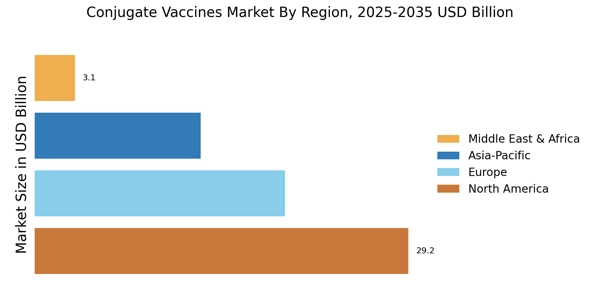
The Conjugate Vaccines Market revenue is expected to witness robust growth across various regions, with significant contributions from North America, Europe, APAC, South America, and MEA. In 2023, North America stands as the dominant region, holding a market valuation of 25.0 USD Billion, to grow to 35.0 USD Billion by 2032, while Europe follows closely with a valuation of 15.0 USD Billion in 2023, increasing to 20.0 USD Billion.
APAC displays considerable potential for growth from 10.0 USD Billion in 2023 to 16.0 USD Billion by 2032, reflecting rising demand for advanced healthcare and immunization practices.South America and MEA have smaller yet significant presences, with market values of 6.0 USD Billion and 6.33 USD Billion in 2023, growing to 8.0 USD Billion and 10.0 USD Billion, respectively, by 2032. The major market growth drivers include rising healthcare expenditure, increasing vaccination awareness, and supportive government policies. However, challenges like Healthcare cold chain logistics and vaccine hesitancy may impede growth.
The market statistics highlight the diversified opportunities across these regions, where North America and Europe dominate primarily due to their advanced healthcare infrastructure and higher vaccination rates.
The Conjugate Vaccines Market is characterized by a diverse range of players involved in the research, development, and distribution of conjugate vaccines, which are critical in providing immunity against various infectious diseases. Technological advancements, regulatory approvals, and an increasing prevalence of vaccine-preventable diseases shape the competitive landscape in this market.
Companies are focusing on enhancing their product portfolios and expanding their market reach through strategic alliances, collaborations, and mergers. Factors such as pricing strategies, distribution networks, and the ability to adapt to changing regulatory frameworks also play a significant role in influencing competition.As the demand for effective vaccines continues to rise globally, the competitive dynamics of the market are expected to evolve, reflecting ongoing innovations and shifts in consumer preferences.
Emergent BioSolutions has established a significant position within the market by leveraging its strong expertise in vaccine development and manufacturing. The company has developed a robust pipeline of conjugate vaccines aimed at addressing various public health needs, which is supported by its advanced research capabilities and facilities. Emergent BioSolutions is recognized for its focus on quality and compliance, ensuring that its products meet stringent regulatory standards.
The company invests in partnerships and collaborations that enhance its research initiatives and expand its market access. This commitment to innovation, along with the capability to scale production, positions Emergent BioSolutions as a formidable competitor in the conjugate vaccines space.Sanofi has also carved out a prominent presence in the market, known for its strong research and development capabilities coupled with a wide-reaching distribution network.
The company's focus on developing vaccines that provide effective immunization against serious diseases is reflected in its extensive portfolio of conjugate vaccines that target different pathogens.Sanofi's strategic investments in cutting-edge technologies and commitment to public health initiatives further bolster its competitive advantage.
By collaborating with various health organizations and tapping into emerging markets, Sanofi continues to expand its footprint and integrate innovative solutions to meet global vaccination demands. The company's established reputation and extensive experience in vaccine production and marketing solidify its role as a key player in this highly competitive sector.





The Conjugate Vaccines Market is witnessing notable developments, particularly with advancements in vaccine production and strategic partnerships among leading companies. Emergent BioSolutions recently emphasized its commitment to enhancing its conjugate vaccine portfolio, while Sanofi announced a collaboration focused on developing innovative pneumococcal vaccines.
Takeda's research initiatives are gaining traction, particularly in response to emerging infectious diseases. Cleveland BioLabs and its focus on targeted immunotherapies continue to shape discussions around vaccine efficacy. In a significant operational move, AbbVie is exploring acquisitions that could bolster its presence in the conjugate vaccine space.
Additionally, Moderna is investing in mRNA technology as a novel approach for conjugate vaccines, reflecting the increasing interest in this platform across the market.
Companies like Pfizer and GlaxoSmithKline are collaborating on large-scale trials for their vaccines aimed at global dissemination. Recent growth within this market has led to increased valuations for major players, indicating a robust demand driven by public health initiatives. Lastly, Johnson & Johnson continues to expand its research capabilities, while AstraZeneca pursues various partnerships to enhance its vaccine portfolio.
The Conjugate Vaccines Market size is projected to reach USD 100.25 Billion by 2035, growing at a CAGR of 4.04%, driven by increasing vaccination programs and technological advancements in vaccine development.
New opportunities lie in:
By 2035, the market is expected to be robust, driven by innovation and global health initiatives.
| MARKET SIZE 2024 | 64.85(USD Billion) |
| MARKET SIZE 2025 | 67.47(USD Billion) |
| MARKET SIZE 2035 | 100.25(USD Billion) |
| COMPOUND ANNUAL GROWTH RATE (CAGR) | 4.04% (2025 - 2035) |
| REPORT COVERAGE | Revenue Forecast, Competitive Landscape, Growth Factors, and Trends |
| BASE YEAR | 2024 |
| Market Forecast Period | 2025 - 2035 |
| Historical Data | 2019 - 2024 |
| Market Forecast Units | USD Billion |
| Key Companies Profiled | Pfizer (US), GlaxoSmithKline (GB), Merck & Co. (US), Sanofi (FR), Novartis (CH), Baxter International (US), Hoffmann-La Roche (CH), AstraZeneca (GB), Serum Institute of India (IN) |
| Segments Covered | Vaccine Type, Indication, Administration Route, End User, Regional |
| Key Market Opportunities | Advancements in conjugate vaccine technology enhance immunogenicity, addressing unmet needs in infectious disease prevention. |
| Key Market Dynamics | Rising demand for conjugate vaccines driven by regulatory support and technological advancements in immunization strategies. |
| Countries Covered | North America, Europe, APAC, South America, MEA |
The Conjugate Vaccines Market is projected to reach a valuation of 100.25 USD Billion by 2035.
In 2024, the overall market valuation was 64.85 USD Billion.
The expected CAGR for the Conjugate Vaccines Market during the forecast period 2025 - 2035 is 4.04%.
Pneumococcal Conjugate Vaccines are projected to generate revenues between 25.0 and 40.0 USD Billion by 2035.
Meningococcal Conjugate Vaccines are projected to generate revenues of 10.0 to 15.0 USD Billion, whereas Typhoid Conjugate Vaccines are expected to reach 14.85 to 25.25 USD Billion.
Preventive Immunization is expected to dominate the Conjugate Vaccines Market by indication, with projected revenues of 40.0 to 60.0 USD Billion.
The Intramuscular administration route is anticipated to have the highest revenue, projected between 25.0 and 38.0 USD Billion.
The expected revenue range for hospitals in the end-user segment is projected to be between 25.0 and 38.0 USD Billion by 2035.
Clinics are projected to generate revenues between 15.0 and 23.0 USD Billion, while pharmacies are expected to reach 12.0 to 18.0 USD Billion.



Kindly complete the form below to receive a free sample of this Report

“This is really good guys. Excellent work on a tight deadline. I will continue to use you going forward and recommend you to others. Nice job”


“Thanks. It’s been a pleasure working with you, please use me as reference with any other Intel employees.”


“Thanks for sending the report it gives us a good global view of the Betaïne market.”


“Thank you, this will be very helpful for OQS.”


“We found the report very insightful! we found your research firm very helpful. I'm sending this email to secure our future business.”


“I am very pleased with how market segments have been defined in a relevant way for my purposes (such as "Portable Freezers & refrigerators" and "last-mile"). In general the report is well structured. Thanks very much for your efforts.”


“I have been reading the first document or the study, ,the Global HVAC and FP market report 2021 till 2026. Must say, good info! I have not gone in depth at all parts, but got a good indication of the data inside!”


“We got the report in time, we really thank you for your support in this process. I also thank to all of your team as they did a great job.”


“The Automotive 48V ECU Components Procurement Intelligence Study” was a complex project, but the Market Research Future (MRFR) team handled it with quality, agility, and customer-centricity. They delivered all requested data on time and within the agreed scope. The team, including Shubhendra Anand and Rahul Gotadki, was always readily available to clarify questions and swiftly implement necessary adjustments, driving the project to a successful conclusion within a very demanding timeframe.
I would also like to specifically commend Akshay Agarwal for his responsiveness and support at every stage—from our initial inquiry on May 6th through to final delivery on June 18th. His dedication made the entire process seamless.”



