Antibody Drug Conjugate Market (2026 - 2035)

Antibody Drug Conjugate Market Research Report: Size, Share, Trend Analysis By Types (Cytotoxic Drug Conjugates, Immunomodulatory Drug Conjugates, Radiolabeled Drug Conjugates, Dual Action Drug Conjugates), By Therapeutic Area (Oncology, Autoimmune Diseases, Infectious Diseases, Neurological Disorders), By Mechanism of Action (Targeted Delivery, Cell Cycle Disruption, Immune Modulation, Antibody-Dependent Cellular Cytotoxicity), By Route of Administration (Intravenous, Subcutaneous, Intramuscular) and By Regional (North America, Europe, South America, Asia Pacific, Middle East and Africa) - Growth Outlook & Industry Forecast Till 2035

Forecast Period
2026-2035
CAGR
26.9%
2025 Market Size
USD 14.52 Billion
2035 Market Size
USD 159.52 Billion
Healthcare ● Updated August 24, 2026 Report ID: MRFR/HC/0607-HCR | Pages: 200 | Author: Nidhi Mandole, Rahul Gotadki

Antibody Drug Conjugate Market Summary

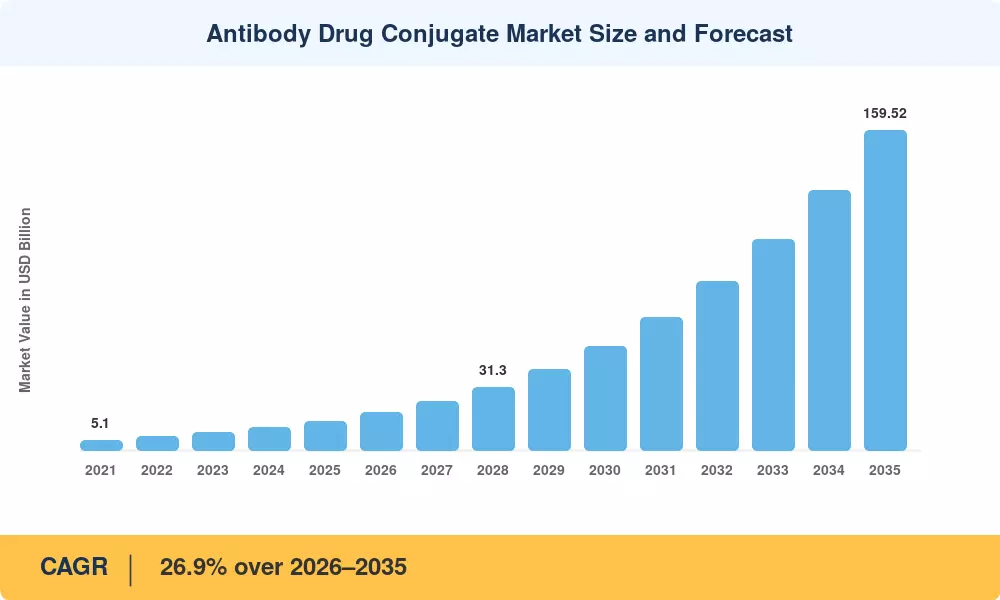
The Antibody Drug Conjugate Market was valued at USD 14.52 Billion in 2025 and opens the forecast window at USD 18.71 Billion in 2026, climbing to USD 159.52 Billion by 2035 at a 26.9% CAGR. Two catalysts anchor that trajectory. The U.S. Food and Drug Administration cleared a record number of conjugate-linked oncology filings under its Real-Time Oncology Review pathway, compressing median review timelines by roughly 11 weeks [1]. Capital followed: Pfizer's USD 43 billion Seagen purchase and AbbVie's USD 10.1 billion ImmunoGen deal moved this modality from specialty bet to portfolio pillar [5][6].

Oncology is quietly abandoning broad-spectrum cytotoxic infusion. Where platinum doublets and taxane regimens once defined first-line care, tumour-directed biologics now deliver payload directly to antigen-expressing cells, sparing marrow and gut epithelium. Site-specific conjugation platforms — THIOMAB chemistry, glycoengineered attachment, enzymatic ligation — have widened therapeutic windows enough to justify premium licensing. Global pharmaceutical R&D allocation toward this class exceeded USD 9.8 billion in 2024 alone [7].

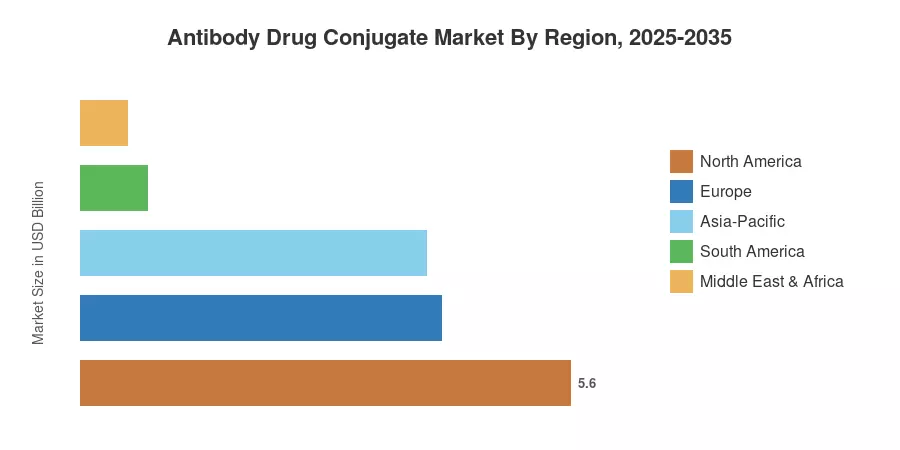
Regional weight sits in North America at 38.6% of 2025 revenue, supported by Medicare outpatient infusion coverage and domestic high-potency manufacturing. Asia-Pacific advances fastest at a 27.2% CAGR through 2035, propelled by Chinese out-licensing economics. Europe holds second position on the strength of coordinated European Medicines Agency assessment and national HTA pathways. The Antibody Drug Conjugate Market enters its second decade with pipeline depth, not scarcity, as the defining constraint.


Key Report Takeaways

• By Product and Payload

  • Enhertu led the Antibody Drug Conjugate Market with a 21.9% product revenue share in 2025
  • Topoisomerase I inhibitor payloads generated USD 7.23 Billion in 2025
  • Microtubule inhibitor payloads (MMAE, DM1, DM4) expand at a 28.6% CAGR to 2035

• By Application and End User

  • Hematologic malignancies held 43.3% of application revenue in 2025
  • Urothelial indications advance at a 27.3% CAGR through 2035
  • Hospitals accounted for USD 6.95 Billion of 2025 end-user revenue

• By Region

  • North America captured 38.6% of Antibody Drug Conjugate Market revenue in 2025
  • Asia-Pacific grows at a 27.2% CAGR, the fastest of any region
  • Europe contributed USD 4.12 Billion in 2025


Market Size and Forecast (2021–2035)

Estimates draw on approved-product revenue disclosures from company filings, IQVIA infusion-volume tracking, national reimbursement claim sets, and clinical-trial enrolment registries. Historical values reconcile bottom-up product revenue against top-down oncology biologics spend; forecast years apply indication-expansion probability weighting to late-stage pipeline assets in the Antibody Drug Conjugate Market.
Antibody Drug Conjugate Market Size and Forecast
Our Impact
Enabled $4.3B Revenue Impact for Fortune 500 and Leading Multinationals
Partnering with 2000+ Global Organizations Each Year
30K+ Citations by Top-Tier Firms in the Industry

Driver Impact Analysis

Driver ~% Impact on CAGR Geographic Relevance Impact Timeline
Accelerated review of linker stability and DAR data ~4.2 Global, U.S.-led Short-term (≤2 yr)
Topoisomerase I efficacy in low-antigen tumours ~5.1 North America, Europe Medium-term (2–4 yr)
Large-cap acquisition and pipeline capital inflow ~4.6 Global Short-term (≤2 yr)
High-potency conjugation capacity build-out ~3.4 North America, Asia-Pacific Medium-term (2–4 yr)
Biomarker-guided patient selection infrastructure ~3.0 Europe, Asia-Pacific Long-term (≥4 yr)
Asia-Pacific out-licensing and domestic approvals ~3.8 Asia-Pacific Medium-term (2–4 yr)
Payer coverage of outpatient infusion episodes ~2.7 North America Long-term (≥4 yr)


Payload Chemistry Rewrites Eligibility Criteria

Topoisomerase I inhibitor payloads changed who qualifies for treatment. DESTINY-Breast04 demonstrated median overall survival of 23.4 months versus 16.8 months for physician's choice chemotherapy in HER2-low disease, a population previously excluded from targeted options [3]. That single readout expanded the addressable breast cohort by an estimated 55%. Regulators followed quickly, and the Antibody Drug Conjugate Market absorbed roughly USD 2.1 billion of incremental annual revenue from label extension alone [8].

Capital Concentration Accelerates Development Timelines

Deal flow resets development economics. Merck's USD 22 billion collaboration with Daiichi Sankyo across three candidates committed USD 4 billion in guaranteed upfront payments, funding parallel Phase III programmes that would otherwise have run sequentially [6]. Sponsors now routinely initiate confirmatory trials before accelerated approval, shortening the gap between conditional and full authorisation by an average of 14 months [1].

Manufacturing Capacity Moves From Bottleneck to Enabler

Contract manufacturers committed over USD 3.6 billion to high-potency conjugation suites between 2023 and 2025, adding an estimated 40% to global licensed capacity [12]. Lonza, Samsung Biologics, and WuXi XDC each opened dedicated bioconjugation lines. Booked lead times have shortened from 30 months to roughly 20, easing the supply constraint that throttled launch curves for second-wave assets.

Reimbursement Architecture Rewards Outpatient Delivery

Medicare's outpatient prospective payment system reimburses conjugate infusion under separately payable drug codes, insulating hospital margins from bundled-episode compression [15]. Approximately 71% of U.S. administrations now occur in hospital outpatient departments rather than inpatient settings. That shift lowered cost per cycle by an estimated USD 1,900 and materially improved formulary acceptance across integrated delivery networks.


Restraints Impact Analysis

Restraint percentages reflect directional drag on compound growth derived from analyst scoring of clinical, regulatory, and commercial friction. Values are indicative rather than additive, and they interact with the drivers catalogued in the Antibody Drug Conjugate Market analysis above.

Restraint ~% Impact on CAGR Geographic Relevance Impact Timeline
Scarcity of licensed high-potency conjugation capacity ~-3.6 Global Medium-term (2–4 yr)
Toxicity-driven discontinuation (ILD, ocular events) ~-2.9 Global Short-term (≤2 yr)
Payload and linker patent litigation ~-2.1 North America, Europe Long-term (≥4 yr)
HTA pricing pressure and reimbursement delay ~-2.4 Europe, Asia-Pacific Medium-term (2–4 yr)
Biomarker testing access gaps ~-1.8 South America, MEA Long-term (≥4 yr)


Toxicity Profiles Constrain Duration of Therapy

Interstitial lung disease remains the sharpest clinical brake. Pooled safety analyses across deruxtecan programmes report all-grade ILD incidence near 12.4%, with grade 5 events at roughly 0.8% [11]. Prescribers respond by mandating baseline high-resolution CT and quarterly monitoring, adding administrative cost and shortening median treatment duration. Ocular surface toxicity in MMAE-linked agents produces similar attrition, with dose modification required in about 28% of treated patients.

Manufacturing Complexity Limits Launch Velocity

Conventional biologics suites are incapable of providing the containment infrastructure necessary for conjugation. Occupational exposure band 5 licenses for cytotoxic handling are held by fewer than 25 facilities worldwide [12]. The average batch failure rate for stochastic conjugation remains at 7–9%, and the cycle time is extended by three weeks due to analytical release testing for drug-antibody ratio distribution. As a result, sponsors opt to stagger launches by geography rather than pursuing a simultaneous global rollout.


Health Technology Assessment Slows European Uptake

The interval between approval and patient access is extended in Europe due to pricing negotiation. In 2024, the average delay between EMA authorization and national reimbursement for oncology biologics in the EU-27 was 517 days, with a range of 133 days in Germany to over 800 days in Poland [13]. Confidential discount agreements that compress the realized net price by an estimated 22–31% are compelled by cost-effectiveness thresholds near GBP 30,000 per QALY.


Antibody Drug Conjugate Market Opportunities

Bispecific and Dual-Payload Architectures

The resistance mechanisms that restrict the durability of single-target therapies are addressed by next-generation constructs that simultaneously target two antigens. Between 2023 and 2025, approximately 46 bispecific antibody drug conjugates were evaluated in clinical settings, with early-phase objective response rates in heavily pretreated cohorts exceeding 40% [7]. By the early 2030s, the Antibody Drug Conjugate Market could be significantly augmented by sponsors who price these assets at a premium to monospecific comparators.


Emerging-Market Licensing and Local Manufacturing

In 2024, the average upfront price of ex-Asia licensing deals was USD 118 million, with tiered royalties, as Chinese and Korean developers have become net exporters of clinical-stage assets [14]. Retaining regional manufacturing rights enables partners to supply Brazil, India, and the Gulf states at landed costs that are 40–55% lower than the Western List Price. This structure facilitates the expansion of volume in systems that were previously unaffordable due to premium pricing.


Companion Diagnostic and Real-World Data Monetisation

Antigen-expression scoring generates a data asset distinct from the therapeutic itself. Digital pathology vendors now license algorithm-derived expression datasets to sponsors for trial enrichment, a revenue stream valued near USD 340 million in 2025 [18]. Participants in the Antibody Drug Conjugate Market that own both drug and diagnostic capture margin twice and gain earlier visibility into indication-expansion signals.

Subcutaneous and Fixed-Dose Reformulation

Converting intravenous infusion to subcutaneous administration cuts chair time from 90 minutes to under 10. Precedent from HER2 monoclonal reformulation shows conversion rates above 60% within three years of launch and per-episode cost savings near USD 1,400 [4]. Reformulation also extends patent runway, an attractive defence as first-wave composition claims approach expiry.

Non-Oncology Indication Expansion

Conjugate chemistry is migrating beyond tumours. Programmes in rheumatoid arthritis, IgA nephropathy, and severe asthma use anti-inflammatory rather than cytotoxic payloads, with 14 candidates in Phase I or II as of late 2025 [20]. Success would open a patient population an order of magnitude larger than current oncology cohorts, though safety thresholds for chronic non-malignant use are materially stricter.


Antibody Drug Conjugate Market Future Outlook

Computational Design Compresses Discovery Cycles

Machine-learning models trained on linker stability and payload release kinetics now screen candidate constructs in silico before wet-lab synthesis. Sponsors report discovery-to-IND timelines shortening from 54 months to roughly 38, with an estimated USD 22 million saved per programme [10]. As these tools mature, the Antibody Drug Conjugate Market should see a wider variety of antigen targets reach the clinic, including those historically dismissed as insufficiently tumour-selective.

Platform Licensing Becomes the Dominant Economic Model

Conjugation chemistry ownership increasingly outperforms single-asset development on risk-adjusted return. Site-specific platform holders collected an estimated USD 1.4 billion in milestone and royalty income during 2025, without carrying commercial infrastructure [7]. Expect further separation between chemistry originators and clinical developers, mirroring the structure that emerged in mRNA delivery.

Resistance Management Shapes Sequencing Strategy

Clinical practice must answer what follows conjugate failure. Retrospective series suggest cross-resistance between agents sharing payload class exceeds 60%, while switching payload mechanism preserves response in about 34% of cases [11]. Sequencing guidelines from major cooperative groups are expected by 2028, and they will materially influence which assets capture second- and third-line volume.

Supply Chain Regionalisation Under Biosecurity Policy

Legislative pressure to reduce dependence on single-country manufacturing is reshaping capacity siting. Proposed U.S. and EU provisions favour domestic or allied-nation conjugation for publicly reimbursed products, and roughly USD 2.8 billion of announced capital expenditure through 2030 targets Western sites [12]. Cost of goods will rise modestly, but the Antibody Drug Conjugate Market gains resilience that procurement committees now price explicitly.


Antibody Drug Conjugate Market Segmentation

By Product

The product mix within the Antibody Drug Conjugate Market has shifted decisively toward deruxtecan-based assets over the past three years.

Segment Metric (2025) Primary Demand Driver
Enhertu 21.9% share HER2-low and ultralow label expansion
Kadcyla USD 2.53 Billion Adjuvant residual disease standard of care
Adcetris 14.6% share Frontline Hodgkin lymphoma combination use
Padcev USD 1.92 Billion First-line urothelial with pembrolizumab
Trodelvy 11.0% share Triple-negative breast and HR+/HER2−
Polivy 8.3% share Frontline DLBCL displacement of R-CHOP
Other and emerging assets 27.2% CAGR Accelerated approvals in gynaecologic and lung cancers


Enhertu's ascent illustrates how label breadth compounds. Sequential approvals across HER2-positive breast, HER2-low breast, gastric, and pan-tumour HER2-expressing disease turned a single molecule into a multi-indication franchise generating roughly USD 3.18 billion in 2025 [8]. Padcev tells a complementary story: combination with checkpoint blockade produced median overall survival of 31.5 months in untreated advanced urothelial carcinoma, displacing platinum chemotherapy as first-line standard and doubling addressable volume within two years [4].

By Payload Class

Segment Metric (2025) Primary Demand Driver
Topoisomerase I inhibitors USD 7.23 Billion Bystander effect enabling low-antigen efficacy
Microtubule inhibitors (MMAE, DM1, DM4) 28.6% CAGR Established safety database and manufacturing maturity
DNA-damaging agents 12.5% share Potency in refractory hematologic disease
Immunomodulatory and other payloads 6.3% share Combination potential with checkpoint inhibition


Payload chemistry now determines commercial ceiling more than antibody selection. Topoisomerase I inhibitors dominate the Antibody Drug Conjugate Market because membrane-permeable metabolites kill neighbouring antigen-negative cells, an effect that expands eligible tumour phenotypes well beyond high-expressors [3]. Microtubule inhibitors retain a durable position through manufacturing familiarity and a two-decade safety record that regulators and formulary committees both find easier to underwrite.

By Linker Chemistry

Segment Metric (2025) Primary Demand Driver
Cleavable 67.1% share Protease-sensitive release enabling bystander killing
Non-cleavable USD 3.11 Billion Reduced off-target release and lower systemic toxicity
Site-specific 28.7% CAGR Homogeneous DAR improving therapeutic index


Cleavable linkers carry today's volume, but site-specific conjugation attracts the licensing premium. Homogeneous drug-antibody ratio distribution reduces batch heterogeneity and narrows pharmacokinetic variability, which regulators increasingly reward with shorter CMC review cycles [9]. Chemistry originators typically extract mid-single-digit royalties plus development milestones, an economic structure that has drawn substantial venture funding into platform companies.

By Application

Segment Metric (2025) Primary Demand Driver
Hematologic cancers 43.3% share Established CD30, CD19, and CD79b target validation
Breast USD 4.30 Billion HER2-low reclassification expanding eligible cohort
Urothelial 27.3% CAGR Nectin-4 combination displacing platinum regimens
Lung 9.1% share TROP2 and HER3 candidates entering late-stage trials
Other solid tumours 6.8% share Gynaecologic and gastric indication expansion


Hematologic cancers continue to be the most prevalent application in the Antibody-Drug Conjugate market, as evidenced by decades of established target validation across the CD30, CD19, and CD79b pathways. Urothelial cancer is the most rapidly expanding application, as novel combination therapies, such as Nectin-4-directed agents in conjunction with immunotherapies, are rapidly replacing conventional platinum-based chemotherapy regimens in frontline settings.


By End User

Segment Metric (2025) Primary Demand Driver
Hospitals USD 6.95 Billion Infusion infrastructure and toxicity monitoring capability
Specialty cancer centres 28.4% share Trial participation and biomarker testing depth
Biopharma and CRO partnerships 28.6% CAGR Outsourced development and manufacturing demand
Ambulatory and other settings 8.5% share Shift toward lower-acuity administration


Hospitals continue to be the primary end-user segment in the Antibody-Drug Conjugate market, as they possess the advanced toxicity monitoring capabilities and established infusion infrastructure necessary for complex regimens. The fastest-growing segment is biopharma and CRO partnerships, which are driven by the increasing demand for outsourcing services in the areas of specialized development, clinical trial execution, and high-potency manufacturing.


Regional Market Share Analysis

Region Metric (2025) Primary Investment Themes
North America 38.6% share Payload manufacturing, Medicare outpatient coverage, biotech M&A
Europe USD 4.12 Billion EMA centralised review, HTA-driven pricing, academic trial networks
Asia-Pacific 27.2% CAGR Domestic approvals, out-licensing economics, CDMO capacity
South America 5.2% share Public tender procurement, biosimilar-adjacent pricing
Middle East & Africa USD 0.54 Billion Sovereign health investment, specialty centre build-out
Total USD 14.52 Billion

Geographic revenue in the Antibody Drug Conjugate Market concentrates where reimbursement supports outpatient infusion and where high-potency manufacturing sits. Asia-Pacific is closing the gap fastest.


North America

Country Metric (2025) Key Driver
US 83.5% of region Medicare Part B separately payable drug codes
Canada USD 0.61 Billion pCPA joint negotiation and CADTH reimbursement alignment
Mexico 27.4% CAGR IMSS specialty oncology procurement expansion


United States dominance rests on infrastructure rather than epidemiology. The Centers for Medicare & Medicaid Services reimbursed approximately USD 4.9 billion in conjugate infusion claims during 2024, with average sales price plus 6% preserving provider margin [15]. Domestic conjugation capacity — concentrated in Indiana, North Carolina, and Massachusetts — supplies roughly half of global commercial supply. The Antibody Drug Conjugate Market in Canada advances more slowly because pan-Canadian price negotiation adds 9–14 months to listing decisions.

Europe

Country Metric (2025) Key Driver
Germany 23.8% of region AMNOG early benefit assessment enabling day-one access
UK USD 0.79 Billion Cancer Drugs Fund managed access agreements
France 17.2% of region ATU early access authorisation programme
Italy 26.1% CAGR AIFA innovative medicines fund allocation
Spain USD 0.34 Billion Regional tender consolidation across autonomous communities
Nordic Countries 6.4% of region Joint Nordic procurement pilot
Russia 22.9% CAGR Domestic biosimilar substitution policy
Rest of Europe USD 0.28 Billion Central European reimbursement harmonisation


German access economics remain the continental benchmark. Free pricing during the first six months post-launch, followed by AMNOG-negotiated rebate, gives sponsors a revenue window worth an estimated USD 40–70 million per major asset [13]. Britain's Cancer Drugs Fund committed GBP 340 million during 2024–25 to managed access agreements, most of which carry data-collection obligations. Growth in the Antibody Drug Conjugate Market across southern Europe depends heavily on regional tender cycles rather than national listing alone.

Asia-Pacific

Country Metric (2025) Key Driver
China 34.2% of region NMPA priority review and NRDL inclusion
Japan USD 0.92 Billion PMDA Sakigake designation and domestic origination
India 30.1% CAGR CDSCO approval pathway and Ayushman Bharat coverage
South Korea 11.6% of region HIRA risk-sharing agreements
ASEAN USD 0.24 Billion Singapore and Thailand specialty centre expansion
Rest of Asia-Pacific 25.8% CAGR Australian PBS listings and NZ Pharmac review


Chinese developers have moved from follower to originator. The National Medical Products Administration approved 11 domestically originated conjugates through 2025, and National Reimbursement Drug List inclusion typically triggers volume expansion of 300–400% within 18 months at negotiated discounts near 60% [17]. Japan contributes disproportionate value because Daiichi Sankyo's origination of deruxtecan chemistry anchors royalty flow domestically. Across the region, the Antibody Drug Conjugate Market benefits from conjugation capacity that undercuts Western contract pricing by roughly 35%.

South America

Country Metric (2025) Key Driver
Brazil 58.3% of region ANVISA registration and CONITEC incorporation decisions
Argentina USD 0.13 Billion Private insurance oncology coverage mandates
Rest of South America 25.4% CAGR Chilean Ley Ricarte Soto high-cost drug fund


Brazilian access splits sharply between public and supplementary systems. ANVISA registration averages 11 months, but CONITEC incorporation into SUS adds a further 18–24 months, meaning most early volume flows through private health plans covering roughly 26% of the population [21]. Argentine uptake tracks currency stability closely; import licensing friction during 2024 delayed several shipments. Regional participants increasingly negotiate volume-based agreements denominated in local currency to insulate against devaluation.

Middle East & Africa

Country Metric (2025) Key Driver
Saudi Arabia 29.7% of region Vision 2030 healthcare privatisation and SFDA fast-track
UAE USD 0.12 Billion Abu Dhabi and Dubai mandatory insurance oncology benefit
South Africa 24.6% CAGR SAHPRA registration backlog clearance programme
Egypt 9.8% of region Universal Health Insurance phased rollout
Rest of MEA USD 0.09 Billion Gulf Cooperation Council joint procurement


Gulf state procurement behaves more like a single buyer than five markets. The GCC joint tender mechanism aggregates demand across member states, and Saudi Arabia's Health Sector Transformation Programme allocated approximately USD 1.2 billion to oncology infrastructure through 2025, including 14 new specialty centres [22]. Sub-Saharan access remains constrained by pathology capacity rather than pricing; fewer than 90 accredited immunohistochemistry laboratories serve the region, limiting the biomarker testing that eligibility depends on.


Antibody Drug Conjugate Market By Region, 2025-2035

Competitive Benchmarking

Concentration in the Antibody Drug Conjugate Market sits at a moderate level, with an estimated Herfindahl-Hirschman Index near 1,150 and a top-five combined share around 55–62%. That structure reflects an unusual dynamic: a handful of originators control commercial revenue while dozens of platform specialists and Chinese developers supply the pipeline. Fragmentation is increasing at the clinical stage even as commercial revenue consolidates.

Company Est. Revenue Share Range Key Offerings for Antibody Drug Conjugate Market Strategic Positioning
Daiichi Sankyo ~14–18% Enhertu, Datroway, HER3-DXd Deruxtecan chemistry originator with royalty leverage
AstraZeneca ~12–16% Enhertu co-commercialisation, Datroway Global commercial reach paired with licensed chemistry
Pfizer (Seagen) ~11–14% Adcetris, Padcev, Tivdak, Tukysa Vertically integrated MMAE platform and manufacturing
Roche / Genentech ~9–12% Kadcyla, Polivy Adjuvant and frontline lymphoma franchise depth
Gilead Sciences ~6–9% Trodelvy TROP2 leadership in triple-negative breast cancer
AbbVie (ImmunoGen) ~5–8% Elahere, maytansinoid platform Gynaecologic oncology focus post-acquisition
Takeda ~3–5% Adcetris (Japan and Asia rights) Regional commercialisation and lifecycle management
ADC Therapeutics ~2–4% Zynlonta, PBD-dimer platform DNA-damaging payload specialist in hematology
RemeGen ~2–4% Disitamab vedotin Chinese originator with expanding out-licensing
Zai Lab ~1–3% In-licensed regional portfolio Greater China commercialisation partner of choice
Merck & Co. ~1–3% Collaboration assets with Daiichi Sankyo Late-entry buyer with checkpoint combination strategy
Sichuan Kelun-Biotech ~1–3% SKB264 and licensed pipeline Low-cost development with Western partnership model


Recent News & Developments

  • Pfizer (December 2023): Completed its USD 43 billion acquisition of Seagen, consolidating MMAE chemistry, four marketed products, and dedicated conjugation capacity under one owner [5].
  • AbbVie (February 2024): Closed the USD 10.1 billion ImmunoGen purchase, adding Elahere and the maytansinoid platform to an oncology portfolio previously weighted toward hematology [6].
  • Merck & Daiichi Sankyo (October 2023): Announced a collaboration worth up to USD 22 billion across three candidates, with USD 4 billion payable regardless of programme outcome [6].
  • Genmab (May 2024): Acquired ProfoundBio for approximately USD 1.8 billion, securing a hydrophilic linker platform and three clinical-stage assets in gynaecologic cancers [7].
  • U.S. FDA (January 2025): Approved Datroway for previously treated HR-positive, HER2-negative metastatic breast cancer, validating TROP2 as a second commercially proven solid-tumour target [1].
  • U.S. FDA (January 2025): Extended Enhertu labelling to HER2-ultralow breast cancer, again enlarging the eligible population and reinforcing the bystander-effect thesis [2].
  • Lonza (September 2024): Commissioned an expanded bioconjugation facility in Visp, adding commercial-scale capacity intended to cut customer lead times by roughly eight months [12].
  • NMPA China (June 2025): Granted priority review to three domestically originated candidates, signalling regulatory intent to accelerate local innovation ahead of NRDL negotiation cycles [17].


Antibody Drug Conjugate Market Report Scope

Parameter Detail
Market Scope Global revenue from approved and late-stage antibody-conjugated cytotoxic and payload-linked oncology therapeutics, segmented by product, payload class, linker chemistry, application, end user, and geography
Study Period 2021–2035 (Historical 2021–2024; Base Year 2025; Forecast 2026–2035)
CAGR 26.9% over 2026–2035
Market Size Checkpoints USD 14.52 Billion (2025); USD 18.71 Billion (2026); USD 66.41 Billion (2031); USD 159.52 Billion (2035)
Fastest Growing Segments Site-specific linkers (28.7% CAGR); biopharma and CRO partnerships (28.6% CAGR); Asia-Pacific (27.2% CAGR)
Companies Profiled Daiichi Sankyo, AstraZeneca, Pfizer (Seagen), Roche/Genentech, Gilead Sciences, AbbVie (ImmunoGen), Takeda, ADC Therapeutics, RemeGen, Zai Lab, Merck & Co., Sichuan Kelun-Biotech
Valuation Currency USD Billion, constant 2025 exchange rates

FAQs

How should institutional investors evaluate valuation multiples in the Antibody Drug Conjugate Market?
Screen for platform ownership rather than single-asset exposure. Conjugation chemistry and payload intellectual property generate durable licensing income, while single-indication developers carry binary readout risk. Deal comparables since 2023 cleared roughly 8–12x forward revenue for platform holders [7].
What contract manufacturing constraints affect supply reliability?
Fewer than 25 facilities worldwide hold high-potency conjugation licences, and booked capacity currently runs 18–24 months out. Buyers should secure dual-site fill-finish agreements before Phase III readouts rather than after approval [12].
Which reimbursement nuances shape procurement in the Antibody Drug Conjugate Market?
Outpatient infusion coding determines margin more than list price does. Centres billing under bundled episode payments absorb premedication and monitoring costs directly, so pharmacy committees now model total episode cost instead of acquisition cost alone [15].
How do site-specific platforms compare with stochastic conjugation on cost?
Site-specific routes raise upstream cost per gram by roughly 20–30% but cut batch rejection and improve homogeneity. Net cost of goods typically converges once commercial scale is reached [9].
What biomarker testing gaps limit adoption in the Antibody Drug Conjugate Market?
Low-expression scoring requires pathologist retraining and validated digital assays. Many mid-tier hospitals lack accredited immunohistochemistry throughput, delaying eligible-patient identification by several weeks [18].
Which safety signals most influence prescriber switching decisions?
Interstitial lung disease and ocular toxicity drive discontinuation more often than neutropenia does. Prescribers weigh monitoring burden heavily when two agents deliver comparable response rates [11].
How are emerging-market licensing structures evolving?
Chinese developers now out-license ex-Asia rights for upfront payments above USD 100 million plus tiered royalties. Regional partners retain manufacturing, which compresses landed cost across price-sensitive health systems [14].    
Author
Author
Author Profile
Nidhi Mandole LinkedIn
Senior Research Analyst
She is an extremely curious individual currently working in Healthcare and Medical Devices Domain. Nidhi is comfortably versed in data centric research backed by healthcare educational background. She leverages extensive data mining and analytics tools such as Primary and Secondary Research, Statistical Analysis, Machine Learning, Data Modelling. Her key role also involves Technical Sales Support, Client Interaction and Project management within the Healthcare team. Lastly, she showcases extensive affinity towards learning new skills and remain fascinated in implementing them.
Co-Author
Co-Author Profile
Rahul Gotadki LinkedIn
Research Manager
He holds an experience of about 9+ years in Market Research and Business Consulting, working under the spectrum of Life Sciences and Healthcare domains. Rahul conceptualizes and implements a scalable business strategy and provides strategic leadership to the clients. His expertise lies in market estimation, competitive intelligence, pipeline analysis, customer assessment, etc.
Share::
Request Free Sample

Research Approach

Secondary Research

The secondary research process involved comprehensive analysis of regulatory databases, peer-reviewed oncology journals, clinical trial repositories, and authoritative biopharmaceutical organizations. Key sources included the US Food & Drug Administration (FDA), European Medicines Agency (EMA), Japan Pharmaceuticals and Medical Devices Agency (PMDA), China National Medical Products Administration (NMPA), ClinicalTrials.gov, World Health Organization (WHO) International Clinical Trials Registry Platform, National Cancer Institute (NCI) Surveillance, Epidemiology, and End Results (SEER) Program, National Center for Biotechnology Information (NCBI/PubMed), American Society of Clinical Oncology (ASCO), European Society for Medical Oncology (ESMO), American Association for Cancer Research (AACR), European Society of Clinical Pharmacy (ESCP), IQVIA National Sales Perspectives, Evaluate Pharma, and proprietary pharmaceutical pipeline databases. These sources were used to collect treatment statistics, regulatory approval data, clinical safety and efficacy studies, epidemiological trends, biomarker prevalence, and competitive landscape analysis for cytotoxic drug conjugates, immunomodulatory conjugates, radiolabeled conjugates, and emerging dual-action ADC technologies.


Primary Research

Qualitative and quantitative insights were obtained by interviewing supply-side and demand-side stakeholders during the primary research process. Supply-side sources encompassed Chief Executive Officers, Presidents of Global Oncology Divisions, Chief Scientific Officers, Heads of Antibody Engineering, Vice Presidents of Bioconjugation Development, regulatory affairs heads for novel biologic licensing, commercial directors for oncology portfolios, and business development executives from leading ADC manufacturers, contract manufacturing organizations (CMOs), and contract development and manufacturing organizations (CDMOs). Medical oncologists, hematologists, clinical pharmacists, pharmacy directors from academic medical centers, formulary committee chairmen, procurement leads from infusion centers, and specialty pharmacy directors were the demand-side sources. Primary research has confirmed clinical pipeline timelines, validated market segmentation across therapeutic areas and mechanisms of action, and collected insights on treatment adoption patterns, institutional purchasing protocols, reimbursement dynamics for hospital-administered biologics, and biosimilar impact assessments.

Primary Respondent Breakdown:

By Designation: C-level Primaries (32%), Director Level (30%), Others (38%)

By Region: North America (38%), Europe (25%), Asia-Pacific (28%), Rest of World (9%)


Market Size Estimation

Global market valuation was derived through revenue mapping and treatment volume analysis. The methodology included:

Identification of 55+ key manufacturers and biotech innovators across North America, Europe, Asia-Pacific, and Latin America, including specialized ADC-focused biopharmaceutical firms and CDMOs with integrated bioconjugation capabilities

Product mapping across cytotoxic drug conjugates, immunomodulatory drug conjugates, radiolabeled conjugates, and dual-action conjugate categories, with further segmentation by target indication (solid tumors vs. hematological malignancies) and generation technology (first-generation, site-specific conjugation, novel linker technologies)

Analysis of reported and modeled annual revenues specific to ADC portfolios, including collaboration revenue, milestone payments, and royalty streams from partnered assets

Coverage of manufacturers representing 75-80% of global market share in 2024, accounting for marketed products such as ado-trastuzumab emtansine, brentuximab vedotin, enfortumab vedotin, fam-trastuzumab deruxtecan, and emerging pipeline assets

Extrapolation using bottom-up (patient volume × treatment duration × ASP by country/region, adjusted for dosing regimens and line of therapy) and top-down (manufacturer revenue validation and service provider capacity utilization) approaches to derive segment-specific valuations across routes of administration and mechanisms of action

Share::
Request Free Sample
Download Free Sample

Kindly complete the form below to receive a free sample of this Report

* Please use a valid business email

Share::
Request Free Sample
Download PDF ×

We do not share your information with anyone. However, we may send you emails based on your report interest from time to time. You may contact us at any time to opt-out.
















