Segmentation Quick Reference
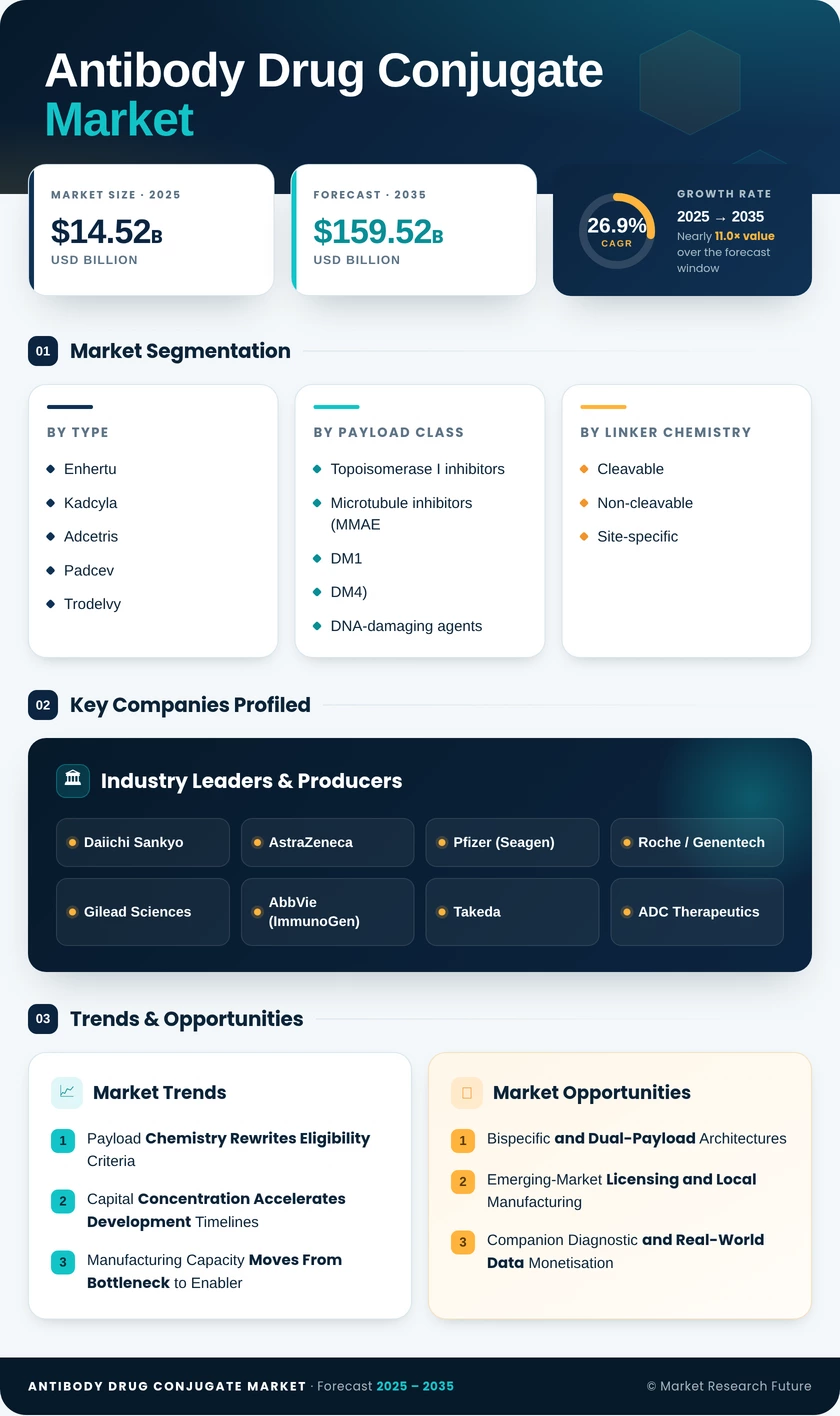
| Dimension | Sub-Segments | Dominant Segment | Fastest Growing Segment |
| By Product | Adcetris, Kadcyla, Padcev, Enhertu, Trodelvy, Polivy, Other and Emerging Assets | Enhertu | Other and Emerging Assets |
| By Payload Class | Microtubule Inhibitors, DNA-Damaging Agents, Topoisomerase I Inhibitors, Immunomodulatory and Other Payloads | Topoisomerase I Inhibitors | Microtubule Inhibitors |
| By Linker Chemistry | Cleavable, Non-Cleavable, Site-Specific | Cleavable | Site-Specific |
| By Application | Breast, Hematologic, Urothelial, Lung, Other Solid Tumours | Hematologic | Urothelial |
| By End User | Hospitals, Specialty Cancer Centres, Biopharma and CRO Partnerships, Ambulatory and Other Settings | Hospitals | Biopharma and CRO Partnerships |
| By Geography | North America, Europe, Asia-Pacific, South America, Middle East & Africa | North America | Asia-Pacific |
Market Segmentation Overview
By Product
| Sub-Segment | Key Trend |
| Adcetris | Frontline Hodgkin lymphoma combination regimens sustain volume against approaching patent milestones |
| Kadcyla | Adjuvant residual-disease positioning holds steady share despite newer HER2 entrants |
| Padcev | Checkpoint-combination approval reset first-line urothelial standard of care |
| Enhertu | Sequential label expansion across HER2-positive, low, and ultralow disease drives franchise economics |
| Trodelvy | TROP2 targeting extends reach into HR-positive breast and lung indications |
| Polivy | Frontline DLBCL data displaces long-standing R-CHOP regimens |
| Other and Emerging Assets | Accelerated approvals in gynaecologic, gastric, and lung cancers broaden the base |
Product-level economics increasingly follow label breadth rather than launch order. Assets able to demonstrate efficacy across antigen-expression gradients capture disproportionate revenue because they convert previously ineligible patients into treatable ones.
By Payload Class
| Sub-Segment | Key Trend |
| Microtubule Inhibitors | Mature safety databases and familiar manufacturing keep this class commercially durable |
| DNA-Damaging Agents | Potency advantages concentrate use in refractory hematologic settings |
| Topoisomerase I Inhibitors | Bystander effect enables efficacy across low-antigen tumour phenotypes |
| Immunomodulatory and Other Payloads | Early-stage combinations with checkpoint blockade target immune-cold tumours |
Payload selection now precedes antibody selection in most discovery programmes. Sponsors optimise for therapeutic index and bystander behaviour first, then screen antibody candidates against the chosen chemistry.
By Linker Chemistry
| Sub-Segment | Key Trend |
| Cleavable | Protease- and pH-sensitive designs remain the volume default across approved assets |
| Non-Cleavable | Lower systemic release supports use where off-target toxicity is the binding constraint |
| Site-Specific | Homogeneous drug-antibody ratio attracts premium licensing and faster CMC review |
Linker design has become the primary differentiator among otherwise similar constructs. Platform owners increasingly monetise chemistry through royalties rather than carrying commercial infrastructure themselves.
By Application
| Sub-Segment | Key Trend |
| Breast | HER2-low reclassification enlarged the eligible cohort by more than half |
| Hematologic | Validated CD30, CD19, and CD79b targets underpin the largest revenue pool |
| Urothelial | Combination with checkpoint inhibition delivered the strongest survival readout to date |
| Lung | TROP2 and HER3 candidates in late-stage trials position this as the next major expansion |
| Other Solid Tumours | Gynaecologic and gastric approvals extend the modality beyond established niches |
Application mix is migrating from hematologic toward solid tumours as payload chemistry improves tumour penetration. That shift raises the ceiling considerably given solid-tumour incidence volumes.
By End User
| Sub-Segment | Key Trend |
| Hospitals | Infusion infrastructure and toxicity monitoring capability concentrate administration here |
| Specialty Cancer Centres | Trial participation and biomarker testing depth support earlier adoption of new assets |
| Biopharma and CRO Partnerships | Outsourced conjugation and analytical services grow fastest as pipelines expand |
| Ambulatory and Other Settings | Subcutaneous reformulation will progressively shift lower-acuity administration outward |
End-user distribution will change more in the next decade than it has in the last. Reformulation and improved safety profiles both push administration toward lower-cost settings.
By Geography
| Sub-Segment | Key Trend |
| North America | Outpatient reimbursement design and domestic manufacturing sustain leadership |
| Europe | Centralised approval paired with fragmented national pricing creates uneven access timing |
| Asia-Pacific | Domestic origination and out-licensing economics deliver the fastest regional growth |
| South America | Public-private access divergence concentrates early volume in supplementary insurance |
| Middle East & Africa | Sovereign healthcare investment builds specialty capacity ahead of demand |
Regional trajectories diverge on infrastructure rather than epidemiology. Where pathology capacity and infusion reimbursement exist together, adoption follows quickly; where either is missing, approval alone changes little.