×
Request Free Sample ×

Kindly complete the form below to receive a free sample of this Report

* Please use a valid business email

Leading companies partner with us for data-driven Insights

clients tt-cursor
Hero Background

cosmetics products Market

ID: MRFR/CG/66448-CR
200 Pages
MRFR Team
December 2025

Share:
Download PDF ×

We do not share your information with anyone. However, we may send you emails based on your report interest from time to time. You may contact us at any time to opt-out.

cosmetics products Market Infographic
Purchase Options

cosmetics products Market Summary

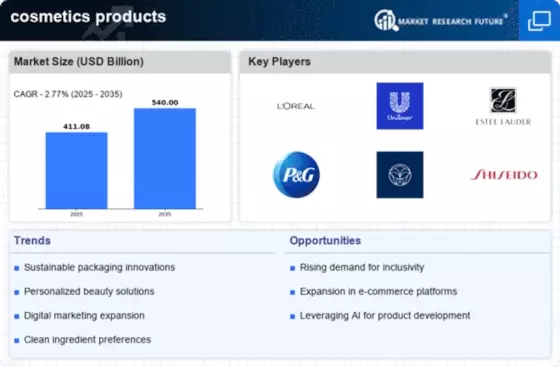
As per MRFR analysis, the Cosmetics Products market was estimated at 400.0 USD Billion in 2024. The cosmetics industry is projected to grow from 411.08 USD Billion in 2025 to 540.0 USD Billion by 2035, exhibiting a compound annual growth rate (CAGR) of 2.77 during the forecast period 2025 - 2035.

Key Market Trends & Highlights

The cosmetics products market is experiencing a transformative shift towards sustainability and personalization.

  • The North American market remains the largest, driven by a strong demand for skincare products.
  • Asia-Pacific is the fastest-growing region, with a notable increase in makeup product consumption.
  • Personalization and inclusivity are becoming essential trends, catering to diverse consumer needs.
  • The rise of e-commerce and innovations in product formulation are key drivers propelling market growth.

Market Size & Forecast

2024 Market Size 400.0 (USD Billion)
2035 Market Size 540.0 (USD Billion)
CAGR (2025 - 2035) 2.77%

Major Players

L'Oreal (FR), Unilever (GB), Estée Lauder (US), Procter & Gamble (US), Coty (US), Shiseido (JP), Revlon (US), Beiersdorf (DE), Avon (GB), Mary Kay (US)

Our Impact
Enabled $4.3B Revenue Impact for Fortune 500 and Leading Multinationals
Partnering with 2000+ Global Organizations Each Year
30K+ Citations by Top-Tier Firms in the Industry

cosmetics products Market Trends

The cosmetics products market is currently experiencing a dynamic evolution, driven by shifting consumer preferences and an increasing emphasis on sustainability. As individuals become more conscious of the ingredients in their beauty products, there is a noticeable shift towards natural and organic formulations. This trend reflects a broader societal movement towards health and wellness, where consumers seek products that align with their values and lifestyle choices. Additionally, the rise of digital platforms has transformed how brands engage with their audience, allowing for personalized marketing strategies that resonate with diverse demographics. Moreover, the cosmetics products market is witnessing a surge in inclusivity, with brands expanding their offerings to cater to a wider range of skin tones and types. This inclusivity not only enhances brand loyalty but also fosters a sense of community among consumers. As the market continues to evolve, it appears that innovation and adaptability will be crucial for brands aiming to thrive in this competitive landscape. The interplay between consumer demand for ethical practices and the rapid advancement of technology suggests that the cosmetics products market will remain vibrant and multifaceted in the foreseeable future.

Sustainability Focus

The cosmetics products market is increasingly prioritizing sustainability, with brands adopting eco-friendly practices and materials. This trend reflects a growing consumer demand for products that minimize environmental impact, leading to innovations in packaging and ingredient sourcing.

Personalization and Customization

There is a notable shift towards personalized beauty solutions, as consumers seek products tailored to their individual needs. Brands are leveraging technology to offer customized formulations, enhancing customer satisfaction and engagement.

Inclusivity in Product Offerings

The cosmetics products market is embracing inclusivity, with brands expanding their ranges to accommodate diverse skin tones and types. This trend not only promotes representation but also strengthens consumer loyalty and brand identity.

Market Segment Insights

By Product Type: Skincare (Largest) vs. Makeup (Fastest-Growing)

The cosmetics products market showcases a diverse range of product types, with skincare emerging as the largest segment. This category encompasses various products aimed at enhancing the skin's health and appearance, contributing significantly to overall market share. Following closely, makeup represents the fastest-growing segment, reflecting changing consumer preferences that prioritize self-expression and creative personal aesthetics. The strong growth in makeup is driven by innovative product launches and the influence of social media trends that elevate cosmetic usage among various demographics.

Skincare: Dominant vs. Makeup: Emerging

Skincare remains the dominant segment within the cosmetics products market, characterized by a wide array of products including moisturizers, serums, and sunscreens that cater to diverse skin types and concerns. This segment benefits from a growing awareness of skincare routines and the importance of health and wellness. On the other hand, makeup is emerging robustly, appealing to a younger audience seeking to enhance their beauty through creativity. The rise of makeup tutorials online and influencer endorsements significantly fuel this segment's growth, indicating a vibrant shift in consumer behavior towards self-expression and experimentation in cosmetics.

By Distribution Channel: Online Retail (Largest) vs. Department Stores (Fastest-Growing)

In the cosmetics products market, the distribution landscape is dynamically evolving, with online retail taking the lead as the largest distribution channel. The shift towards digital shopping has been accelerated by changing consumer preferences and advancements in technology, leading to a significant share for online platforms. Department stores, in contrast, while still relevant, have seen their market share challenged as consumers increasingly opt for the convenience and accessibility that online channels provide.

Department Stores (Dominant) vs. Specialty Stores (Emerging)

Department stores have traditionally been a dominant force in the cosmetics products market, providing a broad range of brands and exclusive products that appeal to diverse customer demographics. However, specialty stores are emerging as significant competitors, catering to niche markets with curated selections and a focus on specific cosmetic needs. The tailored shopping experience and specialized knowledge offered by specialty stores are drawing customers seeking personalized service. This dynamic signifies a shift in consumer behavior toward more specialized retail environments, prompting department stores to innovate their offerings to maintain relevance in this competitive landscape.

By End User: Women (Largest) vs. Teenagers (Fastest-Growing)

In the cosmetics products market, women constitute the largest segment, representing a significant majority of overall sales and consumption. They are driven by diverse product offerings that cater to various beauty needs, allowing for innovations tailored specifically for their preferences. While women remain the cornerstone of the market, the dynamics are shifting with teenage consumers beginning to make their mark, increasingly looking for beauty and personal care solutions that align with their unique identities and social influences.

Women: Dominant vs. Teenagers: Emerging

Women dominate the cosmetics products market due to their long-standing engagement and varied preferences in beauty products, ranging from skincare to make-up. This segment benefits from extensive branding efforts and marketing strategies that resonate with female consumers, creating a strong brand loyalty. On the other hand, the teenagers segment is emerging rapidly, with young individuals seeking products that reflect their personalities and cater to their social media-driven lifestyles. Teenagers are increasingly influenced by trends set by social media influencers and peers, creating a demand for vibrant, affordable, and easy-to-use cosmetics that align well with their identities.

By Formulation Type: Organic (Largest) vs. Synthetic (Fastest-Growing)

In the cosmetics products market, the formulation type segment showcases a diverse array of values, primarily dominated by organic formulations. Consumers are increasingly gravitating towards organic products due to their perceived safety and environmental benefits. Following closely are synthetic formulations, which still hold a significant portion of the market due to their cost-effectiveness and ability to deliver consistent performance. Other formulations such as natural, cruelty-free, and vegan are also gaining traction but at a slower pace compared to the giants of organic and synthetic.

Formulation Type: Organic (Dominant) vs. Synthetic (Emerging)

Organic formulations have established themselves as the dominant force in the cosmetics products market, appealing to consumers' growing desire for sustainability and health-conscious choices. These products are often free from harmful chemicals, utilizing natural ingredients that provide effective results without compromising skin integrity. In contrast, synthetic formulations are an emerging category that continues to gain ground, especially among cost-conscious consumers who seek reliable performance at competitive price points. While synthetic products may offer enhanced shelf life and performance consistency, they are often viewed with skepticism regarding their long-term effects, prompting a significant shift towards more natural alternatives.

By Price Range: Luxury (Largest) vs. Premium (Fastest-Growing)

The cosmetics products market exhibits a diverse price range distribution, with the luxury segment commanding the largest share. Luxury brands appeal to consumers seeking high-quality ingredients and exclusive branding, thus capturing a significant portion of the market. In contrast, the premium segment has gained traction as more consumers are willing to invest in mid-tier products that promise efficacy and value, contributing to a rapidly expanding share of the overall market.

Luxury (Dominant) vs. Premium (Emerging)

The Luxury segment in cosmetics represents high-end products that are often associated with prestige and superior quality. These products frequently leverage unique selling propositions including exclusive ingredients, sustainability practices, and targeted marketing strategies to attract affluent consumers. On the other hand, the Premium segment serves as an emerging category, appealing to a broader audience that desires quality without fully engaging in the luxury price range. This segment capitalizes on the growing trend of consumers looking for effective products that deliver results similar to luxury lines but at more accessible prices.

Get more detailed insights about cosmetics products Market

Key Players and Competitive Insights

The cosmetics products market is currently characterized by a dynamic competitive landscape, driven by innovation, sustainability, and digital transformation. Major players such as L'Oreal (FR), Unilever (GB), and Estée Lauder (US) are at the forefront, each adopting distinct strategies to enhance their market positioning. L'Oreal (FR) emphasizes innovation through its investment in research and development, focusing on personalized beauty solutions. Unilever (GB) is increasingly prioritizing sustainability, aiming to reduce its environmental footprint while expanding its product lines. Estée Lauder (US) leverages digital channels to enhance customer engagement, reflecting a broader trend towards e-commerce and direct-to-consumer sales. Collectively, these strategies contribute to a competitive environment that is both fragmented and concentrated, with key players vying for market share through differentiated offerings.In terms of business tactics, companies are localizing manufacturing and optimizing supply chains to enhance efficiency and responsiveness to market demands. The market structure appears moderately fragmented, with a mix of established brands and emerging players. This fragmentation allows for diverse consumer preferences to be met, while the influence of key players remains substantial, shaping trends and setting benchmarks for quality and innovation.

In November L'Oreal (FR) announced a partnership with a leading tech firm to develop AI-driven skincare solutions. This strategic move is likely to enhance L'Oreal's product personalization capabilities, aligning with consumer demand for tailored beauty experiences. By integrating advanced technology into its offerings, L'Oreal positions itself as a pioneer in the intersection of beauty and technology, potentially setting new industry standards.

In October Unilever (GB) launched a new line of eco-friendly cosmetics, reinforcing its commitment to sustainability. This initiative not only responds to growing consumer awareness regarding environmental issues but also strengthens Unilever's brand image as a responsible corporate entity. The introduction of sustainable products may attract a broader customer base, particularly among environmentally conscious consumers, thereby enhancing market share.

In September Estée Lauder (US) expanded its digital marketing efforts by investing in augmented reality (AR) experiences for consumers. This strategic action aims to enhance online shopping experiences, allowing customers to virtually try on products before purchase. Such innovations are crucial in a market increasingly dominated by e-commerce, as they provide a competitive edge by improving customer engagement and satisfaction.

As of December current trends in the cosmetics products market are heavily influenced by digitalization, sustainability, and the integration of AI technologies. Strategic alliances are becoming increasingly important, as companies collaborate to leverage each other's strengths in technology and market reach. Looking ahead, competitive differentiation is expected to evolve, with a notable shift from price-based competition towards innovation, technological advancements, and supply chain reliability. This evolution suggests that companies that prioritize these areas will likely secure a more robust position in the market.


Key Companies in the cosmetics products Market include

Future Outlook

cosmetics products Market Future Outlook

The cosmetics products market is projected to grow at a 2.77% CAGR from 2025 to 2035, driven by innovation, sustainability, and digital transformation.

New opportunities lie in:

  • Expansion of personalized skincare solutions through AI-driven analysis.
  • Development of eco-friendly packaging to attract environmentally conscious consumers.
  • Investment in augmented reality tools for virtual try-ons to enhance customer experience.

By 2035, the cosmetics products market is expected to achieve robust growth, reflecting evolving consumer preferences and technological advancements.

Market Segmentation

cosmetics products Market End User Outlook

  • Women
  • Men
  • Unisex
  • Teenagers
  • Children

cosmetics products Market Price Range Outlook

  • Luxury
  • Premium
  • Mid-Range
  • Economy
  • Discount

cosmetics products Market Product Type Outlook

  • Skincare
  • Makeup
  • Haircare
  • Fragrance
  • Personal Care

cosmetics products Market Formulation Type Outlook

  • Organic
  • Synthetic
  • Natural
  • Cruelty-Free
  • Vegan

cosmetics products Market Distribution Channel Outlook

  • Online Retail
  • Department Stores
  • Specialty Stores
  • Pharmacies
  • Direct Sales

Report Scope

MARKET SIZE 2024400.0(USD Billion)
MARKET SIZE 2025411.08(USD Billion)
MARKET SIZE 2035540.0(USD Billion)
COMPOUND ANNUAL GROWTH RATE (CAGR)2.77% (2025 - 2035)
REPORT COVERAGERevenue Forecast, Competitive Landscape, Growth Factors, and Trends
BASE YEAR2024
Market Forecast Period2025 - 2035
Historical Data2019 - 2024
Market Forecast UnitsUSD Billion
Key Companies ProfiledL'Oreal (FR), Unilever (GB), Estée Lauder (US), Procter & Gamble (US), Coty (US), Shiseido (JP), Revlon (US), Beiersdorf (DE), Avon (GB), Mary Kay (US)
Segments CoveredProduct Type, Distribution Channel, End User, Formulation Type, Price Range
Key Market OpportunitiesIntegration of sustainable ingredients and eco-friendly packaging in the cosmetics products market.
Key Market DynamicsRising consumer demand for sustainable cosmetics drives innovation and reshapes competitive dynamics in the cosmetics products market.
Countries CoveredNorth America, Europe, APAC, South America, MEA
Leave a Comment
Download Free Sample

Kindly complete the form below to receive a free sample of this Report

Compare Licence

×
Features License Type
Single User Multiuser License Enterprise User
Price $4,950 $5,950 $7,250
Maximum User Access Limit 1 User Upto 10 Users Unrestricted Access Throughout the Organization
Free Customization
Direct Access to Analyst
Deliverable Format
Platform Access
Discount on Next Purchase 10% 15% 15%
Printable Versions