Author

Varsha More

Costume Jewelry Market Size, Share, Industry Trend & Analysis Research Report: Information By Product Type (Necklaces & Chains, Earrings, Rings, Cufflinks & studs, Bracelets, and Others), By Gender (Male, and Female), By Mode of Sale (Retail Sale, and Online Sale), And By Region (North America, Europe, Asia-Pacific, And Rest Of The World) – Forecast Till 2035
As per Market Research Future analysis, the Costume Jewelry Market Size was estimated at 48.62 USD Billion in 2024. The Costume Jewelry industry is projected to grow from 52.41 USD Billion in 2025 to 111.1 USD Billion by 2035, exhibiting a compound annual growth rate (CAGR) of 7.8% during the forecast period 2025 - 2035
The Costume Jewelry Market is experiencing a dynamic shift towards sustainability and personalization, driven by digital engagement.
| 2024 Market Size | 48.62 (USD Billion) |
| 2035 Market Size | 111.1 (USD Billion) |
| CAGR (2025 - 2035) | 7.8% |
Swarovski (AT), Chanel (FR), Tiffany & Co. (US), Pandora (DK), Kate Spade (US), Michael Kors (US), Bvlgari (IT), Guess (US), Alex and Ani (US)
Our Impact
Enabled $4.3B Revenue Impact for Fortune 500 and Leading Multinationals
Partnering with 2000+ Global Organizations Each Year
30K+ Citations by Top-Tier Firms in the Industry
The Costume Jewelry Market is currently experiencing a dynamic evolution, characterized by shifting consumer preferences and innovative design trends. As individuals increasingly seek unique and personalized adornments, the demand for costume jewelry has surged. This market segment is not merely about affordability; it embodies a form of self-expression and creativity. The rise of social media platforms has further amplified this trend, allowing consumers to showcase their distinctive styles and connect with like-minded individuals. Consequently, brands are adapting their strategies to cater to this growing desire for individuality, often incorporating sustainable materials and ethical practices into their offerings. Moreover, the Costume Jewelry Market is witnessing a notable shift towards online retail channels. E-commerce platforms provide consumers with a vast array of choices, enabling them to explore diverse styles from the comfort of their homes. This transition is not only convenient but also aligns with the modern consumer's preference for seamless shopping experiences. As brands enhance their online presence and invest in digital marketing, the market is likely to expand further. The interplay between traditional craftsmanship and contemporary design continues to shape the landscape, suggesting a promising future for the Costume Jewelry Market as it adapts to evolving consumer demands and technological advancements.
The trend towards sustainability is becoming increasingly prominent within the Costume Jewelry Market. Consumers are showing a growing preference for products made from eco-friendly materials and ethically sourced components. This shift reflects a broader societal movement towards environmental consciousness, prompting brands to innovate and adopt sustainable practices in their production processes.
Personalization is emerging as a key trend in the Costume Jewelry Market, with consumers seeking unique pieces that reflect their individual identities. Brands are responding by offering customizable options, allowing customers to select materials, colors, and designs that resonate with their personal style. This trend enhances the emotional connection between consumers and their jewelry.
The rise of digital engagement is transforming the Costume Jewelry Market, as brands increasingly leverage online platforms to reach consumers. E-commerce is expanding rapidly, providing a convenient shopping experience and a wider selection of products. Social media also plays a crucial role in influencing purchasing decisions, as consumers discover new styles and trends through digital channels.
Sustainability trends are becoming increasingly relevant within the costume jewelry Market. Consumers are progressively seeking products that align with their values, particularly regarding environmental impact. Brands that prioritize sustainable materials and ethical production practices are likely to resonate with eco-conscious shoppers. Recent surveys indicate that approximately 70% of consumers are willing to pay a premium for sustainable jewelry options. This shift towards sustainability not only reflects changing consumer preferences but also presents an opportunity for brands to differentiate themselves in a competitive market. The Costume Jewelry Market may see a rise in demand for eco-friendly products, potentially reshaping the landscape of jewelry consumption.
The increasing disposable income among consumers appears to be a pivotal driver for the Costume Jewelry Market. As individuals experience enhanced financial freedom, they are more inclined to spend on non-essential items, including costume jewelry. This trend is particularly evident in emerging markets, where a growing middle class is seeking affordable yet stylish accessories. According to recent data, the costume jewelry segment has witnessed a compound annual growth rate of approximately 5% over the past few years, indicating a robust demand. The willingness to invest in fashionable yet budget-friendly jewelry options suggests that the Costume Jewelry Market is poised for continued expansion as consumer spending habits evolve.
The influence of social media platforms on consumer behavior is increasingly shaping the Costume Jewelry Market. With the rise of influencers and fashion bloggers, costume jewelry has gained significant visibility, leading to heightened consumer interest. Platforms such as Instagram and TikTok serve as vital channels for brands to showcase their products, often resulting in viral trends that drive sales. Data indicates that brands leveraging social media marketing strategies have experienced a sales increase of up to 30%. This trend suggests that the Costume Jewelry Market is adapting to the digital landscape, where visual appeal and online engagement are crucial for attracting a diverse customer base.
The demand for customization and personalization in jewelry is a notable driver for the Costume Jewelry Market. Consumers increasingly desire unique pieces that reflect their individual style and identity. This trend has led to a surge in brands offering customizable options, such as engraved pieces or mix-and-match components. Market data suggests that personalized jewelry sales have grown by approximately 15% annually, indicating a strong consumer preference for tailored products. This inclination towards personalization not only enhances customer satisfaction but also fosters brand loyalty, as consumers are more likely to return to brands that offer bespoke options. The Costume Jewelry Market is thus likely to benefit from this growing trend.
The expansion of e-commerce platforms is significantly influencing the Costume Jewelry Market. As online shopping becomes increasingly prevalent, consumers are turning to digital channels for their jewelry purchases. The convenience of browsing and purchasing from home, coupled with the availability of a wide range of products, has led to a notable increase in online sales. Recent statistics indicate that e-commerce sales in the jewelry sector have surged by over 25% in the past year. This trend suggests that the Costume Jewelry Market is adapting to changing consumer preferences, with brands investing in robust online platforms to enhance customer experience and accessibility.
In the Costume Jewelry Market, the product type segment showcases a diverse array of offerings, with necklaces and chains holding the largest share. They appeal to a broad consumer base due to their versatility and ability to enhance various outfits, making them favorites in both casual and formal settings. Earrings come in a close second, but they are rapidly gaining popularity, especially with innovative designs that cater to changing fashion trends. The competition within these sub-segments remains fierce as brands strive to attract consumer attention with unique styles. Growth trends indicate that earrings, particularly statement pieces, are witnessing the fastest ascent in the market. This surge is driven by increasing consumer preferences for personalized and distinctive jewelry, with many opting for earrings that reflect their individual style. The influence of social media trends and celebrity endorsements further fuels their popularity. As a result, brands are investing in creative designs and sustainable materials to capture the attention of environmentally-conscious shoppers, ensuring that this segment continues to thrive.
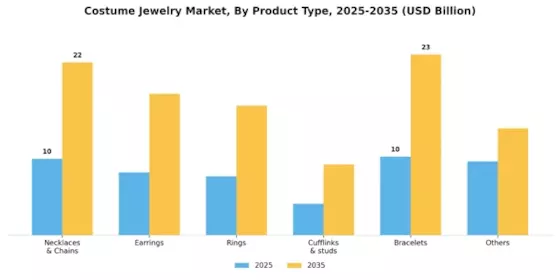
Necklaces & Chains (Dominant) vs. cufflinks & Studs (Emerging)
Necklaces and chains stand out as the dominant category in the Costume Jewelry Market, characterized by their timeless appeal and adaptability to various fashion styles. This segment encompasses a wide range of designs, from delicate pendants to chunky statement pieces, catering to diverse consumer preferences. Their versatility allows them to be worn for different occasions, making them a staple in many jewelry collections. In contrast, cufflinks and studs, although classified as an emerging segment, are gaining traction among fashion-forward consumers looking to elevate their formal wear with unique accessories. While cufflinks traditionally serve a functional purpose, contemporary designs that incorporate intricate detailing and unique materials are capturing the attention of younger audiences, thereby driving growth in this niche market.
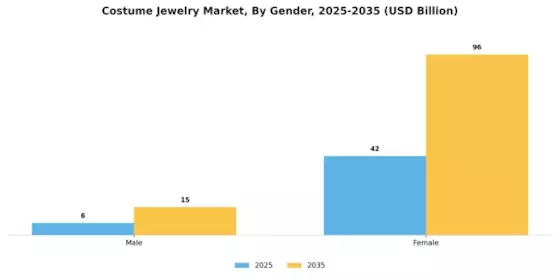
In the Costume Jewelry Market, the gender segment shows a prominent distribution, with females representing the largest share. Women have long been the primary consumers of costume jewelry, influenced by trends in fashion and self-expression. Their purchasing decisions are often driven by a blend of style, affordability, and the desire to accessorize effectively. Meanwhile, the male segment is gaining traction, reflecting a growing trend of men embracing jewelry as a means of personal expression and style enhancement. As the market evolves, this shift indicates a robust potential for segment growth.
Gender: Female (Dominant) vs. Male (Emerging)
The female demographic remains dominant in the Costume Jewelry Market, characterized by diverse preferences and a deep connection to trends in fashion and personal expression. Women are often influenced by social media and celebrity endorsements, leading to a wide variety of costume jewelry styles that resonate with their identities. On the other hand, the male segment is emerging as a dynamic force in the market. Men are increasingly seeking unique pieces that enhance their style, challenging traditional gender norms in jewelry consumption. This change is propelled by growing acceptance of accessories among men, making them a vital segment in the evolving landscape of costume jewelry.
In the Costume Jewelry Market, Retail Sale dominates the mode of sale segment, capturing the majority of market share. This traditional sales channel benefits from customer preferences for in-person shopping experiences, where consumers can physically inspect products before purchase. Retail outlets continue to establish a strong presence in both region-specific and global markets, reinforcing consumer trust and brand loyalty through direct interactions.
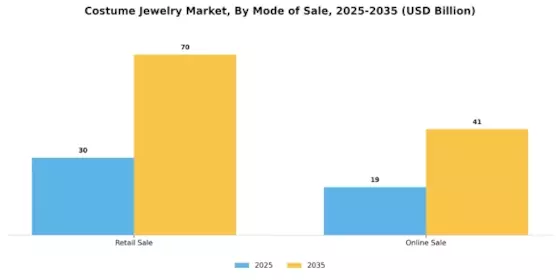
Mode of Sale: Retail Sale (Dominant) vs. Online Sale (Emerging)
Retail Sale stands as the dominant force within the Costume Jewelry Market, leveraging established customer relationships and tactile shopping experiences. It offers consumers the advantage of immediately acquiring products without delay, thereby fostering brand loyalty. On the other hand, Online Sale is emerging rapidly, spurred by increased internet penetration and changing consumer behavior favoring the convenience of shopping from home. The growing influence of social media marketing and influencer endorsements significantly drives this channel forward, appealing especially to younger demographics who seek unique and trendy pieces. As consumers embrace digital shopping, the online segment is poised for further expansion.
Get more detailed insights about Costume Jewelry Market Request Free Sample
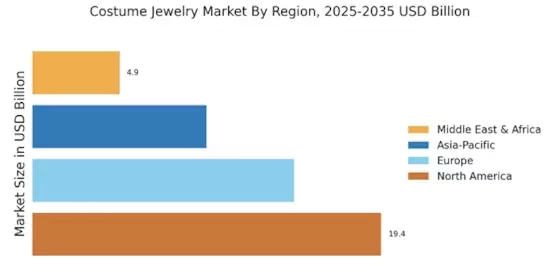
North America is the largest market for costume jewelry, holding approximately 40% of the global share. The region's growth is driven by increasing disposable incomes, a strong fashion culture, and a rising trend towards personalized accessories. Regulatory support for small businesses and e-commerce platforms has further catalyzed market expansion, making it a vibrant hub for costume jewelry sales. The United States is the leading country in this region, with major players like Tiffany & Co., Michael Kors, and Guess dominating the landscape. The competitive environment is characterized by a mix of established brands and emerging designers, catering to diverse consumer preferences. The presence of luxury brands alongside affordable options ensures a broad market appeal, contributing to sustained growth in the sector.
Europe is the second-largest market for costume jewelry, accounting for around 30% of the global market share. The region benefits from a rich cultural heritage in jewelry design, with countries like Italy and France leading in craftsmanship and innovation. Regulatory frameworks promoting sustainable practices and ethical sourcing are increasingly influencing consumer choices, driving demand for eco-friendly products. Italy and France are the leading countries in this market, with iconic brands such as Bvlgari and Chanel setting trends. The competitive landscape is marked by a blend of luxury and artisanal brands, appealing to both high-end consumers and budget-conscious shoppers. The presence of fashion weeks and trade shows in major cities further enhances market visibility and growth opportunities.
Asia-Pacific is witnessing rapid growth in the costume jewelry market, holding approximately 20% of the global share. The region's expansion is fueled by rising disposable incomes, urbanization, and a growing middle class that is increasingly inclined towards fashion accessories. Regulatory initiatives aimed at promoting local artisans and small businesses are also contributing to market growth, enhancing the appeal of unique, handcrafted items. China and India are the leading countries in this region, with a burgeoning demand for both traditional and contemporary designs. The competitive landscape is diverse, featuring both local artisans and international brands like Swarovski and Pandora. The increasing influence of social media and online shopping platforms is reshaping consumer behavior, making it easier for brands to reach a wider audience and drive sales.
The Middle East and Africa region is emerging as a potential market for costume jewelry, currently holding about 10% of the global share. The growth is driven by increasing urbanization, a young population, and a rising interest in fashion and personal expression. Regulatory support for local artisans and initiatives to promote cultural heritage are also fostering market development, creating opportunities for unique jewelry designs. Countries like the UAE and South Africa are at the forefront of this market, with a mix of luxury and affordable brands catering to diverse consumer preferences. The competitive landscape is characterized by a blend of local artisans and international players, creating a vibrant market. The increasing popularity of online shopping is further enhancing accessibility, allowing consumers to explore a wide range of options.
The Costume Jewelry Market is currently characterized by a dynamic competitive landscape, driven by evolving consumer preferences and a growing emphasis on sustainability. Major players such as Swarovski (AT), Tiffany & Co. (US), and Pandora (DK) are strategically positioning themselves to capitalize on these trends. Swarovski (AT) has focused on innovation in design and materials, enhancing its product offerings to appeal to a broader audience. Meanwhile, Tiffany & Co. (US) emphasizes its heritage and craftsmanship, leveraging its brand equity to attract luxury consumers. Pandora (DK) has adopted a more accessible pricing strategy, aiming to expand its market share among younger demographics, thereby shaping a competitive environment that balances luxury with affordability.In terms of business tactics, companies are increasingly localizing manufacturing to reduce lead times and enhance supply chain efficiency. The Costume Jewelry Market appears moderately fragmented, with a mix of established brands and emerging players. This fragmentation allows for diverse consumer choices but also intensifies competition among key players, who are vying for market share through innovative product offerings and strategic partnerships.In August Swarovski (AT) announced a collaboration with a leading fashion designer to launch a limited-edition collection that integrates sustainable materials. This strategic move not only aligns with the growing consumer demand for eco-friendly products but also reinforces Swarovski's commitment to innovation and design excellence. Such collaborations are likely to enhance brand visibility and attract environmentally conscious consumers.In September Tiffany & Co. (US) unveiled a new digital platform aimed at enhancing customer engagement through personalized shopping experiences. This initiative reflects the brand's commitment to digital transformation, allowing it to connect more effectively with its clientele. By leveraging technology, Tiffany & Co. is likely to strengthen its market position and foster customer loyalty in an increasingly digital marketplace.In October Pandora (DK) launched a new line of customizable jewelry that allows consumers to express their individuality. This strategic initiative not only caters to the growing trend of personalization in fashion but also positions Pandora as a leader in consumer-centric design. By focusing on customization, Pandora may enhance its appeal to younger consumers who prioritize unique and personalized products.As of October the Costume Jewelry Market is witnessing significant trends such as digitalization, sustainability, and the integration of artificial intelligence in design and marketing strategies. Strategic alliances among key players are shaping the competitive landscape, fostering innovation and collaboration. Moving forward, competitive differentiation is likely to evolve, with a shift from price-based competition to a focus on innovation, technology, and supply chain reliability. Companies that can effectively leverage these trends will likely secure a competitive edge in this vibrant market.

November 2023: LVMH Group completed the acquisition of Pedemonte Group from the Equinox III SLP SIF investment fund. This strategic move, crucial for the watches & jewelry division and its esteemed jewelry Maisons, promises to substantially boost the Group's production capabilities.
June 2021: DCK Group announced a strategic partnership with Next to introduce a new jewelry brand. Leveraging the proficiency in product design and manufacturing, coupled with deep insights into the fashion jewelry sector, DCK Group is poised to enhance Next's existing accessories range with this innovative brand.
The Costume Jewelry Market is projected to grow at a 7.8% CAGR from 2025 to 2035, driven by rising disposable incomes, fashion trends, and e-commerce expansion.
New opportunities lie in:
By 2035, the market is expected to achieve robust growth, solidifying its position as a key player in the fashion industry.
| MARKET SIZE 2024 | 48.62(USD Billion) |
| MARKET SIZE 2025 | 52.41(USD Billion) |
| MARKET SIZE 2035 | 111.1(USD Billion) |
| COMPOUND ANNUAL GROWTH RATE (CAGR) | 7.8% (2025 - 2035) |
| REPORT COVERAGE | Revenue Forecast, Competitive Landscape, Growth Factors, and Trends |
| BASE YEAR | 2024 |
| Market Forecast Period | 2025 - 2035 |
| Historical Data | 2019 - 2024 |
| Market Forecast Units | USD Billion |
| Key Companies Profiled | Swarovski (AT), Chanel (FR), Tiffany & Co. (US), Pandora (DK), Kate Spade (US), Michael Kors (US), Bvlgari (IT), Guess (US), Alex and Ani (US) |
| Segments Covered | Product Type, Gender, Mode of Sale, Region |
| Key Market Opportunities | Growing consumer preference for sustainable materials in the Costume Jewelry Market presents significant opportunities. |
| Key Market Dynamics | Shifting consumer preferences towards sustainable materials drive innovation and competition in the costume jewelry market. |
| Countries Covered | North America, Europe, APAC, South America, MEA |
The Costume Jewelry Market was valued at 48.62 USD Billion in 2024.
The market is projected to reach 111.1 USD Billion by 2035.
The expected CAGR for the Costume Jewelry Market during 2025 - 2035 is 7.8%.
Bracelets generated 10.0 USD Billion in 2024 and are projected to reach 23.0 USD Billion.
In 2024, the female segment was valued at 42.12 USD Billion, while the male segment was valued at 6.5 USD Billion.
Retail sales accounted for 30.0 USD Billion in 2024, while online sales were valued at 18.62 USD Billion.


The secondary research process involved comprehensive analysis of trade association databases, fashion industry publications, government statistics, and authoritative retail organizations. Key sources included the US Census Bureau (Retail Trade Data), Bureau of Economic Analysis (Personal Consumption Expenditures), European Commission (Eurostat - Textiles and Clothing Trade Data), UK Office for National Statistics (Retail Sales Index), International Trade Centre (ITC) Trade Map, World Customs Organization (Harmonized System Codes for Imitation Jewelry), UN Comtrade Database, Organisation for Economic Co-operation and Development (OECD) Household Spending Data, National Retail Federation (NRF) USA, Accessories Council (US), British Fashion Council, International Costume Jewelry Association, World Gold Council (Fashion Jewelry Trends), CIBJO (World Jewellery Confederation), Fashion Jewelry & Accessories Trade Association, US Consumer Product Safety Commission (CPSC) Regulatory Data), REACH Regulation Database (EU Chemical Compliance for Jewelry Materials), Federal Trade Commission (FTC) Jewelry Guides, and national customs authorities from key markets.
For necklaces and chains, earrings, rings, cufflinks and studs, bracelets, and other product categories across retail and online sales channels, these sources were used to gather import/export statistics, consumer spending patterns, regulatory compliance data, demographic trends, and competitive landscape analysis.
In order to gather both qualitative and quantitative insights, supply-side and demand-side stakeholders were interviewed during the primary research process. CEOs, VPs of Product Development, heads of merchandising, and regional sales directors from fashion houses, private label manufacturers, and costume jewelry makers were examples of supply-side sources. Procurement heads from multi-brand retailers, department store buyers, fast-fashion accessory merchandisers, category managers of e-commerce platforms, and owners of boutique jewelry stores in specialty shops, department stores, online marketplaces, and independent retailers were examples of demand-side sources. In addition to gathering information on consumer purchase patterns, pricing elasticity, and inventory turnover dynamics, primary research validated market segmentation and seasonal collecting pipelines.
Primary Respondent Breakdown:
By Designation: C-level Primaries (32%), Director Level (31%), Others (37%)
By Region: North America (32%), Europe (30%), Asia-Pacific (33%), Rest of World (5%)
Sales volume analysis and revenue mapping were used to get the global market valuation. The methodology comprised:
Finding more than fifty major brands and manufacturers in North America, Europe, Asia-Pacific, Latin America, and the Middle East
Product mapping for bracelets, earrings, rings, cufflinks and studs, necklaces and chains, and other product categories
Examination of modeled and reported yearly revenues for portfolios of costume jewelry
Coverage of brands and manufacturers accounting for 75–80% of the world market in 2024
Extrapolation for segment-specific valuations for gender segments (male/female) and mode of sale (retail/online) across all product categories utilizing top-down (company revenue validation) and bottom-up (unit sales × ASP by country and channel) methodologies
Kindly complete the form below to receive a free sample of this Report

“This is really good guys. Excellent work on a tight deadline. I will continue to use you going forward and recommend you to others. Nice job”


“Thanks. It’s been a pleasure working with you, please use me as reference with any other Intel employees.”


“Thanks for sending the report it gives us a good global view of the Betaïne market.”


“Thank you, this will be very helpful for OQS.”


“We found the report very insightful! we found your research firm very helpful. I'm sending this email to secure our future business.”


“I am very pleased with how market segments have been defined in a relevant way for my purposes (such as "Portable Freezers & refrigerators" and "last-mile"). In general the report is well structured. Thanks very much for your efforts.”


“I have been reading the first document or the study, ,the Global HVAC and FP market report 2021 till 2026. Must say, good info! I have not gone in depth at all parts, but got a good indication of the data inside!”


“We got the report in time, we really thank you for your support in this process. I also thank to all of your team as they did a great job.”


“The Automotive 48V ECU Components Procurement Intelligence Study” was a complex project, but the Market Research Future (MRFR) team handled it with quality, agility, and customer-centricity. They delivered all requested data on time and within the agreed scope. The team, including Shubhendra Anand and Rahul Gotadki, was always readily available to clarify questions and swiftly implement necessary adjustments, driving the project to a successful conclusion within a very demanding timeframe.
I would also like to specifically commend Akshay Agarwal for his responsiveness and support at every stage—from our initial inquiry on May 6th through to final delivery on June 18th. His dedication made the entire process seamless.”



