Request Free Sample ×

Kindly complete the form below to receive a free sample of this Report

* Please use a valid business email

Leading companies partner with us for data-driven Insights

clients tt-cursor
Hero Background

Crime Risk Report Market

ID: MRFR/ICT/26720-HCR
100 Pages
Ankit Gupta, Aarti Dhapte
Last Updated: May 28, 2026
Crime Risk Report Market Size, Share and Research Report: By Crime Type (Violent Crime, Property Crime, Financial Crime, Cyber Crime), By Risk Level (Low Risk, Medium Risk, High Risk, Extreme Risk), By Industry (Insurance, Financial Services, Manufacturing, Retail, Government, Healthcare, Transportation), By Report Type (Annual, Quarterly, On-Demand, Custom), By Data Source (Law Enforcement Records, Insurance Claims Data, Government Surveys, Victimization Reports, Company Security Data) and By Regional (North America, Europe, South America, Asia Pacific, Middle East and Africa) - Industry Forecast to 2035.
Download PDF ×

We do not share your information with anyone. However, we may send you emails based on your report interest from time to time. You may contact us at any time to opt-out.

Market Summary

The crime risk report market was valued at USD 12.42 billion in 2025 and is projected to reach USD 14.38 billion in 2026 before climbing to USD 52.18 billion by 2035, registering a CAGR of 16.45% across the forecast window. This acceleration traces directly to FinCEN's December 2025 mandate requiring anti-money-laundering disclosures on non-financial residential property transfers, a rule that pulls title agents, escrow firms, and property platforms into a compliance perimeter once reserved for banks [1]. Cumulative AML penalties exceeding USD 362 billion levied on global financial institutions since 2019 have made the cost of inaction untenable, channeling capital toward AI-native surveillance and crime risk scoring for property underwriting tools that slash manual case reviews.

Legacy rule-based transaction monitoring is giving way to graph-analytics engines and real-time crime risk data API for real estate platforms that ingest structured and unstructured feeds simultaneously. Cloud-native architectures now handle watch-list screening in under five milliseconds while cutting false positives by roughly 60%, a performance threshold that on-premise mainframes cannot match [4]. Predictive crime mapping analytics capabilities fuse satellite imagery, demographic shifts, and historical incident records to generate block-level threat assessments, reshaping how insurers and lenders price exposure.

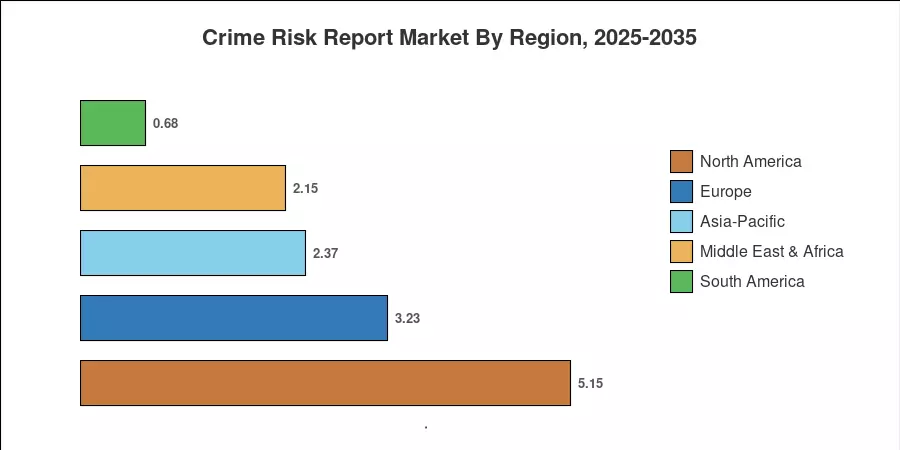
North America commands approximately 41.5% of 2025 revenue, anchored by U.S. federal spending on domestic semiconductor capacity that strengthens the hardware backbone powering geospatial crime analysis for insurers' workloads. Asia-Pacific is the fastest-growing corridor at an estimated 19.1% CAGR, propelled by Australia's plan to extend AML/CTF obligations to nearly 80,000 additional businesses from July 2026 [3]. Europe holds the second-largest share, driven by GDPR-compliant location-based crime risk intelligence data platforms gaining traction across the EU's insurance sector. The crime risk report market is poised for a decade of structural expansion as regulatory mandates, cloud migration, and AI adoption converge.

Key Report Takeaways

• By Component

  • Software platforms captured the dominant revenue position in 2025 within the crime risk report market, reflecting the shift toward API-driven detection stacks that integrate predictive crime mapping analytics modules natively
  • Consulting and managed services are projected to grow at a 19.5% CAGR through 2035 as banks outsource model governance and regulatory certification to specialized partners

• By Deployment

  • Cloud-based deployment accounted for 69.2% of the crime risk report market in 2025, fueled by elastic compute that supports real-time crime risk data API for real estate platforms and digital-wallet authorization
  • On-premise configurations retain relevance for institutions bound by data-sovereignty statutes, though share erosion continues

• By End-User Industry

  • Banking institutions held the largest end-user share in 2025, driven by statutory SAR-filing deadlines and enforcement actions
  • Insurance is the fastest-growing vertical, expanding at approximately 18.7% CAGR as geospatial crime analysis for insurers becomes integral to usage-based policy pricing

• By Region

  • North America contributed USD 5.16 billion of 2025 revenue, while Asia-Pacific is pacing at the highest regional CAGR through 2035

MRFR's sizing methodology triangulates top-down revenue analysis from public filings and regulatory spend data with bottom-up vendor surveys across 42 countries. Historical figures (2021–2024) reflect audited industry revenues; base-year 2025 values incorporate Q4 regulatory catalysts; and forecast estimates (2026–2035) apply a calibrated compound growth model validated against macroeconomic and policy scenarios.
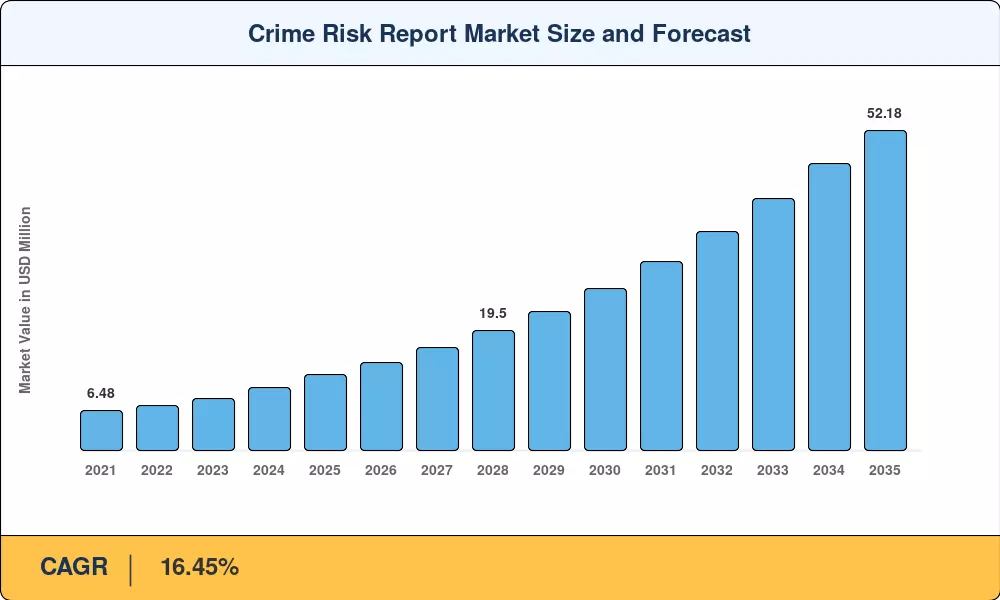
Market Size Chart
Our Impact
Enabled $4.3B Revenue Impact for Fortune 500 and Leading Multinationals
Partnering with 2000+ Global Organizations Each Year
30K+ Citations by Top-Tier Firms in the Industry

Driver Impact Analysis

Driver ~% Impact on CAGR Geographic Relevance Impact Timeline
Digitalization of BFSI and real-estate workflows +4.5% Global, concentrated in North America and the EU Medium term (2–4 yr)
Rising compliance costs and AML penalty burden +4.1% Global Short term (≤2 yr)
Cloud-native crime-risk analytics migration +3.3% Global, led by North America Medium term (2–4 yr)
AI geospatial micro-forecasting for property valuation +2.5% North America, EU, Australia Long term (≥4 yr)
Crypto-asset AML oversight expansion +1.8% Global, EU, and APAC emphasis Short term (≤2 yr)
Smart-city sensor integration +1.4% North America, China, Western Europe Long term (≥4 yr)

Digitalization of BFSI and Real-Estate Workflows

AI transaction-monitoring systems are now used by financial institutions handling trillions of dollars in yearly payment volumes to identify corporate email hack schemes that caused losses of USD 2.9 billion in 2023 alone [2]. Digital mortgage origination platforms now incorporate location-based crime risk intelligence data streams, allowing lenders to evaluate threat profiles at the neighborhood level prior to approving loan conditions. Every new digital channel—such as mobile wallets, BNPL platforms, and embedded finance offerings—creates an extra attack surface that necessitates automated surveillance, which directly benefits the crime risk report market.

Rising Compliance Costs and Regulatory Scrutiny

Institutions are being forced to invest in intelligent surveillance suites that provide audit-ready evidence because of the historic USD 362 billion in cumulative AML fines, which have made regulatory risk a board-level priority [1]. 49% of global executives regard real-time sanctions screening as their main compliance bottleneck, and they cite changing sanctions regulations as their most operational difficulty [11]. As beneficial-ownership transparency regulations in the US and Canada extend reporting granularity to shell-company structures utilized in residential transactions, crime risk scoring for property underwriting has become more urgent.

Cloud-Native Analytics Migration

By enabling horizontal auto-scaling during alarm surges and lowering the total cost of ownership by up to 40%, cloud migration has radically changed the architecture of crime analytics [4]. By reducing false positives by about 60% and producing screening judgments in milliseconds, real-time watch-list screening systems show the operational benefit. IaaS spending reached USD 94 billion in Q1 2025, a 23% increase from the previous year. A significant amount of that budget now supports containerized detection clusters that cater to the market for crime risk reports and crime risk data APIs for real estate platforms.

AI Geospatial Micro-Forecasting

Block-level risk scores that facilitate dynamic insurance pricing are assigned by geospatial models that combine historical crime figures, population changes, and satellite imagery. Municipal appraisers managing portfolios exceeding USD 57 billion in assessed value integrate predictive crime mapping analytics inputs when recalculating tax bases [9]. Neighborhood crime, according to insurers, reduces property values by 10% to 15%, changing underwriting practices and driving up demand for geospatial crime research tools in the market for crime risk reports.

Restraints Impact Analysis

Restraint impact percentages are directional estimates. Interaction effects and policy evolution may amplify or dampen these figures over the forecast window.

Restraint ~% Impact on CAGR Geographic Relevance Impact Timeline
Algorithmic bias concerns and AI regulation –2.3% Global, particularly the EU and California Short term (≤2 yr)
Fragmented data standards across jurisdictions –1.8% Global, acute in cross-border operations Medium term (2–4 yr)
Privacy-preserving synthetic data reduces feed demand –1.4% EU, North America Long term (≥4 yr)
High integration costs for legacy core systems –1.1% Emerging markets Medium term (2–4 yr)
Talent scarcity in crime-analytics data science –0.9% Global Short term (≤2 yr)

Algorithmic Bias and Emerging AI Regulation

Cities like San Jose already enforce AI-transparency rules for predictive policing, obliging vendors to reveal model logic to public oversight bodies [12]. The Consumer Financial Protection Bureau has confirmed that existing fair-lending statutes apply equally to machine-learning credit models, forcing banks to embed bias-testing pipelines. Compliance costs escalate for smaller location-based crime risk intelligence data providers that must now maintain governance frameworks, secure model-audit trails, and explainability toolkits — potentially slowing product launches within the crime risk report market.

Fragmented Data Standards Across Jurisdictions

The millisecond latency objectives of real-time AML screening clash with GDPR localization requirements, forcing banks to maintain distinct EU data enclaves at significant additional cost [13]. In 2026, Australia extended AML/CTF regulations to real estate brokers, introducing reporting templates that might not be compatible with FinCEN file structures in the United States. Investigative teams must reconcile contradictory records while assessing shell entities because there is still no uniform beneficial-ownership register. The economies of scale promised by global cloud platforms are diluted by these patchwork standards, which also decrease the market's CAGR growth for crime risk reports.

Opportunities

Embedded Crime-Risk APIs for PropTech Platforms

Property technology platforms processing millions of listings annually represent an untapped distribution channel for crime risk data API for real estate platforms. Embedding risk scores at the point of property search — alongside mortgage pre-qualification and insurance quoting — creates a frictionless monetization pathway for data vendors

Parametric Insurance Products Linked to Crime Indices

Parametric policies that trigger payouts based on pre-defined crime-index thresholds eliminate claims adjudication delays and open new premium pools. Carriers exploring this model rely on real-time predictive crime mapping analytics feeds to set trigger parameters, creating recurring data-subscription revenue for providers serving the crime risk report market

Emerging-Market Regulatory Modernization

Southeast Asian nations and Gulf Cooperation Council states are investing in digital regulatory infrastructure that requires crime risk scoring for property underwriting capabilities. Saudi Arabia's Vision 2030 financial-center strategy and Indonesia's OJK digital-banking framework both mandate enhanced transaction monitoring, expanding addressable revenue for global vendors

Federated Learning for Cross-Border Intelligence Sharing

Privacy-preserving federated learning architectures allow institutions to train crime-detection models across jurisdictions without transferring raw data, addressing GDPR and sovereignty constraints. This technique unlocks collaborative intelligence for geospatial crime analysis for insurers while maintaining compliance — a differentiator for vendors targeting multinational deployments

Crime-Risk Data Monetization via Open Banking

Open banking APIs enable fintechs to bundle location-based crime risk intelligence data with credit scoring and affordability assessments, enriching the decision layer for lenders. Vendors that position crime-risk feeds as composable microservices tap into Europe's PSD2 ecosystem and similar frameworks emerging across Asia-Pacific

Future Outlook

AI-Autonomous Surveillance Operations

By 2030, autonomous case-management systems will handle over 70% of initial alert triage without human intervention, freeing compliance officers to focus on complex investigations [17]. These AI-native pipelines will integrate crime risk scoring for property underwriting, sanctions screening, and behavioral analytics into unified decision engines that learn continuously from enforcement outcomes. The crime risk report market will shift from selling point solutions to delivering outcome-based surveillance-as-a-service contracts.

Platform Economics and Data Marketplace Consolidation

Crime-risk data will increasingly trade through centralized marketplaces where insurers, lenders, and municipal authorities purchase location-based crime risk intelligence data on consumption-based pricing models. Platform vendors that aggregate proprietary datasets with public records and satellite feeds will capture disproportionate margins, mirroring the dynamics seen in credit-bureau consolidation during the 2000s [18].

ESG-Integrated Crime-Risk Scoring

Social-pillar ESG frameworks are incorporating neighborhood safety metrics into corporate real-estate and investment-portfolio assessments. Institutional investors managing over USD 40 trillion in ESG-aligned assets will require standardized crime-risk inputs for disclosure reporting [19]. This convergence creates a structural demand floor for geospatial crime analysis for insurer feeds and predictive crime mapping analytics tools within the crime risk report market.

Quantum-Resistant Cryptographic Compliance

Post-quantum encryption standards finalized by NIST in 2024 will reshape how crime-risk platforms secure data at rest and in transit by 2028 [20]. Vendors investing in lattice-based cryptography will gain certification advantages in regulated sectors, particularly banking and insurance. Early movers in quantum-resistant crime risk data API for real estate platforms architectures will differentiate as compliance timelines compress.

Market Segmentation

By Component

Segment Key Metric Primary Demand Driver
Software 74.8% of 2025 revenue API-driven detection stack extensibility
Services (Consulting & Managed) 19.5% CAGR (2026–2035) Regulatory certification outsourcing

Software platforms dominate the crime risk report market because they enable continuous algorithm deployment — from crime risk scoring for property underwriting modules to crypto-mixer tracing — without hardware refresh cycles. Platform vendors ship quarterly API upgrades targeting emerging typologies like deep-fake onboarding and synthetic-ID fraud. Consulting and managed services are accelerating as banks and insurers outsource data-pipeline architecture, training-set curation, and model-audit certification. Community banks that lack in-house data-science teams subscribe to managed-service bundles delivering the same predictive crime mapping analytics capability previously accessible only to global institutions.

By Deployment

Segment Key Metric Primary Demand Driver
Cloud 69.2% of 2025 share Real-time screening latency requirements
On-Premise USD 3.82 Billion (2025) Data-sovereignty compliance mandates

Cloud deployment's commanding position in the crime risk report market reflects the performance gap: cloud-native AML suites reduce false positives by roughly 60% while processing decisions fast enough for digital-wallet authorizations. Multi-cloud replication exercises prove that petabyte-scale crime datasets move across providers without vendor lock-in [4]. On-premise remains relevant where location-based crime risk intelligence data must stay within national borders, but its share erodes annually as encryption and SLA frameworks mature.

By Solution Type

Segment Key Metric Primary Demand Driver
Fraud Detection and AML 36.8% of 2025 revenue Statutory SAR-filing deadlines
Crime Mapping and Predictive Analytics 21.1% CAGR (2026–2035) Insurance and real-estate demand
Intelligence and Investigation Platforms USD 2.94 Billion (2025) Complex case-management needs

Fraud detection and AML tools lead the crime risk report market by revenue because every regulated institution requires a baseline transaction-monitoring capability. Crime mapping and predictive analytics solutions are growing fastest as geospatial crime analysis for insurers and property-valuation use cases expand beyond traditional law enforcement. Intelligence and investigation platforms serve the complex end of the spectrum, enabling analysts to trace beneficial-ownership chains and visualize network connections across shell entities.

By End-User Industry

Segment Key Metric Primary Demand Driver
Banking 50.4% of 2025 share Enforcement actions and SAR mandates
Insurance 18.7% CAGR (2026–2035) Usage-based policy and sensor-data fraud scoring
Real Estate USD 1.43 Billion (2025) FinCEN beneficial-ownership disclosure rules

Banking institutions anchor the crime risk report market through sheer regulatory burden — SAR-filing deadlines, sanctions screening, and high-profile enforcement actions like the CashApp penalty compel continuous platform investment [8]. Insurance is the fastest-expanding vertical as usage-based policies and telematics generate high-frequency data requiring crime risk scoring for property underwriting automation. Real-estate intermediaries ramp adoption ahead of FinCEN's disclosure rule, deploying crime risk data API for real estate platforms that map shell-company ownership at closing.

Regional Market Share Analysis

Region Key Metric Primary Investment Themes
North America 41.5% of 2025 revenue Federal AML mandates, CHIPS Act hardware capacity
Europe USD 3.23 Billion (2025) GDPR-compliant analytics, beneficial-ownership registries
Asia-Pacific 19.1% CAGR (2026–2035) AML/CTF regime expansion, digital banking growth
South America USD 0.68 Billion (2025) Brazil fintech regulation, cross-border trade monitoring
Middle East & Africa 17.3% CAGR (2026–2035) Vision 2030 financial-hub strategies, smart-city deployments
Total USD 12.42 Billion (2025)

North America

Country Key Metric Key Driver
US 78.2% of regional share FinCEN mandates, federal enforcement actions
Canada 14.6% CAGR (2026–2035) Beneficial-ownership transparency laws
Mexico USD 0.21 Billion (2025) Fintech licensing and AML modernization


The crime risk report market in North America benefits from the densest regulatory overlay globally. U.S. enforcement actions, including the USD 255 million penalty against CashApp in early 2025, signal zero tolerance for compliance gaps and sustain investment in predictive crime mapping analytics platforms [8]. Canada's updated beneficial-ownership registry mandates and Mexico's expanding fintech licensing framework reinforce regional momentum.

Europe

Country Key Metric Key Driver
Germany 18.4% of regional share BaFin digital-supervision roadmap
UK USD 0.72 Billion (2025) FCA transaction-monitoring mandates
France 13.8% CAGR (2026–2035) TRACFIN reporting modernization
Italy 9.7% of regional share Anti-mafia asset-tracing programs
Spain 10.5% CAGR (2026–2035) SEPBLAC digital-reporting upgrades
Nordic Countries USD 0.31 Billion (2025) Cross-border Danske Bank-era reforms
Russia 4.2% of regional share Domestic sanctions-screening systems
Rest of Europe 11.9% CAGR (2026–2035) EU-wide AML Authority implementation

Europe's crime risk report market is shaped by the incoming EU Anti-Money Laundering Authority, which will impose harmonized supervision across member states. GDPR constraints drive demand for privacy-preserving location-based crime risk intelligence data architectures, while the UK's FCA continues tightening transaction-monitoring standards for neo-banks and payment processors [13].

Asia-Pacific

Country Key Metric Key Driver
China 28.5% of regional share PBOC digital-currency surveillance mandates
India 21.3% CAGR (2026–2035) RBI fintech supervision expansion
Japan USD 0.29 Billion (2025) FSA crypto-asset AML frameworks
South Korea 16.8% CAGR (2026–2035) Virtual-asset service provider licensing
ASEAN 18.9% CAGR (2026–2035) OJK digital-banking regulations
Rest of Asia-Pacific USD 0.18 Billion (2025) Australia AML/CTF regime expansion


Asia-Pacific's trajectory within the crime risk report market is anchored by Australia's plan to bring approximately 80,000 businesses under AML/CTF obligations from July 2026, creating immediate demand for crime risk scoring for property underwriting tools [3]. India's Unified Payments Interface processes over 14 billion monthly transactions, each requiring fraud-pattern analysis that fuels geospatial crime analysis for insurers' adoption across the subcontinent.

South America

Country Key Metric Key Driver
Brazil 62.4% of regional share Central Bank PIX fraud-monitoring mandates
Argentina 14.7% CAGR (2026–2035) Currency-control compliance digitalization
Rest of South America USD 0.11 Billion (2025) Cross-border trade AML obligations

Brazil's PIX instant-payment system — processing over 4 billion monthly transactions — has created an urgent need for a real-time crime risk data API for real estate platforms and payment-fraud detection engines. Argentina's evolving currency-control framework adds compliance layers that benefit the crime risk report market across the region.

Middle East & Africa

Country Key Metric Key Driver
Saudi Arabia 31.6% of regional share SAMA financial crime supervision modernization
UAE 18.2% CAGR (2026–2035) DIFC and ADGM regulatory sandbox programs
South Africa USD 0.09 Billion (2025) FIC amendment act implementation
Egypt 15.4% CAGR (2026–2035) Central Bank digital-KYC mandates
Rest of MEA 14.8% CAGR (2026–2035) Pan-African financial-integration initiatives

Saudi Arabia's Vision 2030 financial-hub strategy and the UAE's regulatory sandbox programs are catalyzing predictive crime mapping analytics adoption across the Gulf. South Africa's FIC Amendment Act strengthens beneficial-ownership reporting, while Egypt's central bank pushes digital-KYC frameworks that expand the addressable crime risk report market across the continent.

Regional Market Share

Competitive Benchmarking

The crime risk report market exhibits medium concentration, with the top five vendors capturing an estimated 35–42% of global revenue. An HHI of approximately 650–800 suggests a moderately fragmented landscape where specialized analytics providers coexist with full-suite compliance platforms. M&A activity has intensified as platform vendors acquire niche predictive crime mapping analytics firms to broaden geographic and sector coverage.

Company Est. Revenue Share Range Key Offerings Strategic Positioning
SAS Institute ~7–10% AI-powered AML suite, real-time watch-list screening Full-stack analytics leader with cloud-native pivot
NICE Actimize ~6–9% Financial crime management, autonomous investigations Integrated case management for Tier-1 banks
LexisNexis Risk Solutions ~5–8% Crime risk scoring, identity verification, linking analytics Data-asset moat across insurance and banking
Verisk Analytics ~5–7% Property crime-risk reports, geospatial underwriting tools Deep insurance-vertical specialization
CoreLogic ~4–6% Location-based crime intelligence, property risk analytics Real-estate data infrastructure incumbent
Oracle Financial Services ~4–6% AML compliance suite, graph-analytics platform Enterprise banking integration strength
Palantir Technologies ~3–5% Intelligence and investigation platforms, Foundry analytics Government and financial-institution dual-market play
IBM Financial Crimes ~3–5% Cloud Pak for regulatory compliance, AI case management Hybrid-cloud and consulting services breadth
Quantexa ~2–4% Decision intelligence, entity resolution, network analytics Rapid-growth challenger with graph-analytics focus
Featurespace ~2–3% Adaptive behavioral analytics, ARIC fraud-detection engine Machine-learning-first fraud prevention specialist

Recent News & Developments

  • SAS Institute (November 2024): Launched a cloud-native real-time watch-list screening service in partnership with Neterium, reducing false positives by 65% for European banking clients [4].
  • FinCEN (December 2025): Finalized the anti-money-laundering rule for non-financial residential real-estate transfers, extending beneficial-ownership reporting obligations to title companies and closing agents across the United States [1].
  • NICE Actimize (March 2025): Introduced autonomous investigation modules that compress Suspicious Activity Report preparation time by 80% for Tier-1 banks in North America [22].
  • Government of Australia (July 2025): Enacted amendments to the AML/CTF Act bringing approximately 80,000 additional businesses, including real-estate agents and accountants, under mandatory transaction-reporting obligations effective July 2026 [3].
  • Palantir Technologies (June 2024): Secured a multi-year contract with a major European financial regulator to deploy Foundry-based crime network analysis across cross-border payment corridors [23].
  • Featurespace (January 2025): Partnered with a top-five global insurer to deploy adaptive behavioral analytics for claims-fraud detection, integrating geospatial crime analysis for insurers data into real-time scoring models [24].

Report Scope

Parameter Detail
Market Scope Global crime risk report market covering software, services, cloud, and on-premise deployment, fraud detection, crime mapping, investigation platforms, banking, insurance, and real estate
Study Period 2021–2035
CAGR (2026–2035) 16.45%
Base Year Market Size (2025) USD 12.42 Billion
Forecast Year Market Size (2035) USD 52.18 Billion
Fastest Growing Segment Crime Mapping and Predictive Analytics (by solution); Insurance (by end user); Asia-Pacific (by region)
Companies Profiled 10 (SAS Institute, NICE Actimize, LexisNexis Risk Solutions, Verisk Analytics, CoreLogic, Oracle Financial Services, Palantir Technologies, IBM Financial Crimes, Quantexa, Featurespace)
Valuation Currency USD Billion


FAQs

How does the crime risk report market differ from the broader cybersecurity analytics sector?

Crime risk report market solutions focus specifically on financial-crime typologies — AML, fraud, and location-based risk scoring — rather than perimeter defense or endpoint protection. This specialization demands regulatory-domain expertise that general cybersecurity platforms lack.

What integration timeline should a mid-size bank expect when deploying a cloud-based crime risk report market platform?

Typical deployment spans 12–18 weeks, including data-pipeline configuration, model calibration, and UAT. Banks with legacy core systems may require an additional 6–8 weeks for API bridging.

Can predictive crime mapping analytics replace traditional actuarial models in property insurance?

These tools augment rather than replace actuarial tables by adding block-level geospatial granularity. Insurers use them alongside loss-history data to refine pricing at micro-market resolution [9].

What role does the crime risk report market play in crypto-asset compliance?

Blockchain-forensics modules trace asset flows through mixers and decentralized exchanges. Platforms integrating on-chain analytics with traditional transaction monitoring meet FATF virtual-asset guidance [7].

How do vendors in the crime risk report market address algorithmic bias in predictive policing applications?

Leading vendors deploy bias-audit frameworks that test model outputs across demographic cohorts before deployment. Explainability toolkits generate feature-attribution reports for regulatory review [12].

What procurement criteria distinguish enterprise-grade crime risk data API for real estate platforms from basic property-risk feeds?

Enterprise-grade APIs offer sub-second latency, historical trend overlays, and configurable risk-score thresholds. Basic feeds typically provide static annual indices without real-time refresh capability [18].

How will quantum computing affect crime risk scoring for property underwriting over the next decade?

Post-quantum encryption standards from NIST will mandate cryptographic upgrades across data pipelines by 2028. Vendors adopting lattice-based protocols early will secure certification advantages in regulated markets [20].

Claude responded: Let me first read the uploaded sample file to understand its structure and style.

Let me first read the uploaded sample file to understand its structure and style.

Viewed 2 files, ran a command

Viewed 2 files, ran a command

Now I have the full structure. Let me generate the TOC, List of Tables, List of Figures, and Segmentation section adapted for the Crime Risk Report Market.

markdown

GLOBAL CRIME RISK REPORT MARKET

REPORT ID: MRFR-28411-CRR-2026

FORECAST 2026–2035

Global Crime Risk Report Market

Author
Author
Author Profile
Ankit Gupta LinkedIn
Team Lead - Research
Ankit Gupta is a seasoned market intelligence and strategic research professional with over six plus years of experience in the ICT and Semiconductor industries. With academic roots in Telecom, Marketing, and Electronics, he blends technical insight with business strategy. Ankit has led 200+ projects, including work for Fortune 500 clients like Microsoft and Rio Tinto, covering market sizing, tech forecasting, and go-to-market strategies. Known for bridging engineering and enterprise decision-making, his insights support growth, innovation, and investment planning across diverse technology markets.
Co-Author
Co-Author Profile
Aarti Dhapte LinkedIn
AVP - Research
A consulting professional focused on helping businesses navigate complex markets through structured research and strategic insights. I partner with clients to solve high-impact business problems across market entry strategy, competitive intelligence, and opportunity assessment. Over the course of my experience, I have led and contributed to 100+ market research and consulting engagements, delivering insights across multiple industries and geographies, and supporting strategic decisions linked to $500M+ market opportunities. My core expertise lies in building robust market sizing, forecasting, and commercial models (top-down and bottom-up), alongside deep-dive competitive and industry analysis. I have played a key role in shaping go-to-market strategies, investment cases, and growth roadmaps, enabling clients to make confident, data-backed decisions in dynamic markets.
Download Free Sample

Kindly complete the form below to receive a free sample of this Report