Download Free Sample
Kindly complete the form below to receive a free sample of this Report
Cryptocurrency Banking Market Size, Share and Research Report By Service Type (Cryptocurrency Wallets, Crypto Lending, Crypto Merchant Services, Payment Processing, Investment Services), By User Type (Individual Users, Retail Investors, Institutional Investors, Businesses), By Deployment Type (Cloud-Based, On-Premises), By Technology (Blockchain Technology, Smart Contracts, Decentralized Finance) and By Regional (North America, Europe, South America, Asia Pacific, Middle East and Africa) - Industry Forecast Till 2035
As per Market Research Future analysis, the Cryptocurrency Banking Market Size was estimated at 5.3 USD Billion in 2024. The Cryptocurrency Banking industry is projected to grow from 6.79 USD Billion in 2025 to 80.92 USD Billion by 2035, exhibiting a compound annual growth rate (CAGR) of 28.12% during the forecast period 2025 - 2035
The Cryptocurrency Banking Market is experiencing a transformative shift towards integration with traditional banking systems and innovative financial solutions.
| 2024 Market Size | 5.3 (USD Billion) |
| 2035 Market Size | 80.92 (USD Billion) |
| CAGR (2025 - 2035) | 28.12% |
Binance (MT), Coinbase (US), Kraken (US), Gemini (US), Bitstamp (LU), Crypto.com (SC), BlockFi (US), Nexo (BG), Bitfinex (HK)
Our Impact
Enabled $4.3B Revenue Impact for Fortune 500 and Leading Multinationals
Partnering with 2000+ Global Organizations Each Year
30K+ Citations by Top-Tier Firms in the Industry
The Cryptocurrency Banking Market is currently experiencing a transformative phase, characterized by the integration of traditional banking practices with innovative blockchain technology. This convergence appears to enhance the accessibility and efficiency of financial services, allowing users to engage in transactions with greater speed and security. As digital currencies gain traction, financial institutions are increasingly exploring ways to incorporate these assets into their offerings, potentially reshaping the landscape of banking. Furthermore, regulatory frameworks are evolving, which may provide clearer guidelines for cryptocurrency operations, fostering a more stable environment for both consumers and businesses. In addition, the rise of decentralized finance (DeFi) platforms is influencing the Cryptocurrency Banking Market, as they offer alternative solutions to conventional banking services. These platforms seem to empower users by providing them with more control over their financial assets, while also reducing reliance on traditional intermediaries. As the market continues to mature, it is likely that collaboration between established banks and emerging crypto firms will become more prevalent, leading to innovative products and services that cater to a diverse clientele. Overall, the Cryptocurrency Banking Market is poised for significant evolution, driven by technological advancements and shifting consumer preferences.
The Cryptocurrency Banking Market is witnessing a notable trend where traditional banking institutions are increasingly adopting blockchain technology. This integration appears to streamline operations, enhance security, and improve transaction efficiency, thereby attracting a broader customer base.
Decentralized finance platforms are gaining momentum within the Cryptocurrency Banking Market, offering users alternative financial services without the need for traditional intermediaries. This trend suggests a shift towards greater autonomy for consumers, potentially reshaping their financial interactions.
As the Cryptocurrency Banking Market develops, regulatory bodies are adapting their approaches to better accommodate digital currencies. This evolution indicates a move towards clearer guidelines, which may foster a more stable and secure environment for both users and financial institutions.
The emergence of regulatory clarity surrounding cryptocurrencies is a crucial driver for the Cryptocurrency Banking Market. As governments and regulatory bodies establish frameworks for digital assets, financial institutions are more inclined to engage with cryptocurrencies. Recent initiatives in various jurisdictions have led to clearer guidelines, which may foster a safer environment for both consumers and businesses. This regulatory clarity could potentially increase institutional investment in cryptocurrencies, further legitimizing their use in banking. Consequently, the Cryptocurrency Banking Market is likely to experience growth as banks adapt to these regulations and develop compliant services that cater to the needs of their clients.
The rising acceptance of digital assets among consumers and businesses appears to be a pivotal driver for the Cryptocurrency Banking Market. As more individuals and institutions recognize the potential of cryptocurrencies, the demand for banking services that accommodate these assets is likely to surge. Recent data indicates that approximately 25% of adults in various regions have engaged with cryptocurrencies, suggesting a growing market. This trend compels traditional banks to innovate and integrate cryptocurrency services, thereby enhancing their offerings. Consequently, the Cryptocurrency Banking Market is expected to expand as financial institutions strive to meet the evolving needs of their clients, potentially leading to a more inclusive financial ecosystem.
The rise of innovative financial products within the Cryptocurrency Banking Market is reshaping the landscape of financial services. Products such as crypto loans, interest-bearing accounts, and yield farming are gaining traction among consumers seeking alternative investment opportunities. Data indicates that the total value locked in DeFi protocols has surpassed USD 100 billion, reflecting a growing interest in these innovative offerings. As traditional banks begin to explore and adopt similar products, the Cryptocurrency Banking Market is poised for expansion. This trend suggests that financial institutions are increasingly recognizing the potential of cryptocurrencies to diversify their product portfolios and attract a broader customer base.
The growing demand for financial inclusion is significantly influencing the Cryptocurrency Banking Market. Many individuals in underserved regions lack access to traditional banking services, creating an opportunity for cryptocurrency-based solutions. Cryptocurrencies can provide a means for these populations to engage in financial activities, such as saving and transferring money, without the barriers posed by conventional banking systems. Recent studies suggest that nearly 1.7 billion adults remain unbanked, highlighting the potential market for cryptocurrency banking services. As financial institutions recognize this demand, they are likely to develop tailored products that cater to these underserved communities, thereby expanding the Cryptocurrency Banking Market.
Technological advancements in blockchain technology are transforming the Cryptocurrency Banking Market. Innovations such as smart contracts and enhanced security protocols are making cryptocurrency transactions more efficient and secure. The market for blockchain technology is projected to reach USD 163 billion by 2027, indicating a robust growth trajectory. These advancements not only facilitate faster transactions but also reduce costs associated with traditional banking methods. As a result, banks are increasingly adopting blockchain solutions to streamline their operations and offer better services to customers. This shift is likely to bolster the Cryptocurrency Banking Market, as more institutions recognize the benefits of integrating blockchain technology into their financial services.
In the Cryptocurrency Banking Market, the service type segment is forecasted to experience a diverse distribution in market shares among its key values. Cryptocurrency Wallets are crucial for users seeking security and control over their digital assets, while Crypto Lending platforms cater to users looking for earning opportunities on idle cryptocurrencies. Payment Processing and Crypto Merchant Services also play pivotal roles in facilitating transactions and increasing usability in real-world scenarios, although they hold a smaller share compared to the leading segments.
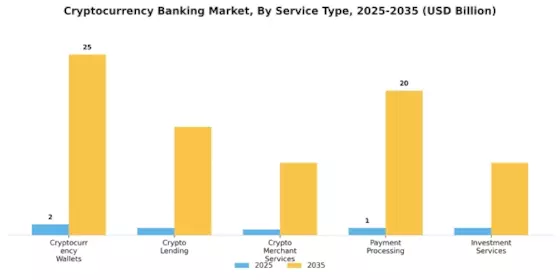
Crypto Lending: Dominant vs. Investment Services: Emerging
Crypto Lending remains the dominant force in the cryptocurrency banking space, providing users with options to earn interest on their crypto holdings while allowing borrowings against collateralized assets. Its prevalence is driven by the high yield potential it offers users in a turbulent market. Investment Services, on the other hand, are emerging rapidly as a favored option for both novice and seasoned investors seeking to diversify their portfolios with cryptocurrencies. They include advisory services and trading platforms aimed at increasing participation in this burgeoning market. As institutional interest grows, the demand for robust investment services that provide insights and professional management will likely rise, indicating substantial growth opportunities.
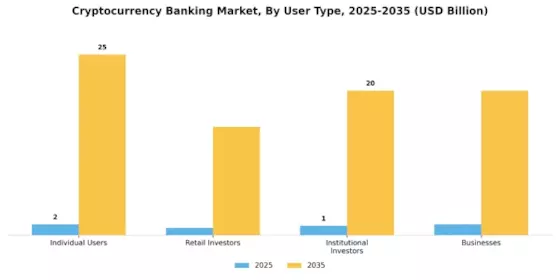
In the Cryptocurrency Banking Market, the user type segment showcases a dynamic distribution among four main categories: Individual Users, Retail Investors, Institutional Investors, and Businesses. Currently, Individual Users hold the largest market share, driven by the growing interest in cryptocurrency as an accessible asset class. Retail Investors also represent a significant portion of this segment, capitalizing on the popularity of various cryptocurrencies for investment purposes. Meanwhile, Institutional Investors are carving out a commendable market share as major financial entities begin to recognize cryptocurrency's potential for diversification.
Individual Users (Dominant) vs. Institutional Investors (Emerging)
Individual Users dominate the Cryptocurrency Banking Market primarily due to their accessibility to digital currencies and ease of use provided by user-friendly platforms. This group generally seeks to diversify their investment portfolios and explore innovative financial solutions. In contrast, Institutional Investors, although an emerging group, are rapidly gaining traction. Their involvement marks a transformational shift in the market, as they leverage substantial resources and expertise to engage in crypto banking activities. Their presence not only enhances market credibility but also drives technological innovation and regulatory advancements, propelling the overall market forward.
In the Cryptocurrency Banking Market, the deployment of services is primarily divided into two segments: cloud-based and on-premises solutions. Cloud-based services hold the largest market share due to their scalability, ease of access, and relatively lower operational costs. Organizations are increasingly adopting cloud solutions for their flexibility and the ability to leverage advanced technologies such as AI and machine learning for enhanced security and user experience. Conversely, on-premises alternatives are gaining traction among sectors where data security and regulatory compliance are critical, albeit they hold a smaller portion of the market.
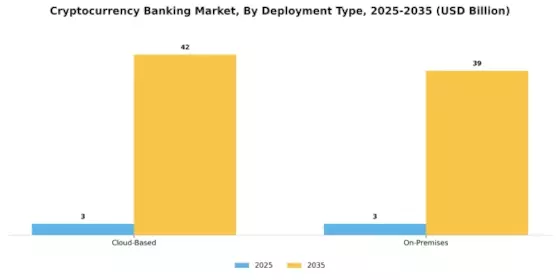
Cloud-Based (Dominant) vs. On-Premises (Emerging)
Cloud-based deployment in cryptocurrency banking is characterized by its rapid adaptability and broad accessibility, making it the dominant choice for many financial institutions. Offering significant advantages, such as reduced infrastructure costs and improved scalability, these solutions enable banks to respond quickly to changing market demands. On the other hand, on-premises solutions are emerging as a preferred choice for enterprises with stringent data governance needs. While these setups tend to be more resource-intensive and costly, they offer enhanced control over sensitive customer data, making them particularly appealing in highly regulated environments, thus carving out a niche segment in the market.
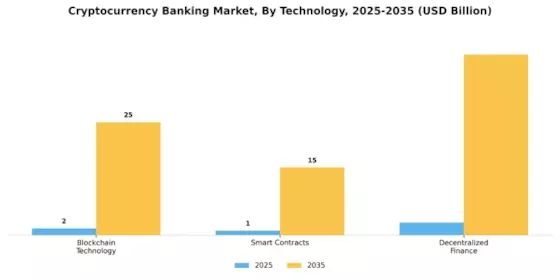
The Cryptocurrency Banking Market showcases a diverse array of technologies, with blockchain technology capturing the largest market share. Its solid foundation allows for secure and transparent transactions, fostering trust and adoption among users. As decentralized finance (DeFi) continues to gain momentum, it is positioned as the fastest-growing sector within this market. DeFi's appeal lies in its ability to provide financial services without the need for traditional banks, which attracts a broad audience seeking autonomy over their financial decisions. In terms of growth trends, the demand for innovative financial solutions is driving investments in both blockchain technology and DeFi. The interoperability of various blockchain networks facilitates an expansive ecosystem, while regulatory developments encourage the legitimacy of cryptocurrency banking. Furthermore, the incorporation of smart contracts enhances transactional efficiency, aligning with the market's push towards automation and transparency.
Blockchain Technology: Dominant vs. Decentralized Finance: Emerging
Blockchain technology holds a dominant position in the Cryptocurrency Banking Market, serving as the backbone for secure and efficient transactions. Its decentralized nature ensures the integrity of data while minimizing risks associated with fraud. Meanwhile, decentralized finance is emerging rapidly, appealing to users seeking diverse financial services without traditional intermediaries. DeFi leverages blockchain for innovative applications like lending, borrowing, and trading, fostering a new era of financial inclusion. With increasing user trust and evolving regulatory frameworks, both segments are expected to complement each other as they reshape the landscape of modern finance. The convergence of these technologies is likely to create a synergistic effect, enhancing user experience and expanding market accessibility.
Get more detailed insights about Cryptocurrency Banking Market Request Free Sample
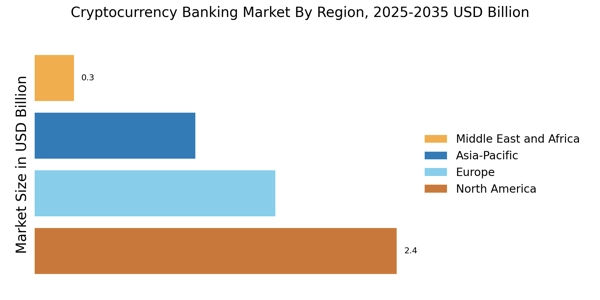
North America is the largest market for cryptocurrency banking, holding approximately 45% of the global market share. The region's growth is driven by increasing adoption of digital currencies, favorable regulatory frameworks, and a tech-savvy population. The U.S. is the primary contributor, followed closely by Canada, which is experiencing a surge in cryptocurrency investments and banking solutions. Regulatory clarity from agencies like the SEC has further fueled this growth. The competitive landscape is robust, with key players such as Coinbase, Kraken, and Gemini leading the charge. These companies are innovating with new financial products and services tailored to meet consumer demands. The presence of established financial institutions venturing into cryptocurrency banking is also notable, enhancing market credibility and attracting more users. The region's focus on security and compliance continues to shape its competitive edge.
Europe is the second-largest market for cryptocurrency banking, accounting for around 30% of the global market share. The region's growth is significantly influenced by the establishment of comprehensive regulatory frameworks, such as the EU's MiCA regulation, which aims to create a unified approach to cryptocurrency. Countries like Germany and France are leading the charge, fostering an environment conducive to innovation while ensuring consumer protection and market integrity. The competitive landscape in Europe is characterized by a mix of established players and emerging startups. Companies like Bitstamp and Nexo are at the forefront, offering a range of services from trading to lending. The presence of a diverse range of cryptocurrencies and blockchain projects further enriches the market. As European nations continue to embrace digital currencies, the region is poised for sustained growth in cryptocurrency banking.
Asia-Pacific is witnessing rapid growth in the cryptocurrency banking sector, holding approximately 20% of the global market share. The region's growth is driven by increasing digitalization, a young population, and rising interest in alternative financial solutions. Countries like China and Japan are leading the way, with China focusing on its digital yuan while Japan embraces a more open regulatory environment for cryptocurrencies, fostering innovation and investment. The competitive landscape is vibrant, with key players like Bitfinex and Crypto.com making significant strides. The region is also home to numerous startups that are innovating in the cryptocurrency space, offering unique services tailored to local markets. As regulatory frameworks evolve, the Asia-Pacific region is expected to see continued growth, attracting both local and international players to its dynamic market.
The Middle East and Africa represent an emerging frontier in the cryptocurrency banking market, holding about 5% of the global market share. The region's growth is driven by increasing interest in digital currencies, particularly in countries like South Africa and the UAE, where regulatory frameworks are beginning to take shape. The rise of fintech solutions and mobile banking is also contributing to the adoption of cryptocurrency banking services, as consumers seek alternative financial options. The competitive landscape is still developing, with a mix of local and international players entering the market. Companies are focusing on building trust and educating consumers about cryptocurrency. The presence of innovative startups and partnerships with established financial institutions is expected to drive growth in the region, making it a key area to watch in the coming years.
The Cryptocurrency Banking Market is currently characterized by a dynamic competitive landscape, driven by rapid technological advancements and evolving consumer preferences. Major players such as Binance (MT), Coinbase (US), and Kraken (US) are at the forefront, each adopting distinct strategies to enhance their market positioning. Binance (MT) focuses on innovation through the continuous development of its trading platform, which integrates advanced features such as AI-driven trading tools. Meanwhile, Coinbase (US) emphasizes regulatory compliance and user education, positioning itself as a trusted platform for new investors. Kraken (US) has carved a niche by offering a wide array of financial products, including futures and margin trading, thereby appealing to more sophisticated traders. Collectively, these strategies contribute to a competitive environment that is increasingly defined by technological prowess and regulatory navigation.In terms of business tactics, companies are increasingly localizing their operations to better serve regional markets, which appears to enhance customer engagement and satisfaction. The market structure is moderately fragmented, with a mix of established players and emerging startups vying for market share. This fragmentation allows for diverse offerings, yet the collective influence of key players like Binance and Coinbase tends to set industry standards, particularly in terms of security and user experience.
In August Binance (MT) announced a strategic partnership with a leading fintech firm to enhance its payment processing capabilities. This move is significant as it not only streamlines transactions for users but also positions Binance to capture a larger share of the growing e-commerce market, where cryptocurrency payments are becoming increasingly accepted. Such partnerships are likely to bolster Binance's competitive edge by improving operational efficiency and expanding its service offerings.
In September Coinbase (US) launched a new educational initiative aimed at demystifying cryptocurrency investments for retail investors. This initiative is crucial as it aligns with Coinbase's strategy to foster a more informed user base, potentially leading to increased trading volumes and customer loyalty. By prioritizing education, Coinbase not only enhances its brand reputation but also contributes to the overall maturation of the cryptocurrency market.
In October Kraken (US) expanded its services to include a new suite of decentralized finance (DeFi) products. This strategic expansion reflects Kraken's commitment to innovation and its recognition of the growing demand for DeFi solutions among investors. By diversifying its offerings, Kraken positions itself to attract a broader audience, particularly those interested in yield farming and liquidity provision, thereby enhancing its competitive stance in the market.
As of October the Cryptocurrency Banking Market is witnessing trends that emphasize digitalization, sustainability, and the integration of artificial intelligence. Strategic alliances are increasingly shaping the competitive landscape, as companies recognize the value of collaboration in navigating regulatory challenges and enhancing technological capabilities. Looking ahead, competitive differentiation is likely to evolve from traditional price-based competition to a focus on innovation, technological advancements, and supply chain reliability. This shift suggests that companies that prioritize these elements will be better positioned to thrive in an increasingly complex market.




The Cryptocurrency Banking Market is projected to grow at a 28.12% CAGR from 2025 to 2035, driven by technological advancements, regulatory clarity, and increasing consumer adoption.
New opportunities lie in:
By 2035, the Cryptocurrency Banking Market is poised for substantial growth and innovation.
| MARKET SIZE 2024 | 5.3(USD Billion) |
| MARKET SIZE 2025 | 6.79(USD Billion) |
| MARKET SIZE 2035 | 80.92(USD Billion) |
| COMPOUND ANNUAL GROWTH RATE (CAGR) | 28.12% (2025 - 2035) |
| REPORT COVERAGE | Revenue Forecast, Competitive Landscape, Growth Factors, and Trends |
| BASE YEAR | 2024 |
| Market Forecast Period | 2025 - 2035 |
| Historical Data | 2019 - 2024 |
| Market Forecast Units | USD Billion |
| Key Companies Profiled | Binance (MT), Coinbase (US), Kraken (US), Gemini (US), Bitstamp (LU), Crypto.com (SC), BlockFi (US), Nexo (BG), Bitfinex (HK) |
| Segments Covered | Service Type, User Type, Deployment Type, Technology, Regional |
| Key Market Opportunities | Integration of decentralized finance solutions within traditional banking frameworks presents a transformative opportunity. |
| Key Market Dynamics | Regulatory changes and technological advancements are reshaping competitive dynamics in the Cryptocurrency Banking Market. |
| Countries Covered | North America, Europe, APAC, South America, MEA |
As of 2024, the Cryptocurrency Banking Market was valued at 5.3 USD Billion.
The market is expected to reach a valuation of 80.92 USD Billion by 2035.
The anticipated CAGR for the Cryptocurrency Banking Market from 2025 to 2035 is 28.12%.
The market analysis includes segments such as Cryptocurrency Wallets, Crypto Lending, and Investment Services.
The Crypto Lending segment is projected to reach 15.0 USD Billion by 2035.
Key players include Binance, Coinbase, Kraken, and Gemini, among others.
The Decentralized Finance segment is expected to reach 40.0 USD Billion by 2035.
By 2035, the market size for Individual Users is projected at 25.0 USD Billion, while Institutional Investors may reach 20.0 USD Billion.
The Cloud-Based deployment segment is expected to reach 42.36 USD Billion by 2035.
The Payment Processing segment is projected to grow to 20.0 USD Billion by 2035.


Kindly complete the form below to receive a free sample of this Report

“This is really good guys. Excellent work on a tight deadline. I will continue to use you going forward and recommend you to others. Nice job”


“Thanks. It’s been a pleasure working with you, please use me as reference with any other Intel employees.”


“Thanks for sending the report it gives us a good global view of the Betaïne market.”


“Thank you, this will be very helpful for OQS.”


“We found the report very insightful! we found your research firm very helpful. I'm sending this email to secure our future business.”


“I am very pleased with how market segments have been defined in a relevant way for my purposes (such as "Portable Freezers & refrigerators" and "last-mile"). In general the report is well structured. Thanks very much for your efforts.”


“I have been reading the first document or the study, ,the Global HVAC and FP market report 2021 till 2026. Must say, good info! I have not gone in depth at all parts, but got a good indication of the data inside!”


“We got the report in time, we really thank you for your support in this process. I also thank to all of your team as they did a great job.”


“The Automotive 48V ECU Components Procurement Intelligence Study” was a complex project, but the Market Research Future (MRFR) team handled it with quality, agility, and customer-centricity. They delivered all requested data on time and within the agreed scope. The team, including Shubhendra Anand and Rahul Gotadki, was always readily available to clarify questions and swiftly implement necessary adjustments, driving the project to a successful conclusion within a very demanding timeframe.
I would also like to specifically commend Akshay Agarwal for his responsiveness and support at every stage—from our initial inquiry on May 6th through to final delivery on June 18th. His dedication made the entire process seamless.”



