Download Free Sample
Kindly complete the form below to receive a free sample of this Report
Customs Brokerage Services Market Research Report By End User (Manufacturing, Retail, E-commerce, Pharmaceutical, Automotive), By Service Type (Customs Clearance, Consultation Services, Compliance Management, Freight Forwarding, Trade Advisory), By Mode of Transportation (Air Freight, Ocean Freight, Land Freight, Rail Freight, Multimodal Transport) And By Region (North America, Europe, Asia-Pacific, And Rest Of The World) – Market Forecast Till 2035.
As per MRFR analysis, the Customs Brokerage Services Market Size was estimated at 12.5 USD Billion in 2024. The Customs Brokerage Services industry is projected to grow from 12.93 USD Billion in 2025 to 18.2 USD Billion by 2035, exhibiting a compound annual growth rate (CAGR) of 3.47% during the forecast period 2025 - 2035.
The Customs Brokerage Services Market is experiencing a dynamic evolution driven by technological advancements and changing consumer behaviors.
| 2024 Market Size | 12.5 (USD Billion) |
| 2035 Market Size | 18.2 (USD Billion) |
| CAGR (2025 - 2035) | 3.47% |
DHL Supply Chain (DE), Kuehne + Nagel (CH), Expeditors International (US), C.H. Robinson (US), DB Schenker (DE), Panalpina (CH), Geodis (FR), UPS Supply Chain Solutions (US), Nippon Express (JP)
Our Impact
Enabled $4.3B Revenue Impact for Fortune 500 and Leading Multinationals
Partnering with 2000+ Global Organizations Each Year
30K+ Citations by Top-Tier Firms in the Industry
The Customs Brokerage Services Market is currently experiencing a dynamic evolution, driven by the increasing complexity of global trade regulations and the need for efficient logistics solutions. As businesses expand their operations internationally, the demand for customs brokerage services has intensified. These services facilitate the smooth movement of goods across borders, ensuring compliance with various legal requirements. The market appears to be adapting to technological advancements, with automation and digital platforms playing a crucial role in streamlining processes. This shift not only enhances operational efficiency but also improves transparency and traceability in customs procedures. Moreover, the growing emphasis on sustainability and environmental considerations is influencing the Customs Brokerage Services Market. Companies are increasingly seeking partners who can provide eco-friendly solutions and adhere to green practices. This trend suggests a potential shift in how customs brokers operate, as they may need to incorporate sustainable practices into their service offerings. Additionally, the rise of e-commerce has transformed the landscape, necessitating faster and more flexible customs solutions to meet consumer expectations. Overall, the Customs Brokerage Services Market is poised for continued growth, driven by evolving trade dynamics and the need for innovative solutions.
The Customs Brokerage Services Market is witnessing a notable trend towards the integration of advanced technologies. Automation, artificial intelligence, and data analytics are increasingly being utilized to enhance operational efficiency. This technological shift allows customs brokers to streamline processes, reduce errors, and improve compliance with regulations. As a result, businesses are likely to benefit from faster clearance times and reduced operational costs.
There is a growing focus on sustainability within the Customs Brokerage Services Market. Companies are increasingly prioritizing eco-friendly practices and seeking partners who align with their environmental goals. This trend indicates a potential shift in service offerings, as customs brokers may need to adopt greener practices and provide solutions that minimize environmental impact, thereby appealing to environmentally conscious clients.
The rise of e-commerce is significantly impacting the Customs Brokerage Services Market. As online shopping continues to grow, there is an increasing demand for efficient customs solutions that can accommodate the rapid movement of goods. This trend suggests that customs brokers must adapt their services to meet the unique challenges posed by e-commerce, such as expedited clearance processes and flexible logistics solutions.
The rapid growth of e-commerce is a significant driver for the Customs Brokerage Services Market. As online shopping continues to expand, the volume of cross-border transactions has surged, necessitating efficient customs clearance processes. In 2025, e-commerce is anticipated to account for nearly 25% of total retail sales, leading to an increased demand for customs brokerage services to facilitate the smooth movement of goods across borders. This growth presents opportunities for customs brokers to offer tailored solutions that address the unique challenges posed by e-commerce, such as managing returns and ensuring compliance with varying regulations. Consequently, the customs brokerage sector is likely to evolve to meet the specific needs of e-commerce businesses, further solidifying its role in international trade.
Trade liberalization is a crucial factor influencing the Customs Brokerage Services Market. The reduction of trade barriers and tariffs has encouraged international trade, resulting in a higher volume of goods crossing borders. In 2025, it is estimated that trade liberalization initiatives will contribute to a 15% increase in cross-border trade activities. This trend creates a favorable environment for customs brokerage services, as businesses require assistance in navigating the complexities of customs regulations and documentation. As countries continue to pursue trade agreements that promote free trade, the demand for customs brokers who can ensure compliance and expedite the clearance process is likely to rise. This driver indicates that trade liberalization not only enhances market opportunities but also reinforces the importance of customs brokerage services in facilitating global commerce.
Supply chain optimization is increasingly recognized as a vital driver within the Customs Brokerage Services Market. As companies strive to enhance operational efficiency and reduce costs, the role of customs brokers becomes more pronounced. In 2025, it is projected that businesses will allocate approximately 20% of their logistics budgets to customs brokerage services to ensure seamless cross-border transactions. This focus on optimization necessitates the expertise of customs brokers who can provide insights into regulatory requirements and streamline the clearance process. Moreover, as supply chains become more complex due to globalization, the need for specialized customs brokerage services that can adapt to varying regulations and market conditions is likely to grow. This driver suggests that the pursuit of supply chain efficiency will continue to elevate the demand for customs brokerage services.
Technological advancements play a pivotal role in shaping the Customs Brokerage Services Market. The integration of digital platforms and automation tools has streamlined customs processes, enhancing efficiency and accuracy. In 2025, it is projected that over 60% of customs brokerage firms will adopt advanced technologies such as artificial intelligence and blockchain to optimize operations. These technologies facilitate real-time tracking of shipments, automated documentation, and improved communication between stakeholders. As businesses increasingly seek to reduce delays and enhance transparency in their supply chains, the demand for technologically adept customs brokerage services is expected to rise. This trend suggests that firms that leverage technology will likely gain a competitive edge in the customs brokerage landscape.
The Customs Brokerage Services Market is increasingly influenced by the complexity of regulatory compliance. As trade regulations evolve, businesses face challenges in adhering to various customs laws and tariffs. This complexity necessitates the expertise of customs brokers who can navigate the intricate landscape of international trade. In 2025, it is estimated that compliance-related costs account for approximately 10% of total logistics expenses, underscoring the demand for proficient customs brokerage services. Furthermore, the rise in trade agreements and tariffs has led to a heightened need for accurate documentation and timely submissions, which customs brokers facilitate. This driver indicates that as regulations become more intricate, the reliance on customs brokerage services is likely to grow, positioning these services as essential for businesses engaged in international trade.
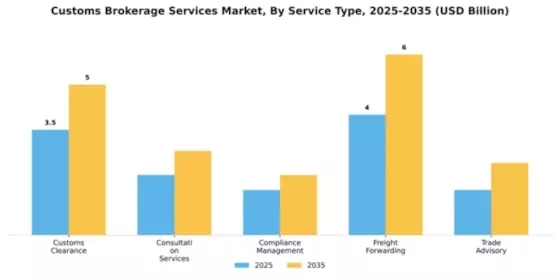
In the Customs Brokerage Services Market, Customs Clearance holds the largest share, illustrating its critical importance in facilitating efficient border transactions. This segment is integral to ensuring that goods are appropriately declared, duties are paid, and compliance with regulations is maintained, thereby enhancing its market dominance. Conversely, Compliance Management is swiftly emerging in response to increasing regulatory demands, showcasing the growing importance of adherence to laws and regulations among businesses engaged in international trade. The growth drivers for these segments are notable. Customs Clearance remains central due to the expanding global trade dynamics, requiring that customs processes be timely and efficient. In contrast, Compliance Management is experiencing accelerated growth fueled by heightened emphasis on regulatory compliance and risk management. Companies are increasingly investing in systems that ensure they navigate the intricate web of trade regulations, thereby positioning Compliance Management as the fastest-growing area in the market.
Customs Clearance (Dominant) vs. Trade Advisory (Emerging)
Customs Clearance stands out as the dominant service in the Customs Brokerage Services Market due to its essential role in ensuring that goods cross borders swiftly and are compliant with international laws. This service encompasses various tasks, including documentation preparation and liaising with customs authorities. On the other hand, Trade Advisory, while still emerging, is gaining traction as businesses seek specialized guidance to navigate complex trade landscapes. As tariffs and trade agreements evolve, the demand for expert advice in trade strategy is on the rise, making Trade Advisory a crucial area for growth. The shift towards strategic engagement with international markets is fueling interest in this emerging segment, as companies strive to optimize their operations and mitigate risks associated with global trade.
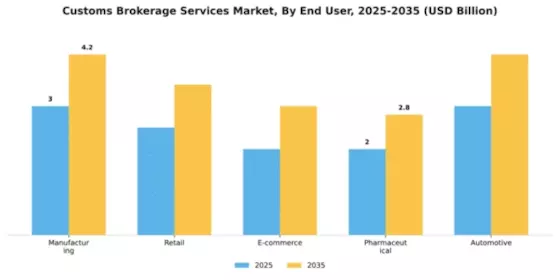
In the Customs Brokerage Services Market, the end-user segment is quite diverse, with notable distributions among Manufacturing, Retail, E-commerce, Pharmaceutical, and Automotive sectors. Manufacturing remains the largest segment, driven by its demand for efficient cross-border trade solutions. E-commerce, on the other hand, is rapidly expanding as consumers increasingly opt for online shopping, requiring seamless customs processes to ensure timely deliveries. Retail and Automotive sectors also hold significant shares, with the Pharmaceutical segment showing unique needs due to regulatory complexities.
Manufacturing: Dominant vs. E-commerce: Emerging
The Manufacturing sector remains dominant in the Customs Brokerage Services Market, characterized by its extensive supply chains and significant international trade activities. Manufacturers value comprehensive services that streamline imports and exports, ensuring compliance with customs regulations. E-commerce, emerging as the fastest-growing segment, demands agility and efficiency due to rapid market changes and consumer expectations. This segment thrives on technological integration and automation to expedite customs clearance, catering to a global customer base that prioritizes speed and cost-effectiveness. As e-commerce continues to expand, the pressures on customs services will grow, presenting both challenges and opportunities for service providers.
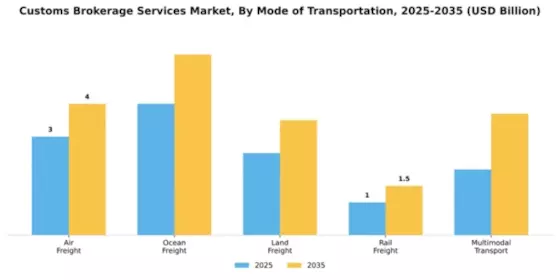
The Customs Brokerage Services Market showcases a diversified mode of transportation segment, with Air Freight holding the largest market share. It offers rapid delivery and efficiency, catering to businesses in need of fast turnaround times. Ocean Freight, on the other hand, is recognized as the fastest-growing segment, appealing to companies focused on cost-effective bulk shipping solutions. This diverse distribution highlights the varying priorities businesses place on speed versus cost within their logistics strategies. Growth trends in the Customs Brokerage Services Market are greatly influenced by the globalization of trade and the demand for streamlined supply chains. Air Freight is driven by e-commerce growth, leading to increased shipment volumes for urgent deliveries. Conversely, Ocean Freight's expansion is supported by the rising preference for sustainable transportation alternatives and advancements in shipping technology that improve efficiency. These trends illustrate the dynamic landscape of transportation modes within customs brokerage services, allowing companies to adapt to changing market demands.
Air Freight (Dominant) vs. Multimodal Transport (Emerging)
Air Freight stands as the dominant force in the Customs Brokerage Services Market, offering unmatched speed and reliability, making it the preferred choice for time-sensitive shipments. It typically caters to high-value goods, ensuring swift transit through airways. In contrast, Multimodal Transport is emerging as a versatile option that integrates various transportation modes for improved efficiency. This approach allows for significant flexibility, combining the strengths of air, sea, and land freight to optimize logistics. As companies increasingly seek tailored solutions to meet their diverse shipping needs, the adoption of Multimodal Transport is expected to rise, providing a strategic alternative to traditional transport methods.
Get more detailed insights about Customs Brokerage Services Market Request Free Sample
North America continues to lead the Customs Brokerage Services market, holding a significant share of 6.25 in 2024. The region's growth is driven by increasing trade volumes, regulatory compliance demands, and technological advancements in logistics. The U.S. and Canada are key players, benefiting from robust infrastructure and trade agreements that facilitate cross-border transactions. Regulatory frameworks are evolving to enhance efficiency and security in customs processes, further propelling market growth. The competitive landscape in North America is characterized by major players such as DHL Supply Chain, Expeditors International, and C.H. Robinson. These companies leverage advanced technologies and extensive networks to provide comprehensive customs solutions. The presence of established firms ensures a high level of service quality and innovation, catering to diverse industries. As trade continues to expand, the demand for customs brokerage services is expected to grow, solidifying North America's position as a market leader.
Europe's Customs Brokerage Services market is valued at 3.5, reflecting a growing demand driven by increased trade activities and regulatory changes. The region is witnessing a shift towards digitalization, with customs processes becoming more automated and efficient. Countries like Germany, France, and the UK are at the forefront, benefiting from strong logistics networks and favorable trade policies. Regulatory bodies are actively working to streamline customs procedures, enhancing the overall market environment. The competitive landscape in Europe features key players such as Kuehne + Nagel and DB Schenker, who are investing in technology to improve service delivery. The presence of multiple logistics hubs across the region facilitates efficient customs operations. As the market evolves, companies are focusing on sustainability and compliance, ensuring they meet both regulatory requirements and customer expectations. This dynamic environment positions Europe as a promising market for customs brokerage services.
The Asia-Pacific region, with a market size of 2.75, is experiencing rapid growth in Customs Brokerage Services, driven by increasing trade activities and globalization. Countries like China, Japan, and India are leading this growth, supported by government initiatives aimed at enhancing trade facilitation. Regulatory reforms are being implemented to streamline customs processes, making it easier for businesses to navigate international trade. The demand for efficient customs services is on the rise as companies seek to optimize their supply chains. The competitive landscape in Asia-Pacific is becoming increasingly dynamic, with key players such as Nippon Express and Geodis expanding their operations. These companies are leveraging technology to provide innovative solutions that meet the evolving needs of their clients. As the region continues to integrate into the global economy, the customs brokerage market is expected to expand, driven by both domestic and international trade demands.
The Middle East and Africa region, with a market size of 0.5, presents significant untapped potential in Customs Brokerage Services. The growth is primarily driven by increasing trade activities and investments in infrastructure. Countries like the UAE and South Africa are emerging as key players, benefiting from strategic locations and improving logistics capabilities. Regulatory frameworks are evolving to support trade facilitation, enhancing the overall market landscape. The competitive environment in this region is still developing, with several local and international players entering the market. Companies are focusing on building capabilities to meet the growing demand for customs services. As trade continues to expand, the customs brokerage market in the Middle East and Africa is poised for growth, driven by both regional and global trade dynamics.
The Customs Brokerage Services Market is characterized by a dynamic competitive landscape, driven by globalization, regulatory complexities, and the increasing need for efficient supply chain management. Key players such as DHL Supply Chain (DE), Kuehne + Nagel (CH), and Expeditors International (US) are strategically positioned to leverage their extensive networks and technological capabilities. These companies focus on digital transformation and operational efficiency, which are critical in navigating the complexities of customs regulations and enhancing customer service. Their collective strategies not only shape the competitive environment but also set benchmarks for service quality and innovation in the market.In terms of business tactics, companies are increasingly localizing their operations to better respond to regional demands and regulatory requirements. Supply chain optimization remains a focal point, with firms investing in advanced technologies to streamline processes. The market appears moderately fragmented, with a mix of large multinational corporations and smaller regional players. The influence of key players is substantial, as they often dictate service standards and pricing strategies, thereby shaping the overall market structure.In November DHL Supply Chain (DE) announced a partnership with a leading technology firm to enhance its customs brokerage capabilities through AI-driven analytics. This strategic move is likely to improve operational efficiency and reduce processing times, thereby providing a competitive edge in a market that increasingly values speed and accuracy. The integration of AI technologies may also facilitate better compliance with evolving regulations, positioning DHL as a leader in innovation within the sector.In October Kuehne + Nagel (CH) expanded its presence in Asia by acquiring a regional customs brokerage firm. This acquisition is significant as it not only broadens Kuehne + Nagel's service offerings but also strengthens its foothold in a rapidly growing market. The strategic importance of this move lies in the potential for enhanced service delivery and increased market share, particularly in regions where customs regulations are becoming more stringent.In September Expeditors International (US) launched a new digital platform aimed at simplifying the customs clearance process for its clients. This initiative reflects a broader trend towards digitalization in the industry, as companies seek to enhance customer experience and operational transparency. The platform's introduction is expected to streamline workflows and reduce delays, thereby reinforcing Expeditors' commitment to reliability and customer satisfaction.As of December the Customs Brokerage Services Market is witnessing trends such as digitalization, sustainability, and AI integration, which are redefining competitive dynamics. Strategic alliances are increasingly shaping the landscape, enabling companies to pool resources and expertise to address complex challenges. Looking ahead, competitive differentiation is likely to evolve from traditional price-based competition to a focus on innovation, technology, and supply chain reliability. This shift underscores the importance of adaptability and forward-thinking strategies in maintaining a competitive edge in a rapidly changing market.


The Customs Brokerage Services Market is projected to grow at a 3.47% CAGR from 2025 to 2035, driven by globalization, e-commerce expansion, and regulatory changes.
New opportunities lie in:
By 2035, the market is expected to be robust, reflecting sustained growth and innovation.
| MARKET SIZE 2024 | 12.5(USD Billion) |
| MARKET SIZE 2025 | 12.93(USD Billion) |
| MARKET SIZE 2035 | 18.2(USD Billion) |
| COMPOUND ANNUAL GROWTH RATE (CAGR) | 3.47% (2025 - 2035) |
| REPORT COVERAGE | Revenue Forecast, Competitive Landscape, Growth Factors, and Trends |
| BASE YEAR | 2024 |
| Market Forecast Period | 2025 - 2035 |
| Historical Data | 2019 - 2024 |
| Market Forecast Units | USD Billion |
| Key Companies Profiled | DHL Supply Chain (DE), Kuehne + Nagel (CH), Expeditors International (US), C.H. Robinson (US), DB Schenker (DE), Panalpina (CH), Geodis (FR), UPS Supply Chain Solutions (US), Nippon Express (JP) |
| Segments Covered | Service Type, End User, Mode of Transportation |
| Key Market Opportunities | Integration of advanced technologies enhances efficiency in the Customs Brokerage Services Market. |
| Key Market Dynamics | Evolving regulatory frameworks and technological advancements reshape competitive dynamics in the Customs Brokerage Services Market. |
| Countries Covered | North America, Europe, APAC, South America, MEA |
As of 2024, the Customs Brokerage Services Market was valued at 12.5 USD Billion.
The market is projected to reach 18.2 USD Billion by 2035.
The expected CAGR for the Customs Brokerage Services Market from 2025 to 2035 is 3.47%.
Freight Forwarding is anticipated to grow from 4.0 USD Billion in 2024 to 6.0 USD Billion by 2035.
The Customs Clearance segment was valued at 3.5 USD Billion in 2024 and is expected to increase to 5.0 USD Billion by 2035.
Key end-user segments include Manufacturing, Retail, E-commerce, Pharmaceutical, and Automotive, with Manufacturing projected to grow from 3.0 USD Billion to 4.2 USD Billion by 2035.
Ocean Freight is likely to grow from 4.0 USD Billion in 2024 to 5.5 USD Billion by 2035.
Key players include DHL Supply Chain, Kuehne + Nagel, Expeditors International, and C.H. Robinson, among others.
Compliance Management services are projected to increase from 1.5 USD Billion in 2024 to 2.0 USD Billion by 2035.
The Trade Advisory segment is expected to grow from 1.5 USD Billion in 2024 to 2.4 USD Billion by 2035.


Kindly complete the form below to receive a free sample of this Report

“This is really good guys. Excellent work on a tight deadline. I will continue to use you going forward and recommend you to others. Nice job”


“Thanks. It’s been a pleasure working with you, please use me as reference with any other Intel employees.”


“Thanks for sending the report it gives us a good global view of the Betaïne market.”


“Thank you, this will be very helpful for OQS.”


“We found the report very insightful! we found your research firm very helpful. I'm sending this email to secure our future business.”


“I am very pleased with how market segments have been defined in a relevant way for my purposes (such as "Portable Freezers & refrigerators" and "last-mile"). In general the report is well structured. Thanks very much for your efforts.”


“I have been reading the first document or the study, ,the Global HVAC and FP market report 2021 till 2026. Must say, good info! I have not gone in depth at all parts, but got a good indication of the data inside!”


“We got the report in time, we really thank you for your support in this process. I also thank to all of your team as they did a great job.”


“The Automotive 48V ECU Components Procurement Intelligence Study” was a complex project, but the Market Research Future (MRFR) team handled it with quality, agility, and customer-centricity. They delivered all requested data on time and within the agreed scope. The team, including Shubhendra Anand and Rahul Gotadki, was always readily available to clarify questions and swiftly implement necessary adjustments, driving the project to a successful conclusion within a very demanding timeframe.
I would also like to specifically commend Akshay Agarwal for his responsiveness and support at every stage—from our initial inquiry on May 6th through to final delivery on June 18th. His dedication made the entire process seamless.”



