×
Request Free Sample ×

Kindly complete the form below to receive a free sample of this Report

* Please use a valid business email

Leading companies partner with us for data-driven Insights

clients tt-cursor
Hero Background

Cyanate Ester Resin Market

ID: MRFR/CnM/8362-HCR
100 Pages
Varsha More
October 2025

Cyanate Ester Resin Market Research Report By Application (Electronic Components, Aerospace Components, Automotive Products, Industrial Machinery), By End-User (Electronics Industry, Aerospace Industry, Automotive Industry, Industrial Sector), By Material Grade (High-Performance Grade, Standard Grade), By Form (Liquid, Solid) and By Regional (North America, Europe, South America, Asia Pacific, Middle East and Africa) - Forecast to 2035

Share:
Download PDF ×

We do not share your information with anyone. However, we may send you emails based on your report interest from time to time. You may contact us at any time to opt-out.

Cyanate Ester Resin Market Infographic
Purchase Options

Cyanate Ester Resin Market Summary

As per MRFR analysis, the Cyanate Ester Resin Market Size was estimated at 1446.64 USD Million in 2024. The Cyanate Ester Resin industry is projected to grow from 1514.81 in 2025 to 2400.61 by 2035, exhibiting a compound annual growth rate (CAGR) of 4.71 during the forecast period 2025 - 2035.

Key Market Trends & Highlights

The Cyanate Ester Resin Market is poised for substantial growth driven by advancements in technology and increasing demand across various sectors.

  • The market experiences heightened demand in aerospace applications, particularly in North America, which remains the largest market.
  • There is a growing focus on sustainable solutions, reflecting a broader industry trend towards environmentally friendly materials.
  • Advancements in processing technologies are facilitating the development of more efficient and effective cyanate ester resins.
  • Key market drivers include rising demand in electronics and significant growth in the aerospace sector, supported by innovations in composite materials.

Market Size & Forecast

2024 Market Size 1446.64 (USD Million)
2035 Market Size 2400.61 (USD Million)
CAGR (2025 - 2035) 4.71%

Major Players

Hexcel Corporation (US), Cytec Industries Inc. (US), Hexion Inc. (US), Gurit Holding AG (CH), SABIC (SA), Mitsubishi Chemical Corporation (JP), Lonza Group AG (CH), Royal DSM (NL), Huntsman Corporation (US)

Cyanate Ester Resin Market Trends

The Cyanate Ester Resin Market is currently experiencing a notable evolution, driven by advancements in material science and increasing demand across various industries. This resin type, known for its superior thermal stability and mechanical properties, is finding applications in aerospace, automotive, and electronics sectors. The growing emphasis on lightweight materials and high-performance composites is propelling the adoption of cyanate esters, as they offer enhanced performance characteristics compared to traditional resins. Furthermore, the trend towards sustainable manufacturing practices is influencing the market, as manufacturers seek eco-friendly alternatives that do not compromise on quality or performance. In addition, the Cyanate Ester Resin Market is witnessing a shift towards innovative formulations and processing techniques. Research and development efforts are focused on improving the resin's properties, such as reducing curing times and enhancing adhesion capabilities. This innovation is likely to attract new players into the market, fostering competition and potentially leading to more diverse product offerings. As industries continue to evolve, the demand for high-performance materials is expected to grow, positioning the Cyanate Ester Resin Market for sustained growth in the foreseeable future.

Increased Demand in Aerospace Applications

The aerospace sector is increasingly utilizing cyanate ester resins due to their lightweight and high-temperature resistance properties. This trend is likely to continue as manufacturers seek materials that enhance fuel efficiency and performance in aircraft.

Focus on Sustainable Solutions

There is a growing emphasis on sustainability within the Cyanate Ester Resin Market. Companies are exploring bio-based cyanate esters and eco-friendly production methods, reflecting a broader industry shift towards environmentally responsible practices.

Advancements in Processing Technologies

Innovations in processing techniques are enhancing the usability of cyanate esters. Improved curing methods and formulations are making these resins more accessible for various applications, potentially expanding their market reach.

Cyanate Ester Resin Market Drivers

Advancements in Electronics

In the realm of electronics, the Global Cyanate Ester Resin Market Industry benefits from the increasing complexity and miniaturization of electronic devices. Cyanate esters are utilized in the production of printed circuit boards and other electronic components due to their excellent thermal stability and dielectric properties. As the demand for high-performance electronics escalates, particularly in telecommunications and consumer electronics, the market is expected to grow significantly. By 2035, the market could reach 2.4 USD Billion, reflecting the essential role of cyanate esters in supporting the evolving needs of the electronics industry.

Market Trends and Projections

The Global Cyanate Ester Resin Market Industry exhibits various trends and projections that highlight its growth trajectory. The market is anticipated to reach 1.45 USD Billion by 2024, with a projected increase to 2.4 USD Billion by 2035. The compound annual growth rate of 4.68% from 2025 to 2035 indicates a steady expansion, driven by diverse applications across aerospace, electronics, automotive, and renewable energy sectors. These trends suggest a robust demand for cyanate esters, reflecting their critical role in advancing technology and sustainability across multiple industries.

Innovations in Material Science

Innovations in material science are significantly influencing the Global Cyanate Ester Resin Market Industry. Research and development efforts are focused on enhancing the properties of cyanate esters, leading to the creation of new formulations that offer improved performance characteristics. These advancements may include increased thermal stability, enhanced adhesion, and better processing capabilities. As industries seek materials that can withstand extreme conditions, the demand for innovative cyanate ester formulations is likely to rise, potentially leading to a more dynamic market landscape as manufacturers adapt to evolving technological requirements.

Growing Demand in Aerospace Sector

The Global Cyanate Ester Resin Market Industry experiences a notable surge in demand driven by the aerospace sector. The lightweight and high-performance characteristics of cyanate esters make them ideal for aerospace applications, where reducing weight while maintaining structural integrity is crucial. As commercial and military aircraft manufacturers increasingly adopt advanced composite materials, the market is projected to reach 1.45 USD Billion in 2024. This growth is indicative of the industry's shift towards materials that enhance fuel efficiency and performance, suggesting a robust future as the aerospace sector continues to innovate.

Emerging Applications in Renewable Energy

The Global Cyanate Ester Resin Market Industry is poised for growth due to emerging applications in the renewable energy sector. As the world shifts towards sustainable energy solutions, cyanate esters are increasingly utilized in wind turbine blades and solar panel components. Their superior mechanical properties and resistance to environmental degradation make them suitable for these applications. The ongoing investments in renewable energy infrastructure are likely to drive demand for cyanate esters, suggesting a potential for significant market expansion in the coming years as the industry aligns with global sustainability goals.

Rising Adoption in Automotive Applications

The automotive industry increasingly adopts cyanate ester resins, contributing to the expansion of the Global Cyanate Ester Resin Market Industry. These resins are favored for their lightweight and durable properties, which are essential for enhancing fuel efficiency and performance in vehicles. As manufacturers strive to meet stringent environmental regulations and consumer demand for sustainable solutions, the use of cyanate esters in automotive applications is likely to grow. This trend may lead to a compound annual growth rate of 4.68% from 2025 to 2035, indicating a promising future for cyanate esters in the automotive sector.
Market Segment Insights

By Application: Aerospace (Largest) vs. Electronics (Fastest-Growing)

In the Cyanate Ester Resin Market, the application segment showcases varied distribution among its key sectors. Aerospace constitutes the largest portion of the market, benefiting from rigorous material requirements that demand high-performance solutions. Following closely, segments like Automotive and Electronics hold significant shares, adapting to the growing trend of lightweight and durable materials, while Telecommunications and Medical are gradually capturing attention with advancements in technology. Growth trends within this segment reflect a robust shift towards advanced materials, particularly in Aerospace and Electronics. The push for lightweight, durable solutions in aerospace applications is paramount, alongside the rising adoption of electronic devices requiring efficient thermal management properties. The emerging markets in Telecommunications and Medical highlight a burgeoning demand driven by technological innovations and a heightened focus on miniaturization and performance enhancements.

Aerospace: Dominant vs. Electronics: Emerging

Aerospace remains a dominant sector within the Cyanate Ester Resin Market, characterized by its stringent material specifications and a growing need for lightweight, high-strength composites. This segment utilizes cyanate esters for their excellent thermal stability and resistance to delamination, making them ideal for critical aerospace applications. Conversely, Electronics is emerging rapidly, driven by the demand for advanced materials that support the latest technology trends. The electronics sector benefits from cyanate esters' exceptional dielectric properties, which are crucial for applications in circuit boards and other electronic components. These contrasting dynamics between the aerospace and electronics segments illustrate the diverse application potential of cyanate esters and their essential roles in advancing material technology.

By End Use: Composite Materials (Largest) vs. Adhesives (Fastest-Growing)

In the Cyanate Ester Resin Market, the share distribution among the end use segments is marked by Composite Materials being the dominant player. This segment benefits from its extensive applications primarily in aerospace and automotive industries due to its superior mechanical properties and thermal resistance. Following closely, Adhesives are emerging rapidly, driven by increasing demands in various applications including construction and electronics, which contributes significantly to their growing market share. The growth trends within this segment are largely propelled by the advancements in materials technology and the heightened focus on lightweight materials across industries. Aerospace and automotive sectors are imposing stringent regulations regarding air and fuel efficiency, fostering the demand for composite materials. Conversely, Adhesives are witnessing a surge in popularity due to their versatility and strong bonding capabilities, aligning with the trends of miniaturization in electronics and sustainable construction practices.

Composite Materials (Dominant) vs. Adhesives (Emerging)

Composite Materials stand as the dominant force in the Cyanate Ester Resin Market due to their unparalleled strength-to-weight ratio, making them ideal for high-performance applications in aerospace and automotive sectors. Their ability to withstand high temperatures and their excellent electrical insulation properties further enhance their appeal. On the other hand, Adhesives, while currently an emerging segment, are rapidly gaining traction because of their utility in various industries, including electronics, building and construction, and specialty materials. The growth of this segment is fueled by innovations that enhance bonding strength and durability, making them indispensable in modern manufacturing processes. As trends move towards eco-friendly solutions, both segments are likely to evolve, emphasizing sustainable materials and application techniques.

By Formulation Type: Prepregs (Largest) vs. Liquid Resins (Fastest-Growing)

In the Cyanate Ester Resin Market, the segmentation by formulation type reveals that prepregs dominate in market share, owing to their superior mechanical properties and thermal stability. They are widely utilized in aerospace and defense applications, reflecting a strong preference from manufacturers for materials that meet stringent performance criteria. Liquid resins, though currently smaller in market share compared to prepregs, are gaining traction due to their versatility and ease of application in various manufacturing processes.

Prepregs (Dominant) vs. Liquid Resins (Emerging)

Prepregs represent the dominant formulation type in the Cyanate Ester Resin Market, characterized by their pre-impregnated fibers that offer outstanding structural integrity and efficiency in production. These materials are crucial for industries demanding high-performance composites. On the other hand, liquid resins are emerging quickly, favored for their adaptability and ability to streamline production processes. While still developing, liquid resins are found in a variety of applications ranging from automotive to consumer electronics, showcasing their potential to reshape the industry landscape as they continue to evolve.

By Curing Method: Thermal Curing (Largest) vs. UV Curing (Fastest-Growing)

In the Cyanate Ester Resin Market, the curing method segment is diversified among several techniques, with Thermal Curing leading in market share. This process is widely adopted due to its proven effectiveness in achieving robust mechanical properties. Following Thermal Curing, UV Curing has emerged as a significant player, capturing an increasing share owing to its rapid processing times and environmental benefits. Chemical and Room Temperature Curing are smaller yet viable segments in specific applications.

Thermal Curing (Dominant) vs. UV Curing (Emerging)

Thermal Curing is characterized by its ability to create strong thermoset resins, making it the preferred choice for industries requiring high-performance materials, such as aerospace and electronics. This segment dominates the market due to its established deployment and reliability. In contrast, UV Curing is gaining momentum, driven by advancements in UV technology that allow for faster processing and a lower carbon footprint. This emerging segment appeals to manufacturers seeking efficiency and sustainable practices, making it increasingly popular in the production of composite materials.

By Market Type: Bulk Resins (Largest) vs. Specialty Resins (Fastest-Growing)

In the Cyanate Ester Resin Market, the distribution of market share among different segment types showcases Bulk Resins as the leader. They occupy the largest portion of the market due to their widespread application in various industrial processes, including aerospace and electronics. Specialty Resins follow, while High-Performance Resins, though smaller in market share, present unique applications that cater to specific high-end requirements. The growth trends highlight Specialty Resins as the fastest-growing segment within the market, driven by rising demands for innovative materials that provide enhanced performance in extreme conditions. Additionally, the increasing need for lightweight materials in sectors such as automotive and defense is propelling the adoption of High-Performance Resins. The interplay of these dynamics underscores a vibrant market landscape.

Bulk Resins (Dominant) vs. Specialty Resins (Emerging)

Bulk Resins dominate the Cyanate Ester Resin Market, widely utilized due to their cost-effectiveness and versatility in numerous applications. They serve as foundational materials in sectors like electronics, automotive, and aerospace, where reliability is paramount. On the other hand, Specialty Resins are emerging as a crucial segment, focusing on niche applications that require innovative solutions to meet specific performance standards. These resins cater to industries seeking specialized characteristics, such as exceptional thermal stability or chemical resistance, thus driving their growth. The contrasting dynamics of these segments reflect an evolving market, where established materials remain vital while innovative solutions gain traction.

Get more detailed insights about Cyanate Ester Resin Market

Regional Insights

North America : Market Leader in Innovation

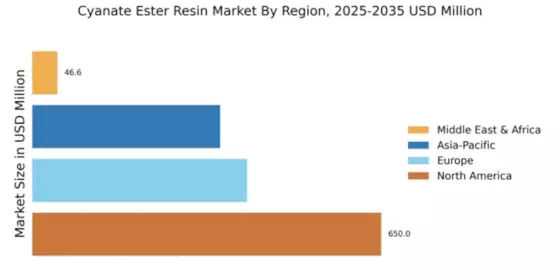
North America is poised to maintain its leadership in the cyanate ester resin market, holding a significant share of 650.0 million. The region's growth is driven by increasing demand in aerospace and automotive sectors, where lightweight and high-performance materials are essential. Regulatory support for advanced materials and sustainability initiatives further catalyze market expansion, making it a hub for innovation and development. The competitive landscape in North America is robust, featuring key players such as Hexcel Corporation, Cytec Industries Inc., and Hexion Inc. These companies are investing heavily in R&D to enhance product performance and meet stringent regulatory standards. The U.S. remains the largest market, supported by a strong manufacturing base and technological advancements, ensuring a steady supply of high-quality cyanate ester resins.

Europe : Emerging Market with Growth Potential

Europe's cyanate ester resin market is valued at 400.0 million, reflecting a growing interest in advanced composite materials across various industries. The region benefits from stringent regulations promoting lightweight materials in automotive and aerospace applications, driving demand for cyanate esters. Additionally, sustainability initiatives are pushing manufacturers to adopt eco-friendly materials, further enhancing market growth prospects. Leading countries in this region include Germany, France, and the UK, where major players like Gurit Holding AG and Royal DSM are actively involved. The competitive landscape is characterized by innovation and collaboration among companies to develop high-performance materials. The European market is expected to see increased investments in R&D, fostering advancements in cyanate ester technology.

Asia-Pacific : Rapid Growth in Emerging Economies

The Asia-Pacific region, with a market size of 350.0 million, is witnessing rapid growth in the cyanate ester resin sector. This growth is fueled by increasing industrialization and demand for high-performance materials in sectors such as electronics and automotive. Countries like China and Japan are leading the charge, supported by government initiatives aimed at enhancing manufacturing capabilities and promoting advanced materials. The competitive landscape in Asia-Pacific is evolving, with key players like Mitsubishi Chemical Corporation and Lonza Group AG making significant inroads. The region's market is characterized by a mix of established companies and emerging startups, all vying for a share of the growing demand for cyanate esters. As the market matures, investments in technology and innovation are expected to rise, further propelling growth.

Middle East and Africa : Niche Market with Growth Opportunities

The Middle East and Africa region, with a market size of 46.64 million, presents a niche opportunity for cyanate ester resins. The growth in this region is primarily driven by increasing investments in infrastructure and aerospace sectors, where high-performance materials are becoming essential. Regulatory frameworks are gradually evolving to support the use of advanced materials, which is expected to boost market demand in the coming years. Countries like South Africa and the UAE are emerging as key players in the market, with local manufacturers beginning to explore the potential of cyanate esters. The competitive landscape is still developing, but there is a growing interest from international companies looking to enter this market. As awareness of the benefits of cyanate esters increases, the region is likely to see a gradual rise in adoption and investment.

Key Players and Competitive Insights

The Cyanate Ester Resin Market is currently characterized by a dynamic competitive landscape, driven by increasing demand for high-performance materials in aerospace, automotive, and electronics sectors. Key players such as Hexcel Corporation (US), Cytec Industries Inc. (US), and Hexion Inc. (US) are strategically positioned to leverage innovation and technological advancements. Hexcel Corporation (US) focuses on enhancing its product portfolio through research and development, while Cytec Industries Inc. (US) emphasizes strategic partnerships to expand its market reach. Hexion Inc. (US) is actively pursuing mergers and acquisitions to consolidate its position, indicating a trend towards a more concentrated market structure.

The business tactics employed by these companies include localizing manufacturing to reduce lead times and optimize supply chains. The market appears moderately fragmented, with several players vying for market share. However, the collective influence of major companies is shaping a competitive environment where innovation and operational efficiency are paramount.

In November 2025, Hexcel Corporation (US) announced a partnership with a leading aerospace manufacturer to develop next-generation cyanate ester resins tailored for advanced aircraft applications. This collaboration is expected to enhance Hexcel's product offerings and solidify its position as a leader in high-performance materials, reflecting a strategic focus on innovation and customer-centric solutions.

In October 2025, Cytec Industries Inc. (US) launched a new line of eco-friendly cyanate ester resins aimed at reducing environmental impact. This initiative aligns with the growing trend towards sustainability in the materials sector, positioning Cytec as a forward-thinking player committed to environmental stewardship. The introduction of these products may attract a broader customer base seeking sustainable alternatives.

In September 2025, Hexion Inc. (US) completed the acquisition of a specialty chemicals company, enhancing its capabilities in producing advanced cyanate ester resins. This strategic move is likely to bolster Hexion's market presence and expand its technological expertise, allowing for the development of innovative solutions that meet evolving customer demands.

As of December 2025, the competitive trends in the Cyanate Ester Resin Market are increasingly defined by digitalization, sustainability, and the integration of artificial intelligence in production processes. Strategic alliances are becoming more prevalent, enabling companies to pool resources and expertise. The shift from price-based competition to a focus on innovation, technology, and supply chain reliability is evident, suggesting that future competitive differentiation will hinge on the ability to deliver high-quality, sustainable products that meet the specific needs of diverse industries.

Key Companies in the Cyanate Ester Resin Market market include

Industry Developments

The Cyanate Ester Resin Market is anticipated to expand at a CAGR of 4.71% from 2023 to 2032, reaching an estimated value of USD 2.0 billion by 2032. This growth is attributed to the increasing demand for high-performance composites in various end-use industries such as aerospace, automotive, and electronics. The rising adoption of cyanate ester resins in printed circuit boards (PCBs) and other electronic components is also driving market growth. Recent news developments in the cyanate ester resin market include the launch of new products and the expansion of production capacities by key players.

For instance, in 2023, Huntsman Corporation announced the launch of its new line of Araldite cyanate ester resins designed for high-performance composites. Additionally, in 2022, Mitsubishi Chemical Corporation announced plans to expand its cyanate ester resin production capacity in Japan to meet the growing demand from the aerospace and automotive industries.

Future Outlook

Cyanate Ester Resin Market Future Outlook

The Cyanate Ester Resin Market is projected to grow at a 4.71% CAGR from 2024 to 2035, driven by advancements in aerospace and electronics applications.

New opportunities lie in:

  • Development of high-performance composites for aerospace applications.
  • Expansion into emerging markets with tailored product offerings.
  • Investment in sustainable manufacturing processes to attract eco-conscious clients.

By 2035, the market is expected to solidify its position as a leader in advanced materials.

Market Segmentation

Cyanate Ester Resin Market End Use Outlook

  • Composite Materials
  • Adhesives
  • Coatings
  • Insulation
  • Electrical Components

Cyanate Ester Resin Market Application Outlook

  • Aerospace
  • Automotive
  • Electronics
  • Telecommunications
  • Medical

Cyanate Ester Resin Market Market Type Outlook

  • Bulk Resins
  • Specialty Resins
  • High-Performance Resins

Cyanate Ester Resin Market Curing Method Outlook

  • Thermal Curing
  • UV Curing
  • Chemical Curing
  • Room Temperature Curing

Cyanate Ester Resin Market Formulation Type Outlook

  • Prepregs
  • Liquid Resins
  • Thermosetting Resins
  • Thermoplastic Resins

Report Scope

MARKET SIZE 20241446.64(USD Million)
MARKET SIZE 20251514.81(USD Million)
MARKET SIZE 20352400.61(USD Million)
COMPOUND ANNUAL GROWTH RATE (CAGR)4.71% (2024 - 2035)
REPORT COVERAGERevenue Forecast, Competitive Landscape, Growth Factors, and Trends
BASE YEAR2024
Market Forecast Period2025 - 2035
Historical Data2019 - 2024
Market Forecast UnitsUSD Million
Key Companies ProfiledHexcel Corporation (US), Cytec Industries Inc. (US), Hexion Inc. (US), Gurit Holding AG (CH), SABIC (SA), Mitsubishi Chemical Corporation (JP), Lonza Group AG (CH), Royal DSM (NL), Huntsman Corporation (US)
Segments CoveredApplication, End Use, Formulation Type, Curing Method, Market Type
Key Market OpportunitiesGrowing demand for lightweight materials in aerospace and automotive sectors drives Cyanate Ester Resin Market opportunities.
Key Market DynamicsRising demand for lightweight materials drives innovation and competition in the cyanate ester resin market.
Countries CoveredNorth America, Europe, APAC, South America, MEA

Leave a Comment

FAQs

What is the market size of the Cyanate Ester Resin Market?

Cyanate Ester Resin Market is expected to grow with a CAGR of 4.71% in the period 2025-2035

What are the major regions contributing to the growth of the Cyanate Ester Resin Market?

The Asia-Pacific region is expected to hold the largest market share during the forecast period. The growth in this region can be attributed to the increasing demand for cyanate ester resins in the aerospace and automotive industries.

What are the key applications of Cyanate Ester Resins?

Cyanate ester resins are primarily used in high-performance composites, adhesives, coatings, and electronics. They offer excellent thermal stability, chemical resistance, and electrical insulation properties, making them suitable for demanding applications.

Who are the major competitors in the Cyanate Ester Resin Market?

Some of the key competitors in the Cyanate Ester Resin Market include BASF, Huntsman, DIC Corporation, Evonik Industries, and ICL.

What factors are driving the growth of the Cyanate Ester Resin Market?

The growth of the Cyanate Ester Resin Market is primarily driven by the increasing demand for high-performance composites in aerospace, automotive, and electronics applications. Additionally, the growing adoption of cyanate ester resins in adhesives and coatings is further contributing to market growth.

What are the challenges faced by the Cyanate Ester Resin Market?

The Cyanate Ester Resin Market faces challenges such as the high cost of raw materials, stringent environmental regulations, and competition from alternative materials. However, ongoing research and development activities are expected to address these challenges and drive market growth.

What are the opportunities for growth in the Cyanate Ester Resin Market?

Opportunities for growth in the Cyanate Ester Resin Market lie in the development of new applications in emerging industries such as renewable energy and healthcare. Additionally, advancements in technology and the introduction of bio-based cyanate ester resins are expected to create new growth avenues.

What is the forecast for the Cyanate Ester Resin Market?

Cyanate Ester Resin Market is projected to grow at a CAGR of 4.71% during the forecast period, 2025-2035

What are the key trends shaping the Cyanate Ester Resin Market?

Key trends shaping the Cyanate Ester Resin Market include the increasing demand for lightweight and durable materials in aerospace and automotive applications, the growing adoption of bio-based resins, and the development of new technologies for the production of cyanate ester resins.

What is the impact of COVID-19 on the Cyanate Ester Resin Market?

The COVID-19 pandemic led to disruptions in supply chains and a decline in demand for cyanate ester resins due to the slowdown in the aerospace and automotive industries. However, the market is expected to recover and continue its growth trajectory as economic activities resume.

Download Free Sample

Kindly complete the form below to receive a free sample of this Report

Compare Licence

×
Features License Type
Single User Multiuser License Enterprise User
Price $4,950 $5,950 $7,250
Maximum User Access Limit 1 User Upto 10 Users Unrestricted Access Throughout the Organization
Free Customization
Direct Access to Analyst
Deliverable Format
Platform Access
Discount on Next Purchase 10% 15% 15%
Printable Versions