Request Free Sample ×

Kindly complete the form below to receive a free sample of this Report

* Please use a valid business email

Leading companies partner with us for data-driven Insights

clients tt-cursor
Hero Background

Dairy Enzymes Market

ID: MRFR/FnB/3710-CR
110 Pages
Snehal Singh
Last Updated: May 28, 2026
Dairy Enzymes Market Size, Share, Industry Trend & Analysis Research Report Information By Enzyme Type (Rennet & Coagulants, Lipase, Lactase, Protease, Catalase, Others), By Application (Cheese Production, Yogurt & Fermented Milk, Milk Processing, Infant Formula & Nutrition, Ice Cream & Frozen Dairy, Whey & Dairy Ingredients), By Source (Microbial / Fermentation-Derived, Animal-Derived, Plant-Derived) –Forecast Till 2035.
Download PDF ×

We do not share your information with anyone. However, we may send you emails based on your report interest from time to time. You may contact us at any time to opt-out.


Dairy Enzymes Market Summary

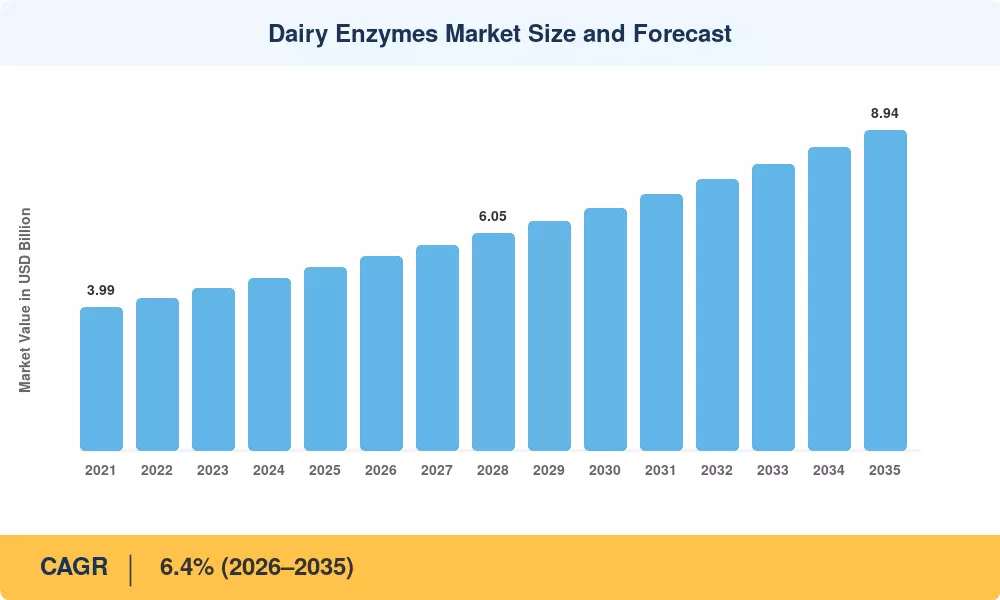
The Dairy Enzymes Market reached an estimated USD 5.12 billion in 2025 and is projected to grow from USD 5.45 billion in 2026 to USD 8.94 billion by 2035, registering a CAGR of 6.4% during 2026–2035. Two catalysts anchor this trajectory: rising global per-capita dairy consumption—up roughly 1.8% annually across developing economies [1]—and tightening food-safety regulations that push processors toward standardized enzyme dairy processing technology over traditional chemical treatments. The European Commission's updated food-enzyme authorization framework (Regulation EC 1332/2008, amended 2024) has accelerated reformulation timelines for hundreds of dairy SKUs, pulling forward capital expenditure cycles across the bloc [2].

Conventional cheesemaking and yogurt production used animal-derived coagulants and batch-level fermentation control. Today, microbial and recombinant fermentation platforms offer consistent rennet coagulation enzyme and lipase dairy taste enzyme preparations at scale, leading to dose variability reductions of up to 40% [3]. In 2024 alone, Novozymes invested more than USD 180 million in enzyme R&D, much of it in dairy applications [4]. The change of the Dairy Enzymes Market from animal-sourced to precision-fermented enzyme portfolios is the key technical transformation through 2035.


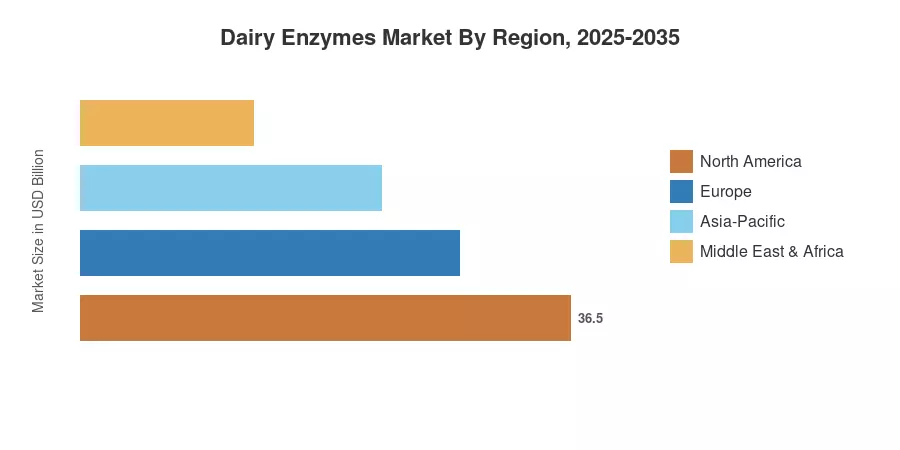
Europe holds the highest proportion of around 34% of the global revenue in the concentrated cheese and fermented-dairy market. Asia-Pacific is the fastest growing market with a predicted CAGR 8.1% driven by increasing protease dairy protein processing capacity in India and China North America represents the second-largest market of around 27%, driven by clean-label reformulation trends and the high demand for lactase cheese ripening enzyme from lactose-free dairy brands. The Dairy Enzymes Market is approaching a decade where biotechnology innovation and regulatory harmonization will jointly dictate the competitive posture.


Key Report Takeaways

• By Enzyme Type

  • Rennet and coagulants lead the Dairy Enzymes Market with an estimated 38% revenue share in 2025, reflecting cheese's dominance in global dairy value chains
  • Lipase enzymes are forecast to grow at a CAGR of 7.2% through 2035, propelled by demand for accelerated cheese ripening and specialty flavor profiles
  • Lactase preparations represent approximately USD 0.87 billion in 2025 revenue, driven by the lactose-free dairy boom

• By Application

  • Cheese production accounts for over 42% of total enzyme consumption in the Dairy Enzymes Market, far exceeding other dairy categories
  • Yogurt and fermented milk applications are projected to reach USD 1.58 billion by 2035
  • Infant formula and nutritional dairy segments show a CAGR of 7.8%, the fastest among application verticals

• By Region

  • Europe's Dairy Enzymes Market dominance stems from its ~USD 1.74 billion contribution in 2025
  • Asia-Pacific's 8.1% CAGR outpaces all other regions, with India and China as primary growth engines
  • North America maintains a 27% global share, anchored by lactase cheese ripening enzyme adoption


Market Size and Forecast (2021–2035)

MRFR's market sizing integrates bottom-up revenue estimation from enzyme manufacturers, trade-flow analysis of dairy processing inputs, and top-down cross-validation against FAO dairy production statistics and Euromonitor consumption data. Historical figures (2021–2024) are based on audited company filings and customs data; the 2025 base year blends Q1–Q3 actuals with Q4 estimates; and the forecast period (2026–2035) applies scenario-weighted CAGR modeling.
Market Size Chart
Our Impact
Enabled $4.3B Revenue Impact for Fortune 500 and Leading Multinationals
Partnering with 2000+ Global Organizations Each Year
30K+ Citations by Top-Tier Firms in the Industry
 

Driver Impact Analysis

Driver ~% Impact on CAGR Geographic Relevance Impact Timeline
Rising lactose-free dairy demand +1.4% Global Short-term (≤2 yr)
Clean-label and natural ingredient regulations +1.1% Europe, N. America Medium-term (2–4 yr)
Precision fermentation scale-up +0.9% Global Long-term (≥4 yr)
Expanding cheese consumption in Asia +0.8% Asia-Pacific Medium-term (2–4 yr)
Infant formula quality mandates +0.7% China, EU Short-term (≤2 yr)
Enzyme immobilization and recycling innovations +0.5% Global Long-term (≥4 yr)
Growing functional dairy segment +0.4% N. America, Europe Medium-term (2–4 yr)


Rising Lactose-Free Dairy Demand

Global lactose-free dairy sales surpassed USD 14 billion in 2024 and are expanding at nearly 9% annually [6]. Lactase enzyme preparations are essential for hydrolyzing lactose in milk, ice cream, and yogurt, and every new lactose-free SKU launch directly translates to incremental enzyme volumes. Valio's lactose-free technology—licensed to over 50 dairy processors worldwide—requires approximately 0.12 grams of lactase per liter of processed milk, establishing a predictable volume-consumption linkage that underpins the Dairy Enzymes Market growth floor [6].

Clean-Label and Natural Ingredient Regulations

The EU’s harmonized list of food enzymes, which is scheduled to include over 300 recognized enzyme preparations by the end of 2026, mandates that processors substitute undeclared processing aids with registered, identity-preserved enzyme products [2]. This regulatory push results in a compliance-driven replacement cycle that amounts to an estimated USD 380 million of incremental enzyme purchases across Europe alone through 2030. This trend is also seen in North America, where the U.S. FDA’s new GRAS notification procedure received 47 submissions relating to enzymes in 2024, a 62% increase year-over-year [12].


Precision Fermentation Scale-Up

Precision fermentation enables the production of animal-identical rennet coagulation enzyme proteins using engineered microbial hosts, bypassing calf-derived sources entirely. DSM-Firmenich's Maxiren XDS chymosin—produced via Aspergillus niger fermentation—already captures over 60% of the global chymosin market [7]. Production costs fell 18% between 2021 and 2024 as fermentation tank utilization rates improved. By 2030, precision-fermented enzymes are expected to represent over 75% of the total rennet supply in the Dairy Enzymes Market [7].

Expanding Cheese Consumption in Asia-Pacific

Per-capita cheese consumption in China rose from 0.1 kg in 2015 to 0.4 kg in 2024, and India's processed-cheese segment grew 14% in value terms during the same period [8]. Each kilogram of cheese requires approximately 0.03 grams of rennet and measurable quantities of lipase, dairy flavor enzyme for specialty varieties. As Asian dairy firms scale up domestic cheese production lines—Amul commissioned two new cheese plants in Gujarat in 2024—the associated enzyme demand directly expands the Dairy Enzymes Market footprint in the region [8].


Restraints Impact Analysis

Restraint impact percentages follow the same directional methodology described in Section 4. They represent headwinds that moderate the CAGR, not direct subtractions.

Restraint ~% Impact on CAGR Geographic Relevance Impact Timeline
Price sensitivity in developing markets –0.6% South America, Africa Short-term (≤2 yr)
GMO perception and labeling barriers –0.5% Europe, Japan Medium-term (2–4 yr)
Raw material cost volatility (substrates) –0.4% Global Short-term (≤2 yr)
Shelf-life limitations of liquid enzymes –0.3% Tropical regions Long-term (≥4 yr)
Regulatory approval lead times –0.3% EU, China Medium-term (2–4 yr)


Price Sensitivity in Developing Economies

In Sub-Saharan Africa and parts of South America, enzyme costs can represent 8–12% of total dairy processing input costs, compared with 3–5% in Europe, where higher throughput spreads fixed enzyme expenses [13]. Smallholder dairy processors—which account for roughly 55% of milk processing volume in East Africa—often revert to traditional rennet or acid coagulation to avoid enzyme procurement costs. This price ceiling constrains the addressable Dairy Enzymes Market in regions where dairy industrialization is still nascent.

GMO Perception and Labeling Barriers

Over 70% of commercial dairy enzymes are produced using genetically modified microorganisms, yet consumer surveys in Germany and Japan show that 45–55% of respondents prefer "non-GMO" labeled dairy products. This perception gap forces some processors to source costlier non-GM enzyme alternatives or invest in consumer education campaigns. The resulting friction slows enzyme dairy processing technology adoption, particularly for protease dairy protein processing applications in premium yogurt and infant-nutrition segments.

Regulatory Approval Lead Times

The EU’s backlog of food-enzyme authorizations, some dating back to 2015, generates uncertainty for enzyme makers looking to bring products to market [2]. In China, the 18–24 months’ CFSA registration of new food enzymes delays the market launch of innovative lipase dairy flavor enzyme and lactase cheese ripening enzyme preparations. These durations disincentivize smaller enzyme producers from applying for registrations, thereby entrenching market share among incumbents that already possess existing permits.


Opportunities

Lactose-Free and Reduced-Allergen Dairy Expansion

The lactose-free dairy segment is projected to exceed USD 22 billion by 2030, and every product extension—from lactose-free cream cheese to lactose-free condensed milk—requires dedicated lactase enzyme dosing [6]. Enzyme suppliers that co-develop application-specific lactase formulations with dairy processors can lock in long-term supply agreements. This opportunity directly strengthens the Dairy Enzymes Market by converting consumer health trends into recurring enzyme revenues

Enzyme-as-a-Service and Digital Dosing Platforms

Several enzyme manufacturers are piloting subscription-based dosing platforms that integrate IoT sensors into dairy processing lines, adjusting enzyme dosing in real time based on milk composition variability [10]. Chr. Hansen's FlexDose pilot with Arla Foods reduced enzyme waste by 22% and improved batch consistency. This data-driven model transforms enzyme sales from commodity transactions into value-added services, opening new revenue streams within the Dairy Enzymes Market

Emerging Market Dairy Industrialization

India's Operation Flood successor programs and Kenya's Dairy Board modernization initiative are channeling government subsidies toward mechanized processing, which inherently requires standardized enzyme inputs [8][13]. The Dairy Enzymes Market stands to capture incremental demand as artisanal processors convert to semi-industrial operations. Enzyme companies offering training, cold-chain solutions, and smaller packaging formats will win disproportionate share in these geographies

Plant-Based and Hybrid Dairy Applications

Cross-over enzyme applications in plant-based dairy alternatives—using protease dairy protein processing techniques to improve texture in oat-milk cheese or almond-milk yogurt—represent a nascent but fast-growing adjacency [11]. The global plant-based dairy market reached USD 25 billion in 2024, and enzyme-enabled texture improvement is a key technical differentiator. Suppliers investing in dual-application enzyme portfolios can diversify beyond traditional dairy and expand the addressable Dairy Enzymes Market

Specialty Cheese and Artisanal Flavor Differentiation

Premium cheese segments (aged Gouda, blue cheese, washed-rind varieties) command 3–5× price premiums and rely heavily on lipase dairy flavor enzyme blends and proprietary culture-enzyme combinations for flavor development [3]. As consumer willingness to pay for artisanal cheese grows—specialty cheese retail sales in the U.S. grew 11% in 2024—enzyme suppliers offering customized flavor-enzyme kits can capture higher margins


Future Outlook

Precision Fermentation and Synthetic Biology Integration

Synthetic biology platforms will enable custom-designed enzyme variants optimized for specific dairy substrates—a lactase engineered for A2 milk, or a protease tuned for camel-milk protein hydrolysis. The global synthetic biology market is projected to reach USD 45 billion by 2032 [7], and dairy enzyme customization represents a high-value niche. The Dairy Enzymes Market will increasingly segment between commodity enzyme suppliers and precision-biology innovators.

Sustainability and Carbon Footprint Reduction

Life-cycle assessments show that enzyme-assisted cheese production reduces water usage by 15–20% and CO₂ emissions by 10–12% compared with traditional acid-coagulation methods [18]. As Scope 3 reporting mandates expand—the EU's CSRD directive requires food-sector emissions disclosure by 2026—dairy processors will favor enzyme dairy processing technology that demonstrably lowers their carbon intensity. This regulatory tailwind positions enzymes as a sustainability enabler, not merely a processing input.

AI-Driven Process Optimization

Machine-learning models trained on fermentation and coagulation data are beginning to optimize enzyme dosing, timing, and temperature profiles in real-time dairy operations [10]. Novozymes' digital enzyme platform reported a 15% reduction in enzyme consumption per unit of cheese output during pilot trials with European processors. By 2030, AI-integrated enzyme dosing could become standard across Tier-1 dairy operations, reshaping the Dairy Enzymes Market toward higher-value, lower-volume enzyme preparations.

Convergence of Dairy and Alternative Protein Enzymes

The boundary between traditional dairy and alternative protein processing is blurring. Protease dairy protein processing techniques are being adapted for precision-fermented whey and casein production—companies like Perfect Day and New Culture use microbial hosts to produce dairy-identical proteins that still require enzymatic processing [11]. This convergence expands the total addressable market for dairy enzyme manufacturers willing to bridge both sectors, and it redefines the Dairy Enzymes Market beyond conventional animal-milk processing.


Market Segmentation

By Enzyme Type

Segment Key Metric Primary Demand Driver
Rennet & Coagulants ~38% share (2025) Global cheese production volumes
Lipase CAGR 7.2% Accelerated cheese ripening, flavor development
Lactase USD 0.87 B (2025) Lactose-free dairy product proliferation
Protease ~15% share (2025) Protein hydrolysis for infant formula and sports dairy
Catalase CAGR 5.1% Hydrogen peroxide removal in cold-pasteurized milk
Others (Transglutaminase, Esterase) USD 0.22 B (2025) Yogurt texture improvement, specialty applications


Rennet and coagulants anchor the Dairy Enzymes Market by enzyme type, reflecting cheese's position as the single largest dairy category by value. Microbial and fermentation-produced chymosin has largely displaced animal-derived rennet in industrial cheese production, with recombinant variants offering superior milk-clotting specificity and batch consistency [7]. The rennet coagulation enzyme segment benefits from steady 2–3% annual growth in global cheese output, providing a stable demand floor even in mature markets.

Lipase enzymes represent the fastest-growing type segment, driven by the premium cheese boom and accelerated ripening technologies that compress aging timelines from months to weeks. Italian-style cheeses (Provolone, Romano) and blue-veined varieties depend on lipase dairy flavor enzyme preparations for their characteristic sharp, piquant flavors [3]. Meanwhile, lactase preparations benefit from the structural consumer shift toward lactose-free dairy—a trend with no signs of reversal as awareness of lactose intolerance expands in Asia-Pacific and Latin American populations.

By Application

Segment Key Metric Primary Demand Driver
Cheese Production ~42% share (2025) Largest single dairy category by enzyme intensity
Yogurt & Fermented Milk CAGR 7.0% Probiotic and functional dairy trends
Milk Processing (Fluid) USD 0.67 B (2025) Lactose hydrolysis, UHT stability
Infant Formula & Nutrition CAGR 7.8% Stringent quality mandates in China and the EU
Ice Cream & Frozen Dairy ~8% share (2025) Texture optimization, lactose-free variants
Whey & Dairy Ingredients USD 0.31 B (2025) Sports nutrition, protein isolate production


Cheese production dominates the Dairy Enzymes Market by application because each kilogram of cheese requires measurable inputs of rennet coagulation enzyme, and often supplementary lipase and protease additions for flavor and texture development. The application segment is resilient to economic cycles—cheese consumption has grown every year since 2010 globally [1]. Infant formula and nutritional dairy applications show the highest growth rate, as China's GB 10765-2021 standard and the EU's Delegated Regulation 2023/589 both mandate specific protein hydrolysis levels achievable only through controlled protease dairy protein processing [9].

By Source

Segment Key Metric Primary Demand Driver
Microbial / Fermentation-Derived ~62% share (2025) Cost efficiency, scalability, halal/kosher compliance
Animal-Derived CAGR 3.2% Traditional cheese heritage, artisanal demand
Plant-Derived USD 0.18 B (2025) Niche vegetarian and organic dairy applications


Microbial and fermentation-derived enzymes command the majority of the Dairy Enzymes Market by source, reflecting three decades of industrial transition away from animal-derived preparations. Fermentation-produced enzymes offer batch-to-batch consistency, lower unit costs at scale, and inherent compliance with halal, kosher, and vegetarian labeling requirements [17]. Animal-derived enzymes retain a loyal niche in artisanal and PDO-protected cheese production where tradition mandates calf rennet, but volume growth is minimal.


Regional Market Share Analysis

Region Key Metric Primary Investment Themes
Europe ~34% global share Cheese heritage, clean-label compliance, enzyme R&D hubs
North America ~27% global share Lactose-free expansion, functional dairy, FDA GRAS pipeline
Asia-Pacific 8.1% CAGR (2026–2035) Cheese adoption, infant formula, dairy industrialization
South America USD 0.38 B (2025) Brazil-led dairy processing modernization
Middle East & Africa 5.9% CAGR (2026–2035) Halal enzyme certification, UHT processing growth
Total USD 5.12 B (2025)

The Dairy Enzymes Market exhibits clear geographic stratification, with Europe's mature cheese and fermented-dairy infrastructure sustaining its leadership while Asia-Pacific's rapid dairy industrialization drives the fastest growth rates.


Europe

Country Key Metric Key Driver
Germany ~22% of regional revenue Largest cheese producer in EU, enzyme R&D centers
France CAGR 5.8% Specialty cheese and AOC-protected varieties
Netherlands ~14% of regional revenue Global enzyme manufacturing hub (DSM-Firmenich)
Italy USD 0.19 B (2025) Mozzarella and Parmigiano-Reggiano enzyme demand
Rest of Europe ~28% of regional revenue Scandinavian functional dairy, Eastern European growth


Europe's Dairy Enzymes Market benefits from the world's highest per-capita cheese consumption—averaging 18.5 kg annually across the EU-27 [1]. Germany's enzyme procurement volumes are closely tied to its 2.4-million-tonne annual cheese output. At the same time, the Netherlands hosts the global headquarters and primary fermentation plants of DSM-Firmenich and several specialty enzyme firms. The EU's food-enzyme positive list finalization is expected to trigger a reformulation wave that will sustain enzyme demand growth through 2030 [2].

North America

Country Key Metric Key Driver
United States ~82% of regional revenue Lactose-free dairy leadership, FDA GRAS pathway
Canada CAGR 6.0% Cheese export growth, clean-label trends
Mexico USD 0.07 B (2025) Emerging processed cheese segment


The U.S. dominates North America's Dairy Enzymes Market, driven by 47 new lactase-based product launches in 2024 alone and a robust FDA GRAS notification pipeline for novel enzyme preparations [6][12]. Protease dairy protein processing applications in sports nutrition and high-protein dairy beverages are a secondary growth vector. Canada's cheese exports to Asia rose 19% in 2024, pulling enzyme demand higher in tandem [8].

Asia-Pacific

Country Key Metric Key Driver
China ~35% of regional revenue Infant formula mandates, cheese adoption
India CAGR 9.3% Dairy industrialization, Operation Flood legacy
Japan USD 0.21 B (2025) Functional dairy, probiotic yogurt enzymes
Australia & New Zealand ~12% of regional revenue Dairy export processing, ingredient-grade enzyme use
Rest of Asia-Pacific CAGR 7.5% Southeast Asian UHT dairy expansion


Asia-Pacific represents the most dynamic segment of the Dairy Enzymes Market. China's CFSA mandated stricter enzyme-purity standards for infant formula in 2023, pushing domestic producers toward imported enzyme preparations from European suppliers [9]. India's Amul and Mother Dairy collectively processed over 35 million liters of milk daily in 2024, and their shift toward enzyme-standardized processing lines creates volume-scale enzyme demand that smaller regional producers cannot yet match [8].

South America

Country Key Metric Key Driver
Brazil ~68% of regional revenue Largest dairy producer in Latin America
Argentina CAGR 6.8% Cheese exports, Mozzarella production scale
Rest of South America USD 0.04 B (2025) Emerging dairy processing


Brazil's dairy sector processed approximately 35 billion liters of milk in 2024, and enzyme adoption is accelerating as mid-size processors upgrade from artisanal to semi-industrial operations [13]. The Dairy Enzymes Market in South America remains price-sensitive. Still, government-subsidized modernization programs in Brazil's Minas Gerais dairy belt are lowering the adoption barrier for rennet coagulation enzyme and lipase dairy flavor enzyme products.

Middle East & Africa

Country Key Metric Key Driver
Saudi Arabia ~28% of regional revenue Large-scale UHT dairy operations
UAE CAGR 6.5% Premium dairy imports, halal enzyme certification
South Africa USD 0.05 B (2025) Regional dairy processing hub
Rest of MEA ~38% of regional revenue East African dairy modernization


Halal-certified enzyme preparations are a critical differentiator in the Middle East's Dairy Enzymes Market, as non-halal animal-derived rennet faces import restrictions in several GCC countries [17]. Saudi Arabia's Almarai—the world's largest vertically integrated dairy company—procured an estimated USD 28 million in enzyme inputs during 2024. East Africa's smallholder dairy modernization, supported by World Bank and IFAD programs, represents a long-term enzyme demand pool [13].


Regional Market Share
 

Competitive Benchmarking

The Dairy Enzymes Market is moderately concentrated, with an estimated top-five revenue share of 55–60% and a Herfindahl-Hirschman Index (HHI) of approximately 1,200–1,400, indicating moderate concentration. The competitive field includes global enzyme conglomerates, specialty dairy-enzyme houses, and regional manufacturers serving local dairy processors.

Company Est. Revenue Share Range Key Offerings for the Dairy Enzymes Market Strategic Positioning
Chr. Hansen (Novonesis) ~18–22% Chymosin, lipases, lactases, cultures Full dairy bioconversion portfolio, digital dosing
DSM-Firmenich ~14–18% Maxiren chymosin, Delvo-series enzymes Precision fermentation leader, sustainability focus
Novozymes (Novonesis) ~10–14% Lactozym, Lipopan, protease blends Broad enzyme platform, AI-driven process optimization
Kerry Group ~5–8% Dairy taste enzymes, protein hydrolysates Application-led solutions, clean-label positioning
Advanced Enzyme Technologies ~4–6% Lactase, lipase, protease preparations Cost-competitive manufacturing base in India
Amano Enzyme Inc. ~3–5% Specialty lipases, transglutaminase Japanese precision, niche flavor-enzyme expertise
Koninklijke DSM (legacy entities) ~2–4% Enzyme-culture co-development Integrated culture-enzyme solutions
Biocatalysts Ltd. ~1–3% Custom lipase dairy flavor enzyme blends Tailored solutions for artisanal cheese producers
Maps Enzymes Ltd. ~1–2% Rennet, lactase, protease Emerging-market cost leadership (India)
Enzyme Development Corporation ~1–2% Dairy-grade lipase, protease U.S.-focused specialty enzyme supplier


Recent News & Developments

  • Novonesis (Chr. Hansen + Novozymes merger) (January 2024): Completed the landmark merger, creating the world's largest biosolutions company, consolidating dairy enzyme portfolios under a single entity and signaling accelerated R&D investment in enzyme dairy processing technology [19].


Report Scope

Parameter Detail
Market Scope Global Dairy Enzymes Market — production, processing, and distribution of enzymes used in dairy manufacturing
Study Period 2021–2035
CAGR 6.4% (2026–2035)
Base Year Market Size USD 5.12 Billion (2025)
Forecast Endpoint USD 8.94 Billion (2035)
Fastest Growing Segment Infant Formula & Nutrition Applications (CAGR 7.8%)
Fastest Growing Region Asia-Pacific (CAGR 8.1%)
Companies Profiled 10 (Chr. Hansen/Novonesis, DSM-Firmenich, Novozymes/Novonesis, Kerry Group, Advanced Enzyme Technologies, Amano Enzyme, Koninklijke DSM, Biocatalysts, Maps Enzymes, Enzyme Development Corporation)
Valuation Currency USD (constant 2025 dollars)


FAQs

How do enzyme procurement contracts typically structure pricing for large dairy processors?

Most Tier-1 dairy companies negotiate volume-tiered contracts with 12–24-month terms, locking in unit pricing that declines 5–10% at higher volume thresholds [4]. Spot purchasing is rare among industrial buyers due to the critical role enzymes play in batch consistency.

What cold-chain requirements apply to liquid enzyme shipments in tropical climates?

Liquid enzyme preparations generally require storage at 2–8°C and lose 15–25% activity after 72 hours above 25°C [16]. Granulated and immobilized enzyme formats offer superior thermal stability, making them preferred for distribution in equatorial regions.

How does halal certification affect enzyme sourcing decisions in the Dairy Enzymes Market?

GCC import regulations require halal-certified enzyme preparations for all dairy products sold domestically, disqualifying porcine-derived lipase variants [17]. Microbial fermentation-derived enzymes inherently qualify, giving fermentation-based suppliers a structural advantage in Middle Eastern markets.

What role does transglutaminase play in yogurt manufacturing within the Dairy Enzymes Market?

Transglutaminase cross-links milk proteins to improve yogurt gel firmness and reduce syneresis without adding stabilizers [3]. Adoption is growing at 6–8% annually in Greek-style yogurt production, where clean-label texturizing is a competitive differentiator.

Can enzyme suppliers serve both traditional dairy and precision-fermented dairy clients simultaneously?

Yes—protease and lipase formulations are substrate-agnostic and function identically on microbially produced casein and whey [11]. Several Dairy Enzymes Market leaders already supply both conventional and alternative-protein manufacturers from the same production lines.

How do PDO and AOC cheese regulations limit enzyme innovation in European artisanal cheese?

Protected designation rules often mandate specific enzyme types (e.g., calf rennet for Parmigiano-Reggiano), restricting substitution with microbial alternatives [22]. This regulatory rigidity preserves a niche for animal-derived enzymes but caps innovation adoption in heritage cheese categories.

What is the typical payback period for investing in automated enzyme dosing systems in the Dairy Enzymes Market?

Automated dosing systems cost USD 80,000–250,000 depending on line throughput and typically achieve payback within 18–30 months through 15–22% enzyme waste reduction [10]. Mid-size processors with 50,000+ liters daily throughput see the fastest returns.


Author
Author
Author Profile
Snehal Singh LinkedIn
Manager - Research
High acumen in analyzing complex macro & micro markets with more than 6 years of work experience in the field of market research. By implementing her analytical skills in forecasting and estimation into market research reports, she has expertise in Packaging, Construction, and Equipment domains. She handles a team size of 20-25 resources and ensures smooth running of the projects, associated marketing activities, and client servicing.

Research Approach


Secondary Research

The secondary research process involved comprehensive analysis of regulatory databases, peer-reviewed food science journals, dairy industry publications, and authoritative health and agricultural organizations. Key sources included the US Food & Drug Administration (FDA), European Food Safety Authority (EFSA), Food and Agriculture Organization (FAO)/WHO Codex Alimentarius Commission, International Dairy Federation (IDF), American Dairy Science Association (ADSA), European Dairy Association (EDA), National Dairy Council (NDC), International Food Additives Council (IFAC), Enzyme Technical Association (ETA), Food Chemicals Codex (FCC), PubMed/NCBI (for enzymology and dairy biotechnology research), Food and Drug Law Institute (FDLI), EU Food Feed Enzymes Consortium, and national dairy associations from key markets (National Milk Producers Federation, Dairy UK, China Dairy Industry Association). These sources were used to collect enzyme approval data, GRAS (Generally Recognized as Safe) notifications, Novel Food regulatory statuses, production statistics, dairy processing technology trends, clinical studies on enzyme functionality, and market landscape analysis for carbohydrases, proteases, lipases, polymerases/nucleases, and phytases in dairy applications.


Primary Research

To gather both qualitative and quantitative information, the primary research process involved interviewing players from both the supply and demand sides. CEOs, MDs of fermentation operations, VPs of biotech research and development, heads of industrial enzyme development, and commercial directors from biotech original equipment manufacturers (OEMs), microbial fermentation firms, and specialty enzyme manufacturers were among the supply-side sources. Members of the demand side included CPOs from cheese manufacturing cooperatives and yogurt and probiotic companies, heads of research and development at infant formula companies, and directors of operations from whey processing and ice cream factories. The primary research provided evidence of market segmentation based on enzyme categories and sources, verified the timelines for the next-generation enzymatic solutions' product pipeline, and obtained insights into the following: patterns of formulation adoption, pricing strategies for bulk enzyme procurement, demand for clean-label enzymes, and regulatory compliance dynamics in dairy applications compared to plant-based alternatives.

Primary Respondent Breakdown:

By Designation: C-level Primaries (28%), Director Level (32%), Others (40%)

By Region: North America (32%), Europe (29%), Asia-Pacific (33%), Rest of World (6%)


Market Size Estimation

Global market valuation was derived through revenue mapping and volume consumption analysis across fermentation-derived and plant-derived enzyme categories. The methodology included:

Identification of 55+ key enzyme manufacturers and biotechnology firms across North America, Europe, Asia-Pacific, and Latin America

Product mapping across carbohydrase (lactase, etc.), protease, lipase, polymerase/nuclease, phytase, and other dairy enzyme categories, further segmented by source (plant-based vs. animal & microorganisms)

Analysis of reported and modeled annual revenues specific to dairy enzyme portfolios, including bulk industrial sales and specialty formulation segments

Coverage of manufacturers representing 75-80% of global market share in 2024

Extrapolation using bottom-up (dairy production volume × enzyme inclusion rates × average selling price by country/region) and top-down (manufacturer revenue validation against dairy industry procurement data) approaches to derive segment-specific valuations for cheese production, milk processing, yogurt fermentation, whey modification, ice cream manufacturing, and infant formula applications

Download Free Sample

Kindly complete the form below to receive a free sample of this Report
















