Request Free Sample ×

Kindly complete the form below to receive a free sample of this Report

* Please use a valid business email

Leading companies partner with us for data-driven Insights

clients tt-cursor
Hero Background

Brewing Enzymes Market

ID: MRFR/FnB/4870-HCR
128 Pages
Snehal Singh
Last Updated: May 30, 2026
Brewing Enzymes Market Size, Share, Industry Trend & Analysis Research Report By Enzyme Type (Amylase, Alphalase, Beta-Glucanase, Protease, Others), By Source (Microbial, Plant), By Form (Liquid, Dry), By Application (Beer, Wine), By Region (North America, Europe, Asia-Pacific, South America, Middle East & Africa) - Forecast to 2035
Download PDF ×

We do not share your information with anyone. However, we may send you emails based on your report interest from time to time. You may contact us at any time to opt-out.


Brewing Enzymes Market Summary

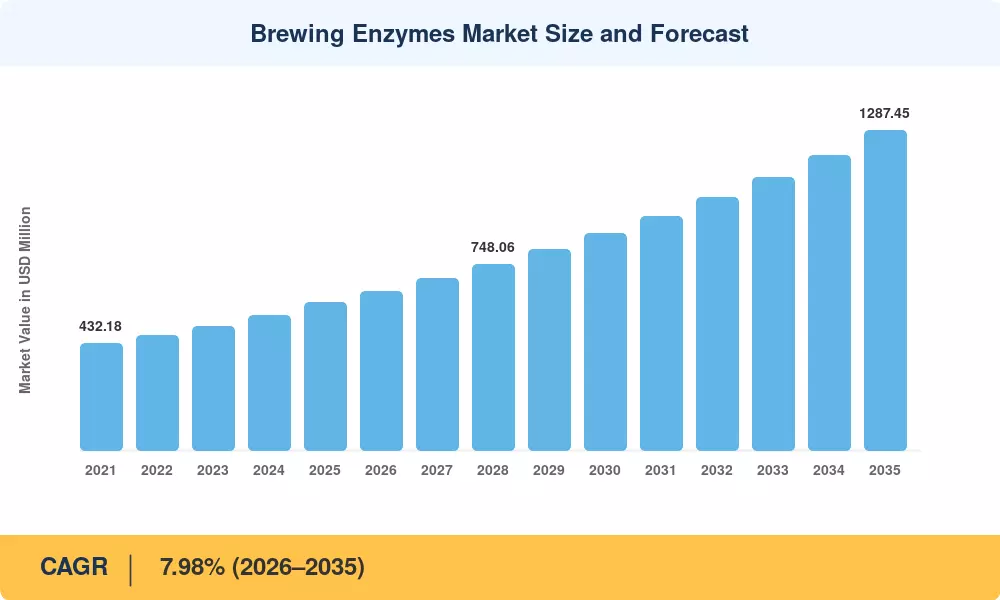
The Brewing Enzymes Market stood at an estimated USD 596.26 Million in 2025 and is projected to reach USD 641.53 Million in 2026 before climbing to USD 1,287.45 Million by 2035, registering a CAGR of 7.98% across the forecast window. This trajectory reflects a structural shift in the global beverage industry, where brewers increasingly rely on enzymatic solutions to control fermentation outcomes, cut water and energy usage, and meet tightening sustainability mandates. The European Commission's Farm to Fork Strategy, which targets a 50% reduction in chemical pesticide use by 2030, has indirectly accelerated the adoption of microbial-derived brewing enzymes as clean-label processing aids [1].

Legacy adjunct-dependent brewing processes are giving way to precision fermentation platforms that leverage tailored enzyme cocktails for amylase mashing, glucanase beer filtration, and protease wort clarity optimization. AB InBev's USD 30 Million investment in enzyme-driven water-reduction technology across 15 breweries signals the scale of capital flowing into brewing enzyme efficiency yield improvements [2]. Craft brewery enzyme application is equally reshaping the landscape, as independent operators seek consistent batch quality without the capital expense of traditional malt houses.

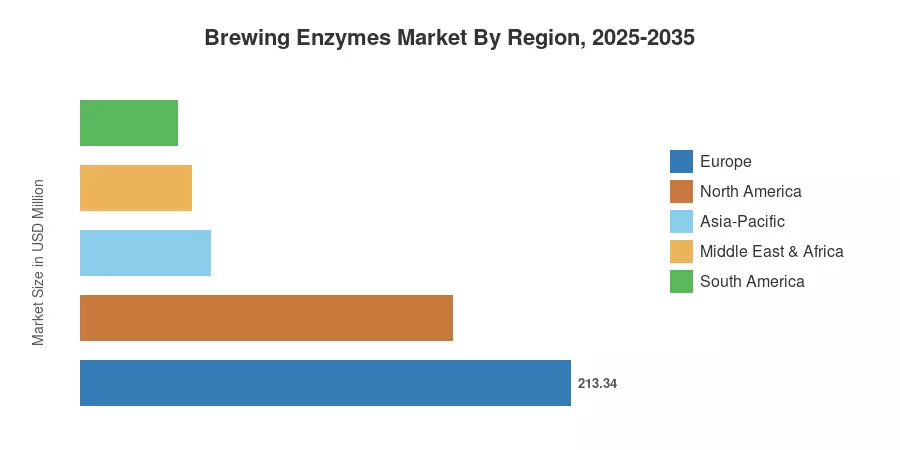
Europe captured roughly 35.78% of the Brewing Enzymes Market revenue in 2025, anchored by Germany's Reinheitsgebot-adjacent innovation corridors and Belgium's specialty ale tradition. Asia-Pacific is the fastest-growing region at a projected 9.48% CAGR through 2035, fueled by surging beer consumption across China, India, and Vietnam. North America, the second-largest region at approximately 27.14% share, benefits from the craft brewing revolution and expanding low-alcohol and gluten-free product lines The decade ahead will be defined by enzyme customization, sustainability-linked procurement, and digital fermentation monitoring.


Key Report Takeaways

• By Enzyme Type

  • Amylase mashing accounted for approximately 40.12% of the Brewing Enzymes Market in 2025, driven by its essential role in starch-to-sugar conversion during the mashing stage
  • Beta-glucanase is forecast to grow at an 8.55% CAGR through 2035, as glucanase beer filtration demands rise alongside the shift to barley-heavy grain bills
  • Protease wort clarity applications are expanding among craft brewers seeking haze-free lagers without extended cold conditioning

• By Source

  • Microbial enzymes commanded a dominant position in the Brewing Enzymes Market in 2025, with revenue exceeding USD 450 Million
  • Plant-derived enzymes are growing at a 6.92% CAGR, supported by clean-label consumer preferences in organic brewing

• By Application

  • Beer production represented the overwhelming majority of the Brewing Enzymes Market demand in 2025, underpinned by the global expansion of microbreweries and brewpubs
  • Wine enzyme applications are projected to advance at a 9.42% CAGR as winemakers adopt pectinase and glucanase formulations for juice clarification

• By Region

  • Europe held the largest regional share of the Brewing Enzymes Market, led by Germany, the UK, and France
  • Asia-Pacific is the fastest-growing region, with craft brewery enzyme application gaining rapid traction in China and India


Market Size and Forecast (2021–2035)

The estimates below integrate primary interviews with enzyme manufacturers, brewery procurement officers, and trade association databases, triangulated against customs and production data. Historical figures (2021–2024) reflect actual market performance, while the base year (2025) uses a blend of trailing twelve-month shipment data and forward purchase orders.
Brewing Enzymes Market Size and Forecast
Our Impact
Enabled $4.3B Revenue Impact for Fortune 500 and Leading Multinationals
Partnering with 2000+ Global Organizations Each Year
30K+ Citations by Top-Tier Firms in the Industry
 

Driver Impact Analysis

Driver ~% Impact on CAGR Geographic Relevance Impact Timeline
Rising global beer and alcoholic beverage consumption ~22% Global Short-term (≤2 yr)
Craft brewery and microbrewery proliferation ~19% North America, Europe Medium-term (2–4 yr)
Demand for gluten-free and low-alcohol specialty beers ~16% North America, Asia-Pacific Medium-term (2–4 yr)
Sustainability mandates and water-reduction targets ~14% Europe, Asia-Pacific Long-term (≥4 yr)
Advances in precision fermentation technology ~12% Global Long-term (≥4 yr)
Adoption of enzyme-based adjunct replacement ~10% South America, MEA Medium-term (2–4 yr)
Digital brewhouse monitoring integration ~7% North America, Europe Long-term (≥4 yr)


Rising Beer Consumption and Independent Brewery Growth

Global beer production topped 1.89 billion hectoliters in 2024, with emerging economies contributing the largest incremental volume [3]. India's beer output grew 11.2% year-over-year, while Vietnam and the Philippines each posted double-digit gains. Every new microbrewery and brewpub represents a procurement node for amylase mashing enzymes, glucanase beer filtration aids, and protease wort clarity enhancers. The Brewers Association reported 9,906 independent craft breweries operating in the United States alone by the end of 2023, up 4.8% from 2023 [5]. This decentralized production model favors enzyme-based brewing because smaller facilities lack the grain storage and kilning capacity of macro breweries, making enzymatic starch conversion the most cost-effective path to consistent wort profiles.

Specialty Beer Demand — Gluten-Free and Low-Alcohol Variants

Consumers' health-driven shift toward low-alcohol and gluten-free beer has created a high-value niche requiring sophisticated enzymatic toolkits. Prolyl endopeptidases and dedicated protease wort clarity blends are now standard in gluten-reduced brewing protocols certified below 20 ppm [6]. The global gluten-free beer segment exceeded USD 2.1 Billion in retail value in 2024, growing at roughly 9% annually. Craft brewery enzyme application in this space is accelerating as brewers seek to replicate the mouthfeel of traditional barley beers using sorghum, millet, and rice mashes that require tailored amylase mashing profiles.

Sustainability Mandates and Water-Efficiency Targets

AB InBev, Heineken, and Carlsberg have each committed to reducing water usage per hectoliter of beer by 15–25% before 2030 [2]. Enzymatic lautering and mashing processes cut water demand by enabling higher-gravity brewing followed by controlled dilution. The European Commission's revised Industrial Emissions Directive (2024) specifically encourages bioprocessing aids, positioning brewing enzyme efficiency yield optimization as a compliance tool rather than an optional input [1]. This regulatory tailwind is strong enough to sustain long-term demand growth even in mature European brewing markets.

Precision Fermentation and Enzyme Customization

Next-generation microbial expression systems — particularly engineered strains of Aspergillus niger and Trichoderma reesei — now produce enzyme cocktails with activity levels 30–40% above legacy fermentation outputs [9]. These precision fermentation platforms let suppliers tailor temperature stability, pH optima, and substrate specificity for individual brewery conditions, unlocking brewing enzyme efficiency yield gains that were previously impossible with off-the-shelf products.


Restraints Impact Analysis

Restraint ~% Negative Impact on CAGR Geographic Relevance Impact Timeline
Complex and varying food-additive regulations (FDA, USDA, EU) ~–28% Global Short-term
Price sensitivity among small-scale brewers ~–22% South America, MEA, Asia-Pacific Medium-term
Consumer perception of "chemical" processing aids ~–18% Europe, North America Long-term
Limited enzyme awareness in traditional brewing cultures ~–17% MEA, parts of Asia-Pacific Long-term
Supply-chain concentration in microbial feedstocks ~–15% Global Medium-term


Regulatory Complexity and Compliance Costs

Enzymes used in beer production face divergent regulatory pathways across jurisdictions. The U.S. FDA classifies most brewing enzymes as GRAS processing aids, while the EU requires pre-market authorization under Regulation (EC) No 1332/2008 [12]. China's GB 2760 standard imposes separate documentation for each enzyme activity claim. For global enzyme suppliers, maintaining parallel dossiers raises compliance costs by an estimated 8–12% of revenue, a burden that ultimately inflates prices for smaller buyers and slows the Brewing Enzymes Market penetration in price-sensitive regions.

Price Sensitivity in Emerging Brewery Segments

Microbreweries in South America and Southeast Asia often operate on razor-thin margins, allocating less than 2% of raw-material budgets to processing aids [13]. When commodity malt prices spike — as they did following the 2023 European drought — breweries cut enzyme spending first. This cyclical sensitivity creates volatility in craft brewery enzyme application volumes and constrains revenue growth in otherwise high-potential geographies.

Clean-Label Perception Challenges

Consumer polls suggest that 34% of craft beer drinkers in Germany and the UK connect enzymatic processing with “unnatural” production processes, despite enzymes being naturally occurring proteins. This perceived gap also diminishes the marketing power breweries may tap into with enzyme-enabled innovations such as haze-free IPAs and extended-shelf-life ales, and dampens the demand signal for protease wort clarity and glucanase beer filtration goods in premium retail channels.


Brewing Enzymes Market Opportunities

Enzyme-Enabled Gluten-Free and Functional Beer Innovation

The functional beverages trend provides a runway for enzyme formulations that enable protein enrichment, retention of prebiotic fibers, and controlled glycemic profiles in beer. By using amylase mashing in combination with new limit-dextrinase mixes, breweries can make low-glycemic beers that are attractive to diabetic and health-conscious consumers, a niche market that has yet to be tapped in the Brewing Enzymes Market


Digital Fermentation Monitoring and Enzyme Dosing Platforms

IoT-enabled brewhouse sensors paired with AI-based dosing algorithms can optimize enzyme addition in real time, reducing over-dosing by 15–20% while maintaining target wort profiles [11]. This data-driven model opens a recurring-revenue SaaS opportunity for enzyme manufacturers who bundle monitoring subscriptions with product supply, deepening customer lock-in and expanding brewing enzyme efficiency yield margins

Emerging Markets — Africa and South Asia

Sub-Saharan Africa's beer production is projected to grow at 6.5% annually through 2030, yet enzyme penetration remains below 30% of addressable volume [15]. As SABMiller legacy operations modernize under AB InBev ownership and local sorghum-based breweries scale up, the opportunity for tailored amylase mashing and glucanase beer filtration products is substantial

Enzyme Recycling and Immobilized-Enzyme Technology

Immobilized-enzyme reactor systems, in which proteases and amylases are attached to solid supports and reused across numerous batches, can lower per-batch enzyme costs by 35–45% [9]. Adoption is still early, but the technology promises to minimize the cost barrier for small-scale craft brewery enzyme use while increasing sustainability measures


Wine and Cider Enzyme Cross-Sell

Wine and cider producers share similar clarification and filtration challenges with brewers. Enzyme companies that adapt glucanase beer filtration formulations for must treatment and cider pectin degradation can access an adjacent Brewing Enzymes Market segment forecast to grow at over 9% CAGR


Brewing Enzymes Market Future Outlook

AI-Integrated Brewhouse Operations

Artificial intelligence is poised to transform enzyme dosing from a static recipe parameter into a dynamic, real-time optimization variable. By 2030, an estimated 25% of mid-to-large breweries will deploy machine-learning models that adjust amylase mashing, glucanase beer filtration, and protease wort clarity additions based on continuous wort-sensor feedback [11]. This convergence of biotech and digital technology will raise brewing enzyme efficiency yield while reducing raw material waste by 12–18%.

Sustainability Reporting and ESG-Linked Procurement

As Scope 3 emissions reporting becomes mandatory under the EU Corporate Sustainability Reporting Directive and the SEC’s climate disclosure rules, breweries are under pressure to quantify the environmental benefit of enzymatic processing over traditional options [1]. The preferred providers will be those with confirmed lifecycle-assessment data and carbon-offset certifications, changing the competitive dynamics of the Brewing Enzymes Market until 2035.


Next-Generation Enzyme Engineering

CRISPR-edited microbial strains and cell-free enzyme synthesis platforms promise to deliver enzyme products with 50–60% higher specific activity than current commercial offerings by 2032 [9]. These next-generation products will compress dosing volumes, lower freight costs, and enable dry formulation breakthroughs — accelerating the shift from liquid to powder-based enzyme delivery that already shows an 9.48% CAGR trajectory

Expansion into Adjacent Fermented Beverages

Kombucha, hard seltzer, and fermented tea jointly constitute a total addressable market of nearly USD 35 billion globally by 2030 [17]. All styles require enzymatic processing similar to that used in making traditional beer, from starch conversion to clarity. Enzyme firms that tailor craft brewery enzyme application platforms to these adjacent categories will diversify revenue and mitigate the cyclicality of dependence on the core beer segment of the Brewing Enzymes Market.


Brewing Enzymes Market Segmentation

By Enzyme Type

Segment Key Metric Primary Demand Driver
Amylase ~40.12% share (2025) Core starch-conversion role in amylase mashing
Alphalase USD 52.48 Million (2025) High-temperature liquefaction for adjunct brewing
Beta-Glucanase 8.55% CAGR Glucanase beer filtration efficiency gains
Protease USD 67.34 Million (2025) Protease wort clarity for haze-free beers
Others 6.84% CAGR Specialty enzymes for flavor modification


The Brewing Enzymes Market is anchored by amylase, which remains the highest-volume enzyme class due to its indispensable role in converting grain starch into fermentable sugars during the mashing process. Amylase mashing efficiency directly determines extract yield, making it the single most impactful enzyme input for brewery profitability. Alpha-amylase variants engineered for thermostability above 85°C now dominate the segment, enabling brewers to run high-temperature infusion mashes that cut process time by 20% [9].

Beta-glucanase represents the fastest-growing enzyme type within the Brewing Enzymes Market, driven by breweries' need to reduce wort viscosity and prevent filter blockages caused by beta-glucan carryover from undermodified barley and wheat. Glucanase beer filtration applications are particularly critical in craft brewery enzyme application settings, where small-scale plate-and-frame filters are sensitive to viscosity spikes. Protease wort clarity enzymes are gaining ground as consumer expectations for visually clear beers intensify across lager categories, and as gluten-reduction protocols require controlled proteolysis [6].

By Source

Segment Key Metric Primary Demand Driver
Microbial ~78.72% share (2025) Scalability and consistency of fermentation-derived enzymes
Plant 7.45% CAGR Clean-label and organic brewing preferences


Microbial enzymes dominate the Brewing Enzymes Market because fermentation-based production delivers standardized activity levels, batch-to-batch consistency, and the ability to engineer substrate-specific enzyme variants. Plant-derived enzymes — primarily malt-native amylases and papain — retain a loyal following among traditional European brewers and organic-certified operations that avoid bioengineered inputs.

By Form

Segment Key Metric Primary Demand Driver
Liquid ~67.94% share (2025) Ease of dosing and in-line injection compatibility
Dry 9.48% CAGR Shelf stability and lower shipping costs


Liquid enzyme formulations lead the Brewing Enzymes Market owing to their compatibility with automated dosing systems and direct-to-mash-tun injection. Dry formulations, however, are the faster-growing format as improvements in spray-drying and granulation technology preserve enzyme activity while extending shelf life beyond 24 months — a critical advantage for craft brewery enzyme application in remote or tropical locations where cold-chain logistics are unreliable [16].

By Application

Segment Key Metric Primary Demand Driver
Beer ~92.18% share (2025) Global beer production expansion
Wine 9.42% CAGR Pectinase and glucanase adoption in winemaking


Beer production accounts for the vast majority of the Brewing Enzymes Market, reflecting the sheer volume of global lager, ale, and specialty beer output. Wine enzyme applications, though smaller in absolute terms, are the fastest-growing segment as vintners adopt enzymatic must treatment for improved extraction, clarification, and filtration — applications that share enzymatic mechanisms with glucanase beer filtration and protease wort clarity solutions used in brewing


Regional Market Share Analysis

Region Key Metric Primary Investment Themes
North America ~27.14% share (2025) Craft brewery enzyme application, gluten-free innovation
Europe ~35.78% share (2025) Sustainability compliance, precision fermentation
Asia-Pacific 9.48% CAGR (2026–2035) Volume-driven growth, new brewery commissioning
South America USD 42.38 Million (2025) Adjunct brewing modernization
Middle East & Africa 8.12% CAGR (2026–2035) Sorghum-based brewing, import substitution
Total USD 596.26 Million (2025)

The Brewing Enzymes Market exhibits distinct regional dynamics shaped by brewing traditions, regulatory frameworks, and consumer taste evolution. Europe leads revenue share due to its dense concentration of established breweries and advanced enzyme adoption, while Asia-Pacific drives the fastest growth as rising disposable incomes fuel beer consumption across China, India, and Southeast Asia.


North America

Country Key Metric Key Driver
US ~78.4% of regional share Craft brewery enzyme application dominance
Canada 6.85% CAGR Growing craft and gluten-free segments
Mexico USD 12.74 Million (2025) Mass-lager enzyme modernization


The United States remains the anchor of the North American Brewing Enzymes Market, with over 10,000 craft breweries utilizing enzymatic processing aids for amylase mashing, protease wort clarity control, and adjunct sugar conversion [5]. Canada's evolving excise duty framework for small breweries incentivizes process efficiency, pushing enzyme adoption. Mexico's major lager producers — Grupo Modelo and FEMSA — have begun integrating high-temperature alpha-amylase systems to improve brewing enzyme efficiency yield in tropical brewing conditions.

Europe

Country Key Metric Key Driver
Germany ~28.6% of regional share Reinheitsgebot-adjacent innovation
UK 7.62% CAGR Cask ale revival and craft expansion
France USD 18.92 Million (2025) Wine-to-beer crossover enzyme demand
Italy 8.14% CAGR Artisanal brewing growth
Spain ~6.1% of regional share Lager modernization
Nordic Countries USD 14.58 Million (2025) Sustainability-led brewing
Russia 5.89% CAGR Import-substitution enzyme programs
Rest of Europe ~11.3% of regional share Eastern European brewery upgrades


Europe's Brewing Enzymes Market benefits from the world's most mature regulatory acceptance of enzymatic processing aids and a brewery density unmatched by any other region. The European Brewery Convention's 2024 guidelines on sustainable brewing explicitly endorse enzyme-based water reduction and energy optimization [1]. Germany's mid-size breweries increasingly pair traditional decoction mashing with targeted amylase mashing enzyme additions to lower energy consumption by 10–15% per batch, while UK craft breweries lead in protease wort clarity experimentation for New England IPA styles.

Asia-Pacific

Country Key Metric Key Driver
China ~38.2% of regional share Macro-brewery enzyme standardization
India 10.74% CAGR Microbrewery boom in metro cities
Japan USD 11.86 Million (2025) Premium happoshu and craft segments
South Korea 9.22% CAGR Low-alcohol beer enzyme innovation
ASEAN ~14.7% of regional share Vietnam and Philippines beer volume surge
Rest of Asia-Pacific 7.89% CAGR Emerging markets catch-up


Asia-Pacific is the fastest-growing region in the Brewing Enzymes Market, propelled by a 4.8% annual increase in per-capita beer consumption across the ASEAN bloc [3]. China Resources Beer and Tsingtao Brewery have invested in enzyme-driven high-gravity brewing to meet domestic demand without proportional water-use increases. India's microbrewery count surpassed 350 in 2024, with glucanase beer filtration and craft brewery enzyme application becoming standard in cities like Bengaluru, Mumbai, and Gurugram.

South America

Country Key Metric Key Driver
Brazil ~62.8% of regional share Ambev enzyme modernization programs
Argentina 7.34% CAGR Craft cervecería growth
Rest of South America USD 6.12 Million (2025) Regional adjunct-brewing upgrades


Brazil dominates the South American Brewing Enzymes Market through Ambev's scale operations, which have progressively adopted amylase mashing and protease wort clarity solutions to manage cost per hectoliter amid inflationary grain prices. Argentina's craft beer scene — concentrated in Buenos Aires and Mendoza — is a growing pocket of craft brewery enzyme application, though volume remains small relative to Brazil's industrial output.

Middle East & Africa

Country Key Metric Key Driver
Saudi Arabia 6.48% CAGR Non-alcoholic malt beverage enzyme use
UAE ~18.3% of regional share Hospitality-driven beer import processing
South Africa USD 8.94 Million (2025) SAB/AB InBev local enzyme sourcing
Egypt 7.15% CAGR Expanding licensed brewing
Rest of MEA ~29.6% of regional share Sorghum and millet-based traditional brewing


The Middle East & Africa Brewing Enzymes Market is bifurcated between non-alcoholic malt beverage processing in the Gulf states and rapidly modernizing beer production in Sub-Saharan Africa. South Africa's brewery sector — anchored by AB InBev's local operations — is the region's largest enzyme consumer, particularly for glucanase beer filtration in sorghum-based brewing [15]. Saudi Arabia's non-alcoholic malt drink industry, valued at over USD 1.2 Billion domestically, increasingly deploys amylase mashing enzymes to improve flavor consistency and brewing enzyme efficiency yield.


Brewing Enzymes Market By Region, 2025-2035
 

Competitive Benchmarking

The Brewing Enzymes Market exhibits medium concentration, with the top five players collectively holding an estimated 55–62% revenue share. The Herfindahl-Hirschman Index (HHI) for the industry falls within the 1,200–1,500 range, indicating a moderately consolidated structure dominated by global enzyme conglomerates but challenged by regional specialty formulators. Strategic differentiation centers on application-specific enzyme blends, technical service depth, and co-development partnerships with brewery R&D teams.

Company Est. Revenue Share Range Key Offerings for Brewing Enzymes Market Strategic Positioning
Novozymes (now Novonesis) ~16–20% Attenuzyme, Ultraflo, Ceremix blends Global leader in amylase mashing and glucanase beer filtration solutions
DSM-Firmenich ~12–15% Brewers Compass suite, Rapidase Integrated nutrition-enzyme platform
AB Enzymes ~8–11% Rohalase, Rohapect for brewing Mid-market specialist with strong European presence
Kerry Group ~6–9% Biobrew enzyme range Flavor-enzyme integration for craft brewery enzyme application
Soufflet Biotechnologies ~4–6% Maltogenic amylase systems Malt-house-integrated enzyme supply
BASF (Enzyme Division) ~4–6% Brewing-grade protease and amylase blends Chemical-to-bioprocessing transition strategy
Aumgene Biosciences ~2–4% Custom microbial enzyme formulations India-focused, cost-competitive positioning
Dyadic International ~2–4% C1 expression platform enzymes Next-gen enzyme engineering for brewing enzyme efficiency yield
Maps Enzymes ~2–3% Alpha-amylase and glucoamylase Indian and ASEAN regional specialist
Advanced Enzyme Technologies ~2–3% SEBrew product line Emerging-market protease wort clarity solutions


Recent News & Developments

  • Novonesis (March 2025): Launched Ceremix Flex, a next-generation multi-enzyme blend designed for high-adjunct brewing, targeting 15% improvement in brewing enzyme efficiency yield for Asian macro-breweries [Ref 9].


  • Advanced Enzyme Technologies (November 2023): Commissioned a new fermentation plant in Nashik, India, with 5,000-ton annual capacity dedicated to brewing-grade amylase mashing enzymes [Ref 21].


Brewing Enzymes Market Report Scope

Parameter Detail
Market Scope Global Brewing Enzymes Market — production, sale, and application of enzymes for beer and wine production
Study Period 2021–2035
CAGR 7.98% (2026–2035)
Market Size (2025) USD 596.26 Million
Market Size (2035) USD 1,287.45 Million
Fastest Growing Segment Dry form enzymes (9.48% CAGR); Asia-Pacific region (9.48% CAGR)
Companies Profiled 10 (Novonesis, DSM-Firmenich, AB Enzymes, Kerry Group, Soufflet Biotechnologies, BASF, Aumgene Biosciences, Dyadic International, Maps Enzymes, Advanced Enzyme Technologies)
Valuation Currency USD Million


FAQs

How do brewing enzymes affect the final flavor profile of craft beers?

Enzymes influence flavor by controlling the ratio of fermentable to non-fermentable sugars; higher amylase mashing doses produce drier, crisper beers, while reduced dosing preserves residual sweetness. Protease wort clarity enzymes also reduce chill-haze proteins that can mask hop aromatics [Ref 9].

What shelf-life considerations apply when selecting dry versus liquid Brewing Enzymes Market products?

Dry enzyme formulations typically retain over 90% activity for 24 months at ambient temperature, while liquid variants require cold storage and lose 5–10% activity annually. Craft breweries in tropical climates increasingly favor dry formats for this reason [Ref 16].

Are there viable enzyme alternatives for breweries seeking organic certification?

Plant-derived malt enzymes and papain qualify under USDA NOP and EU organic regulations as non-synthetic processing aids. These options carry lower specific activity, so brewers must increase dosing rates by 20–30% to match microbial enzyme performance [Ref 14].

How does enzyme dosing integrate with existing brewhouse automation systems?

Modern PLC-controlled brewhouses accept enzyme dosing modules that inject liquid formulations proportionally to mash volume via peristaltic pumps. Integration typically requires a one-time hardware retrofit costing USD 8,000–15,000 per vessel [Ref 11].

What is the typical payback period for switching from traditional mashing to enzyme-assisted brewing?

Most mid-size breweries report a 10–14-month payback driven by 8–12% extract yield improvement and 15% water savings. Brewing enzyme efficiency yield gains accelerate payback for operations running above 50,000 hectoliters annually [Ref 2].

How do Brewing Enzymes Market suppliers handle regulatory differences between the US and EU?

Suppliers maintain dual dossiers — FDA GRAS notifications for the US and EFSA safety assessments for the EU — adding 8–12% to compliance overhead. Companies like Novonesis and DSM-Firmenich absorb this cost at scale, while smaller players often focus on a single jurisdiction [Ref 12].

What role do Brewing Enzymes Market innovations play in non-alcoholic beer production?

Specialized amylase and glucoamylase blends enable controlled fermentation that produces <0.5% ABV beers with full mouthfeel. These enzyme systems are critical because thermal dealcoholization degrades flavor compounds that enzymes help preserve [Ref 6].


Author
Author
Author Profile
Snehal Singh LinkedIn
Manager - Research
High acumen in analyzing complex macro & micro markets with more than 6 years of work experience in the field of market research. By implementing her analytical skills in forecasting and estimation into market research reports, she has expertise in Packaging, Construction, and Equipment domains. She handles a team size of 20-25 resources and ensures smooth running of the projects, associated marketing activities, and client servicing.
Download Free Sample

Kindly complete the form below to receive a free sample of this Report
















