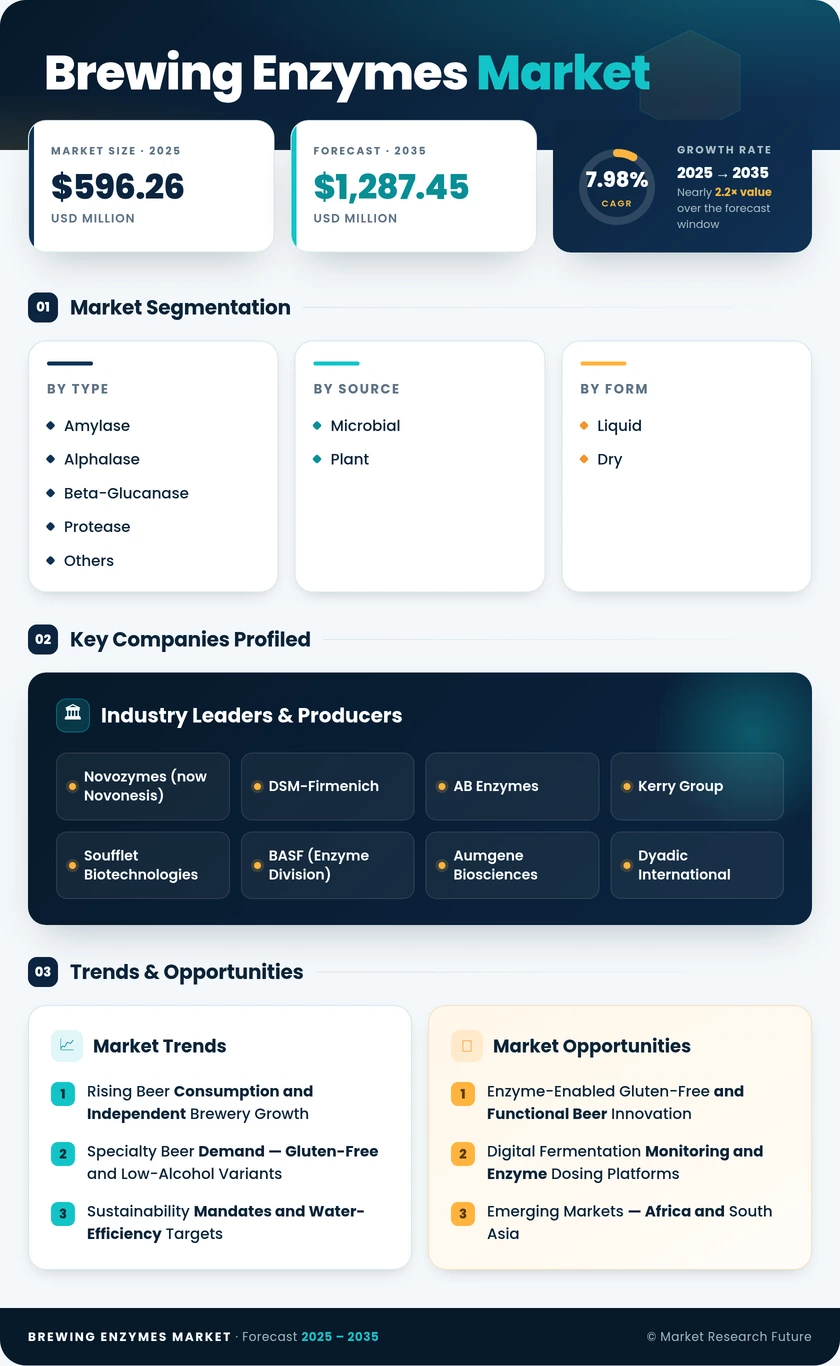
Segmentation Quick Reference
| Dimension | Sub-Segments | Dominant Segment | Fastest Growing Segment |
| Enzyme Type | Amylase, Alphalase, Beta-Glucanase, Protease, Others | Amylase | Beta-Glucanase |
| Source | Microbial, Plant | Microbial | Plant |
| Form | Liquid, Dry | Liquid | Dry |
| Application | Beer, Wine | Beer | Wine |
| Region | North America, Europe, Asia-Pacific, South America, Middle East & Africa | Europe | Asia-Pacific |
Market Segmentation Overview
By Enzyme Type
| Sub-Segment | Key Trend |
| Amylase | Thermostable alpha-amylase variants dominate; high-gravity brewing adoption rising |
| Alphalase | Industrial liquefaction applications expanding in adjunct-heavy brewing regions |
| Beta-Glucanase | Filtration efficiency gains driving adoption in craft and mid-size breweries |
| Protease | Gluten-reduction protocols and haze-free lager demand accelerating uptake |
| Others | Lipase, pullulanase, and specialty blends for flavor and foam modification |
Enzyme type segmentation reflects the functional specificity that brewers require at each stage of the production process. Amylase remains the volume leader because every brewery — regardless of size or style — depends on starch-to-sugar conversion, while beta-glucanase is the growth engine as filtration bottlenecks become the binding constraint in high-throughput brewing operations.
By Source
| Sub-Segment | Key Trend |
| Microbial | Engineered Aspergillus and Trichoderma strains delivering higher specific activity |
| Plant | Organic and clean-label positioning sustaining a niche but loyal customer base |
Microbial-source enzymes dominate because fermentation platforms scale economically and allow precise activity standardization. Plant enzymes retain relevance in heritage and organic brewing contexts where GMO-free sourcing is a regulatory or marketing requirement.
By Form
| Sub-Segment | Key Trend |
| Liquid | Preferred for automated dosing in large and mid-size brewhouses |
| Dry | Growing fastest due to shelf stability, reduced cold-chain costs, and emerging-market logistics advantages |
Form selection increasingly depends on brewery location and scale. Liquid enzymes suit automated, climate-controlled facilities, while dry formulations are gaining share in regions where cold-chain infrastructure is limited and storage conditions are variable.
By Application
| Sub-Segment | Key Trend |
| Beer | Core application spanning lager, ale, stout, and specialty styles globally |
| Wine | Pectinase and glucanase crossover from brewing driving rapid adoption in winemaking |
Beer remains the overwhelming application for brewing enzymes, but the wine segment is attracting cross-functional R&D investment as enzyme companies adapt existing filtration and clarification products for grape-must processing.
By Region
| Sub-Segment | Key Trend |
| North America | Craft brewery density and gluten-free innovation driving enzyme demand |
| Europe | Regulatory maturity and sustainability mandates sustaining the largest market |
| Asia-Pacific | Volume growth in China and India; fastest regional CAGR |
| South America | Adjunct-heavy brewing modernization led by Brazil's Ambev operations |
| Middle East & Africa | Non-alcoholic malt beverages and sorghum-based brewing creating new demand pockets |
Regional dynamics are shaped by the intersection of brewing tradition, regulatory environment, and consumer taste evolution. Europe's size advantage reflects decades of enzyme integration, while Asia-Pacific's growth rate mirrors the explosive expansion of per-capita beer consumption across developing economies.