Data Management Platform Market (2026 - 2035)

Data Management Platform Market Size, Share and Research Report By Functionality (First-Party Data, Second-Party Data, Third-Party Data), By Data Source (Web Analytics Tools, Mobile Web and Apps, CRM Data, POS Data, Social Networks), By Deployment (Cloud, On-Premise), By Enterprise Size (Large Enterprises, SMEs), By Industry Vertical (Retail and E-Commerce, Media and Entertainment, Healthcare and Pharma, BFSI, Travel and Hospitality, Others) and By Regional (North America, Europe, South America, Asia Pacific, Middle East and Africa) - Industry Forecast to 2035.
ID: MRFR/ICT/3154-CR
100 Pages
Apoorva Priyadarshi, Shubham Munde
Last Updated: July 02, 2026
Data Management Platform Market
Market Size
Forecast Period2026-2035
CAGR (2026-2035)12.6%
2025 Market SizeUSD 2.76 Billion
2035 Market SizeUSD 9.15 Billion
Key Players
Oracle
Salesforce
Adobe
Lotame
The Trade Desk
LiveRamp
Opportunities
  • Healthcare and Pharmaceutical Vertical Expansion
  • Emerging Market Digital Advertising Growth
  • Data Clean Room and Secure Collaboration Revenue Streams

Data Management Platform Market Summary

The Data Management Platform Market reached USD 2.76 billion in 2025 and is projected to grow from USD 3.14 billion in 2026 to USD 9.15 billion by 2035, registering a CAGR of 12.6% during the forecast period (2026–2035). Tightening data privacy legislation — including GDPR enforcement actions that exceeded EUR 2.1 billion in cumulative fines through 2024 and the phased deprecation of third-party cookies across major browsers — has pushed enterprises toward unified, consent-driven data architectures [1]. These regulatory catalysts, combined with retail media networks generating an estimated USD 45 billion in global ad spend by 2024, have turned the Data Management Platform Market into a critical infrastructure category for data-driven marketing and analytics [2].

Legacy tag-management and siloed analytics stacks are giving way to composable, API-first orchestration layers powered by embedded machine learning. Cloud-native platform spending across advertising technology alone surpassed USD 12 billion globally in 2024, reflecting the industry's decisive shift toward elastic, real-time decisioning environments [3]. Organizations now consolidate audience activation, identity resolution, and consent management within a single platform rather than stitching together point solutions.

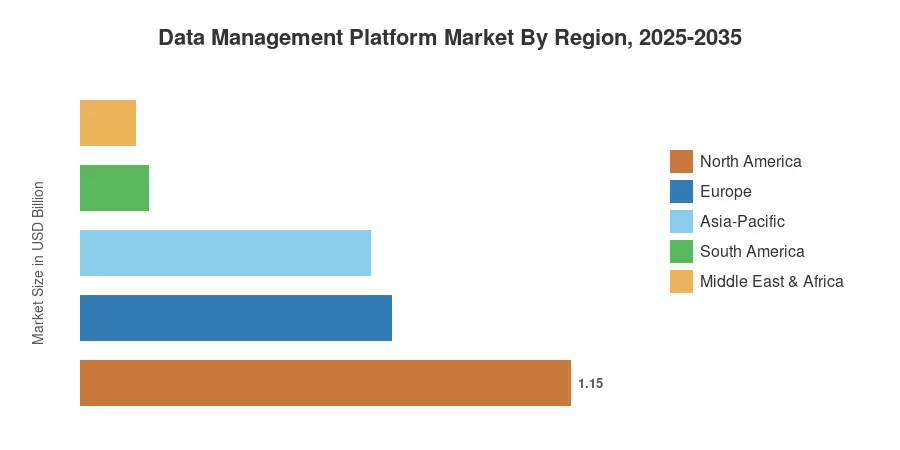
North America held 41.6% of the Data Management Platform Market in 2025, anchored by the United States' mature programmatic advertising ecosystem and stringent state-level privacy statutes. Asia-Pacific is the fastest-growing region at a 24.8% CAGR through 2035, driven by expanding digital advertising budgets across India, Southeast Asia, and China [4]. Europe accounted for the second-largest share at 26.3%, buoyed by GDPR-aligned platform investments. The Data Management Platform Market is set to benefit from 5G rollouts, edge computing adoption, and the growing monetization of consented first-party data assets through the balance of this decade.


Key Report Takeaways

• By Functionality

  • First-party data modules captured 49.2% of the Data Management Platform Market revenue in 2025, reflecting enterprises' pivot to owned audience data amid cookie deprecation.
  • Second-party data capabilities are expanding at a CAGR of 18.2% through 2035, powered by data clean rooms and secure collaboration partnerships.

• By Deployment

  • Cloud-based delivery models held a 74.5% share of the Data Management Platform Market in 2025, driven by scalability requirements for real-time audience activation.


• By Enterprise Size


  • SMEs posted the fastest growth at a 16.4% CAGR, as self-service platforms lowered adoption barriers.

• By Region

  • North America generated USD 1.15 billion in 2025 Data Management Platform Market revenue, sustained by advanced programmatic ecosystems.
  • Asia-Pacific is advancing at a 24.8% CAGR through 2035, the fastest among all regions.


Market Size and Forecast (2021–2035)

Market Research Future employs a triangulated methodology combining top-down industry sizing, bottom-up vendor revenue aggregation, and secondary validation through regulatory filings and advertising expenditure databases. Historical figures reflect verified platform subscription revenues, professional services, and managed data activation fees. Forecast estimates incorporate macroeconomic indicators, digital advertising spend trajectories, and privacy regulation adoption curves.
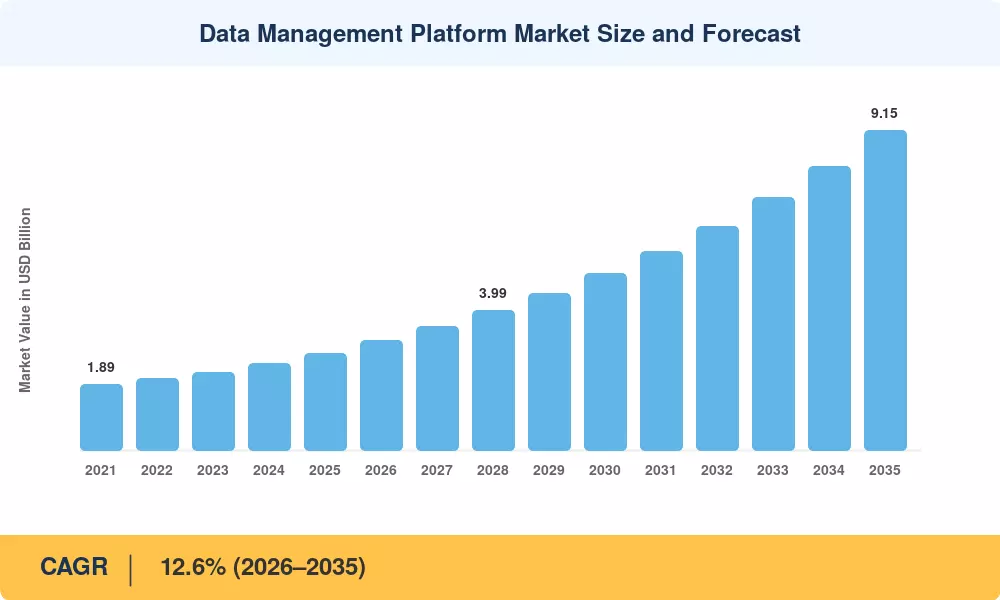
Data Management Platform Market Size and Forecast
Our Impact
Enabled $4.3B Revenue Impact for Fortune 500 and Leading Multinationals
Partnering with 2000+ Global Organizations Each Year
30K+ Citations by Top-Tier Firms in the Industry

Driver Impact Analysis

Driver ~% Impact on CAGR Geographic Relevance Impact Timeline
Privacy regulation enforcement ~18% Global Short-term (≤2 yr)
Third-party cookie deprecation ~16% North America, Europe Short-term (≤2 yr)
Retail media network expansion ~14% North America, Asia-Pacific Medium-term (2–4 yr)
AI/ML-embedded personalization ~15% Global Medium-term (2–4 yr)
5G and edge computing rollouts ~12% Asia-Pacific, MEA Long-term (≥4 yr)
Data clean room adoption ~13% North America, Europe Medium-term (2–4 yr)
Healthcare digital transformation ~12% Global Long-term (≥4 yr)


Privacy Regulation Enforcement

GDPR enforcement actions surpassed EUR 4.2 billion cumulatively by early 2025, while the California Privacy Rights Act and Virginia Consumer Data Protection Act created a patchwork of state-level mandates in the United States [1]. These regulations compel enterprises to adopt consent-orchestration platforms capable of managing opt-in preferences across jurisdictions in real time. The Data Management Platform Market directly benefits as compliance costs for manual data governance outstrip subscription fees for automated, policy-aware platforms.

Third-Party Cookie Deprecation

Roughly 65% of all browser traffic worldwide is impacted by Google's phased Chrome cookie restrictions, which expand on earlier blocks by Safari and Firefox [7]. Only technologies that consolidate first-party signals, such as CRM, POS, and authenticated online traffic, can bridge the basic infrastructure gap faced by advertisers who rely on cookie-based audience targeting. Perhaps the most significant driver of the data management platform market between 2025 and 2028 will be this structural change.


Retail Media Network Expansion

Retail media ad spending reached approximately USD 45 billion globally in 2024, with Amazon, Walmart, and emerging networks in APAC monetizing first-party shopper data as a standalone business line [2]. These networks require platform infrastructure for ingesting high-velocity transaction data, building deterministic shopper graphs, and activating audiences across off-site channels. The Data Management Platform Market is evolving to serve as the orchestration backbone for this rapidly commercializing data supply chain.

AI and Machine Learning Integration

Embedded ML services — including lookalike modeling, predictive lifetime value scoring, and real-time bid optimization — now appear in over 70% of enterprise-tier platform deployments [8]. estimated that AI-augmented marketing technology spending exceeded USD 8.5 billion in 2024, and the Data Management Platform Market captures a meaningful share of this wallet as vendors embed predictive analytics directly into their core offerings rather than relying on external model-serving infrastructure.


Restraints Impact Analysis

Restraint ~% Drag on CAGR Geographic Relevance Impact Timeline
Data sovereignty and localization mandates ~−8% Europe, Asia-Pacific Short-term (≤2 yr)
Integration complexity with legacy martech ~−7% Global Medium-term (2–4 yr)
Talent shortage in data engineering ~−5% North America, Europe Long-term (≥4 yr)
Vendor lock-in concerns ~−6% Global Medium-term (2–4 yr)
Economic uncertainty and ad-spend volatility ~−4% Global Short-term (≤2 yr)


Data Sovereignty and Localization Mandates

Countries including India, Indonesia, and Russia have enacted data localization requirements that force multinationals to maintain regionally partitioned infrastructure [16]. For the Data Management Platform Market, these mandates increase deployment costs by 15–25% for cross-border advertisers who must replicate platform instances in multiple jurisdictions rather than operating a single global tenant.

Integration Complexity with Legacy Martech

Enterprises operating five-to-seven-year-old marketing technology stacks face integration timelines of 6–12 months when migrating to modern platforms [17]. Middleware licensing, custom API development, and organizational change management create friction that slows net-new platform adoption. A 2024 survey found that 43% of marketing leaders cited integration difficulty as the primary barrier to consolidating their audience data infrastructure.

Talent Shortage in Data Engineering

The addressable buyer base of the Data Management Platform Market is limited by the worldwide scarcity of data engineers and privacy-certified analytics specialists [18]. University pipeline production is still insufficient, despite the U.S. Bureau of Labor Statistics projecting a 35% growth in data-related employment through 2032. Managed services, which have a higher total cost of ownership, are the default option for organizations lacking internal knowledge.


Data Management Platform Market Opportunities

Healthcare and Pharmaceutical Vertical Expansion

Healthcare and pharma represent the fastest-growing vertical for the Data Management Platform Market at a 19.1% CAGR through 2035 [11]. HIPAA-compliant platform modules that ingest EHR-derived insights while maintaining patient anonymity open a USD 1.2 billion incremental opportunity. Pharmaceutical companies seeking HCP targeting and patient journey mapping are rapidly adopting privacy-safe activation workflows.

Emerging Market Digital Advertising Growth

Between 2022 and 2024, digital ad expenditure in Southeast Asia, Latin America, and the Middle East increased by more than 20% per year [4]. Advertisers need platform skills that have hitherto been centred in Western Europe and North America as programmatic infrastructure develops in these areas. The market for data management platforms has the potential to meet this emerging need, especially in Brazil and India, where mobile-first consumers predominate.


Data Clean Room and Secure Collaboration Revenue Streams

Data clean rooms — secure environments where multiple parties run joint analytics without exposing raw data — generated approximately USD 500 million in technology spending in 2024 [13]. Platform vendors that embed clean room functionality into their core offering position themselves as neutral data collaboration intermediaries, creating recurring SaaS revenue streams beyond traditional advertising use cases. This convergence reshapes the Data Management Platform Market's competitive boundaries.

Connected TV and Cross-Device Identity Resolution

CTV ad spending surpassed USD 30 billion in the United States in 2024, yet audience measurement across streaming, mobile, and desktop remains fragmented [14]. Platforms that deliver deterministic cross-device identity graphs gain preferential access to premium CTV inventory, a dynamic that rewards Data Management Platform Market vendors investing in household-level identity resolution.

Monetization of Consented First-Party Data Assets

Publishers and retailers sitting on large consented audience pools increasingly view their data as a monetizable asset class [2]. Platform vendors enabling data licensing, audience extension, and private marketplace creation allow these enterprises to generate incremental revenue from their data. This "data-as-a-product" trend extends the Data Management Platform Market's value proposition well beyond traditional media buying.


Data Management Platform Market Future Outlook

AI-Native Platform Architecture

By 2028, the majority of enterprise-tier data management platforms will operate on AI-native architectures where machine learning models are embedded at the data-ingestion layer rather than bolted on as post-processing modules [8]. This shift reduces activation latency from hours to milliseconds, enabling real-time bid decisioning and dynamic creative optimization directly within the Data Management Platform Market's core workflow. Projects that AI-augmented marketing spend will exceed USD 107 billion globally by 2028, with platform infrastructure capturing roughly 12% of that total [15].

Privacy-Enhancing Technologies as a Competitive Moat

Federated learning, differential privacy, and homomorphic encryption are transitioning from research concepts to production-grade features within commercial platforms [13]. Vendors that operationalize these privacy-enhancing technologies will capture regulated verticals — financial services, healthcare, government — that remain largely underserved by the Data Management Platform Market today. The World Economic Forum estimates that privacy-tech investment exceeded USD 2.4 billion in 2024 and is doubling every 18 months.

Platform Consolidation and the CDP-DMP Convergence

The boundary between customer data platforms and data management platforms continues to blur as enterprises demand a single system of record for both known and anonymous audiences [9]. Acquisitions and product mergers between 2024 and 2026 have already reduced the number of independent pure-play vendors. By 2030, the Data Management Platform Market will likely operate as a sub-layer within broader customer intelligence suites, with standalone offerings persisting primarily in mid-market and publisher-focused segments.

Sustainability and ESG Data Governance

Growing ESG reporting requirements, including the SEC's climate disclosure regulations and the EU's Corporate Sustainability Reporting Directive, are broadening the meaning of "data management" beyond marketing [19]. Adjacent budgets will be unlocked by platforms that expand their governance frameworks to manage social impact indicators, supply chain traceability measurements, and carbon footprint data. Because of its orchestration features, the Data Management Platform Market can work as a cross-functional data centre instead of just a marketing tool.


Data Management Platform Market Segmentation

By Functionality

Segment Metric Primary Demand Driver
First-Party Data 49.2% share (2025) Cookie deprecation and owned data strategies
Second-Party Data 18.2% CAGR (2026–2035) Data clean room partnerships
Third-Party Data USD 0.58 Billion (2025) Programmatic audience extension


First-party data modules dominate the Data Management Platform Market because enterprises increasingly treat owned audience information as a strategic asset rather than a by-product of digital operations. The deprecation of third-party cookies has accelerated this shift, driving demand for platforms that ingest CRM records, authenticated web sessions, and loyalty program data into unified identity graphs. Second-party data capabilities are surging as clean room technology matures, enabling retailers, publishers, and advertisers to collaborate on joint analytics without exposing raw personal data.

By Data Source

Segment Metric Primary Demand Driver
Web Analytics Tools 33.0% share (2025) Established digital measurement infrastructure
Mobile Web and Apps 16.9% CAGR (2026–2035) App commerce and mobile-first markets
CRM Data USD 0.42 Billion (2025) Sales-marketing alignment mandates
POS Data 14.5% CAGR (2026–2035) Retail media monetization
Social Networks USD 0.22 Billion (2025) Influencer analytics and social commerce


Web analytics tools remain the top data source feeding into the Data Management Platform Market, reflecting their entrenched position in enterprise martech stacks. Mobile web and app data, however, is the fastest-growing source as smartphone penetration deepens across emerging economies and app-commerce spend outpaces desktop. POS data integration is gaining traction rapidly as brick-and-mortar retailers seek to close the measurement loop between online campaigns and in-store transactions.

By Deployment

Segment Metric Primary Demand Driver
Cloud 74.5% share (2025) Scalability and real-time processing requirements
On-Premise USD 0.70 Billion (2025) Regulated industries with data residency mandates


Cloud delivery overwhelmingly dominates the Data Management Platform Market, driven by the need for elastic compute during peak campaign periods and seamless integration with cloud-native advertising exchanges. On-premise deployments persist in financial services and defense-adjacent verticals where data residency mandates prohibit public cloud storage of personally identifiable information.

By Enterprise Size

Segment Metric Primary Demand Driver
Large Enterprises 67.8% share (2025) Complex multi-channel activation needs
SMEs 16.4% CAGR (2026–2035) Self-service platform democratization


Large enterprises command the bulk of the Data Management Platform Market due to their sprawling data estates, multi-brand portfolio requirements, and willingness to invest in custom integrations. SMEs represent the higher-growth segment as vendors introduce self-service tiers with pre-built connectors, usage-based pricing, and no-code audience builders that lower adoption barriers significantly.

By Industry Vertical

Segment Metric Primary Demand Driver
Retail and E-Commerce 28.0% share (2025) Omnichannel personalization and retail media
Media and Entertainment USD 0.47 Billion (2025) Audience monetization and subscription churn reduction
Healthcare and Pharma 19.1% CAGR (2026–2035) HIPAA-compliant HCP targeting
BFSI USD 0.34 Billion (2025) Fraud detection and cross-sell analytics
Travel and Hospitality 15.8% CAGR (2026–2035) Dynamic pricing and loyalty data activation
Others USD 0.28 Billion (2025) Government, education, automotive


Retail and e-commerce lead the Data Management Platform Market's vertical mix because retailers generate massive volumes of transactional and behavioral data that directly fuel audience activation and retail media revenue streams. Healthcare and pharma are the fastest-growing vertical as pharmaceutical companies adopt privacy-safe platforms for HCP engagement, clinical trial recruitment targeting, and patient journey analytics under strict regulatory guardrails [11].


Regional Market Share Analysis

Region Metric Primary Investment Themes
North America 41.6% share (2025) Programmatic maturity, state privacy laws, retail media
Europe 26.3% share (2025) GDPR compliance, cross-border data governance
Asia-Pacific 24.8% CAGR (2026–2035) Mobile advertising scale, 5G deployment
South America USD 0.16 Billion (2025) E-commerce digitization, fintech data growth
Middle East & Africa USD 0.13 Billion (2025) Smart city initiatives, telecom data monetization
Total USD 2.76 Billion (2025)

The Data Management Platform Market exhibits a clear transatlantic concentration, with North America and Europe collectively commanding nearly 68% of 2025 revenue. Asia-Pacific is the fastest-growing region, driven by mobile-first economies and rapid digitization of advertising infrastructure.


North America

Country Metric Key Driver
United States 82.4% of regional share Programmatic ad ecosystem and CCPA compliance
Canada 10.6% CAGR (2026–2035) PIPEDA modernization and retail media
Mexico USD 0.03 Billion (2025) E-commerce growth and fintech data activation


The United States anchors the Data Management Platform Market in North America, home to the world's largest programmatic exchanges, the most advanced retail media networks, and an evolving state-level privacy patchwork that incentivizes sophisticated consent management. Canada's modernization of federal privacy law through Bill C-27 is catalyzing enterprise DMP adoption among mid-market retailers and financial institutions [1].

Europe

Country Metric Key Driver
Germany 22.1% of regional share Automotive and industrial advertising digitization
United Kingdom 11.8% CAGR (2026–2035) Post-Brexit data adequacy framework
France USD 0.09 Billion (2025) Luxury retail and media conglomerate adoption
Italy 9.8% CAGR (2026–2035) Fashion and tourism data monetization
Spain USD 0.05 Billion (2025) Digital banking and telco partnerships
Nordic Countries 10.4% CAGR (2026–2035) Advanced consent culture and publisher coalitions
Russia USD 0.02 Billion (2025) Localized platform mandates
Rest of Europe 18.5% of regional share Multi-market privacy harmonization


GDPR continues to shape the European Data Management Platform Market, where consent-first architectures are table stakes rather than differentiators [1]. Germany's automotive sector is investing heavily in first-party data strategies as OEMs seek to build direct consumer relationships, while the UK's evolving data adequacy framework post-Brexit positions London as a testing ground for cross-jurisdictional data sharing models.

Asia-Pacific

Country Metric Key Driver
China 34.7% of regional share Super-app ecosystems and walled-garden data
India 28.6% CAGR (2026–2035) Mobile-first advertising and UPI-linked commerce
Japan USD 0.07 Billion (2025) Brand safety emphasis and publisher consolidation
South Korea 14.2% CAGR (2026–2035) K-content global export and audience analytics
ASEAN 26.1% CAGR (2026–2035) E-commerce hyper-growth across Indonesia, Vietnam
Rest of Asia-Pacific USD 0.03 Billion (2025) Government digitization programs


Asia-Pacific's explosive growth in the Data Management Platform Market stems from a convergence of mobile commerce adoption, rapidly expanding digital advertising budgets, and government-led digitization programs [4]. India's Digital Personal Data Protection Act, enacted in 2023, is creating a compliance-driven upgrade cycle similar to GDPR's effect in Europe, while China's platform ecosystem — dominated by Alibaba, Tencent, and ByteDance — generates proprietary data volumes that demand enterprise-grade management infrastructure.

South America

Country Metric Key Driver
Brazil 62.5% of regional share LGPD enforcement and fintech data ecosystems
Argentina 13.8% CAGR (2026–2035) Digital advertising formalization
Rest of South America USD 0.03 Billion (2025) Cross-border e-commerce growth


Brazil's Lei Geral de Proteção de Dados (LGPD) enforcement has compelled major retailers and financial institutions to invest in structured data platforms, making the country the anchor of the South American Data Management Platform Market [16]. Fintech firms operating across Brazil and Argentina are early movers in leveraging platform infrastructure for credit-scoring audience data.

Middle East & Africa

Country Metric Key Driver
Saudi Arabia 28.3% of regional share Vision 2030 digital advertising transformation
UAE 15.6% CAGR (2026–2035) Smart city and tourism data monetization
South Africa USD 0.02 Billion (2025) POPIA compliance-driven platform adoption
Egypt 14.2% CAGR (2026–2035) Mobile-first youth demographic
Rest of MEA 26.4% of regional share Telecom operator data partnerships


Saudi Arabia's Vision 2030 initiative has channeled significant investment into digital infrastructure, including advertising technology platforms that enable government tourism boards and retail conglomerates to activate audience data at scale. The UAE's position as a regional media hub sustains the Data Management Platform Market through demand from multinational advertisers targeting affluent audiences across the Gulf Cooperation Council [4].


Data Management Platform Market By Region, 2025-2035

Competitive Benchmarking

The Data Management Platform Market exhibits medium concentration, with the top five vendors estimated to hold 38–46% of global revenue. The Herfindahl-Hirschman Index falls in the moderately competitive range, reflecting a mix of enterprise-scale incumbents and agile pure-play specialists. Competitive dynamics remain fluid as CDP vendors expand into DMP territory and advertising technology conglomerates bundle platform capabilities into broader suites.

Company Est. Revenue Share Range Key Offerings Strategic Positioning
Oracle ~8–12% Oracle Data Cloud, BlueKai DMP, Moat Analytics Full-stack advertising and data cloud integration
Salesforce ~7–11% Audience Studio, Data Cloud, Marketing Cloud CRM-centric unified audience activation
Adobe ~6–10% Audience Manager, Real-Time CDP, Experience Platform Creative-to-activation workflow integration
Lotame ~5–8% Panorama ID, Data Exchange, Curation Platform Independent, cookieless identity focus
The Trade Desk ~4–7% Unified ID 2.0, Koa AI, Open Internet Platform Demand-side programmatic and open web advocacy
LiveRamp ~4–7% RampID, Data Collaboration Platform, Clean Room Identity resolution and secure collaboration
Nielsen ~3–6% Nielsen ONE, Marketing Cloud, Audience Segments Media measurement and cross-platform reach
Permutive ~2–4% Edge-Processing DMP, Publisher Platform, Cohort Engine Privacy-first, on-device processing
Cloudera ~2–4% Cloudera Data Platform, Machine Learning, Data Hub Hybrid cloud big-data and ML infrastructure
OnAudience ~1–3% Global Data Marketplace, Audience Analytics, Taxonomy Data marketplace and taxonomy standardization


Recent News & Developments


  • Salesforce (November 2024): Expanded Data Cloud with zero-copy data sharing for Snowflake and Databricks environments, reducing integration timelines for the Data Management Platform Market by up to 60% [9].


  • Adobe (March 2025): Integrated federated machine learning into Audience Manager, allowing pharmaceutical clients to run HIPAA-compliant lookalike models without transferring patient data [11].
  • LiveRamp (April 2025): Partnered with Carrefour to build a European retail media clean room, processing over 50 million consented shopper profiles [13].
  • Lotame (June 2024): Released Panorama ID 3.0 with deterministic-probabilistic hybrid matching, reaching 4.2 billion device IDs globally [14].
  • European Data Protection Board (February 2025): Published guidelines on DMP compliance under the Digital Markets Act, clarifying consent requirements for audience data sharing between gatekeepers and advertisers [1].


Data Management Platform Market Report Scope

Parameter Details
Market Scope Global Data Management Platform Market by Functionality, Data Source, Deployment, Enterprise Size, Industry Vertical, and Geography
Study Period 2021–2035
CAGR 12.6% (2026–2035)
Base Year Market Size USD 2.76 Billion (2025)
Forecast Endpoint USD 9.15 Billion (2035)
Fastest Growing Segment Healthcare and Pharma (by vertical); Second-Party Data (by functionality)
Companies Profiled Oracle, Salesforce, Adobe, Lotame, The Trade Desk, LiveRamp, Nielsen, Permutive, Cloudera, OnAudience
Valuation Currency USD Billion


FAQs

How should enterprises evaluate vendor lock-in risk when selecting a data management platform?
Prioritize platforms offering open APIs, portable data schemas, and multi-cloud deployment options. Contractual data portability clauses and published SLA exit terms provide additional safeguards against switching costs [9].
What total cost of ownership should mid-market companies expect for a cloud-deployed platform?
Mid-market deployments typically range from USD 120,000 to USD 350,000 annually, including platform licensing, integration, and managed services. Self-service tiers with usage-based pricing can reduce this by 40–60% [12].
How do data clean rooms differ from traditional data management platform functionality?
Clean rooms enable multi-party analytics on combined datasets without exposing raw records, whereas traditional platforms focus on single-tenant audience activation. Many vendors now embed clean room modules directly into their platform [13].
Which privacy-enhancing technologies are most relevant for the Data Management Platform Market?
Federated learning and differential privacy are the most production-ready options, enabling model training and audience insights without centralizing personal data. Homomorphic encryption remains promising but carries computational overhead [19].
How does connected TV integration affect platform selection criteria?
CTV demands deterministic household-level identity graphs and real-time frequency capping across devices. Platforms lacking native CTV connectors force advertisers into fragmented measurement workflows [14].
What role do data management platforms play in retail media network operations?
They serve as the ingestion and activation backbone, unifying shopper transaction data with online behavioral signals to build addressable audience segments for off-site media monetization [2].
How are healthcare and pharma companies addressing regulatory barriers to platform adoption?
HIPAA-compliant modules using tokenized patient identifiers and on-premise processing enclaves allow pharma firms to activate HCP audiences without exposing protected health information [11].    
Author
Author
Author Profile
Apoorva Priyadarshi LinkedIn
Research Analyst
With 4+ years of experience in Market Intelligence and Strategic Research, Apoorv specializes in ICT, Semiconductor, and BFSI markets. Combining strong analytical capabilities with a deep understanding of technology-driven industries, he focuses on delivering data-driven insights that support strategic decision-making. With a background in technology and business research, Apoorv has contributed to numerous global market studies, competitive landscape analyses, and opportunity assessments across sectors such as semiconductors, digital banking, cybersecurity, and telecommunications.
Co-Author
Co-Author Profile
Shubham Munde LinkedIn
Team Lead - Research
Shubham brings over 7 years of expertise in Market Intelligence and Strategic Consulting, with a strong focus on the Automotive, Aerospace, and Defense sectors. Backed by a solid foundation in semiconductors, electronics, and software, he has successfully delivered high-impact syndicated and custom research on a global scale. His core strengths include market sizing, forecasting, competitive intelligence, consumer insights, and supply chain mapping. Widely recognized for developing scalable growth strategies, Shubham empowers clients to navigate complex markets and achieve a lasting competitive edge. Trusted by start-ups and Fortune 500 companies alike, he consistently converts challenges into strategic opportunities that drive sustainable growth.

Research Approach


Secondary Research

The secondary research process involved comprehensive analysis of regulatory databases, technology publications, industry whitepapers, and authoritative government organizations. Key sources included the US Department of Commerce (Digital Economy Reports), European Commission (Digital Strategy & GDPR Implementation Reports), National Institute of Standards and Technology (NIST), Federal Trade Commission (FTC) (Data Privacy & Consumer Protection Reports), International Telecommunication Union (ITU) (ICT Statistics Database), Organization for Economic Cooperation and Development (OECD) (Digital Economy Outlook), US Census Bureau (E-Commerce & Technology Adoption Statistics), Eurostat (Digital Economy & Society Statistics), National Cyber Security Centre (NCSC) (UK Data Protection Guidelines), Australian Bureau of Statistics (Internet Usage & Technology Adoption), China Ministry of Industry and Information Technology (MIIT), Japan Ministry of Internal Affairs and Communications (ICT Statistics), World Economic Forum (WEF) (Global Technology Governance), and International Data Corporation (IDC) Government Insights. These sources were used to collect digital adoption statistics, data privacy regulation compliance data, cloud infrastructure trends, enterprise software spending patterns, and market landscape analysis for first-party data, second-party data, and third-party data management platforms across web analytics, mobile applications, CRM integration, POS systems, and social network data sources.


Primary Research

To gather both qualitative and quantitative insights, supply-side and demand-side stakeholders were interviewed during the primary research phase. Chief Technology Officers (CTOs), Chief Data Officers (CDOs), VPs of Product Engineering, heads of cloud infrastructure, and commercial directors from DMP software vendors, cloud service providers, and MarTech companies were examples of supply-side suppliers. Chief marketing officers (CMOs), directors of digital marketing, heads of customer analytics, data privacy officers, and procurement leads from media publishers, advertising agencies, enterprise marketers, e-commerce platforms, and retail conglomerates were among the demand-side sources. Insights on platform adoption trends, pricing models (SaaS vs. on-premise), and data governance frameworks were obtained through primary research, which also validated market segmentation across data types and sources and verified product roadmap timescales.

Primary Respondent Breakdown:

By Designation: C-level Primaries (42%), Director Level (25%), Others (33%)

By Region: North America (32%), Europe (30%), Asia-Pacific (28%), Rest of World (10%)


Market Size Estimation

Global market valuation was derived through revenue mapping and enterprise adoption analysis. The methodology included:

Identification of 50+ key technology vendors across North America, Europe, Asia-Pacific, and Latin America, including pure-play DMP providers, integrated marketing cloud vendors, and enterprise software conglomerates

Platform mapping across first-party data (owned CRM/POS data), second-party data (partner-sourced), and third-party data (aggregated/acquired) segments, with further granularity across web analytics tools, mobile web, mobile apps, social networks, and CRM/POS integrations

Analysis of reported and modeled annual revenues specific to DMP software portfolios, including subscription-based SaaS revenues, licensing fees, and professional services

Coverage of vendors representing 75-80% of global market share in 2024, ensuring comprehensive representation of both established players and emerging challengers

Extrapolation using bottom-up (enterprise user adoption × average contract value by country/segment) and top-down (vendor revenue validation & IT spending correlation) approaches to derive segment-specific valuations for ad agencies, marketers, and publishers verticals

Region: More balanced between North America (32% vs. 35%) and Europe (30% vs. 27%), increased Asia-Pacific (28% vs. 30%), and expanded Rest of World (10% vs. 8%)

Market Segments: Aligned with DMP-specific categories (data types, data sources, end users: ad agencies/marketers/publishers)

Download Free Sample

Kindly complete the form below to receive a free sample of this Report

Download PDF ×

We do not share your information with anyone. However, we may send you emails based on your report interest from time to time. You may contact us at any time to opt-out.
















