×
Request Free Sample ×

Kindly complete the form below to receive a free sample of this Report

* Please use a valid business email

Leading companies partner with us for data-driven Insights

clients tt-cursor
Hero Background

Defense Cyber Warfare Market

ID: MRFR/ICT/33657-HCR
100 Pages
Aarti Dhapte
October 2025

Defense Cyber Warfare Market Research Report: By Application (Network Security, Data Protection, Threat Intelligence, Incident Response, Vulnerability Management), By Type (Software Solutions, Services, Hardware Solutions), By Deployment Mode (On-Premise, Cloud-Based, Hybrid), By End Use (Government, Military, Defense Contractors) and By Regional (North America, Europe, South America, Asia Pacific, Middle East and Africa) - Forecast to 2035.

Share:
Download PDF ×

We do not share your information with anyone. However, we may send you emails based on your report interest from time to time. You may contact us at any time to opt-out.

Defense Cyber Warfare Market
 Infographic
Purchase Options

Defense Cyber Warfare Market Summary

As per MRFR analysis, the Defense Cyber Warfare Market Size was estimated at 152.7 USD Billion in 2024. The Defense Cyber Warfare industry is projected to grow from 163.88 USD Billion in 2025 to 332.16 USD Billion by 2035, exhibiting a compound annual growth rate (CAGR) of 7.32 during the forecast period 2025 - 2035.

Key Market Trends & Highlights

The Defense Cyber Warfare Market is poised for substantial growth driven by escalating threats and technological advancements.

  • North America remains the largest market for defense cyber warfare, reflecting significant investment in cyber defense initiatives.
  • The Asia-Pacific region is emerging as the fastest-growing market, driven by increasing cybersecurity awareness and regulatory pressures.
  • Network security continues to dominate the market, while endpoint security is rapidly gaining traction as a critical area of focus.
  • The escalating cyber threat landscape and technological advancements in cyber warfare are key drivers propelling market growth.

Market Size & Forecast

2024 Market Size 152.7 (USD Billion)
2035 Market Size 332.16 (USD Billion)
CAGR (2025 - 2035) 7.32%

Major Players

Northrop Grumman (US), Raytheon Technologies (US), Lockheed Martin (US), BAE Systems (GB), General Dynamics (US), Thales Group (FR), L3Harris Technologies (US), Cisco Systems (US), Palantir Technologies (US)

Defense Cyber Warfare Market Trends

The Defense Cyber Warfare Market is currently experiencing a transformative phase, driven by the increasing reliance on digital infrastructure and the escalating threats posed by cyber adversaries. Nations are recognizing the necessity of robust cyber defense mechanisms to safeguard critical assets and maintain national security. This market encompasses a wide array of technologies and services aimed at enhancing cybersecurity capabilities, including threat intelligence, incident response, and advanced encryption methods. As geopolitical tensions rise, the demand for sophisticated cyber warfare solutions is likely to intensify, prompting governments to invest heavily in both offensive and defensive cyber operations. Moreover, the landscape of the Defense Cyber Warfare Market is evolving with the integration of artificial intelligence and machine learning technologies. These innovations are expected to enhance threat detection and response times, thereby improving overall cybersecurity posture. Collaboration between public and private sectors is also becoming increasingly vital, as shared intelligence can lead to more effective strategies against cyber threats. The market appears poised for growth, with an emphasis on developing comprehensive frameworks that address both current and emerging challenges in the cyber domain.

Increased Investment in Cyber Defense

Governments are allocating more resources to bolster their cyber defense capabilities. This trend reflects a growing awareness of the potential risks associated with cyber threats and the need for advanced protective measures.

Integration of Advanced Technologies

The incorporation of artificial intelligence and machine learning into cybersecurity strategies is becoming more prevalent. These technologies enhance the ability to detect and respond to threats, thereby improving overall security effectiveness.

Public-Private Partnerships

Collaboration between government entities and private sector organizations is gaining traction. Such partnerships facilitate the sharing of intelligence and resources, leading to more robust defenses against cyber warfare.

Defense Cyber Warfare Market Drivers

Rising Demand for Cloud Services

The Global Data Processing and Hosting Service Market Industry experiences a notable surge in demand for cloud services, driven by businesses seeking scalable and flexible solutions. In 2024, the market is valued at approximately 141.6 USD Billion, reflecting the increasing reliance on cloud infrastructure for data storage and processing. Companies are migrating to cloud platforms to enhance operational efficiency and reduce costs. This trend is expected to continue as organizations prioritize digital transformation, with cloud services projected to play a pivotal role in the industry's growth trajectory.

Market Segment Insights

By Application: Network Security (Largest) vs. Endpoint Security (Fastest-Growing)

In the Defense Cyber Warfare Market, Network Security holds the largest market share among the application segments, showcasing its essential role in protecting military communications and networks from cyber threats. Following closely is Endpoint Security, which is recognized as the fastest-growing segment due to the increasing demand for safeguarding individual devices against sophisticated attacks. Both segments are crucial for a comprehensive defense strategy, catering to various operational requirements in a technologically evolving landscape. The growth trends in these segments reflect the dynamic nature of cyber threats facing defense organizations. Network Security is being propelled by ongoing military investments in infrastructure upgrades and enhanced threat detection capabilities. On the other hand, the accelerating adoption of mobile and cloud technologies has sparked significant interest in Endpoint Security solutions, making it critical for defense agencies to protect a growing number of entry points from potential cyber incursions.

Network Security (Dominant) vs. Cloud Security (Emerging)

Network Security has firmly established itself as the dominant application in the Defense Cyber Warfare Market due to its foundational role in protecting military networks and information systems. It encompasses various technologies designed to defend against intrusions and ensure data integrity, making it an essential component of any nation's cyber warfare strategy. Conversely, Cloud Security is emerging as a vital segment, driven by the increasing reliance on cloud computing for defense operations. As military entities shift toward cloud-based solutions for their operational needs, the demand for robust security measures that secure cloud environments is expected to grow. This shift underscores the importance of having safeguards that not only protect data in transit but also ensure compliance and operational continuity in a dispersed and increasingly digital defense framework.

By End Use: Government (Largest) vs. Military (Fastest-Growing)

In the Defense Cyber Warfare Market, the Government segment leads in market share, driven by increased investments in cybersecurity initiatives and national defense strategies. This segment's prevalence is underscored by the need for fortified infrastructure against cyber threats, ensuring the protection of sensitive data and national security. Meanwhile, the Military segment exhibits rapid growth, attributed to the ongoing advancements in technology and an increasing emphasis on operational readiness.

Government (Dominant) vs. Military (Emerging)

The Government segment is characterized by its dominance in the Defense Cyber Warfare market as agencies increasingly prioritize cybersecurity amid rising global threats. This segment encompasses federal, state, and local government entities that are investing heavily in advanced cyber defense systems. In contrast, the Military segment is emerging as a focal point of growth due to the increasing reliance on digital warfare capabilities. The Military's adoption of innovative technologies, such as automated threat detection and response systems, positions it as a key player in the evolving landscape of defense cyber warfare, driving demand for sophisticated solutions.

By Deployment Type: On-Premises (Largest) vs. Cloud-Based (Fastest-Growing)

In the Defense Cyber Warfare Market, deployment types are diversifying, with On-Premises solutions currently holding the largest market share. These solutions are favored due to their robust security measures, providing organizations within the defense sector with control over their sensitive data. Conversely, Cloud-Based solutions are emerging rapidly, driven by their flexibility, scalability, and reduced operational costs, appealing to entities looking to enhance efficiency without compromising security. The Hybrid deployment models are beginning to carve a niche, allowing organizations to blend both On-Premises and Cloud-Based solutions, thus enjoying the benefits of each.

Deployment Type: On-Premises (Dominant) vs. Cloud-Based (Emerging)

On-Premises deployment in the Defense Cyber Warfare Market is characterized by its strict compliance with national security standards, ensuring that sensitive defense information remains secure within localized infrastructure. This deployment type is widely preferred by government entities that prioritize data sovereignty. On the other hand, Cloud-Based solutions are gaining traction as emerging technologies enable real-time analytics and collaboration across platforms. They attract organizations seeking cost-effective, scalable options, benefiting from ongoing advancements in cybersecurity measures in the cloud. The shift towards Hybrid models is notable, as organizations look to leverage the strengths of both On-Premises and Cloud solutions, creating a more versatile approach to cyber defense.

By Service Type: Consulting (Largest) vs. Managed Services (Fastest-Growing)

In the Defense Cyber Warfare Market, the service type segment is composed of Consulting, Managed Services, and Training and Support. Among these, Consulting holds the largest market share due to the critical need for specialized expertise in cybersecurity strategies and risk management. Managed Services follows closely, gaining ground as organizations seek outsourcing solutions for cybersecurity efforts to maintain vigilance against evolving threats.

Consulting (Dominant) vs. Managed Services (Emerging)

Consulting services in the Defense Cyber Warfare Market are characterized by their focus on strategic advisory, risk assessment, and customized solutions tailored to the unique security needs of defense organizations. This segment has established itself as dominant, driven by the increasing complexities of cyber threats and the necessity for organizations to stay ahead in their defense strategies. On the other hand, Managed Services are emerging rapidly as organizations recognize the advantages of outsourcing cybersecurity operations. This segment thrives on providing continuous monitoring, threat detection, and incident response, allowing defense entities to optimize resource allocation while enhancing their cyber resilience. Together, these segments complement each other in fortifying defense against cyber warfare.

By Solution Type: Threat Intelligence (Largest) vs. Incident Response (Fastest-Growing)

In the Defense Cyber Warfare Market, the Solution Type segment is vital for operational security, comprising several key areas: Threat Intelligence, Incident Response, Vulnerability Management, and Security Information and Event Management (SIEM). Among these, Threat Intelligence holds the largest market share due to its foundational role in anticipating cyber threats and bolstering defense measures. Conversely, Incident Response is emerging as the fastest-growing segment as organizations increasingly prioritize rapid remediation capabilities following cyber incidents to protect sensitive data and maintain operational integrity.

Incident Response: Dominant vs. Vulnerability Management: Emerging

Incident Response has established itself as a dominant force in the Defense Cyber Warfare Market, driven by heightened awareness of cyber threats and the need for agile response strategies. Organizations recognize the critical importance of having structured protocols to address breaches efficiently, which enhances incident management capabilities. Vulnerability Management, while emerging, is gaining traction as proactive security measures are prioritized. This segment focuses on identifying and mitigating vulnerabilities before they can be exploited. With regulatory pressures and growing cyber threats, both solutions are vital for maintaining operational resilience.

Get more detailed insights about Defense Cyber Warfare Market

Regional Insights

North America : Cybersecurity Leadership and Innovation

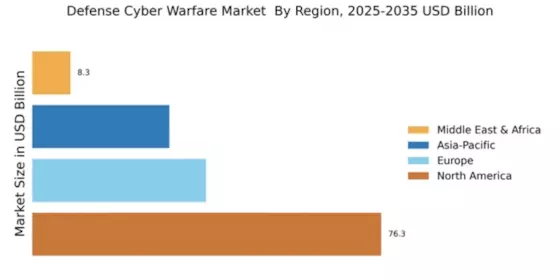
North America leads the Defense Cyber Warfare market with a significant share of 76.35%. The region's growth is driven by increasing cyber threats, government investments in cybersecurity infrastructure, and stringent regulations aimed at protecting national security. The demand for advanced cyber defense solutions is further fueled by the rise of sophisticated cyber attacks targeting critical infrastructure and defense systems. The United States is the primary player in this market, hosting major defense contractors like Northrop Grumman, Raytheon Technologies, and Lockheed Martin. These companies are at the forefront of developing innovative cyber warfare technologies. The competitive landscape is characterized by continuous advancements in AI and machine learning, enhancing the capabilities of defense systems against evolving cyber threats.

Europe : Growing Cyber Defense Initiatives

Europe's Defense Cyber Warfare market is valued at €38.0 billion, reflecting a growing emphasis on cybersecurity across member states. The region is witnessing increased investments in cyber defense initiatives, driven by regulatory frameworks such as the EU Cybersecurity Act. This act aims to enhance the overall cybersecurity posture of EU member states, fostering collaboration and information sharing among nations. Leading countries in this market include the UK, Germany, and France, where key players like BAE Systems and Thales Group are actively involved. The competitive landscape is evolving, with a focus on public-private partnerships to bolster cyber defense capabilities. The presence of advanced research institutions further supports innovation in cybersecurity technologies, ensuring Europe remains resilient against cyber threats.

Asia-Pacific : Emerging Cyber Warfare Landscape

The Asia-Pacific region, with a market size of $30.0 billion, is rapidly emerging as a significant player in the Defense Cyber Warfare sector. The growth is driven by increasing cyber threats, government initiatives to enhance national security, and the rising adoption of advanced technologies. Countries are investing heavily in cybersecurity frameworks to protect critical infrastructure and sensitive data from cyber attacks. Key players in this region include L3Harris Technologies and Cisco Systems, with countries like China, India, and Japan leading the charge. The competitive landscape is marked by a surge in local startups focusing on innovative cybersecurity solutions. As nations prioritize cyber defense, collaboration between government and private sectors is becoming essential to address the growing challenges in the cyber domain.

Middle East and Africa : Strategic Cyber Defense Developments

The Middle East and Africa region, valued at $8.35 billion, is increasingly recognizing the importance of cyber defense in national security strategies. The growth is driven by rising cyber threats and the need for robust cybersecurity measures to protect critical infrastructure. Governments are implementing policies to enhance cybersecurity capabilities, fostering a more secure digital environment. Countries like the UAE and South Africa are leading the way in adopting advanced cyber defense technologies. The competitive landscape includes both local and international players, with a focus on building partnerships to enhance cybersecurity resilience. As the region continues to develop its cyber capabilities, investment in training and awareness programs is also gaining traction to combat cyber threats effectively.

Key Players and Competitive Insights

The Defense Cyber Warfare Market is characterized by a rapidly evolving competitive landscape, driven by increasing geopolitical tensions and the growing sophistication of cyber threats. Major players such as Northrop Grumman (US), Raytheon Technologies (US), and Lockheed Martin (US) are at the forefront, leveraging their technological prowess and extensive experience in defense systems. These companies are strategically positioned to capitalize on the demand for advanced cyber capabilities, focusing on innovation, partnerships, and regional expansion to enhance their market presence. Their collective strategies not only shape the competitive environment but also indicate a trend towards integrated solutions that combine hardware and software capabilities.

Key business tactics within this market include localizing manufacturing and optimizing supply chains to enhance responsiveness to client needs. The competitive structure appears moderately fragmented, with several key players exerting significant influence. This fragmentation allows for a diverse range of offerings, yet the presence of dominant firms like BAE Systems (GB) and General Dynamics (US) suggests a competitive dynamic where innovation and technological advancement are paramount.

In November 2025, Northrop Grumman (US) announced a strategic partnership with a leading cloud service provider to enhance its cyber defense capabilities. This collaboration aims to integrate advanced AI technologies into their existing systems, thereby improving threat detection and response times. The strategic importance of this move lies in its potential to position Northrop Grumman as a leader in the integration of AI within cyber warfare, addressing the increasing demand for sophisticated defense solutions.

In October 2025, Raytheon Technologies (US) unveiled a new suite of cyber defense tools designed specifically for military applications. This launch reflects the company's commitment to innovation and its focus on developing tailored solutions that meet the unique challenges faced by defense agencies. The introduction of these tools is likely to strengthen Raytheon's competitive edge, as it aligns with the growing trend of customized defense solutions in the market.

In September 2025, Lockheed Martin (US) expanded its cyber operations by acquiring a cybersecurity firm specializing in threat intelligence. This acquisition is indicative of Lockheed Martin's strategy to bolster its capabilities in proactive cyber defense, enhancing its portfolio of services. The integration of this expertise is expected to provide Lockheed Martin with a more comprehensive approach to cyber warfare, further solidifying its position in the market.

As of December 2025, current trends in the Defense Cyber Warfare Market include a pronounced shift towards digitalization, sustainability, and the integration of AI technologies. Strategic alliances are increasingly shaping the competitive landscape, fostering innovation and collaboration among key players. Looking ahead, competitive differentiation is likely to evolve, with a greater emphasis on technological innovation and supply chain reliability, moving away from traditional price-based competition. This evolution suggests that companies will need to continuously adapt and innovate to maintain their competitive advantage in an increasingly complex and dynamic market.

Key Companies in the Defense Cyber Warfare Market market include

Industry Developments

  • Q2 2024: BAE Systems wins $318 million U.S. Army contract for cyber defense BAE Systems secured a $318 million contract from the U.S. Army to provide cyber defense capabilities, including advanced threat detection and response solutions for military networks.
  • Q2 2024: Palantir Technologies awarded $178 million U.S. Air Force cyber operations contract Palantir Technologies was selected by the U.S. Air Force for a $178 million contract to deliver software and analytics platforms supporting cyber operations and digital defense initiatives.
  • Q3 2024: Lockheed Martin opens new cyber innovation center in Maryland Lockheed Martin inaugurated a new cyber innovation center in Maryland, aimed at developing next-generation cyber warfare and defense technologies for government and military clients.
  • Q2 2024: Thales acquires Tesserent to expand cyber defense portfolio Thales completed the acquisition of Australian cybersecurity firm Tesserent, strengthening its position in the defense cyber warfare market and expanding its managed security services.
  • Q1 2025: Raytheon launches new AI-powered cyber threat detection platform for defense clients Raytheon introduced an artificial intelligence-driven cyber threat detection platform designed specifically for military and government agencies to enhance real-time threat identification.
  • Q2 2025: Northrop Grumman secures $400 million Pentagon contract for cyber warfare systems Northrop Grumman was awarded a $400 million contract by the U.S. Department of Defense to develop and deploy advanced cyber warfare systems for military applications.
  • Q1 2024: CrowdStrike partners with NATO to bolster alliance cyber defense CrowdStrike announced a strategic partnership with NATO to provide endpoint protection and threat intelligence services, enhancing the alliance's cyber defense posture.
  • Q3 2024: Microsoft launches new secure cloud platform for defense sector Microsoft unveiled a secure cloud platform tailored for defense agencies, offering enhanced encryption, compliance, and cyber resilience features for sensitive military operations.
  • Q2 2025: Darktrace wins UK Ministry of Defence contract for AI cyber defense Darktrace secured a contract with the UK Ministry of Defence to deploy its AI-powered cyber defense solutions across critical military infrastructure.
  • Q1 2025: Israel Aerospace Industries and Lockheed Martin announce cyber defense joint venture Israel Aerospace Industries and Lockheed Martin formed a joint venture focused on developing integrated cyber defense solutions for global defense customers.
  • Q2 2024: Cado Security raises $50 million to expand cloud cyber forensics for defense clients Cado Security closed a $50 million funding round to accelerate development of its cloud-based cyber forensics platform, targeting defense and intelligence agencies.
  • Q3 2025: U.S. DoD launches Cyber Talent Management System to recruit cyber warfare specialists The U.S. Department of Defense announced the launch of a new Cyber Talent Management System aimed at recruiting and retaining top cyber warfare specialists for national defense.

Future Outlook

Defense Cyber Warfare Market Future Outlook

The Defense Cyber Warfare Market is projected to grow at a 7.32% CAGR from 2024 to 2035, driven by increasing cyber threats, technological advancements, and government investments.

New opportunities lie in:

  • Development of AI-driven threat detection systems
  • Expansion of cybersecurity training programs for military personnel
  • Partnerships with tech firms for advanced cyber defense solutions

By 2035, the market is expected to be robust, reflecting substantial growth and innovation.

Market Segmentation

Defense Cyber Warfare Market End Use Outlook

  • Government
  • Military
  • Defense Contractors
  • Intelligence Agencies
  • Critical Infrastructure

Defense Cyber Warfare Market Application Outlook

  • Network Security
  • Endpoint Security
  • Application Security
  • Data Security
  • Cloud Security

Defense Cyber Warfare Market Service Type Outlook

  • Consulting
  • Managed Services
  • Training and Support

Defense Cyber Warfare Market Solution Type Outlook

  • Threat Intelligence
  • Incident Response
  • Vulnerability Management
  • Security Information and Event Management

Defense Cyber Warfare Market Deployment Type Outlook

  • On-Premises
  • Cloud-Based
  • Hybrid

Report Scope

MARKET SIZE 2024152.7(USD Billion)
MARKET SIZE 2025163.88(USD Billion)
MARKET SIZE 2035332.16(USD Billion)
COMPOUND ANNUAL GROWTH RATE (CAGR)7.32% (2024 - 2035)
REPORT COVERAGERevenue Forecast, Competitive Landscape, Growth Factors, and Trends
BASE YEAR2024
Market Forecast Period2025 - 2035
Historical Data2019 - 2024
Market Forecast UnitsUSD Billion
Key Companies ProfiledNorthrop Grumman (US), Raytheon Technologies (US), Lockheed Martin (US), BAE Systems (GB), General Dynamics (US), Thales Group (FR), L3Harris Technologies (US), Cisco Systems (US), Palantir Technologies (US)
Segments CoveredApplication, End Use, Deployment Type, Service Type, Solution Type
Key Market OpportunitiesIntegration of artificial intelligence in cybersecurity solutions enhances defense capabilities in the Defense Cyber Warfare Market.
Key Market DynamicsRising cyber threats drive innovation and investment in defense cyber warfare technologies and strategies.
Countries CoveredNorth America, Europe, APAC, South America, MEA

Leave a Comment

FAQs

1. What is the expected market size of the Data Processing and Hosting Service Market by 2034?

• The Data Processing and Hosting Service Market is expected to be valued at 309.50 USD Billion by 2034.

2. What is the compound annual growth rate (CAGR) for the Data Processing and Hosting Service Market from 2025 to 2034?

• The expected CAGR for the Data Processing and Hosting Service Market from 2025 to 2034 is 7.32%.

3. Which region is projected to have the largest market share in the Data Processing and Hosting Service Market by 2032?

• North America is projected to have the largest market share, valued at 115.0 USD Billion by 2032.

4. What is the market value of Data Hosting services in 2032?

• The market value for Data Hosting services is expected to reach 68.0 USD Billion by 2032.

5. Who are the key players in the Data Processing and Hosting Service Market?

• Key players include Amazon Web Services, Google LLC, Oracle Corporation, Alibaba Group, and Microsoft Corporation.

6. What is the projected value of Data Processing services by 2032?

• Data Processing services are expected to be valued at 90.0 USD Billion by 2032.

7. How much is the Data Analytics segment expected to grow by 2032?

• The Data Analytics segment is projected to grow to 42.0 USD Billion by 2032.

8. What is the market size of the APAC region for the Data Processing and Hosting Service Market by 2032?

• The market size of the APAC region is expected to be valued at 50.0 USD Billion by 2032.

9. What is the anticipated value of the Data Integration segment in 2032?

• The Data Integration segment is expected to reach a value of 50.0 USD Billion by 2032.

10. What is the expected market size of the South America American region for this market by 2032?

• The market size for South America is projected to be 10.0 USD Billion by 2032.

Download Free Sample

Kindly complete the form below to receive a free sample of this Report

Compare Licence

×
Features License Type
Single User Multiuser License Enterprise User
Price $4,950 $5,950 $7,250
Maximum User Access Limit 1 User Upto 10 Users Unrestricted Access Throughout the Organization
Free Customization
Direct Access to Analyst
Deliverable Format
Platform Access
Discount on Next Purchase 10% 15% 15%
Printable Versions