×
Request Free Sample ×

Kindly complete the form below to receive a free sample of this Report

* Please use a valid business email

Leading companies partner with us for data-driven Insights

clients tt-cursor
Hero Background

Delivery Robots Market

ID: MRFR/SEM/6082-HCR
100 Pages
Ankit Gupta
October 2025

Delivery Robots Market Research Report Information By Component (Hardware, Software, Services), By Type (Fully Autonomous, Semi-Autonomous), By Load Carrying Capacity (Upto 10kg, 10.01-50kg, more than 50kg), And By Region (North America, Europe, Asia-Pacific, And Rest Of The World) – Industry Forecast Till 2035

Share:
Download PDF ×

We do not share your information with anyone. However, we may send you emails based on your report interest from time to time. You may contact us at any time to opt-out.

Delivery Robots Market Infographic
Purchase Options

Delivery Robots Market Summary

As per MRFR analysis, the Delivery Robots Market was estimated at 7.81 USD Billion in 2024. The Delivery Robots industry is projected to grow from 9.77 USD Billion in 2025 to 90.97 USD Billion by 2035, exhibiting a compound annual growth rate (CAGR) of 25.0 during the forecast period 2025 - 2035.

Key Market Trends & Highlights

The Delivery Robots Market is experiencing robust growth driven by technological advancements and increasing demand for efficient delivery solutions.

  • Technological advancements are enhancing the capabilities and efficiency of delivery robots, particularly in North America.
  • The Asia-Pacific region is emerging as the fastest-growing market, driven by urbanization and increasing e-commerce activities.
  • Food delivery remains the largest segment, while grocery delivery is rapidly gaining traction due to changing consumer preferences.
  • Rising demand for contactless delivery and e-commerce growth are key drivers propelling the market forward.

Market Size & Forecast

2024 Market Size 7.81 (USD Billion)
2035 Market Size 90.97 (USD Billion)
CAGR (2025 - 2035) 25.0%

Major Players

Starship Technologies (EE), Nuro (US), Kiwibot (US), Robomart (US), TeleRetail (DE), Gatik (US), Savioke (US), Marble (US), Cleveron (EE)

Delivery Robots Market Trends

The Delivery Robots Market is currently experiencing a notable transformation, driven by advancements in technology and changing consumer preferences. As urban areas become increasingly congested, the demand for efficient and contactless delivery solutions appears to be rising. Companies are investing in innovative designs and functionalities to enhance the capabilities of delivery robots, which may lead to improved operational efficiency and customer satisfaction. Furthermore, the integration of artificial intelligence and machine learning into these systems suggests a potential for greater autonomy and adaptability in various environments. In addition to technological advancements, regulatory frameworks are evolving to accommodate the growing presence of delivery robots. Local governments are beginning to establish guidelines that facilitate the safe operation of these machines in public spaces. This regulatory support could foster a more conducive environment for market growth, as businesses gain clarity on compliance requirements. Moreover, partnerships between technology firms and logistics companies are likely to emerge, indicating a collaborative approach to addressing the challenges faced in the Delivery Robots Market. Overall, the landscape appears dynamic, with numerous opportunities for innovation and expansion in the near future.

Technological Advancements

The Delivery Robots Market is witnessing rapid technological progress, particularly in areas such as navigation systems and artificial intelligence. These innovations enhance the robots' ability to operate autonomously, navigate complex environments, and interact with customers effectively.

Regulatory Developments

As the presence of delivery robots increases, regulatory bodies are beginning to establish frameworks that govern their operation. This trend indicates a growing recognition of the need for safety and compliance, which may ultimately support market expansion.

Collaborative Partnerships

The formation of partnerships between technology providers and logistics companies is becoming more prevalent. Such collaborations may lead to the development of integrated solutions that address operational challenges, thereby enhancing the overall efficiency of delivery services.

Delivery Robots Market Drivers

Growing E-commerce Sector

The rapid expansion of the e-commerce sector significantly influences the Global Delivery Robots Market Industry. As consumers increasingly turn to online shopping, the demand for efficient and timely delivery solutions intensifies. Delivery robots offer a unique advantage by providing last-mile delivery services that are cost-effective and environmentally friendly. This trend is expected to propel the market to an estimated 7.81 USD Billion in 2024. Major e-commerce players are exploring partnerships with robotics companies to enhance their delivery capabilities. The integration of delivery robots into e-commerce logistics not only improves customer satisfaction but also streamlines operations, making it a critical driver of market growth.

Market Growth Projections

The Global Delivery Robots Market Industry is poised for remarkable growth, with projections indicating a substantial increase in market value. By 2024, the market is expected to reach 7.81 USD Billion, and by 2035, it could soar to 91.0 USD Billion. This growth trajectory suggests a compound annual growth rate of 25.01% from 2025 to 2035. Factors contributing to this expansion include technological advancements, increasing demand for contactless delivery, and supportive regulatory frameworks. As the market evolves, it is likely to attract significant investment, fostering innovation and competition among key players in the industry.

Supportive Regulatory Frameworks

The Global Delivery Robots Market Industry benefits from supportive regulatory frameworks that facilitate the deployment of delivery robots in urban areas. Governments are increasingly recognizing the potential of autonomous delivery systems to alleviate traffic congestion and reduce carbon emissions. As regulations evolve, cities are establishing guidelines that allow for the safe operation of delivery robots on public roads. This regulatory support is crucial for the growth of the market, as it encourages investment and innovation. By 2025, the market is likely to experience a compound annual growth rate of 25.01% through 2035, driven by favorable policies that promote the integration of delivery robots into existing logistics networks.

Urbanization and Population Growth

Urbanization and population growth are key factors driving the Global Delivery Robots Market Industry. As more people migrate to urban centers, the demand for efficient delivery solutions escalates. Delivery robots are well-suited for navigating congested city streets, providing a practical solution to the challenges posed by urban logistics. The increasing population density in metropolitan areas creates a pressing need for innovative delivery methods that can keep pace with consumer expectations. This trend is likely to contribute to the market's projected growth, with estimates suggesting a rise to 91.0 USD Billion by 2035. The ability of delivery robots to operate in densely populated areas positions them as a vital component of future urban logistics.

Rising Demand for Contactless Delivery

The Global Delivery Robots Market Industry experiences a notable surge in demand for contactless delivery solutions. This trend is driven by consumer preferences for safety and convenience, particularly in urban areas. As e-commerce continues to expand, delivery robots are increasingly seen as a viable solution to meet consumer expectations. In 2024, the market is projected to reach 7.81 USD Billion, reflecting a growing acceptance of automated delivery systems. Companies such as Starship Technologies and Nuro are leading the charge, deploying robots in various cities worldwide. This shift towards automation not only enhances efficiency but also aligns with the evolving landscape of consumer behavior.

Technological Advancements in Robotics

Technological advancements play a pivotal role in shaping the Global Delivery Robots Market Industry. Innovations in artificial intelligence, machine learning, and sensor technology enhance the capabilities of delivery robots, enabling them to navigate complex urban environments. These advancements contribute to improved safety, efficiency, and reliability of delivery services. As a result, the market is expected to witness substantial growth, with projections indicating a rise to 91.0 USD Billion by 2035. Companies are increasingly investing in research and development to create more sophisticated robots that can operate autonomously, thereby reducing operational costs and improving service delivery.

Market Segment Insights

By Application: Food Delivery (Largest) vs. Grocery Delivery (Fastest-Growing)

The Delivery Robots Market is witnessing a significant distribution in market share across various application segments. Among these, Food Delivery holds the largest share, leveraging the increasing demand for contactless delivery solutions within the food service industry. In contrast, Grocery Delivery is emerging rapidly, fueled by changing consumer shopping habits that favor convenience and online purchasing, particularly post-pandemic. Growth trends within the Delivery Robots Market are heavily influenced by the rising preference for automation and efficiency in logistics. Food Delivery continues to dominate due to its established presence and consumer trust, while Grocery Delivery is accelerating as more retailers adopt robotic solutions to streamline their operations. Innovations in robotics technology and increasing investments are also propelling the growth of these segments.

Food Delivery: Dominant vs. Grocery Delivery: Emerging

In the Delivery Robots Market, Food Delivery stands out as the dominant segment, characterized by established infrastructure and high consumer demand. Robots designed for food delivery possess advanced navigation systems and temperature-controlled compartments, ensuring timely and safe transport of meals. On the other hand, Grocery Delivery is emerging as a compelling segment, driven by technological advancements and consumer trends favoring ease of access to goods. These robots offer dynamic routing capabilities and varying storage options, making them suitable for diverse grocery items. As the demand for convenient shopping experiences grows, both segments are likely to see sustained interest, with Food Delivery maintaining its stronghold while Grocery Delivery attracts investment and innovation.

By End Use: Retail (Largest) vs. Healthcare (Fastest-Growing)

In the Delivery Robots Market, the retail sector takes the lead with the largest market share, benefiting from the increasing demand for automated solutions to enhance customer experience. As retailers look to streamline operations and improve efficiency, the deployment of delivery robots has proven to be a strategic move. Healthcare follows as a fast-growing segment, driven by the need for contactless delivery services in medical facilities, pharmaceuticals, and supplies, making it a critical area for investment and development.

Retail (Dominant) vs. Healthcare (Emerging)

The retail sector stands as a dominant player in the delivery robots market, characterized by its heavy investment in automation and logistics solutions to meet the changing consumer expectations. Retailers are increasingly adopting delivery robots to facilitate efficient product distribution and enhance the shopping experience. In contrast, the healthcare sector is emerging rapidly, propelled by increasing operational demands and the need for swift, reliable delivery of medical supplies and equipment. The growing trend of telemedicine and the heightened focus on patient safety during the pandemic have further amplified the importance of delivery robots, positioning it as a key growth area for the future.

By Robot Type: Autonomous Mobile Robots (Largest) vs. Aerial Delivery Drones (Fastest-Growing)

In the Delivery Robots Market, Autonomous Mobile Robots hold the largest market share, driving a significant portion of industry revenue. They are widely adopted in various sectors, such as logistics and warehousing, contributing to efficient order fulfillment and reducing operational costs. Aerial Delivery Drones, on the other hand, are emerging rapidly, capturing the attention of logistics companies with their unique capabilities, especially in urban areas where traditional delivery methods face challenges.

Autonomous Mobile Robots (Dominant) vs. Aerial Delivery Drones (Emerging)

Autonomous Mobile Robots (AMRs) are designed for versatile applications and have garnered a dominant position within the Delivery Robots Market. Their capabilities in navigating complex environments and performing tasks such as picking, packing, and transporting goods enhance operational efficiency. They are favored for their scalability and ability to integrate with existing warehouse management systems. In contrast, Aerial Delivery Drones represent an emerging segment, leveraging advanced technology to offer swift parcel delivery. Their adaptability to airspace regulations and development of autonomous flight paths positions them favorably for rapid adoption, especially in last-mile delivery solutions. As urbanization increases, the demand for aerial delivery solutions is expected to surge, making this segment one to watch.

By Payload Capacity: Lightweight (Largest) vs. Heavyweight (Fastest-Growing)

In the Delivery Robots Market, the segment distribution by payload capacity shows a significant concentration in the lightweight category, which holds the largest market share. This segment, designed for goods that require minimal handling, caters to urban areas where quick delivery is essential. In contrast, the heavyweight category, while smaller in share, is rapidly gaining traction as businesses seek to transport larger items efficiently. The medium weight segment maintains a steady presence, serving as a bridge between the two extremes and facilitating versatile delivery options. Growth trends in the delivery robots by payload capacity are driven by the increasing demand for last-mile delivery solutions. The lightweight segment benefits from the ongoing shift towards e-commerce, where rapid, small deliveries are necessary. Meanwhile, the heavyweight robots are becoming more popular in sectors such as retail and logistics, where moving larger packages is becoming a critical operational need. As technology advances, both segments are expected to evolve, influencing overall market dynamics.

Lightweight (Dominant) vs. Heavyweight (Emerging)

The lightweight segment in the delivery robots market is currently leading with its focus on quick and efficient delivery of small parcels, appealing primarily to urban consumers and businesses. These robots are characterized by their compact design, ease of deployment, and ability to navigate crowded city environments. They are ideal for last-mile deliveries in densely populated areas. On the other hand, the heavyweight segment is emerging as a strong contender, particularly in sectors requiring larger payload capabilities. Despite starting with a smaller market share, heavyweight delivery robots offer significant advantages for transporting bulky items. Their robustness and enhanced payload capacity position them as pivotal solutions for businesses aiming to optimize their logistics operations.

By Technology: Artificial Intelligence (Largest) vs. Sensor Technology (Fastest-Growing)

The Delivery Robots Market exhibits a diverse distribution of technology segments. Among these, Artificial Intelligence (AI) leads with significant market share, driving advancements in operational efficiency and autonomous navigation. AI's capacity for data processing and decision-making gives it a competitive edge over other technologies. Sensor Technology, while currently holding a smaller share compared to AI, is witnessing rapid adoption and growth as it enhances robot perception and environmental interaction, making it vital for the development of intelligent robots.

Technology: AI (Dominant) vs. Sensor Technology (Emerging)

Artificial Intelligence (AI) remains the dominant force in the Delivery Robots Market, powering advanced algorithms that facilitate real-time learning and adaptation. This technology enhances navigation precision and user interface, making delivery processes smoother and more reliable. On the other hand, Sensor Technology is emerging as a critical component, rapidly evolving to improve the safety and efficiency of delivery robots. Enhanced sensors, such as LiDAR and stereo cameras, enable robots to navigate complex environments. As demand grows for more capable robots, the focus on sophisticated sensor technology will continue to rise, establishing it as a key player in future developments.

Get more detailed insights about Delivery Robots Market

Regional Insights

North America : Innovation and Market Leadership

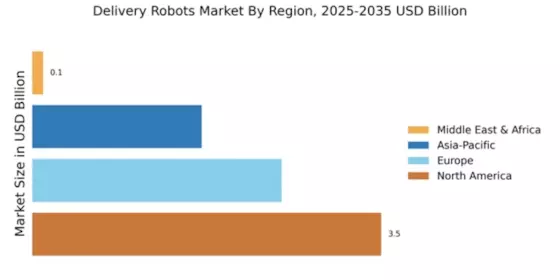
North America is poised to maintain its leadership in the Delivery Robots Market, holding a significant market share of 3.5 in 2024. The region's growth is driven by increasing demand for contactless delivery solutions, advancements in robotics technology, and supportive regulatory frameworks. Cities are increasingly adopting delivery robots to enhance logistics efficiency, particularly in urban areas where traffic congestion is prevalent. The competitive landscape is robust, with key players like Nuro, Kiwibot, and Gatik leading the charge. The U.S. is the primary market, supported by a favorable environment for innovation and investment in autonomous technologies. Companies are actively collaborating with local governments to ensure compliance with regulations, further solidifying their market presence. The focus on sustainability and reducing carbon footprints is also shaping the future of delivery solutions in the region.

Europe : Emerging Market with Regulatory Support

Europe is rapidly emerging as a significant player in the Delivery Robots Market, with a market size of 2.5. The region benefits from strong regulatory support aimed at fostering innovation in autonomous delivery systems. Countries like Germany and the UK are leading the charge, implementing frameworks that encourage the deployment of delivery robots in urban settings. The demand for efficient last-mile delivery solutions is driving investments in this sector. The competitive landscape features key players such as TeleRetail and Cleveron, who are leveraging advanced technologies to enhance service delivery. The European market is characterized by a collaborative approach between private companies and government bodies, ensuring that safety and efficiency standards are met. This synergy is crucial for the successful integration of delivery robots into everyday logistics operations.

Asia-Pacific : Rapid Adoption and Growth Potential

The Asia-Pacific region is witnessing a surge in the Delivery Robots Market, with a market size of 1.7. This growth is fueled by increasing urbanization, a burgeoning e-commerce sector, and a rising demand for efficient delivery solutions. Countries like Japan and China are at the forefront, implementing smart city initiatives that integrate delivery robots into their logistics frameworks. Regulatory bodies are gradually adapting to accommodate these innovations, further driving market expansion. The competitive landscape is diverse, with local startups and established companies vying for market share. Key players are focusing on technological advancements and partnerships to enhance their service offerings. The region's unique challenges, such as varying regulatory environments and infrastructure readiness, are being addressed through innovative solutions tailored to local needs, positioning Asia-Pacific as a dynamic market for delivery robots.

Middle East and Africa : Emerging Market with Unique Challenges

The Middle East and Africa represent an emerging market for delivery robots, with a market size of 0.11. The growth in this region is driven by increasing urbanization and a growing interest in technology-driven solutions for logistics. However, challenges such as regulatory hurdles and infrastructure limitations are prevalent. Countries like the UAE are exploring pilot projects to assess the feasibility of delivery robots in urban areas, indicating a cautious yet optimistic approach to market entry. The competitive landscape is still developing, with a few local players beginning to emerge. The focus is on adapting delivery solutions to meet the unique needs of the region, including addressing safety and operational challenges. As governments begin to recognize the potential of delivery robots, there is an opportunity for growth, albeit at a slower pace compared to other regions.

Key Players and Competitive Insights

The Delivery Robots Market is currently characterized by a dynamic competitive landscape, driven by technological advancements and increasing consumer demand for efficient last-mile delivery solutions. Key players such as Starship Technologies (EE), Nuro (US), and Gatik (US) are at the forefront, each adopting distinct strategies to enhance their market positioning. Starship Technologies (EE) focuses on innovation in autonomous delivery systems, while Nuro (US) emphasizes partnerships with major retailers to expand its operational footprint. Gatik (US) is strategically positioned in the B2B segment, providing autonomous delivery solutions for supply chains, which collectively shapes a competitive environment that is increasingly reliant on technological differentiation and strategic collaborations.

In terms of business tactics, companies are localizing manufacturing and optimizing supply chains to enhance operational efficiency. The market structure appears moderately fragmented, with several players vying for market share. However, the collective influence of key players is significant, as they leverage their technological capabilities and partnerships to create a more cohesive market presence.

In November 2025, Nuro (US) announced a partnership with a leading grocery chain to expand its delivery services across multiple states. This strategic move is likely to enhance Nuro's market penetration and operational efficiency, allowing it to capitalize on the growing demand for automated delivery solutions in the retail sector. The partnership underscores the importance of collaboration in scaling operations and meeting consumer expectations for rapid delivery.

In October 2025, Gatik (US) secured a contract with a major logistics provider to deploy its autonomous delivery vehicles for middle-mile logistics. This development is pivotal as it not only reinforces Gatik's position in the B2B market but also highlights the increasing acceptance of autonomous solutions in traditional logistics frameworks. Such contracts may signal a shift in how logistics companies view automation as a viable solution for efficiency and cost reduction.

In September 2025, Starship Technologies (EE) expanded its operations into new urban areas, launching its delivery robots in several metropolitan regions. This expansion reflects a strategic focus on urban markets, where demand for last-mile delivery is surging. By increasing its geographical footprint, Starship aims to enhance its service offerings and compete more effectively against other players in the market.

As of December 2025, current competitive trends indicate a strong emphasis on digitalization, sustainability, and AI integration within the Delivery Robots Market. Strategic alliances are increasingly shaping the landscape, as companies recognize the need for collaboration to drive innovation and enhance service delivery. Looking ahead, competitive differentiation is likely to evolve from traditional price-based competition to a focus on technological innovation, supply chain reliability, and customer-centric solutions. This shift may redefine market dynamics, compelling companies to invest in advanced technologies and sustainable practices to maintain a competitive edge.

Key Companies in the Delivery Robots Market market include

Industry Developments

  • Q2 2024: Serve Robotics raises $30M to scale up autonomous sidewalk robot deliveries Serve Robotics, a developer of autonomous delivery robots, announced a $30 million funding round to expand its fleet and accelerate commercial deployments in new U.S. cities.
  • Q2 2024: Uber-backed Serve Robotics to go public via SPAC merger Serve Robotics, which operates delivery robots for last-mile logistics, announced plans to go public through a merger with a special purpose acquisition company (SPAC), aiming to raise capital for further expansion.
  • Q2 2024: Ottonomy.IO Announces Partnership with Posten Norge for Autonomous Last-Mile Deliveries in Norway Ottonomy.IO, a delivery robot startup, entered a partnership with Norway's national postal service, Posten Norge, to pilot autonomous last-mile delivery robots in select Norwegian cities.
  • Q2 2024: Starship Technologies Launches Delivery Robot Operations in Tokyo Starship Technologies, a leading autonomous delivery robot company, launched its first commercial robot delivery service in Tokyo, marking its entry into the Japanese market.
  • Q3 2024: Amazon expands Scout delivery robot trials to Germany Amazon announced the expansion of its Scout autonomous delivery robot trials to Germany, its first deployment of the technology outside the United States.
  • Q3 2024: Nuro secures $100 million in Series D funding to accelerate autonomous delivery vehicle production Nuro, a U.S.-based autonomous delivery vehicle company, raised $100 million in Series D funding to scale up manufacturing and deployment of its delivery robots.
  • Q3 2024: Kiwibot partners with Sodexo to deploy delivery robots on 50 more U.S. college campuses Kiwibot, a delivery robot startup, announced a partnership with food services giant Sodexo to expand its robot delivery services to 50 additional college campuses across the United States.
  • Q4 2024: Refraction AI launches new REV-2 delivery robot for urban environments Refraction AI unveiled its next-generation REV-2 delivery robot, designed for improved navigation and safety in dense urban settings, and announced pilot programs with several U.S. retailers.
  • Q4 2024: BoxBot opens new manufacturing facility in Texas to meet rising demand for delivery robots BoxBot, a developer of autonomous delivery robots, opened a new manufacturing facility in Texas to increase production capacity and support growing customer demand.
  • Q1 2025: Starship Technologies raises $90 million to expand global delivery robot fleet Starship Technologies secured $90 million in new funding to accelerate the global rollout of its autonomous delivery robots and invest in R&D.
  • Q2 2025: Nuro receives California regulatory approval for fully driverless delivery operations Nuro obtained regulatory approval from California authorities to operate its autonomous delivery vehicles without a safety driver, enabling fully driverless commercial deliveries in the state.
  • Q2 2025: Amazon launches Scout delivery robots in London Amazon launched its Scout autonomous delivery robots in London, marking the first deployment of the technology in the UK as part of its European expansion strategy.

Future Outlook

Delivery Robots Market Future Outlook

The Delivery Robots Market is projected to grow at a 25.0% CAGR from 2024 to 2035, driven by advancements in automation, urbanization, and demand for efficient logistics solutions.

New opportunities lie in:

  • Integration of AI for route optimization
  • Partnerships with e-commerce platforms for last-mile delivery
  • Development of autonomous charging stations for fleet management

By 2035, the Delivery Robots Market is expected to be a pivotal component of global logistics.

Market Segmentation

Delivery Robots Market End Use Outlook

  • Retail
  • Healthcare
  • Hospitality
  • E-commerce

Delivery Robots Market Robot Type Outlook

  • Autonomous Mobile Robots
  • Ground Delivery Robots
  • Aerial Delivery Drones
  • Hybrid Delivery Robots

Delivery Robots Market Technology Outlook

  • Navigation Technology
  • Communication Technology
  • Sensor Technology
  • Artificial Intelligence

Delivery Robots Market Application Outlook

  • Food Delivery
  • Parcel Delivery
  • Medical Supply Delivery
  • Grocery Delivery

Delivery Robots Market Payload Capacity Outlook

  • Lightweight
  • Medium Weight
  • Heavyweight

Report Scope

MARKET SIZE 20247.81(USD Billion)
MARKET SIZE 20259.77(USD Billion)
MARKET SIZE 203590.97(USD Billion)
COMPOUND ANNUAL GROWTH RATE (CAGR)25.0% (2024 - 2035)
REPORT COVERAGERevenue Forecast, Competitive Landscape, Growth Factors, and Trends
BASE YEAR2024
Market Forecast Period2025 - 2035
Historical Data2019 - 2024
Market Forecast UnitsUSD Billion
Key Companies ProfiledStarship Technologies (EE), Nuro (US), Kiwibot (US), Robomart (US), TeleRetail (DE), Gatik (US), Savioke (US), Marble (US), Cleveron (EE)
Segments CoveredApplication, End Use, Robot Type, Payload Capacity, Technology
Key Market OpportunitiesIntegration of artificial intelligence enhances efficiency and safety in the Delivery Robots Market.
Key Market DynamicsRising consumer demand for contactless delivery drives innovation and competition in the Delivery Robots Market.
Countries CoveredNorth America, Europe, APAC, South America, MEA

Market Highlights

Author
Ankit Gupta
Senior Research Analyst

Ankit Gupta is an analyst in market research industry in ICT and SEMI industry. With post-graduation in "Telecom and Marketing Management" and graduation in "Electronics and Telecommunication" vertical he is well versed with recent development in ICT industry as a whole. Having worked on more than 150+ reports including consultation for fortune 500 companies such as Microsoft and Rio Tinto in identifying solutions with respect to business problems his opinions are inclined towards mixture of technical and managerial aspects.

Leave a Comment

FAQs

How much is the Delivery Robots market?

The global Delivery Robots market size was valued at USD 7.81 billion in 2024.

What is the growth rate of the Delivery Robots market?

The global market is projected to grow at a CAGR of 25.00% during the forecast period, 2025 to 2035.

Which region held the largest market share in the Delivery Robots market?

North america had the largest share in the global Delivery Robots market.

Who are the key players in the Delivery Robots market?

The key players in the market are Amazon Robotics, Robby Technologies, Robomart, Boston Dynamics, Eliport, Starship Technologies, Panasonic, Jd.Com, Nuro, Savioke, Marble, Dispatch, Piaggio Fast Forward, Teleretail and BoxBot.

Which type led the Delivery Robots market?

The fully autonomous category dominated the market in 2022.

Which component had the largest market share in the market?

The hardware had the largest share in the global market for Delivery Robots.

Download Free Sample

Kindly complete the form below to receive a free sample of this Report

Compare Licence

×
Features License Type
Single User Multiuser License Enterprise User
Price $4,950 $5,950 $7,250
Maximum User Access Limit 1 User Upto 10 Users Unrestricted Access Throughout the Organization
Free Customization
Direct Access to Analyst
Deliverable Format
Platform Access
Discount on Next Purchase 10% 15% 15%
Printable Versions