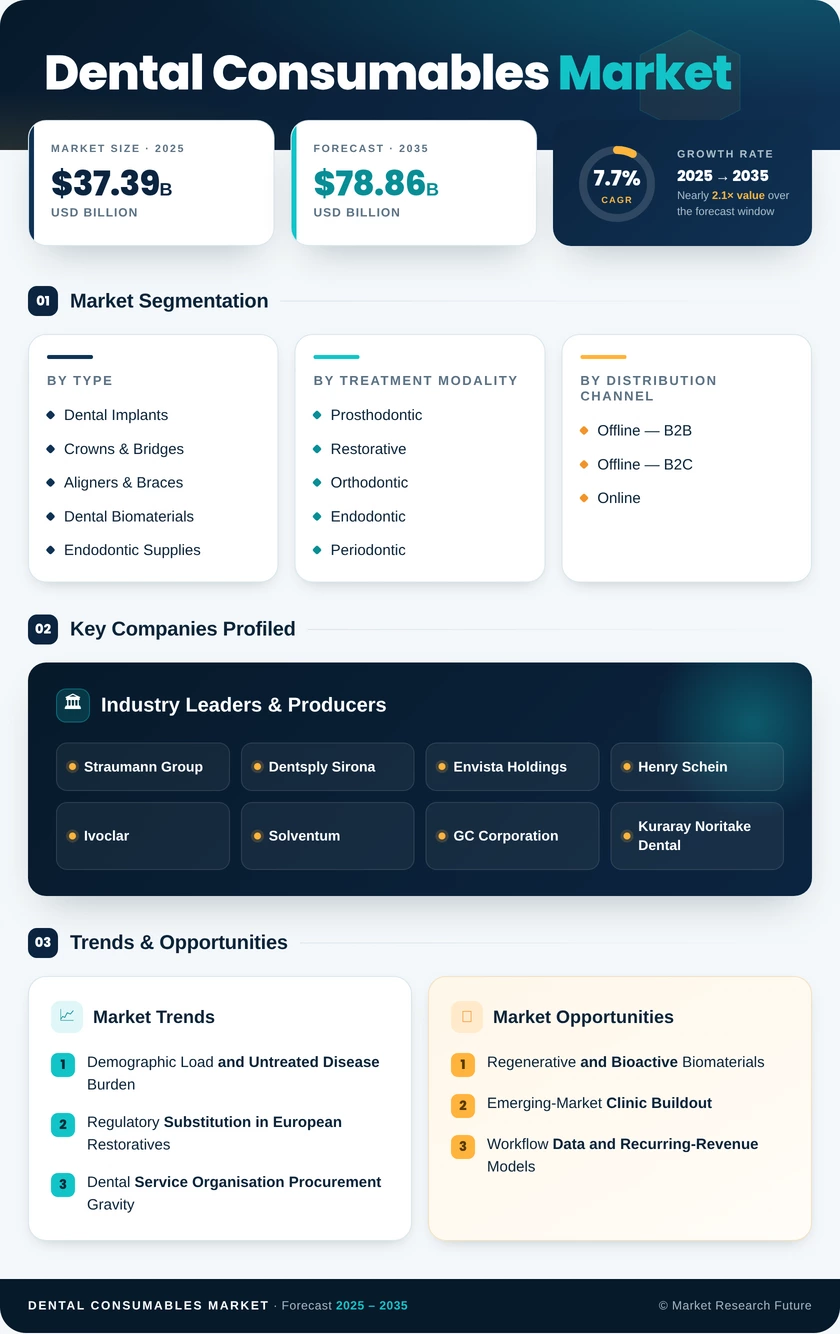
Segmentation Quick Reference
| Dimension | Sub-Segments | Dominant Segment | Fastest Growing Segment |
| By Product Type | Dental Implants; Crowns & Bridges; Aligners & Braces; Dental Biomaterials; Endodontic Supplies; Anaesthetics; Whitening Products; Personal Protective Wear; Others | Dental Implants | Personal Protective Wear |
| By Treatment Modality | Prosthodontic; Restorative; Orthodontic; Endodontic; Periodontic; Preventive & Other | Prosthodontic | Orthodontic |
| By Distribution Channel | Offline — B2B; Offline — B2C; Online | Offline — B2B | Online |
| By End-User | Dental Clinics; DSO / Group Practices; Dental Hospitals; Dental Laboratories; Others | Dental Clinics | DSO / Group Practices |
| By Geography | North America; Europe; Asia-Pacific; South America; Middle East & Africa | North America | Asia-Pacific |
Market Segmentation Overview
By Product Type
| Sub-Segment | Key Trend |
| Dental Implants | Surface technology and workflow integration defend margin against tender-driven price compression |
| Crowns & Bridges | Chairside milling collapses two-visit protocols into single-visit delivery |
| Aligners & Braces | Case starts migrate from orthodontic specialists to general practitioners |
| Dental Biomaterials | Grafting and membrane use rises as full-arch and compromised-site cases grow |
| Endodontic Supplies | Bioceramic sealers and rotary systems displace legacy obturation methods |
| Anaesthetics | Volume tracks total procedure count; low differentiation, high reliability of demand |
| Whitening Products | Consumer-adjacent demand cycles with discretionary spending |
| Personal Protective Wear | Post-pandemic usage intensity reset permanently above pre-2020 baselines |
| Others | Impression, isolation, and finishing supplies consolidating toward fewer suppliers |
Product economics are diverging. High-value categories compete on clinical evidence and integrated workflow, while commodity lines compete purely on landed cost and distributor reliability — and group purchasing is widening that gap every year.
By Treatment Modality
| Sub-Segment | Key Trend |
| Prosthodontic | Ageing populations sustain crown, bridge, and denture volume across all regions |
| Restorative | European amalgam prohibition redirects volume to composite and glass-hybrid chemistry |
| Orthodontic | Aligner adoption in general practice broadens the treatable population |
| Endodontic | Tooth retention preferred over extraction where insurance permits |
| Periodontic | Severe gum disease burden drives scaling, regeneration, and maintenance consumables |
| Preventive & Other | Sealant and varnish programmes gain payer recognition on cost-avoidance grounds |
Modality boundaries are blurring where digital workflows let one visit deliver what previously spanned several. Suppliers increasingly sell against a protocol rather than a specialty.
By Distribution Channel
| Sub-Segment | Key Trend |
| Offline — B2B | Distributor service, financing, and clinical support remain decisive for equipment-linked consumables |
| Offline — B2C | Direct-to-practice specialty lines bypass distributor margin on differentiated products |
| Online | Automated replenishment and price transparency accelerate commodity migration |
Channel choice follows product complexity. Anything requiring clinical training or service coverage stays offline; anything reordered on a schedule moves online.
By End-User
| Sub-Segment | Key Trend |
| Dental Clinics | Largest installed base; increasingly buying through affiliated purchasing groups |
| DSO / Group Practices | Formulary standardisation concentrates spend among fewer, broader-portfolio suppliers |
| Dental Hospitals | Complex surgical and multidisciplinary caseloads sustain premium material demand |
| Dental Laboratories | Volume eroding as chairside fabrication internalises prosthetic work |
| Others | Academic and public health programmes anchor preventive product demand |
Buyer sophistication is the defining shift of this decade. Independent clinicians selected products; procurement committees select suppliers, and that change rewards scale, education infrastructure, and evidence depth over individual product merit.