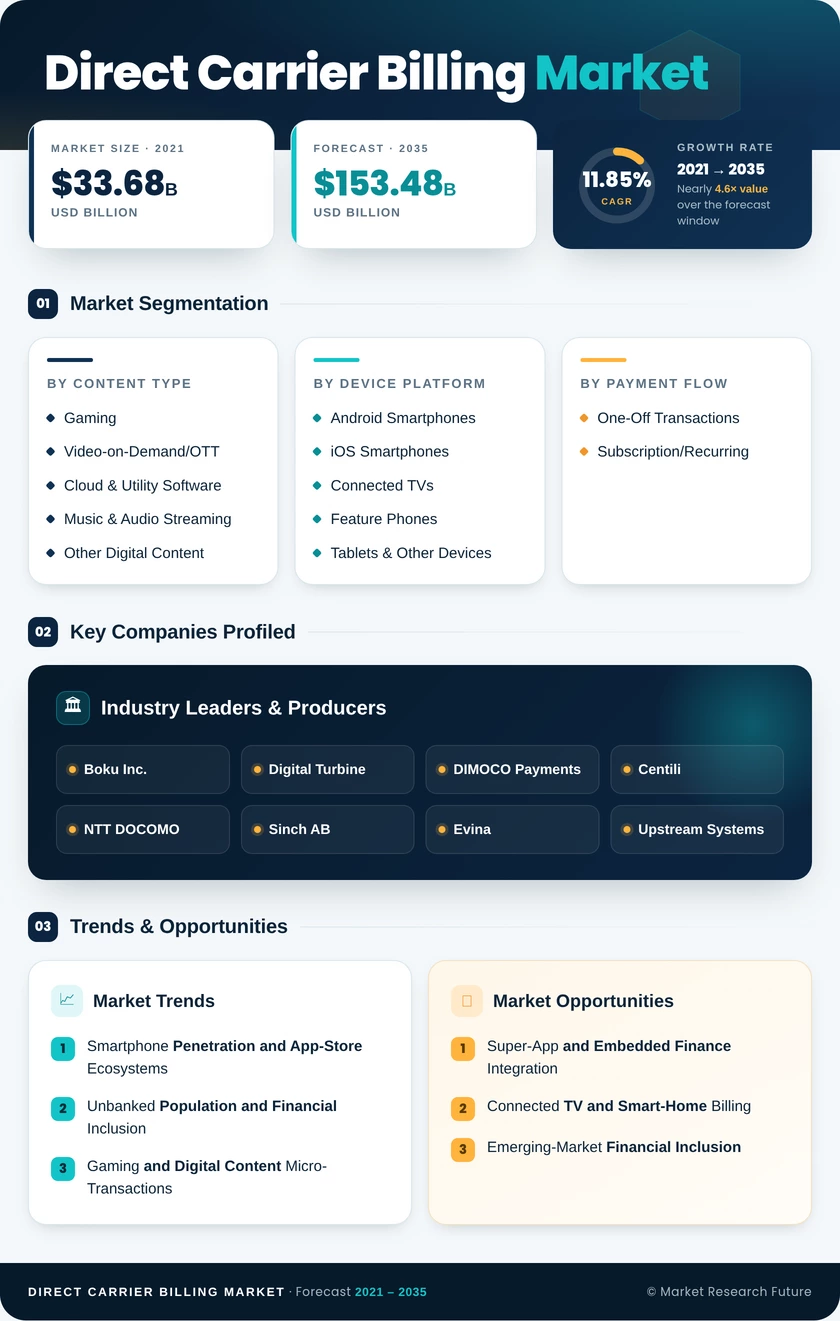
Segmentation Quick Reference
| Dimension | Sub-Segments | Dominant Segment (2025) | Fastest Growing Segment |
| Content Type | Gaming; Video-on-Demand/OTT; Cloud & Utility Software; Music & Audio Streaming; Other Digital Content | Gaming (44.20% share) | Cloud & Utility Software (14.20% CAGR) |
| Device Platform | Android Smartphones; iOS Smartphones; Connected TVs; Feature Phones; Tablets & Other Devices | Android Smartphones (76.10% share) | Connected TVs (13.10% CAGR) |
| Payment Flow | One-Off Transactions; Subscription/Recurring | One-Off Transactions (55.10% share) | Subscription/Recurring (13.75% CAGR) |
| Operator Type | Mobile Network Operators; MVNOs | Mobile Network Operators (87.85% share) | MVNOs (14.05% CAGR) |
| End-User Segment | Unbanked/Under-banked Consumers; Banked Consumers | Unbanked/Under-banked (52.80% share) | Banked Consumers (13.20% CAGR) |
Market Segmentation Overview
By Content Type
| Sub-Segment | Key Trend |
| Gaming | In-app micro-transactions dominate mobile billing volumes; cloud gaming expanding addressable base |
| Video-on-Demand / OTT | Operator-bundled streaming subscriptions growing across emerging markets |
| Cloud & Utility Software | SaaS subscription-on-bill models gaining traction among SMBs in underbanked regions |
| Music & Audio Streaming | Premium tier upgrades via carrier billing reducing subscriber churn |
| Other Digital Content | E-books, news paywalls, and EdTech platforms diversifying content mix |
Gaming drives the highest billing volumes due to the alignment between mobile-game monetization mechanics and carrier billing's impulse-purchase flow. Cloud and utility software is expected to grow fastest as enterprise SaaS vendors discover operator billing as a low-friction distribution channel in markets with limited card penetration.
By Device Platform
| Sub-Segment | Key Trend |
| Android Smartphones | Google Play's native billing API supports 70+ country operator integrations |
| iOS Smartphones | Apple expanding regional carrier billing support selectively |
| Connected TVs | Large-screen content purchases favor charge-to-remote billing |
| Feature Phones | SMS-based billing sustains relevance in low-income rural markets |
| Tablets & Other Devices | Cross-device content-access models require unified billing identity |
Android smartphones remain the primary billing endpoint given Google Play's expansive operator-integration footprint. Connected TVs represent the emerging frontier, as the absence of physical input devices on large screens makes carrier billing the most natural checkout mechanism for streaming and pay-per-view content.
By Payment Flow
| Sub-Segment | Key Trend |
| One-Off Transactions | Impulse digital purchases remain the core use case for carrier billing |
| Subscription / Recurring | OTT, music, and SaaS recurring billing growing as operators support auto-renewal |
One-off transactions currently dominate by volume, but subscription billing is gaining share rapidly as operators build auto-renewal and subscription-management capabilities into their billing platforms.
By Operator Type
| Sub-Segment | Key Trend |
| Mobile Network Operators | Leverage established subscriber relationships and proprietary billing stacks |
| MVNOs | Adopt white-label billing platforms to compete without building in-house infrastructure |
Mobile network operators retain structural dominance through their control of subscriber identity and billing infrastructure. MVNOs are the faster-growing segment as aggregator platforms reduce the technical and commercial barriers to launching carrier billing services.
By End-User Segment
| Sub-Segment | Key Trend |
| Unbanked / Under-banked Consumers | Mobile airtime remains the primary digital payment instrument for over 1 billion adults |
| Banked Consumers | Convenience-driven adoption growing as carrier billing wins share from card-based checkout |
Unbanked consumers constitute the historical core of carrier billing demand, but banked consumers represent the faster-growing user base as one-tap convenience and higher conversion rates attract users who have access to alternative payment methods but prefer the simplicity of charge-to-bill.