Drilling Tools Market (2026 - 2035)

Drilling Tools Market Size, Share & Growth Analysis Report By Type (Drill Bit, Drill Pipe, Drill Collar, Drill Reamer and Stabilizer, Drill Swivel, Other Tools), By Application (Development and Production Drilling, Geothermal Drilling, Other Applications), By Location of Deployment (Onshore, Offshore), By End-User (Oil and Gas Operators, Geothermal Developers, Other End-Users) and By Regional (North America, Europe, South America, Asia Pacific, Middle East and Africa) – Industry Growth & Forecast to 2035
ID: MRFR/EnP/4429-HCR
100 Pages
Chitranshi Jaiswal
Last Updated: July 10, 2026
Drilling Tools Market
Market Size
Forecast Period2026-2035
CAGR (2026-2035)5.00%
2026 Market SizeUSD 10.35 Billion
2035 Market SizeUSD 16.06 Billion
Key Players
SLB
Baker Hughes
Halliburton
NOV
Weatherford
National Oilwell Varco
Opportunities
  • Enhanced Geothermal System Commercialization
  • Data-Driven Tool-Performance-as-a-Service Models
  • Emerging-Market Exploration Ramp

Drilling Tools Market Summary

The Drilling Tools Market reached an estimated USD 9.86 billion in 2025 and is projected to grow from USD 10.35 billion in 2026 to USD 16.06 billion by 2035, registering a compound annual growth rate of 5.00% during the forecast period. Selective reinvestment in high-return wells and final investment decisions on deep- and ultra-deepwater assets across Brazil, the US Gulf of Mexico, and West Africa are anchoring the Drilling Tools Market expansion. Governments in more than 30 countries have introduced accelerated permitting frameworks for upstream exploration since 2023, collectively unlocking an estimated USD 78 Billion in new drilling commitments through 2030 [1].

A significant technology transformation is reshaping the Drilling Tools Market as operators replace conventional fixed-cutter and roller-cone assemblies with rotary steerable systems and high-specification mud motors that shorten rig time by 15–25% per lateral section [2]. National energy security mandates—including the US Inflation Reduction Act provisions for domestic critical-mineral drilling and the EU Critical Raw Materials Act—are channeling fresh capital toward advanced downhole equipment, with combined public-private investment surpassing USD 14 billion through 2028 [3].

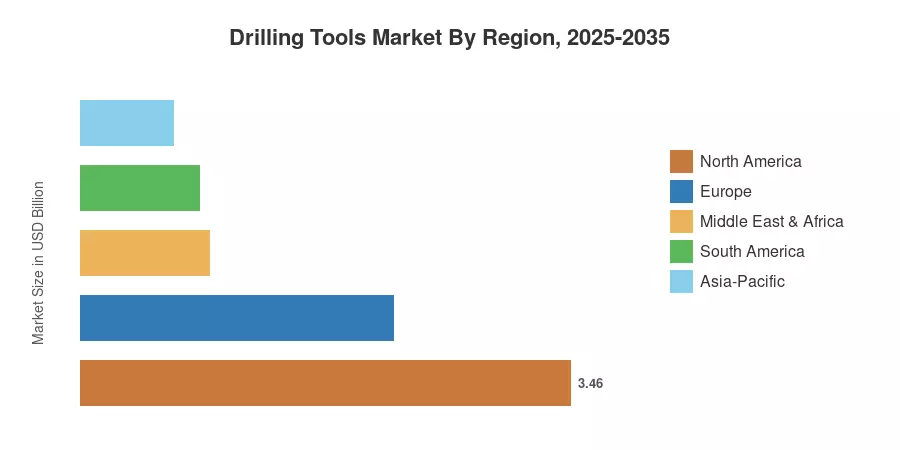
North America remained the dominant force in the Drilling Tools Market, commanding a 35.1% revenue share in 2025, powered by sustained Permian Basin and Montney formation activity. Asia-Pacific is the fastest-growing region with a projected 6.65% CAGR through 2035, driven by accelerating offshore programs in Southeast Asia and India's expanded sedimentary-basin licensing rounds. Europe held the second-largest share at 22.4%, supported by North Sea decommissioning-to-redevelopment cycles and growing geothermal well counts in Germany and Iceland [4]. The Drilling Tools Market trajectory over the coming decade will hinge on how quickly operators integrate automation, data analytics, and lower-carbon drilling programs into their capital budgets.


Key Report Takeaways

• By Tool Type

  • Drill bits accounted for 34.3% of the Drilling Tools Market in 2025, reflecting the universal requirement for cutting structures across every well design.
  • The "Other Tools" category is poised to expand at an 8.31% CAGR through 2035, fueled by growing adoption of specialty jars, hole openers, and casing-exit tools in complex completions.

• By Application

  • Development and production drilling represented 47.8% of the Drilling Tools Market in 2025, as brownfield infill programs kept mature basins productive.
  • Geothermal drilling is forecast to register a 9.92% CAGR through 2035, supported by enhanced geothermal system pilot projects in the US, Germany, and Japan.

• By Region

  • North America generated 35.1% of the Drilling Tools Market revenue in 2025, anchored by horizontal-well intensity across tight-oil and shale-gas plays.
  • Asia-Pacific is set to record the fastest regional growth at 6.65% CAGR, as India, Indonesia, and Australia ramp up exploration investment.


Market Size and Forecast (2021–2035)

Market Research Future derived historical figures from upstream capital expenditure databases, oilfield-service revenue disclosures, and customs-trade data. Forecast projections apply a calibrated CAGR model validated against rig-count trajectories, FID pipelines, and regional permitting trends [5].
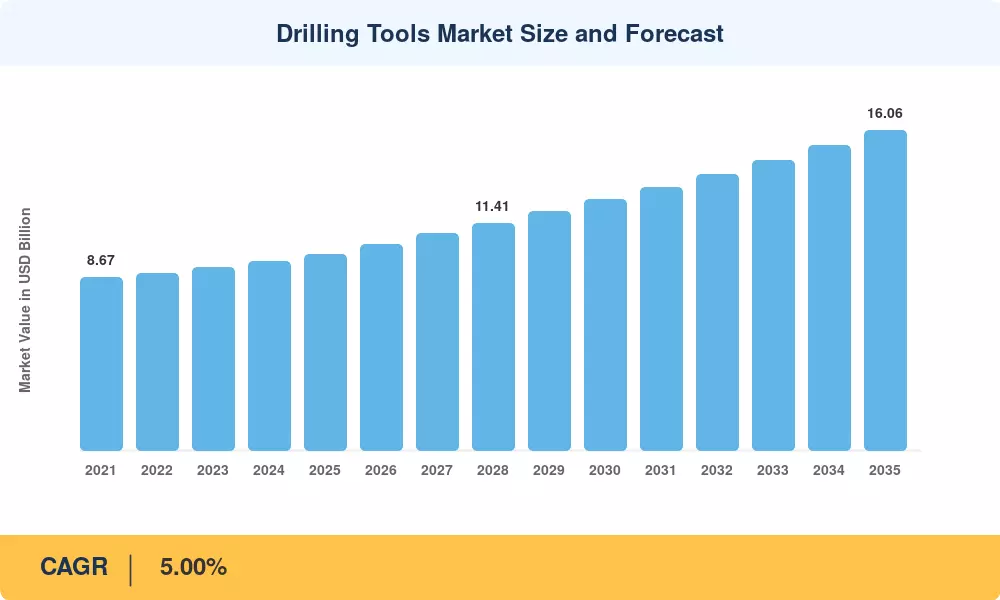
Drilling Tools Market Size and Forecast
Our Impact
Enabled $4.3B Revenue Impact for Fortune 500 and Leading Multinationals
Partnering with 2000+ Global Organizations Each Year
30K+ Citations by Top-Tier Firms in the Industry

Driver Impact Analysis

Driver ~% Impact on CAGR Geographic Relevance Impact Timeline
Deepwater & Ultra-Deepwater FID Pipeline 18–22% Brazil, US GoM, West Africa Medium-term (2–4 yr)
Shale & Tight-Oil Horizontal Drilling Intensity 15–18% North America, Argentina Short-term (≤2 yr)
Geothermal & CCUS Well Programs 12–15% US, Europe, Japan Long-term (≥4 yr)
National Energy Security Mandates 10–13% India, China, Saudi Arabia Medium-term (2–4 yr)
Rotary Steerable System Adoption 8–11% Global Short-term (≤2 yr)
Critical-Mineral Exploration Drilling 6–9% Australia, Canada, DRC Long-term (≥4 yr)
Supply-Chain Localization & Vertical Integration 5–7% Global Medium-term (2–4 yr)


Deepwater & Ultra-Deepwater FID Pipeline

Petrobras sanctioned 15 new floating production units between 2023 and 2025, each requiring purpose-built drilling assemblies rated for pressures exceeding 15,000 psi and temperatures above 150 °C [7]. These projects are expected to consume over USD 4.8 billion in drilling tools and services through 2030, creating sustained demand for high-specification stabilizers, reamers, and managed-pressure-drilling equipment. The Drilling Tools Market stands to benefit as operators in the US Gulf of Mexico mirror this FID momentum with Willow-class developments that mandate extended-reach lateral capabilities.

Shale & Tight-Oil Horizontal Drilling Intensity

Operators in the Permian Basin drilled an average lateral length of 3,400 meters in 2024, a 12% increase over 2022, which directly increased the amount of drill pipe, collars, and cutting structures used per well [8]. Through 2028, the US Department of Energy projects that the number of horizontal wells in the Lower 48 will rise by 6% every year. Longer laterals necessitate higher torque-rated connections and high-end PDC-based cutting systems that can maintain steering at deep, which improves the drilling tools market.


Geothermal & Carbon-Capture Well Programs

The US DOE's Enhanced Geothermal Shot initiative targets a cost reduction to USD 45 per megawatt-hour by 2035, which the agency projects could catalyze 90 GW of geothermal capacity requiring approximately 15,000 new wells [9]. Each geothermal well operates at downhole temperatures that exceed 200 °C, pushing demand toward heat-resistant tool steels and thermally stable cutting elements. This expansion represents a meaningful diversification pathway for the Drilling Tools Market beyond hydrocarbon cycles.

National Energy Security Mandates

India's Open Acreage Licensing Policy Round IX, concluded in early 2025, awarded 28 new exploration blocks spanning 120,000 km² of sedimentary area, with mandatory work-program drilling commitments totaling USD 1.2 billion over five years [10]. China's 14th Five-Year Plan targets a 15% increase in domestic natural gas output by 2030. Both mandates create guaranteed procurement pipelines for drill bits, swivels, and stabilizers, reinforcing the Drilling Tools Market growth thesis in Asia-Pacific.


Restraints Impact Analysis

Restraint ~% Impact on CAGR Geographic Relevance Impact Timeline
Commodity-Price Volatility & Capex Cyclicality –8 to –12% Global Short-term (≤2 yr)
Specialty-Metal Supply Constraints (Tungsten, Cobalt) –5 to –8% Global Medium-term (2–4 yr)
ESG-Driven Drilling Moratoriums –4 to –6% Europe, North America Long-term (≥4 yr)
Skilled-Workforce Shortages –3 to –5% Global Medium-term (2–4 yr)
Regulatory Permitting Delays –2 to –4% US, Brazil Short-term (≤2 yr)


Commodity-Price Volatility & Capex Cyclicality

Within two quarters, an estimated 12–18% decrease in global upstream capital spending is triggered by a 20% drop in Brent crude prices, which immediately reduces the Drilling Tools Market's procurement volumes [14]. According to the International Energy Agency, the single biggest cause of demand uncertainty is the connection between changes in oil prices and orders for drilling tools, which have been above 0.82 since 2015.


Specialty-Metal Supply Constraints

Tungsten carbide accounts for roughly 60% of the material cost in premium drill-bit inserts, and China controls over 80% of global tungsten refining capacity [13]. Trade restrictions and export licensing requirements introduced in 2024 have extended lead times from 8 to 14 weeks for certain grades. Service companies responded with long-term purchase agreements and recycling programs, but cost pass-through has compressed margins across the Drilling Tools Market supply chain.

ESG-Driven Drilling Moratoriums

Several European jurisdictions, including France and Denmark, have enacted permanent bans on new hydrocarbon exploration permits, while the Netherlands imposed a production cap on the Groningen field [15]. These policies remove addressable well-count from the Drilling Tools Market in affected basins and create regulatory uncertainty that chills investment in adjacent frontier areas.


Drilling Tools Market Opportunities

Enhanced Geothermal System Commercialization

Fervo Energy's Project Cape demonstration in Utah achieved a closed-loop flow rate of 63 liters per second in 2024, validating the commercial viability of horizontal geothermal wells drilled with oilfield techniques [9]. As enhanced geothermal system deployments scale from pilot to commercial, the Drilling Tools Market is positioned to supply high-temperature-rated bits, stabilizers, and mud motors adapted for crystalline-rock formations.

Data-Driven Tool-Performance-as-a-Service Models

Leading service providers are transitioning from per-unit equipment sales to performance-based contracts where revenue scales with meters drilled or rate of penetration achieved. SLB's Performance Live platform, for example, integrates downhole sensor data with cloud analytics to optimize bit selection in real time [11]. This shift toward outcome-based pricing could expand the addressable Drilling Tools Market by enabling smaller operators to access premium tools without upfront capital outlay.

Emerging-Market Exploration Ramp

Sub-Saharan Africa holds an estimated 125 billion barrels of undiscovered recoverable resources, yet exploration drilling intensity remains below 0.3 wells per 1,000 km² of prospective acreage [18]. Countries including Namibia, Mozambique, and Senegal have attracted major operator commitments since 2023. The Drilling Tools Market opportunity here is amplified by the near-total reliance on imported tooling, which favors established global suppliers with regional service hubs.

Carbon-Capture and Hydrogen Storage Wells

In 2024, the Global CCS Institute recorded 41 new capture-facility FIDs, all of which required injection-well drilling operations using traditional rotary equipment [19]. An additional demand stream for well building is created by the installation of hydrogen storage caverns in salt domes throughout Texas and northwest Europe. These non-hydrocarbon uses lessen cyclical exposure and diversify the Drilling Tools Market's revenue source.


Automation and Closed-Loop Drilling Systems

Autonomous drilling rigs capable of closed-loop steering reduced non-productive time by up to 30% in 2024 pilot programs across the Middle East [20]. The real-time data feedback loop demands smarter tool designs—embedded sensors, self-diagnosing connections, and adaptive cutting structures. As automation penetration rises, the Drilling Tools Market will see a premium-product mix shift that lifts average selling prices by an estimated 8–12% per well.


Drilling Tools Market Future Outlook

AI-Assisted and Autonomous Drilling Operations

The integration of machine-learning algorithms into drilling-control systems will reshape the Drilling Tools Market over the next decade. Autonomous closed-loop steering pilots reduced connection times by 40% and bit-trip frequency by 25% during 2024 field trials in Oman and the Permian Basin [20]. The IEA projects that full-rig automation could lower per-well drilling costs by 18–22% by 2032, accelerating the payback period for premium downhole tools and embedded-sensor assemblies [1].

Electrification and Hybrid-Power Rig Platforms

Electric and hybrid drilling rigs are displacing diesel-mechanical systems across land-based operations, with over 120 e-rigs operating in North America by mid-2025 [8]. Electrified top drives and drawworks impose different torque and vibration profiles on downhole assemblies, creating re-engineering demand within the Drilling Tools Market. Providers that optimize tool metallurgy and connection designs for electric-rig operating envelopes will capture a disproportionate share.

ESG Reporting and Low-Carbon Drilling Mandates

The Task Force on Climate-related Financial Disclosures framework, adopted by more than 4,000 organizations by 2025, increasingly requires operators to quantify the carbon intensity of drilling operations [15]. This trend pushes procurement toward tools that extend bit runs, reduce trip counts, and minimize energy consumption per meter drilled. The Drilling Tools Market will see ESG compliance evolve from a reputational consideration to a contractual specification embedded in tender documents.

Platform Economics and Integrated Service Bundles

Major oilfield-service companies are bundling drilling tools with directional services, mud systems, and real-time analytics into integrated performance contracts. Baker Hughes and Halliburton both expanded their integrated-well-construction portfolios in 2024 [11]. This bundling compresses standalone Drilling Tools Market margins for smaller manufacturers but raises barriers to entry and increases switching costs for operators, ultimately consolidating market share among the top five providers.


Drilling Tools Market Segmentation

By Type

Segment Key Metric Primary Demand Driver
Drill Bit 34.3% share (2025) Universal cutting-structure requirement
Drill Pipe USD 2.12 Billion (2025) Lateral-length extension programs
Drill Collar 4.38% CAGR (2026–2035) Weight-on-bit needs in deviated wells
Drill Reamer and Stabilizer 11.8% share (2025) Hole-quality assurance in deepwater
Drill Swivel USD 0.73 Billion (2025) Rotary-table rig fleet sustaining demand
Other Tools 8.31% CAGR (2026–2035) Specialty tools for complex completions


Drill bits remain the single largest product category in the Drilling Tools Market, and the segment's steady share reflects the non-discretionary nature of cutting-structure procurement—every well, regardless of type or geography, requires at least one bit run. Technology competition within this segment centers on matrix-body versus steel-body designs, cutter diamond grades, and hydraulic efficiency. Operators in high-temperature geothermal and ultra-deep formations are increasingly specifying thermally stable polycrystalline compacts that extend single-run footage beyond 3,000 meters.

The "Other Tools" category—encompassing jars, hole openers, casing-exit mills, and fishing tools—is the Drilling Tools Market's fastest-growing type segment. Demand is driven by the growing complexity of wellbore architectures, particularly multi-lateral and extended-reach designs that require specialty intervention equipment during drilling and completion phases.

By Application

Segment Key Metric Primary Demand Driver
Development and Production Drilling 47.8% share (2025) Brownfield infill and pad drilling
Geothermal Drilling 9.92% CAGR (2026–2035) EGS pilots and district-heating programs
Other Applications USD 1.58 Billion (2025) Mining, water-well, CCUS injection


Development and production drilling dominate the Drilling Tools Market application mix because mature-basin operators continuously drill infill wells to offset natural production decline rates of 5–8% per year. Pad-drilling techniques in the Permian Basin and Western Canadian Sedimentary Basin compress cycle times, increasing bit and pipe throughput per rig.

Geothermal drilling is emerging as the Drilling Tools Market's highest-growth application. The US DOE's Enhanced Geothermal Shot targets 90 GW of new geothermal capacity, each gigawatt requiring approximately 165 deep wells with bottom-hole temperatures exceeding 200 °C [9]. This extreme operating environment demands heat-resistant alloys and abrasion-resistant stabilizers that command price premiums of 30–50% over conventional hydrocarbon-well specifications.

By Location of Deployment

Segment Key Metric Primary Demand Driver
Onshore 63.2% share (2025) Shale, tight-oil, and geothermal wells
Offshore 5.94% CAGR (2026–2035) Deepwater FIDs in Brazil, GoM, and Africa


Onshore activity accounts for the majority of the Drilling Tools Market because land-based rig counts globally outnumber offshore units by roughly five to one. Offshore drilling, however, is the faster-growing deployment segment as deepwater FIDs accelerate across pre-salt Brazil, the US Gulf of Mexico, and newly opened frontier basins in Namibia and Guyana. Offshore wells consume 2–3× the tool inventory of a typical onshore well due to extended casing programs and higher operating pressures.

By End-User

Segment Key Metric Primary Demand Driver
Oil and Gas Operators 82.5% share (2025) Core upstream E&P activity
Geothermal Developers 7.12% CAGR (2026–2035) Clean-energy capacity additions
Other End-Users USD 0.62 Billion (2025) Mining, utilities, and government agencies


Regional Market Share Analysis

Region Key Metric Primary Investment Themes
North America 35.1% share (2025) Shale laterals, GoM deepwater, geothermal pilots
Europe USD 2.21 Billion (2025) North Sea redevelopment, geothermal heating
Asia-Pacific 6.65% CAGR (2026–2035) Offshore gas, sedimentary-basin licensing
South America USD 0.84 Billion (2025) Pre-salt deepwater, Vaca Muerta shale
Middle East & Africa 9.2% share (2025) Capacity expansion, frontier exploration
Total USD 9.86 Billion (2025)

The Drilling Tools Market exhibits a regionally concentrated structure, with North America and Asia-Pacific collectively representing nearly 60% of global demand. Rig deployment patterns, subsurface geology, and policy frameworks drive distinct tool-mix profiles across each geography.


North America

Country Key Metric Key Driver
US 72.4% of regional share Permian & Eagle Ford horizontal programs
Canada 18.6% of regional share Montney & Duvernay development
Mexico 5.18% CAGR Shallow-water Campeche revival


North America's dominance in the Drilling Tools Market stems from the world's highest horizontal-well density. The US alone operated over 580 active drilling rigs in late 2024, consuming roughly 2.8 drill bits per completed lateral [8]. Canada's Trans Mountain Pipeline expansion is stimulating upstream reinvestment in heavy-oil and condensate-rich plays, while Mexico's regulatory reforms are gradually reopening shallow-water blocks to international operators.

Europe

Country Key Metric Key Driver
Germany 4.82% CAGR Deep geothermal for district heating
UK 28.3% of regional share North Sea brownfield redevelopment
France USD 0.18 Billion (2025) Geothermal-only drilling programs
Italy 12.1% of regional share Adriatic gas reactivation
Spain 3.9% of regional share Geothermal exploration
Nordic Countries USD 0.15 Billion (2025) Arctic shelf delineation wells
Russia 24.5% of regional share Western Siberia sustaining programs
Rest of Europe 7.8% of regional share Central European geothermal expansion


The European Drilling Tools Market is transitioning from a hydrocarbon-extraction focus toward geothermal and carbon-storage applications. Germany's Federal Mining Act amendments fast-tracked 48 geothermal drilling permits in 2024, while the UK North Sea Transition Authority approved 31 new development wells across five brownfield licenses in the same period [4].

Asia-Pacific

Country Key Metric Key Driver
China 34.8% of regional share Sichuan shale gas, Tarim deep wells
India 7.24% CAGR OALP sedimentary-basin blocks
Japan USD 0.21 Billion (2025) Geothermal resource development
South Korea 3.5% of regional share Offshore continental shelf exploration
ASEAN 5.89% CAGR Offshore gas in Malaysia & Indonesia
Rest of Asia-Pacific 8.1% of regional share Australia CSG & frontier basins


Asia-Pacific represents the fastest-growing opportunity within the Drilling Tools Market, driven by India's ambition to reduce energy imports by 10% through domestic production gains and China's push to develop Sichuan Basin shale reserves at depths exceeding 4,500 meters [10]. Indonesia's upstream regulator approved 15 new exploration plans for development in 2024, each requiring multi-well drilling campaigns that boost regional tool procurement.

South America

Country Key Metric Key Driver
Brazil 64.2% of regional share Pre-salt Santos & Campos basins
Argentina 5.75% CAGR Vaca Muerta horizontal expansion
Rest of South America USD 0.11 Billion (2025) Guyana & Suriname exploration


Brazil is the cornerstone of the South American Drilling Tools Market, where Petrobras and partner-operated pre-salt programs sustain a fleet of more than 30 floating drilling rigs year-round [7]. Argentina's Vaca Muerta formation has attracted over USD 5 billion in committed drilling investment since 2023, with horizontal-well completions quadrupling between 2021 and 2025.

Middle East & Africa

Country Key Metric Key Driver
Saudi Arabia 38.1% of regional share Jafurah unconventional gas program
UAE 5.62% CAGR ADNOC capacity-expansion drilling
South Africa USD 0.04 Billion (2025) Offshore Orange Basin exploration
Egypt 14.3% of regional share Mediterranean deepwater gas
Rest of MEA 21.9% of regional share Namibia frontier exploration


The Middle East & Africa segment of the Drilling Tools Market is anchored by Saudi Arabia's Jafurah unconventional gas program, which targets 2 billion cubic feet per day of production by 2030 and requires over 3,000 wells across its full development plan [20]. Namibia's Orange Basin discoveries by Shell and TotalEnergies generated significant FID momentum starting in 2024, positioning West Africa as a new frontier demand center.


Drilling Tools Market By Region, 2025-2035

Competitive Benchmarking

The Drilling Tools Market operates under moderate concentration, with the top five companies holding an estimated 50–58% of global revenue in 2024. The Herfindahl-Hirschman Index for this space sits in the 1,200–1,500 range, indicating a moderately competitive environment where large integrated service providers coexist with specialized manufacturers [21]. Barriers to entry remain high due to metallurgical IP, global service-network requirements, and qualification cycles that can exceed 18 months for new tool designs.

Company Est. Revenue Share Range Key Offerings for Drilling Tools Market Strategic Positioning
SLB 14–18% Smith Bits, rotary steerable systems, drilling optimization platforms Full-cycle integrated drilling solutions
Baker Hughes 11–15% Hughes Christensen bits, AutoTrak systems, tubular services Technology-led downhole tool portfolio
Halliburton 10–14% Sperry Drilling, Baroid fluids, drill bits, and reamers Completions-to-drilling integration
NOV 7–10% ReedHycalog bits, tubulars, rig equipment, downhole tools Equipment manufacturing scale
Weatherford 5–8% Drilling jars, stabilizers, fishing tools, tubular running services Specialty tool and intervention focus
National Oilwell Varco (Grant Prideco) 3–5% Premium drill pipe and connections High-spec tubular niche
Schoeller-Bleckmann Oilfield Equipment 2–4% Non-magnetic drill collars, MWD housings Precision-machined component specialist
Varel Energy Solutions 2–4% Fixed-cutter and roller-cone bits Regional bit manufacturing
Ulterra Drilling Technologies 1–3% Counterstrike PDC bits, custom cutter layouts Fast-cycle bit design innovation
Wenzel Downhole Tools 1–2% Drilling jars, accelerators, intensifiers Niche shock-tool specialist


Recent News & Developments

  • SLB (September 2024): Launched the Neuro autonomous drilling platform, integrating real-time lithology prediction with closed-loop steering, reducing non-productive time by 32% in Permian Basin trials [11].
  • Halliburton (March 2024): Signed a five-year integrated drilling services contract with ADNOC covering over 1,200 wells across onshore Abu Dhabi concessions [20].
  • Weatherford (January 2025): Expanded its managed-pressure-drilling portfolio with the launch of the Victus 2.0 rotating control device for deepwater applications [23].
  • US Department of Energy (August 2024): Awarded USD 74 Million in grants under the Enhanced Geothermal Shot program, funding six demonstration projects that will require dedicated high-temperature drilling tool sets [9].
  • Petrobras (May 2024): Approved the Búzios 10 FPSO development, adding an estimated 180 new subsea wells to the Brazilian pre-salt drilling pipeline through 2032 [7].


Drilling Tools Market Report Scope

Parameter Detail
Market Scope Global Drilling Tools Market
Study Period 2021–2035
CAGR (2026–2035) 5.00%
Base Year 2025 — USD 9.86 Billion
2026 Starting Forecast Value USD 10.35 Billion
2035 Endpoint Value USD 16.06 Billion
Fastest Growing Segment (Type) Other Tools (8.31% CAGR)
Fastest Growing Segment (Application) Geothermal Drilling (9.92% CAGR)
Companies Profiled 10 (SLB, Baker Hughes, Halliburton, NOV, Weatherford, and others)
Valuation Currency USD Billion


FAQs

How do operators evaluate the total cost of ownership when selecting drill bits for extended-reach wells?
Operators compare cost per meter drilled rather than unit price, factoring in run footage, rate of penetration, and trip time. Integrated performance contracts increasingly shift cost risk to the service provider [2].
What qualification steps does a new drilling-tool manufacturer face before field deployment?
New entrants must complete laboratory burst and fatigue testing, followed by supervised field trials spanning 10–15 wells. The full qualification cycle typically runs 12–24 months [6].
How does tungsten-carbide recycling affect supply security for the Drilling Tools Market?
Recycling recovers up to 95% of the tungsten content from spent inserts, reducing dependence on primary mining. Several major suppliers now source 20–30% of carbide feedstock through closed-loop recycling programs [13].
What role do digital twins play in optimizing drilling-tool performance?
Digital twins simulate downhole conditions to predict bit wear and optimize weight-on-bit parameters before spudding. Early adopters report 10–15% improvement in single-run footage [11].
How are managed-pressure-drilling systems changing tool specifications in the Drilling Tools Market?
Managed-pressure drilling narrows the pressure window, requiring tighter tolerances on stabilizer gauge and reamer expansion mechanisms. Tool OEMs are redesigning seals and actuation systems for dynamic-pressure environments [23].
What insurance and liability considerations apply to autonomous drilling-tool deployment?
Liability frameworks remain evolving; most operators carry additional equipment-failure riders when deploying closed-loop steering systems. Industry working groups are drafting standardized risk-allocation templates [16].
How do geothermal well requirements differ from conventional hydrocarbon wells for the Drilling Tools Market?
Geothermal wells encounter harder crystalline rock and temperatures above 200 °C, demanding thermally stable diamond compacts and heat-treated drill-pipe grades. Tool replacement rates run 40–60% higher than conventional wells [9].    
Author
Author
Author Profile
Chitranshi Jaiswal LinkedIn
Team Lead - Research
Chitranshi is a Team Leader in the Chemicals & Materials (CnM) and Energy & Power (EnP) domains, with 6+ years of experience in market research. She leads and mentors teams to deliver cross-domain projects that equip clients with actionable insights and growth strategies. She is skilled in market estimation, forecasting, competitive benchmarking, and both primary & secondary research, enabling her to turn complex data into decision-ready insights. An engineer and MBA professional, she combines technical expertise with strategic acumen to solve dynamic market challenges. Chitranshi has successfully managed projects that support market entry, investment planning, and competitive positioning, while building strong client relationships. Certified in Advanced Excel & Power BI she leverages data-driven approaches to ensure accuracy, clarity, and impactful outcomes.
Download Free Sample

Kindly complete the form below to receive a free sample of this Report

Download PDF ×

We do not share your information with anyone. However, we may send you emails based on your report interest from time to time. You may contact us at any time to opt-out.