×
Request Free Sample ×

Kindly complete the form below to receive a free sample of this Report

* Please use a valid business email

Leading companies partner with us for data-driven Insights

clients tt-cursor
Hero Background

Driveline Additives Market

ID: MRFR/CnM/8425-HCR
111 Pages
Priya Nagrale
October 2025

Driveline Additives Market Research Report By Product Type (Antiwear and EP Additives, Friction Modifiers, Antioxidants and Corrosion Inhibitors, Emulsifiers and Viscosity Modifiers), By Application (Automotive, Industrial, Marine), By Viscosity Grade (SAE 75W, SAE 80W, SAE 90W, SAE 140W, Other), By Performance Level (API GL-4, API GL-5, API MT-1, MIL-PRF-2105E, Other) and By Regional (North America, Europe, South America, Asia-Pacific, Middle East and Africa) - Forecast to 2035

Share:
Download PDF ×

We do not share your information with anyone. However, we may send you emails based on your report interest from time to time. You may contact us at any time to opt-out.

Driveline Additives Market Infographic
Purchase Options

Driveline Additives Market Summary

As per MRFR analysis, the Driveline Additives Market Size was estimated at 10.66 USD Billion in 2024. The Driveline Additives industry is projected to grow from 10.94 USD Billion in 2025 to 14.23 USD Billion by 2035, exhibiting a compound annual growth rate (CAGR) of 2.66 during the forecast period 2025 - 2035.

Key Market Trends & Highlights

The Driveline Additives Market is poised for growth driven by sustainability and technological advancements.

  • The market is increasingly influenced by a focus on sustainability and eco-friendly formulations.
  • Technological advancements are enhancing the performance and efficiency of driveline additives.
  • North America remains the largest market, while Asia-Pacific is recognized as the fastest-growing region.
  • The rising demand for fuel efficiency and stringent environmental regulations are key drivers of market growth.

Market Size & Forecast

2024 Market Size 10.66 (USD Billion)
2035 Market Size 14.23 (USD Billion)
CAGR (2025 - 2035) 2.66%

Major Players

BASF (DE), Chevron (US), ExxonMobil (US), Fuchs Petrolub (DE), Lubrizol (US), Royal Dutch Shell (NL), TotalEnergies (FR), Afton Chemical (US), Innospec (GB)

Driveline Additives Market Trends

The Driveline Additives Market is currently experiencing a dynamic evolution, driven by the increasing demand for enhanced performance and efficiency in automotive applications. As vehicles become more sophisticated, the need for specialized additives that improve lubrication, reduce friction, and enhance overall driveline functionality is becoming more pronounced. This market appears to be influenced by various factors, including advancements in technology, regulatory changes, and shifting consumer preferences towards more sustainable and efficient solutions. Manufacturers are likely focusing on developing innovative formulations that cater to the diverse needs of modern drivetrains, which may include electric and hybrid vehicles. In addition, the growing awareness regarding environmental concerns is prompting stakeholders to explore eco-friendly alternatives in driveline additives. This trend suggests a potential shift towards bio-based and biodegradable products, which could reshape the competitive landscape. Furthermore, the increasing integration of smart technologies in vehicles may lead to the development of additives that not only enhance performance but also provide real-time monitoring capabilities. Overall, the Driveline Additives Market appears poised for growth, with opportunities emerging from technological advancements and changing consumer expectations.

Sustainability Focus

The Driveline Additives Market is witnessing a notable shift towards sustainability, as manufacturers increasingly prioritize eco-friendly formulations. This trend reflects a growing consumer demand for products that minimize environmental impact, leading to the development of bio-based and biodegradable additives. Such innovations not only align with regulatory requirements but also cater to the preferences of environmentally conscious consumers.

Technological Advancements

Technological progress is significantly influencing the Driveline Additives Market, with manufacturers investing in research and development to create high-performance additives. These advancements aim to enhance lubrication properties, reduce wear, and improve fuel efficiency. As vehicles evolve, particularly with the rise of electric and hybrid models, the need for specialized additives that meet new performance standards becomes increasingly critical.

Integration of Smart Technologies

The integration of smart technologies into vehicles is emerging as a key trend within the Driveline Additives Market. This development suggests a potential for additives that not only improve performance but also incorporate monitoring capabilities. Such innovations may enable real-time assessments of driveline conditions, thereby enhancing maintenance practices and overall vehicle reliability.

Driveline Additives Market Drivers

Growing Automotive Industry

The expansion of the automotive industry plays a pivotal role in driving the Global Driveline Additives Market Industry. As vehicle production increases, the demand for driveline additives, which enhance performance and longevity, rises correspondingly. In 2024, the market is projected to reach 10.7 USD Billion, reflecting the industry's robust growth. This trend is particularly evident in emerging markets where vehicle ownership is on the rise. The integration of advanced technologies in vehicles necessitates the use of specialized driveline additives to ensure optimal performance, thereby propelling market growth.

Increased Focus on Vehicle Performance

The growing consumer emphasis on vehicle performance and longevity significantly impacts the Global Driveline Additives Market Industry. As consumers become more discerning, the demand for high-quality driveline additives that enhance vehicle efficiency and durability is on the rise. This trend is particularly pronounced in high-performance and luxury vehicle segments, where consumers are willing to invest in premium additives. The market's growth trajectory reflects this shift, with expectations of reaching 10.7 USD Billion in 2024. Manufacturers are responding by developing innovative formulations that cater to these performance-oriented consumers.

Technological Advancements in Additives

Technological innovations in driveline additives significantly influence the Global Driveline Additives Market Industry. The development of high-performance additives that improve fuel efficiency and reduce emissions aligns with global sustainability goals. For instance, advancements in synthetic additives provide superior lubrication and protection, which are crucial for modern drivetrains. As manufacturers increasingly adopt these technologies, the market is expected to grow, with projections indicating a rise to 14.2 USD Billion by 2035. This shift towards more efficient and environmentally friendly products suggests a promising future for the industry.

Expansion of Electric and Hybrid Vehicles

The increasing adoption of electric and hybrid vehicles is reshaping the Global Driveline Additives Market Industry. As these vehicles become more prevalent, there is a growing need for specialized driveline additives that cater to their unique requirements. This transition presents both challenges and opportunities for manufacturers, as they must innovate to meet the demands of this evolving market. The projected growth to 14.2 USD Billion by 2035 indicates a significant shift in consumer preferences and technological advancements. The industry is likely to adapt by developing additives that enhance the efficiency and performance of electric drivetrains.

Regulatory Compliance and Environmental Standards

Stringent regulatory frameworks regarding emissions and fuel efficiency are driving the Global Driveline Additives Market Industry. Governments worldwide are implementing stricter standards, compelling manufacturers to adopt driveline additives that comply with these regulations. This compliance not only enhances vehicle performance but also contributes to reduced environmental impact. As a result, the market is likely to experience sustained growth, with a projected CAGR of 2.66% from 2025 to 2035. The push for greener technologies is expected to further elevate the demand for specialized additives that meet these evolving standards.
Market Segment Insights

By Application: Transmission Fluids (Largest) vs. Gear Oils (Fastest-Growing)

Within the Driveline Additives Market, the application segment showcases a diverse range of products, with Transmission Fluids holding the largest market share. This segment is crucial as it caters to both manual and automatic transmissions, offering essential lubrication and performance enhancement. Following close behind are Gear Oils and Differential Fluids, while Transfer Case Fluids, though smaller in market share, play a vital role in specific vehicle applications.

Transmission Fluids (Dominant) vs. Gear Oils (Emerging)

Transmission Fluids are a dominant player in the driveline additives segment, primarily due to their essential role in vehicle performance and longevity. They provide crucial lubrication, cooling, and protection for transmission systems, making them an indispensable component in both conventional and electric vehicles. Gear Oils are emerging rapidly, driven by the increasing demand for high-performance vehicles requiring advanced lubrication solutions. These oils enhance gear performance, reduce wear and friction, and are increasingly formulated to meet stringent automotive standards, positioning them as a necessary option for modern drivetrains.

By End Use: Automotive (Largest) vs. Industrial (Fastest-Growing)

In the Driveline Additives Market, the automotive segment holds the largest share, driven by the continuous demand for enhanced vehicle performance and fuel efficiency. This segment caters to a diverse range of applications, from passenger cars to heavy-duty vehicles, reflecting its critical role in the market's overall performance. Conversely, the industrial segment, while smaller, is recognized as the fastest-growing, fueled by the expansion of manufacturing and construction industries that require high-performance lubricants and additives to optimize equipment efficiency and longevity.

Automotive: Passenger Cars (Dominant) vs. Heavy-Duty (Emerging)

The automotive segment is further divided into passenger cars and heavy-duty applications, with passenger cars dominating the market due to the sheer volume of vehicles produced and consumed globally. These vehicles require driveline additives to enhance performance, improve fuel economy, and reduce emissions, thereby aligning with regulatory standards and consumer preferences. On the other hand, heavy-duty applications are an emerging market within this segment, driven by the need for robust additives that can withstand extreme operating conditions and high loads, making them critical for commercial fleets and construction machinery.

By Type: Synthetic Additives (Largest) vs. Bio-based Additives (Fastest-Growing)

In the Driveline Additives Market, the 'Type' segment reveals a diverse distribution of value among synthetic, mineral, and bio-based additives. Synthetic additives hold the largest share due to their widespread use in performance enhancement and lubrication. They are highly favored for their superior stability and efficiency in extreme conditions, contributing to their dominance. Mineral additives, although significant, are becoming less prevalent as manufacturers shift towards more advanced synthetic alternatives. Conversely, bio-based additives are emerging as the fastest-growing segment, attracting attention for their eco-friendly characteristics and compliance with sustainability trends.

Synthetic Additives (Dominant) vs. Bio-based Additives (Emerging)

Synthetic additives are currently positioned as the dominant force in the Driveline Additives Market. Their ability to enhance lubricity and reduce wear in driveline components has made them indispensable in high-performance applications. As automotive technologies evolve, synthetic additives continue to evolve, catering to new specifications and demanding environments. On the other hand, bio-based additives represent an emerging category, gaining traction due to their renewable origins and lower environmental impact. As consumers and manufacturers alike prioritize sustainability, bio-based additives are quickly becoming a significant alternative, promising growth potential while addressing regulatory pressures for greener solutions.

By Functionality: Friction Modifiers (Largest) vs. Corrosion Inhibitors (Fastest-Growing)

The Driveline Additives Market is characterized by a diverse range of functionalities, with Friction Modifiers commanding the largest market share. Their ability to reduce friction between moving parts enhances engine efficiency and contributes to lower fuel consumption, making them highly sought after by automotive manufacturers. Corrosion Inhibitors, while currently smaller in market share, represent the fastest-growing segment as they provide essential protection against rust and corrosion, which is becoming increasingly important in the development of long-lasting driveline fluids.

Friction Modifiers (Dominant) vs. Corrosion Inhibitors (Emerging)

Friction Modifiers are recognized as the dominant component within the Driveline Additives Market, effectively minimizing wear and tear on engine components. They enhance the performance of lubricants and boost fuel efficiency, thus appealing to eco-conscious consumers and industries aiming to reduce operational costs. In contrast, Corrosion Inhibitors are emerging rapidly to address the evolving needs of the automotive and industrial sectors, where environmental factors and material longevity are critical. Their formulation allows for extended protection in severe conditions, driving a surge in demand as industries prioritize reliability and maintenance reduction.

By Formulation: Single Component (Largest) vs. Multi Component (Fastest-Growing)

In the Driveline Additives Market, the formulation segment exhibits a diverse landscape dominated by single-component formulations. These formulations are preferred for their simplicity and effectiveness, making them the largest contributor to the market share. On the other hand, multi-component formulations are gaining traction due to their ability to combine different functionalities for enhanced performance. Their increasing popularity reflects a shift towards more complex formulations driven by advanced automotive technologies. As the automotive industry evolves, the demand for efficient and high-performance driveline additives is surging. Multi-component formulations are particularly well-received in high-performance applications where multiple attributes, such as lubrication and efficiency, are required. The growing focus on sustainability and reduced emissions is also propelling the adoption of concentrated solutions, which are considered an emerging trend, gaining competitive ground in the market as manufacturers innovate to meet new regulatory standards.

Single Component (Dominant) vs. Multi Component (Emerging)

Single-component formulations have long been the dominant force in the Driveline Additives Market, characterized by their straightforward application and reliable performance. They offer end-users an easy-to-use solution without the complexities associated with combining multiple additives. However, as automotive technology advances, multi-component formulations are emerging, bringing innovative features such as enhanced fuel efficiency and longer-lasting performance. These formulations are tailored for specific requirements, making them increasingly desirable for modern vehicles. The shift towards multi-component systems reflects a growing industry trend towards customization in driveline solutions, promising better overall functionality and supporting the latest advancements in vehicle performance.

Get more detailed insights about Driveline Additives Market

Regional Insights

North America : Market Leader in Additives

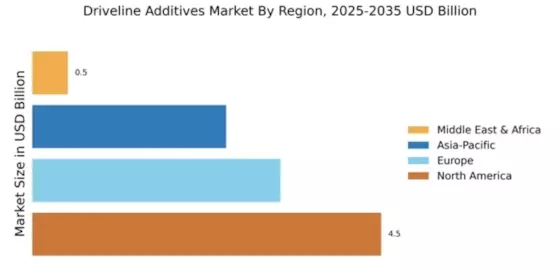
North America is poised to maintain its leadership in the Driveline Additives Market, holding a significant market share of 4.5 in 2024. The region's growth is driven by increasing automotive production, stringent environmental regulations, and a shift towards high-performance lubricants. Demand for advanced driveline solutions is further fueled by the rise in electric vehicles (EVs) and hybrid technologies, which require specialized additives to enhance efficiency and performance. The competitive landscape in North America is robust, featuring key players such as Chevron, ExxonMobil, and Lubrizol. These companies are investing heavily in R&D to innovate and meet the evolving needs of the automotive sector. The presence of established manufacturers and a strong distribution network contribute to the region's dominance, ensuring a steady supply of high-quality driveline additives to meet market demands.

Europe : Innovation and Sustainability Focus

Europe's Driveline Additives Market is characterized by a strong emphasis on sustainability and innovation, with a market size of 3.2. The region is witnessing a shift towards eco-friendly additives, driven by stringent EU regulations aimed at reducing emissions and enhancing fuel efficiency. This regulatory environment is fostering demand for advanced formulations that comply with environmental standards, thus propelling market growth. Leading countries such as Germany, France, and the UK are at the forefront of this transition, supported by major players like BASF and TotalEnergies. The competitive landscape is marked by collaborations and partnerships aimed at developing sustainable solutions. As the automotive industry in Europe increasingly adopts electric and hybrid vehicles, the demand for specialized driveline additives is expected to rise significantly, ensuring a dynamic market environment.

Asia-Pacific : Emerging Market Potential

The Asia-Pacific region, with a market size of 2.8, is emerging as a significant player in the Driveline Additives Market. The rapid growth of the automotive sector, particularly in countries like China and India, is driving demand for high-performance additives. Increasing vehicle production and rising consumer awareness regarding vehicle maintenance are key factors contributing to this growth. Additionally, government initiatives promoting cleaner fuels and advanced technologies are further catalyzing market expansion. China stands out as a leading country in this region, with major companies like Fuchs Petrolub and Innospec establishing a strong presence. The competitive landscape is evolving, with local manufacturers also entering the market to meet the growing demand. As the region continues to urbanize and vehicle ownership rises, the need for innovative driveline solutions will become increasingly critical, positioning Asia-Pacific for substantial growth in the coming years.

Middle East and Africa : Untapped Market Opportunities

The Middle East and Africa region, with a market size of 0.16, presents untapped opportunities in the Driveline Additives Market. The growth is primarily driven by increasing automotive sales and a rising demand for high-quality lubricants. As economies in this region develop, there is a growing focus on enhancing vehicle performance and longevity, which is expected to boost the demand for specialized additives. Additionally, government initiatives aimed at improving infrastructure and transportation are likely to support market growth. Countries like South Africa and the UAE are leading the way in automotive advancements, with key players beginning to establish a foothold in the market. The competitive landscape is gradually evolving, with both international and local companies vying for market share. As awareness of the benefits of advanced driveline additives increases, the region is set to experience significant growth in the coming years, making it an attractive market for investment.

Key Players and Competitive Insights

The Driveline Additives Market is characterized by a competitive landscape that is increasingly shaped by innovation, sustainability, and strategic partnerships. Key players such as BASF (DE), Chevron (US), and ExxonMobil (US) are actively pursuing strategies that emphasize technological advancements and eco-friendly formulations. These companies are not only focusing on enhancing product performance but are also aligning their operations with global sustainability goals, which appears to be a significant driver of market growth. The collective efforts of these firms in research and development, alongside their commitment to reducing environmental impact, are likely to redefine competitive dynamics in the sector.

In terms of business tactics, companies are increasingly localizing manufacturing to enhance supply chain efficiency and reduce operational costs. The market structure is moderately fragmented, with several players vying for market share, yet the influence of major corporations remains substantial. This competitive environment encourages innovation and drives companies to optimize their supply chains, ensuring that they can respond swiftly to market demands while maintaining product quality.

In November 2025, BASF (DE) announced the launch of a new line of bio-based driveline additives aimed at reducing carbon emissions. This strategic move not only aligns with global sustainability trends but also positions BASF as a leader in eco-friendly solutions within the market. The introduction of these products is expected to attract environmentally conscious consumers and enhance BASF's competitive edge.

Similarly, in October 2025, Chevron (US) expanded its partnership with a leading technology firm to integrate AI-driven analytics into its production processes. This initiative is anticipated to optimize operational efficiency and improve product formulation, thereby enhancing Chevron's market position. The integration of advanced technologies reflects a broader trend within the industry towards digital transformation, which is likely to yield significant competitive advantages.

Moreover, in September 2025, ExxonMobil (US) unveiled a new initiative focused on developing high-performance driveline additives that meet stringent regulatory standards. This strategic focus on compliance and performance not only addresses market demands but also reinforces ExxonMobil's commitment to innovation. By prioritizing regulatory alignment, the company is likely to strengthen its reputation and customer trust in a highly competitive market.

As of December 2025, the competitive trends in the Driveline Additives Market are increasingly influenced by digitalization, sustainability, and the integration of advanced technologies. Strategic alliances are becoming more prevalent, enabling companies to leverage shared expertise and resources. The shift from price-based competition to a focus on innovation and supply chain reliability is evident, suggesting that future differentiation will hinge on technological advancements and sustainable practices. Companies that can effectively navigate these trends are likely to emerge as leaders in the evolving market landscape.

Key Companies in the Driveline Additives Market market include

Industry Developments

  • Q1 2025: ENEOS Corporation Announces New Driveline Fluid Blending Facility in Gujarat, India ENEOS Corporation announced the opening of a driveline fluid blending facility in Gujarat, India, to meet rising demand for synthetic gear oils with enhanced additive formulations in Southeast Asia. The facility aims to optimize logistics and regional scalability for light commercial vehicle sales.
  • Q1 2025: Afton Chemical Launches e-Axle Additive Platform for Electric Transmissions Afton Chemical Corporation released its new e-axle additive platform engineered for electric vehicle transmissions operating under high-voltage conditions, supporting thermal stability and anti-wear performance in EV-specific applications.
  • Q1 2025: Lubrizol Expands OEM-Aligned Additive Platforms for Hybrid and Electric Vehicle Powertrains Lubrizol announced the expansion of its OEM-aligned additive platforms to meet the frictional and load-bearing requirements of hybrid and electric vehicle powertrains, in response to regulatory policies promoting carbon neutrality.

Future Outlook

Driveline Additives Market Future Outlook

The Driveline Additives Market is projected to grow at a 2.66% CAGR from 2024 to 2035, driven by increasing automotive production and demand for fuel efficiency.

New opportunities lie in:

  • Development of bio-based driveline additives for eco-friendly vehicles.
  • Integration of smart additives with IoT for real-time performance monitoring.
  • Expansion into emerging markets with tailored product offerings.

By 2035, the Driveline Additives Market is expected to achieve robust growth, reflecting evolving industry demands.

Market Segmentation

Driveline Additives Market Type Outlook

  • Synthetic Additives
  • Mineral Additives
  • Bio-based Additives

Driveline Additives Market End Use Outlook

  • Automotive
  • Industrial
  • Commercial
  • Marine

Driveline Additives Market Application Outlook

  • Transmission Fluids
  • Gear Oils
  • Differential Fluids
  • Transfer Case Fluids

Driveline Additives Market Formulation Outlook

  • Single Component
  • Multi Component
  • Concentrated Solutions

Driveline Additives Market Functionality Outlook

  • Friction Modifiers
  • Viscosity Index Improvers
  • Corrosion Inhibitors
  • Extreme Pressure Additives

Report Scope

MARKET SIZE 202410.66(USD Billion)
MARKET SIZE 202510.94(USD Billion)
MARKET SIZE 203514.23(USD Billion)
COMPOUND ANNUAL GROWTH RATE (CAGR)2.66% (2024 - 2035)
REPORT COVERAGERevenue Forecast, Competitive Landscape, Growth Factors, and Trends
BASE YEAR2024
Market Forecast Period2025 - 2035
Historical Data2019 - 2024
Market Forecast UnitsUSD Billion
Key Companies ProfiledBASF (DE), Chevron (US), ExxonMobil (US), Fuchs Petrolub (DE), Lubrizol (US), Royal Dutch Shell (NL), TotalEnergies (FR), Afton Chemical (US), Innospec (GB)
Segments CoveredApplication, End Use, Type, Functionality, Formulation
Key Market OpportunitiesIntegration of advanced synthetic formulations to enhance driveline efficiency and reduce emissions.
Key Market DynamicsRising demand for high-performance driveline additives driven by stringent automotive efficiency regulations and technological advancements.
Countries CoveredNorth America, Europe, APAC, South America, MEA

Leave a Comment

FAQs

What is the current and projected size of the Driveline Additives Market?

Driveline Additives Market is projected to register a CAGR of 2.66% from 2025-2035

Which region is expected to dominate the Driveline Additives Market?

Asia-Pacific is anticipated to lead the Driveline Additives Market, owing to the increasing vehicle production and growing demand for fuel-efficient vehicles in countries such as China, India, and Japan.

What are the key applications of Driveline Additives?

Driveline Additives find application in various components of vehicles, including transmissions, differentials, and axles. They are used to enhance the performance and durability of these components, reduce friction, and improve fuel efficiency.

Who are the major players in the Driveline Additives Market?

Key players operating in the Driveline Additives Market include The Lubrizol Corporation, Infineum International Limited, Chevron Oronite Company LLC, Afton Chemical Corporation, and Evonik Industries AG.

What are the major factors driving the growth of the Driveline Additives Market?

The growing demand for fuel-efficient vehicles, stringent emission regulations, and increasing vehicle production are the primary factors driving the growth of the Driveline Additives Market.

What are the challenges faced by the Driveline Additives Market?

The challenges faced by the Driveline Additives Market include the development of alternative fuels and electric vehicles, which may reduce the demand for traditional driveline systems.

What are the opportunities for growth in the Driveline Additives Market?

Opportunities for growth in the Driveline Additives Market lie in the development of new and innovative additives that meet the evolving needs of the automotive industry, as well as the expansion into emerging markets.

How is the Driveline Additives Market expected to evolve in the future?

The Driveline Additives Market is expected to witness continued growth in the coming years, driven by the increasing adoption of fuel-efficient vehicles and the growing automotive industry in emerging markets.

What are the key trends shaping the Driveline Additives Market?

Key trends shaping the Driveline Additives Market include the shift towards electric vehicles, the development of new additive technologies, and the increasing focus on sustainability.

What are the potential risks associated with the Driveline Additives Market?

Potential risks associated with the Driveline Additives Market include the impact of economic downturns, changes in government regulations, and the emergence of disruptive technologies.

Download Free Sample

Kindly complete the form below to receive a free sample of this Report

Compare Licence

×
Features License Type
Single User Multiuser License Enterprise User
Price $4,950 $ $7,250
Maximum User Access Limit 1 User Upto 10 Users Unrestricted Access Throughout the Organization
Free Customization
Direct Access to Analyst
Deliverable Format
Platform Access
Discount on Next Purchase 10% 15% 15%
Printable Versions