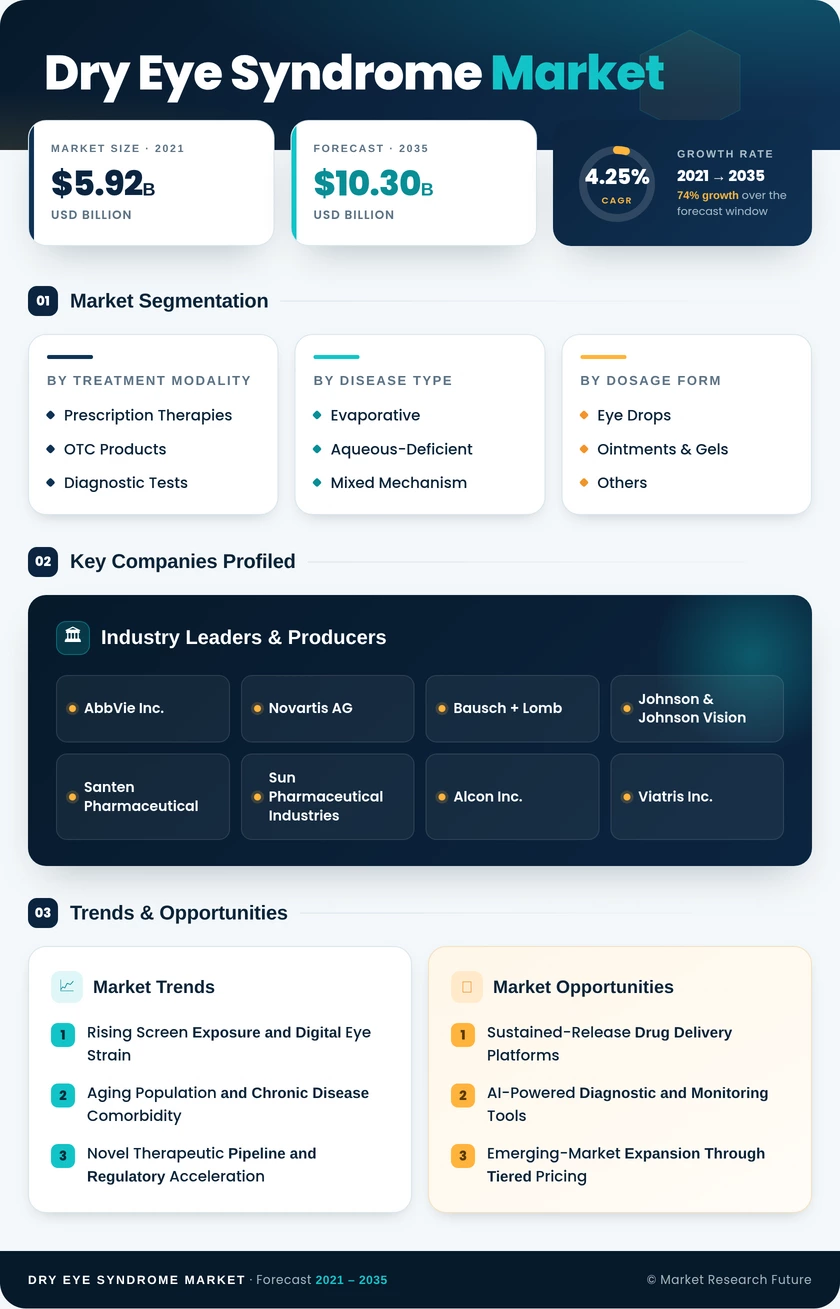
Segmentation Quick Reference
| Dimension | Sub-Segments | Dominant Segment | Fastest Growing Segment |
| Treatment Modality | Prescription Therapies, OTC Products, Diagnostic Tests | Prescription Therapies (45.3% share) | Diagnostic Tests (7.10% CAGR) |
| Disease Type | Evaporative, Aqueous-Deficient, Mixed Mechanism | Evaporative (56.1% share) | Aqueous-Deficient (8.01% CAGR) |
| Dosage Form | Eye Drops, Ointments & Gels, Others | Eye Drops (70.2% share) | Ointments & Gels (8.60% CAGR) |
| Distribution Channel | Hospital Pharmacies, Independent Pharmacies, Online Pharmacies | Hospital Pharmacies (65.9% share) | Online Pharmacies (10.58% CAGR) |
| Geography | North America, Europe, Asia-Pacific, South America, Middle East & Africa | North America (38.0% share) | Asia-Pacific (7.84% CAGR) |
Market Segmentation Overview
By Treatment Modality
| Sub-Segment | Key Trend |
| Prescription Therapies | Shift toward disease-modifying immunomodulatory and anti-inflammatory agents over symptomatic lubricants. |
| OTC Products | Preservative-free formulations are gaining share as consumer awareness of ingredient safety grows. |
| Diagnostic Tests | Point-of-care tear osmolarity and meibography devices are becoming standard in ophthalmology practices. |
Prescription therapies continue to anchor the treatment modality landscape as payer systems increasingly cover chronic dry eye management. Diagnostic tests are the emerging growth story, driven by miniaturized imaging devices that enable rapid in-office disease classification and treatment monitoring.
By Disease Type
| Sub-Segment | Key Trend |
| Evaporative | Linked to digital device use and gland dysfunction, the largest patient cohort globally |
| Aqueous-Deficient | Autoimmune-associated cases being identified earlier through improved rheumatology screening |
| Mixed Mechanism | Complex presentations requiring combination therapies; growing clinical recognition |
Evaporative dry eye dominates prevalence data, but aqueous-deficient cases are accelerating as systemic autoimmune screening programs identify previously undiagnosed patients. Mixed mechanism cases represent a therapeutic frontier requiring multi-modal treatment approaches.
By Dosage Form
| Sub-Segment | Key Trend |
| Eye Drops | Ubiquitous first-line delivery format; preservative-free variants gaining rapid uptake |
| Ointments & Gels | Preferred for nighttime use; longer contact time provides sustained therapeutic benefit |
| Others | Nasal sprays, intracanalicular inserts, and thermal pulsation devices expand delivery options. |
Eye drops remain the default dosage form due to patient familiarity and clinician comfort. Alternative delivery formats — particularly nasal sprays and sustained-release inserts — are carving out distinct niches for patients who struggle with topical drop compliance.
By Distribution Channel
| Sub-Segment | Key Trend |
| Hospital Pharmacies | Specialist prescribing drives initial dispensing; institutional purchasing power secures volume pricing. |
| Independent Pharmacies | Community-based chronic refill channel; important for patient convenience and continuity |
| Online Pharmacies | Subscription refill models driving adherence; fastest-growing channel by CAGR. |
Hospital pharmacies anchor the distribution landscape through their role as the initial dispensing point following specialist consultation. Online pharmacies are reshaping the refill and adherence landscape through automated subscription programs that reduce drop-off rates.
By Geography
| Sub-Segment | Key Trend |
| North America | Mature payer infrastructure, high diagnosis rates, strong Rx pipeline adoption |
| Europe | Regulatory harmonization, preservative-free mandates, and aging demographics |
| Asia-Pacific | Tele-ophthalmology expansion, government screening programs and rapid urbanization |
| South America | Public health integration is beginning; Brazil's SUS inclusion is a watershed moment. |
| Middle East & Africa | Vision 2030 and medical tourism investments are driving specialty care infrastructure. |
North America commands the largest revenue share, but Asia-Pacific's structural growth drivers — aging populations, digital-health adoption, and government investment in ophthalmic infrastructure — position it as the clear growth leader through 2035.