Request Free Sample ×

Kindly complete the form below to receive a free sample of this Report

* Please use a valid business email

Leading companies partner with us for data-driven Insights

clients tt-cursor
Hero Background

Dynamic Random Access Memory Market

ID: MRFR/ICT/36179-HCR
100 Pages
Aarti Dhapte
Last Updated: June 02, 2026
Dynamic Random Access Memory (DRAM) Market Size, Share and Research Report: By Application (Consumer Electronics, Computers, Automotive, Telecommunications), By Type (Synchronous Dynamic Random Access Memory, Double Data Rate Synchronous Dynamic Random Access Memory, Static Random Access Memory), By End Use (Personal Electronics, Commercial Devices, Industrial Applications), By Technology (3D DRAM, LPDDR, GDDR) and By Regional (North America, Europe, South America, Asia Pacific, Middle East and Africa) - Industry Forecast to 2035
Download PDF ×

We do not share your information with anyone. However, we may send you emails based on your report interest from time to time. You may contact us at any time to opt-out.

  1. 1 Market Overview |
    1. 1.1 Study Assumptions & Market Definition |
    2. 1.2 Scope of the Study |
    3. 1.3 Research Methodology
  2. 2 Market Summary & Key Takeaways
  3. 3 Market Dynamics |
    1. 3.1 Market Drivers Analysis | |
      1. 3.1.1 AI/ML Training Infrastructure Expansion | |
      2. 3.1.2 DDR5/DDR6 Platform Transition | |
      3. 3.1.3 5G Smartphone Density Increases | |
      4. 3.1.4 Automotive ADAS & Infotainment Growth | |
      5. 3.1.5 Edge Computing & IoT Proliferation | |
      6. 3.1.6 Government Semiconductor Subsidies | |
      7. 3.1.7 HBM Demand for AI Accelerators |
    2. 3.2 Market Restraints Analysis | |
      1. 3.2.1 Cyclical Oversupply & Pricing Volatility | |
      2. 3.2.2 Capital Intensity of EUV Migration | |
      3. 3.2.3 US–China Export Controls on Advanced Nodes | |
      4. 3.2.4 NAND-to-DRAM Workload Substitution | |
      5. 3.2.5 Environmental & Water Usage Constraints |
    3. 3.3 Market Opportunity Analysis | |
      1. 3.3.1 HBM and CXL Memory Expansion | |
      2. 3.3.2 Automotive and Industrial DRAM | |
      3. 3.3.3 Emerging Market Semiconductor Assembly | |
      4. 3.3.4 Data Monetization Through Memory Analytics | |
      5. 3.3.5 GDDR Evolution for Graphics and AI Inference |
    4. 3.4 Industry Value Chain Analysis |
    5. 3.5 Porter's Five Forces Analysis
  4. 4 Global Dynamic Random Access Memory Market Size & Forecast (2021–2035) |
    1. 4.1 Historical Market Size (2021–2025) |
    2. 4.2 Current & Forecast Market Size (2026–2035) |
    3. 4.3 Market Size by Revenue (USD Billion) |
    4. 4.4 Year-over-Year Growth Analysis
  5. 5 Segmentation Analysis |
    1. 5.1 By Memory Type | |
      1. 5.1.1 DDR5 | |
      2. 5.1.2 DDR4 | |
      3. 5.1.3 LPDDR5/5X | |
      4. 5.1.4 HBM (HBM2/HBM3/HBM3E) | |
      5. 5.1.5 GDDR6/GDDR7 |
    2. 5.2 By Application | |
      1. 5.2.1 Data Centers & Cloud | |
      2. 5.2.2 Consumer Electronics | |
      3. 5.2.3 Automotive | |
      4. 5.2.4 Networking & Telecom | |
      5. 5.2.5 Industrial & IoT |
    3. 5.3 By End User | |
      1. 5.3.1 Enterprise & Hyperscale | |
      2. 5.3.2 OEM/ODM | |
      3. 5.3.3 Government & Defense | |
      4. 5.3.4 Consumer/Retail |
    4. 5.4 By Capacity | |
      1. 5.4.1 Less Than or Equal to 4 GB | |
      2. 5.4.2 4 - 8 GB | |
      3. 5.4.3 8 - 16 GB
    5. 5.4 4 Greater Than or Equal to 16 GB
  6. 6 Regional Analysis |
    1. 6.1 Asia-Pacific | |
      1. 6.1.1 South Korea | |
      2. 6.1.2 China | |
      3. 6.1.3 Japan | |
      4. 6.1.4 Taiwan | |
      5. 6.1.5 India | |
      6. 6.1.6 Rest of Asia-Pacific |
    2. 6.2 North America | |
      1. 6.2.1 United States | |
      2. 6.2.2 Canada | |
      3. 6.2.3 Mexico |
    3. 6.3 Europe | |
      1. 6.3.1 Germany | |
      2. 6.3.2 France | |
      3. 6.3.3 United Kingdom | |
      4. 6.3.4 Rest of Europe |
    4. 6.4 South America | |
      1. 6.4.1 Brazil | |
      2. 6.4.2 Rest of South America |
    5. 6.5 Middle East & Africa | |
      1. 6.5.1 UAE | |
      2. 6.5.2 Saudi Arabia | |
      3. 6.5.3 Rest of Middle East & Africa
  7. 7 Competitive Landscape |
    1. 7.1 Market Share Analysis (2025) |
    2. 7.2 Competitive Benchmarking Matrix |
    3. 7.3 Company Profiles | |
      1. 7.3.1 Samsung Electronics | |
      2. 7.3.2 SK Hynix | |
      3. 7.3.3 Micron Technology | |
      4. 7.3.4 Nanya Technology | |
      5. 7.3.5 Winbond Electronics | |
      6. 7.3.6 CXMT (ChangXin Memory Technologies) | |
      7. 7.3.7 ADATA | |
      8. 7.3.8 Kingston Technology | |
      9. 7.3.9 Corsair | |
      10. 7.3.10 G. SKILL
  8. 8 Future Outlook & Strategic Recommendations (2026–2035) |
    1. 8.1 AI-Centric Memory Architectures |
    2. 8.2 Platform Economics and Memory-as-a-Service |
    3. 8.3 Sustainability and Green Semiconductor Manufacturing |
    4. 8.4 DDR6 and Beyond — The Next Standards Cycle
  9. 9 Recent Developments & News
  10. 10 Frequently Asked Questions (FAQs)
  11. 11 Report Scope & Methodology |
    1. 11.1 Study Period & Base Year |
    2. 11.2 Data Sources & Citations |
    3. 11.3 Abbreviations
  12. 12 LIST OF TABLES |
  13. TABLE 1 Global Dynamic Random Access Memory Market Size & Forecast, by Revenue (USD Billion), 2021–2035 |
  14. TABLE 2 Global Dynamic Random-Access Memory Market – Year-over-Year Growth Analysis, 2021–2035 |
  15. TABLE 3 Global Dynamic Random-Access Memory Market – Driver Impact Analysis, 2026–2035 |
  16. TABLE 4 Global Dynamic Random-Access Memory Market – Restraint Impact Analysis, 2026–2035 |
  17. TABLE 5 Global Dynamic Random Access Memory Market Size, by Memory Type, 2021–2035 (USD Billion) |
  18. TABLE 6 Global Dynamic Random Access Memory Market Size, by Application, 2021–2035 (USD Billion) |
  19. TABLE 7 Global Dynamic Random Access Memory Market Size, by End User, 2021–2035 (USD Billion) |
  20. TABLE 8 Global Dynamic Random Access Memory Market Size, by region, 2021–2035 (USD Billion) |
  21. TABLE 9 Asia-Pacific Dynamic Random Access Memory Market Size, by Country, 2021–2035 (USD Billion) |
  22. TABLE 10 North America Dynamic Random Access Memory Market Size, by Country, 2021–2035 (USD Billion) |
  23. TABLE 11 Europe Dynamic Random Access Memory Market Size, by Country, 2021–2035 (USD Billion) |
  24. TABLE 12 South America Dynamic Random Access Memory Market Size, by Country, 2021–2035 (USD Billion) |
  25. TABLE 13 Middle East & Africa Dynamic Random Access Memory Market Size, by Country, 2021–2035 (USD Billion) |
  26. TABLE 14 Asia-Pacific Dynamic Random Access Memory Market Size, by Memory Type, 2021–2035 (USD Billion) |
  27. TABLE 15 Asia-Pacific Dynamic Random Access Memory Market Size, by Application, 2021–2035 (USD Billion) |
  28. TABLE 16 Asia-Pacific Dynamic Random Access Memory Market Size, by End User, 2021–2035 (USD Billion) |
  29. TABLE 17 North America Dynamic Random Access Memory Market Size, by Memory Type, 2021–2035 (USD Billion) |
  30. TABLE 18 North America Dynamic Random Access Memory Market Size, by Application, 2021–2035 (USD Billion) |
  31. TABLE 19 North America Dynamic Random Access Memory Market Size, by End User, 2021–2035 (USD Billion) |
  32. TABLE 20 Europe Dynamic Random Access Memory Market Size, by Memory Type, 2021–2035 (USD Billion) |
  33. TABLE 21 Europe Dynamic Random Access Memory Market Size, by Application, 2021–2035 (USD Billion) |
  34. TABLE 22 Europe Dynamic Random Access Memory Market Size, by End User, 2021–2035 (USD Billion) |
  35. TABLE 23 South America Dynamic Random Access Memory Market Size, by Memory Type, 2021–2035 (USD Billion) |
  36. TABLE 24 South America Dynamic Random Access Memory Market Size, by Application, 2021–2035 (USD Billion) |
  37. TABLE 25 South America Dynamic Random Access Memory Market Size, by End User, 2021–2035 (USD Billion) |
  38. TABLE 26 Middle East & Africa Dynamic Random Access Memory Market Size, by Memory Type, 2021–2035 (USD Billion) |
  39. TABLE 27 Middle East & Africa Dynamic Random Access Memory Market Size, by Application, 2021–2035 (USD Billion) |
  40. TABLE 28 Middle East & Africa Dynamic Random Access Memory Market Size, by End User, 2021–2035 (USD Billion) |
  41. TABLE 29 South Korea Dynamic Random Access Memory Market Size, by Memory Type, 2021–2035 (USD Billion) |
  42. TABLE 30 South Korea Dynamic Random Access Memory Market Size, by Application, 2021–2035 (USD Billion) |
  43. TABLE 31 China Dynamic Random Access Memory Market Size, by Memory Type, 2021–2035 (USD Billion) |
  44. TABLE 32 China Dynamic Random Access Memory Market Size, by Application, 2021–2035 (USD Billion) |
  45. TABLE 33 Japan Dynamic Random Access Memory Market Size, by Memory Type, 2021–2035 (USD Billion) |
  46. TABLE 34 Japan Dynamic Random Access Memory Market Size, by Application, 2021–2035 (USD Billion) |
  47. TABLE 35 Taiwan Dynamic Random Access Memory Market Size, by Memory Type, 2021–2035 (USD Billion) |
  48. TABLE 36 Taiwan Dynamic Random Access Memory Market Size, by Application, 2021–2035 (USD Billion) |
  49. TABLE 37 India Dynamic Random Access Memory Market Size, by Memory Type, 2021–2035 (USD Billion) |
  50. TABLE 38 India Dynamic Random Access Memory Market Size, by Application, 2021–2035 (USD Billion) |
  51. TABLE 39 United States Dynamic Random Access Memory Market Size, by Memory Type, 2021–2035 (USD Billion) |
  52. TABLE 40 United States Dynamic Random Access Memory Market Size, by Application, 2021–2035 (USD Billion) |
  53. TABLE 41 Canada Dynamic Random Access Memory Market Size, by Memory Type, 2021–2035 (USD Billion) |
  54. TABLE 42 Canada Dynamic Random Access Memory Market Size, by Application, 2021–2035 (USD Billion) |
  55. TABLE 43 Mexico Dynamic Random Access Memory Market Size, by Memory Type, 2021–2035 (USD Billion) |
  56. TABLE 44 Mexico Dynamic Random Access Memory Market Size, by Application, 2021–2035 (USD Billion) |
  57. TABLE 45 Germany Dynamic Random Access Memory Market Size, by Memory Type, 2021–2035 (USD Billion) |
  58. TABLE 46 Germany Dynamic Random Access Memory Market Size, by Application, 2021–2035 (USD Billion) |
  59. TABLE 47 France Dynamic Random Access Memory Market Size, by Memory Type, 2021–2035 (USD Billion) |
  60. TABLE 48 France Dynamic Random Access Memory Market Size, by Application, 2021–2035 (USD Billion) |
  61. TABLE 49 United Kingdom Dynamic Random Access Memory Market Size, by Memory Type, 2021–2035 (USD Billion) |
  62. TABLE 50 United Kingdom Dynamic Random Access Memory Market Size, by Application, 2021–2035 (USD Billion) |
  63. TABLE 51 Brazil Dynamic Random Access Memory Market Size, by Memory Type, 2021–2035 (USD Billion) |
  64. TABLE 52 Brazil Dynamic Random Access Memory Market Size, by Application, 2021–2035 (USD Billion) |
  65. TABLE 53 UAE Dynamic Random Access Memory Market Size, by Memory Type, 2021–2035 (USD Billion) |
  66. TABLE 54 UAE Dynamic Random Access Memory Market Size, by Application, 2021–2035 (USD Billion) |
  67. TABLE 55 Saudi Arabia Dynamic Random Access Memory Market Size, by Memory Type, 2021–2035 (USD Billion) |
  68. TABLE 56 Saudi Arabia Dynamic Random Access Memory Market Size, by Application, 2021–2035 (USD Billion) |
  69. TABLE 57 Competitive Benchmarking Matrix – Dynamic Random-Access Memory Market, 2025 |
  70. TABLE 58 Company Profiles – Key Players, Dynamic Random-Access Memory Market |
  71. TABLE 59 Recent Developments & Strategic Announcements, 2023–2025 |
  72. TABLE 60 Report Scope & Methodology Summary
  73. 13 LIST OF FIGURES |
  74. FIGURE 1 Dynamic Random Access Memory Market Dynamics Overview |
  75. FIGURE 2 Industry Value Chain Analysis – Dynamic Random-Access Memory Market |
  76. FIGURE 3 Porter's Five Forces Analysis – Dynamic Random-Access Memory Market |
  77. FIGURE 4 Global Dynamic Random Access Memory Market Size Trend, 2021–2035 (USD Billion) |
  78. FIGURE 5 Dynamic Random Access Memory Market Share, by Memory Type, 2025 (%) |
  79. FIGURE 6 Dynamic Random Access Memory Market Share, by Application, 2025 (%) |
  80. FIGURE 7 Dynamic Random Access Memory Market Share, by End User, 2025 (%) |
  81. FIGURE 8 Dynamic Random Access Memory Market Share, by region, 2025 (%) |
  82. FIGURE 9 Asia-Pacific Dynamic Random Access Memory Market Size Trend, 2021–2035 (USD Billion) |
  83. FIGURE 10 North America Dynamic Random Access Memory Market Size Trend, 2021–2035 (USD Billion) |
  84. FIGURE 11 Europe Dynamic Random Access Memory Market Size Trend, 2021–2035 (USD Billion) |
  85. FIGURE 12 South America Dynamic Random Access Memory Market Size Trend, 2021–2035 (USD Billion) |
  86. FIGURE 13 Middle East & Africa Dynamic Random Access Memory Market Size Trend, 2021–2035 (USD Billion) |
  87. FIGURE 14 Competitive Landscape – Market Share Distribution, 2025 (%) |
  88. FIGURE 15 HBM Revenue Growth Trajectory, 2021–2035 (USD Billion) |
  89. FIGURE 16 DDR5 vs DDR4 Bit Shipment Crossover, 2022–2028 (%) |
  90. FIGURE 17 DRAM Average Selling Price Index, 2021–2035 (Index: 2021 = 100)

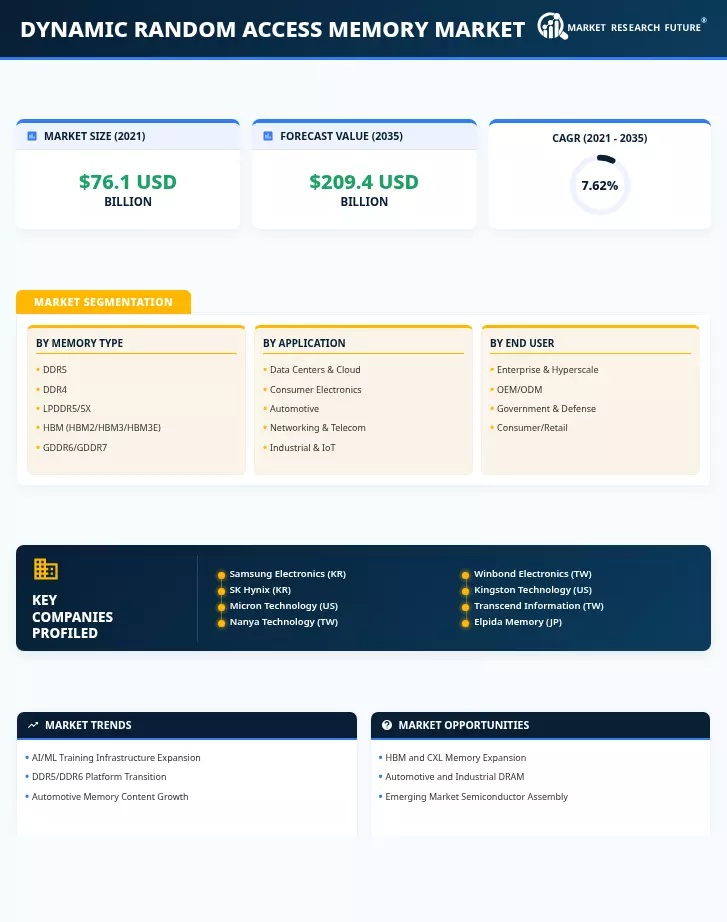
Segmentation Quick Reference

Dimension Sub-Segments Dominant Segment Fastest Growing Segment
By Memory Type DDR5, DDR4, LPDDR5/5X, HBM (HBM2/HBM3/HBM3E), GDDR6/GDDR7 DDR5 (~38% share) HBM (18.5% CAGR)
By Application Data Centers & Cloud, Consumer Electronics, Automotive, Networking & Telecom, Industrial & IoT Data Centers & Cloud (~35% share) Automotive (11.2% CAGR)
By End User Enterprise & Hyperscale, OEM/ODM, Government & Defense, Consumer/Retail Enterprise & Hyperscale (~44% share) OEM/ODM (6.9% CAGR)


Market Segmentation Overview

By Memory Type

Sub-Segment Key Trend
DDR5 Server platform mandates from Intel/AMD are driving a rapid DDR4-to-DDR5 transition.
DDR4 Legacy installed base declines; budget PCs and older servers sustain residual demand.
LPDDR5/5X Smartphone SoC integration is increasing average content per device to 10–16 GB
HBM (HBM2/HBM3/HBM3E) AI GPU co-packaging demand is creating multi-year supply constraints
GDDR6/GDDR7 Gaming GPU refresh cycles and JEDEC GDDR7 ratification fueling bandwidth upgrades


The memory type segmentation reflects DRAM's diversification from a commodity PC component into a portfolio of specialized products serving distinct bandwidth, power, and density requirements across servers, mobile devices, GPUs, and AI accelerators.

By Application

Sub-Segment Key Trend
Data Centers & Cloud Hyperscaler AI infrastructure is driving 1 TB+ memory per server configurations.
Consumer Electronics LPDDR5 adoption in flagship smartphones and thin-and-light laptops
Automotive ADAS and centralized compute architectures requiring automotive-grade ECC DRAM
Networking & Telecom 5G RAN and edge routing equipment increasing per-node memory content
Industrial & IoT Factory automation and smart meters are creating incremental low-power DRAM demand.


Application segmentation highlights the shift in DRAM demand gravity from consumer PCs toward enterprise data centers and automotive electronics, with the latter category exhibiting the strongest CAGR through the forecast period.

By End User

Sub-Segment Key Trend
Enterprise & Hyperscale Cloud CAPEX budgets growing 25–30% annually; procurement increasingly centralized
OEM/ODM PC, server, and smartphone manufacturers are integrating DRAM earlier in design cycles.
Government & Defense Secure computing and space-grade memory requirements supporting premium pricing
Consumer/Retail DIY PC builds and gaming peripheral upgrades are sustaining aftermarket module sales


End-user segmentation captures the purchasing dynamics across the DRAM value chain, from direct hyperscaler procurement to retail channel distribution, reflecting how buying power concentration among three to five cloud customers is reshaping supplier negotiations.