×
Request Free Sample ×

Kindly complete the form below to receive a free sample of this Report

Leading companies partner with us for data-driven Insights

clients tt-cursor
Hero Background

E Bike Tire Market

ID: MRFR/AT/21548-HCR
128 Pages
Sejal Akre
October 2025

E-Bike Tire Market Research Report By Tire Type (Clincher Tires, Tubeless Tires, Solid Tires), By Material (Rubber, Silicone, Polyurethane), By Wheel Size (12 inches, 16 inches, 20 inches, 24 inches, 26 inches, 28 inches, 32 inches), By Application (Commuting, Recreational, Electric Cargo Bikes), By Drive Type (Motorized, Non-Motorized) and By Regional (North America, Europe, South America, Asia Pacific, Middle East and Africa) - Forecast to 2035

Share:
Download PDF ×

We do not share your information with anyone. However, we may send you emails based on your report interest from time to time. You may contact us at any time to opt-out.

E Bike Tire Market Infographic
Purchase Options

E Bike Tire Market Summary

As per MRFR analysis, the E-Bike Tire Market Size was estimated at 2.815 USD Billion in 2024. The E-Bike Tire industry is projected to grow from 3.323 in 2025 to 17.5 by 2035, exhibiting a compound annual growth rate (CAGR) of 18.07 during the forecast period 2025 - 2035.

Key Market Trends & Highlights

The E-Bike Tire Market is experiencing a dynamic shift towards sustainability and technological innovation.

  • The market is increasingly driven by a focus on sustainability, with consumers seeking eco-friendly transportation options.
  • Technological integration in tire design is enhancing performance and safety, particularly in North America, the largest market.
  • Customization and variety in tire options are becoming essential, with clincher tires dominating while tubeless tires are rapidly gaining traction.
  • Key market drivers include the growing demand for eco-friendly transportation and advancements in tire design, particularly in the Asia-Pacific region.

Market Size & Forecast

2024 Market Size 2.815 (USD Billion)
2035 Market Size 17.5 (USD Billion)
CAGR (2025 - 2035) 18.07%

Major Players

Schwalbe (DE), Continental (DE), Michelin (FR), Kenda (TW), Maxxis (TW), Pirelli (IT), Dunlop (GB), Vittoria (IT), Tannus (KR)

E Bike Tire Market Trends

The E-Bike Tire Market is currently experiencing a notable transformation, driven by a surge in demand for sustainable transportation solutions. As urban areas become increasingly congested, e-bikes are emerging as a viable alternative to traditional vehicles, prompting manufacturers to innovate in tire technology. This shift is characterized by a growing emphasis on durability, puncture resistance, and performance in various weather conditions. Additionally, the integration of smart technologies into e-bike tires is gaining traction, suggesting a future where connectivity and data analytics play a crucial role in enhancing user experience and safety. Moreover, the E-Bike Tire Market is witnessing a diversification of product offerings, catering to a wide range of consumer preferences. From recreational riders to commuters, the market is adapting to meet the specific needs of different segments. This trend indicates a potential for increased customization, allowing consumers to select tires that align with their riding style and environmental conditions. As the market evolves, it appears that collaboration between manufacturers and technology providers will be essential in driving innovation and meeting the demands of a growing customer base.

Sustainability Focus

The E-Bike Tire Market is increasingly prioritizing eco-friendly materials and production processes. Manufacturers are exploring sustainable rubber alternatives and recyclable components, reflecting a broader commitment to environmental responsibility.

Technological Integration

There is a rising trend towards incorporating smart technologies within e-bike tires. Features such as pressure monitoring systems and performance analytics are becoming more prevalent, enhancing safety and user experience.

Customization and Variety

The market is diversifying its product range to cater to various consumer needs. This trend suggests a shift towards offering specialized tires for different riding conditions and preferences, allowing for greater personalization.

E Bike Tire Market Drivers

Health and Fitness Trends

The growing emphasis on health and fitness is contributing to the expansion of the E-Bike Tire Market. E-bikes are increasingly recognized as a means to promote physical activity while providing an enjoyable riding experience. As more individuals seek to incorporate exercise into their daily routines, e-bikes are becoming a popular choice for commuting and recreational activities. This trend is reflected in the rising sales of e-bikes, which are projected to increase by over 15% annually. Consequently, the demand for high-quality e-bike tires that enhance performance and safety is likely to rise. The E-Bike Tire Market stands to gain from this health-conscious consumer base, as manufacturers focus on developing tires that support active lifestyles.

Technological Advancements in Tire Design

Technological innovations are reshaping the E-Bike Tire Market, with advancements in materials and design enhancing tire performance. The integration of smart technologies, such as pressure sensors and wear indicators, is becoming more prevalent. These innovations not only improve safety but also enhance the overall riding experience. For instance, tires that can self-adjust pressure based on terrain conditions are gaining traction. The market for smart e-bike tires is expected to grow significantly, with estimates suggesting a compound annual growth rate of over 10% in the coming years. This evolution in tire technology indicates a promising future for the E-Bike Tire Market, as manufacturers strive to meet the demands of tech-savvy consumers.

Rising E-Commerce and Online Sales Channels

The proliferation of e-commerce is reshaping the E-Bike Tire Market, as consumers increasingly turn to online platforms for purchasing tires. The convenience of online shopping, coupled with the ability to compare products and prices, is driving this trend. In 2025, online sales of e-bike accessories, including tires, are expected to account for a significant portion of the market, with estimates suggesting a growth rate of around 20% annually. This shift towards digital sales channels is prompting manufacturers to enhance their online presence and optimize their distribution strategies. As a result, the E-Bike Tire Market is likely to experience increased competition and innovation, as companies strive to capture the attention of online consumers.

Urbanization and Infrastructure Development

The rapid urbanization trend is influencing the E-Bike Tire Market, as more cities invest in cycling infrastructure. Improved bike lanes and parking facilities are encouraging urban dwellers to opt for e-bikes as a viable commuting option. In many regions, local governments are promoting e-bikes as a solution to traffic congestion and pollution. This urban shift is likely to increase the demand for e-bikes, subsequently boosting the need for specialized tires that can withstand urban conditions. The E-Bike Tire Market is expected to benefit from this trend, as manufacturers adapt their products to cater to the unique challenges posed by urban environments, such as potholes and varied terrain.

Growing Demand for Eco-Friendly Transportation

The increasing awareness of environmental issues appears to drive the E-Bike Tire Market. Consumers are increasingly seeking sustainable transportation options, leading to a surge in e-bike adoption. In 2025, the e-bike market is projected to reach a valuation of approximately 24 billion USD, indicating a robust growth trajectory. This shift towards eco-friendly alternatives is likely to enhance the demand for specialized e-bike tires designed for durability and performance. Manufacturers are responding by developing tires that not only meet performance standards but also utilize sustainable materials. This trend suggests that the E-Bike Tire Market will continue to expand as more consumers prioritize environmentally responsible choices in their transportation methods.

Market Segment Insights

By Type: Clincher Tires (Largest) vs. Tubeless Tires (Fastest-Growing)

In the E-Bike Tire Market, Clincher Tires dominate the segment with significant market share, reflecting their widespread acceptance among e-bike users. Their design offers excellent performance and versatility, making them the preferred choice for a broad audience. On the other hand, Tubeless Tires, which provide a higher level of puncture resistance and enhanced performance, are rapidly gaining traction, showcasing their appeal in the growing e-bike segment.

Clincher Tires (Dominant) vs. Tubeless Tires (Emerging)

Clincher Tires are currently the dominant segment in the E-Bike Tire Market, occupying a significant portion due to their longstanding reputation for reliability and performance. They feature a straightforward installation process, making them user-friendly and appealing to a wide range of riders. Meanwhile, Tubeless Tires represent an emerging trend, increasingly favored for their ability to reduce the risk of flats and improve ride quality. This segment is driven by growing demand for high-performance biking solutions among enthusiasts who prioritize the durability and efficiency of their e-bikes, further stimulating innovation and development within this market.

By Material: Rubber (Largest) vs. Silicone (Fastest-Growing)

In the E-Bike Tire Market, the material segment is predominantly characterized by rubber, which holds the largest market share due to its well-established properties, durability, and performance under various conditions. Rubber tires are favored for their better traction, comfort, and ability to provide a smooth riding experience, making them the preferred choice among consumers. In contrast, silicone tires are emerging and gaining traction for their unique properties, including superior elasticity and resistance to environmental factors, which make them suitable for specific applications in e-bikes. Growth trends in the material segment are largely driven by advancements in tire technology and increasing demand for lightweight and highly durable materials. As e-bikes become a more popular mode of transportation, manufacturers are continually exploring innovative materials to enhance the overall riding experience. Silicone is on the rise due to its lightweight nature and improved performance attributes, making it appealing for manufacturers looking to differentiate their products in a competitive market.

Rubber (Dominant) vs. Silicone (Emerging)

Rubber continues to dominate the E-Bike Tire Market due to its proven track record in performance and reliability. It offers excellent grip, shock absorption, and an overall comfortable ride, making it the go-to choice for many e-bike manufacturers. Its widespread availability and familiarity among consumers further cement its leading position in the market. On the other hand, silicone is an emerging material gaining attention for its innovative properties, including enhanced flexibility and resistance to heat and wear. This makes silicone a compelling option for manufacturers looking to produce high-performance tires that are lighter and more energy-efficient, appealing to the growing segment of environmentally-conscious e-bike users.

By Wheel Size: 26 inches (Largest) vs. 20 inches (Fastest-Growing)

In the E-Bike Tire Market, the wheel size of 26 inches holds the predominant market share, making it the preferred choice among consumers. This size caters to a variety of riding styles and is compatible with a significant number of e-bike models available in the market today. Following closely, the 20 inches wheel size is emerging as a noteworthy contender due to its rising popularity among urban commuters who favor compact and lightweight designs.

26 inches (Dominant) vs. 20 inches (Emerging)

The 26 inches wheel size is recognized for its balance of comfort, stability, and performance, making it the dominant choice for a wide range of riders including those who enjoy recreational and off-road biking. Its widespread use in established e-bike designs solidifies its market position. Conversely, the 20 inches wheel size is gaining traction as an emerging option, particularly among city commuters. Its compact design enhances maneuverability and ease of storage, appealing to new urban e-bike buyers. As urban mobility continues to evolve, the demand for smaller wheel sizes is expected to grow.

By Application: Commuting (Largest) vs. Electric Cargo Bikes (Fastest-Growing)

The E-Bike Tire Market is predominantly characterized by its application segments, with commuting tires accounting for the largest market share. This segment benefits from the increasing urbanization and the subsequent rise in daily commuting by e-bikes, which are seen as a more eco-friendly alternative to traditional transportation modes. Recreational use follows, appealing to leisure riders looking for comfort and performance on varied terrains, while electric cargo bikes represent a notable segment, driven by the growing need for efficient last-mile delivery solutions. Growth trends in the E-Bike Tire Market indicate a robust increase in demand driven by sustainability awareness and shifting consumer preferences. The commuting segment is bolstered by government initiatives promoting e-bike usage, whereas electric cargo bikes are soaring in popularity due to their utility in logistics and delivery services. The recreational segment continues to hold its ground but has a more stable growth trajectory compared to the dynamically evolving commuting and cargo bike segments.

Commuting (Dominant) vs. Recreational (Emerging)

The commuting segment is a dominant force within the E-Bike Tire Market, characterized by tires designed for durability and performance under urban conditions. Commuting tires typically offer a balance of grip, puncture resistance, and low rolling resistance to facilitate efficient travel. Conversely, the recreational segment is emerging, appealing to cyclists who enjoy leisurely rides on diverse terrains. Tires in this category often feature enhanced shock absorption and tread designs catering to off-road conditions. The distinction between these segments highlights the varied consumer needs, with commuting tires focusing on practicality and efficiency, while recreational tires offer a more adventure-oriented experience.

By Drive Type: Motorized (Largest) vs. Non-Motorized (Fastest-Growing)

In the E-Bike Tire Market, the drive type segment exhibits a diverse distribution between motorized and non-motorized options. Currently, motorized tires dominate the market, favored for their compatibility with electric bicycles, which have surged in popularity. Motorized tires account for the largest share of the segment, driven by the rising adoption of e-bikes among commuters and recreational users alike, who seek enhanced performance and speed. Conversely, non-motorized tires are gaining traction rapidly due to growing consumer interest in eco-friendly and health-conscious transportation alternatives, appealing to a segment of riders who prefer traditional bicycles.

Drive Type: Motorized (Dominant) vs. Non-Motorized (Emerging)

Motorized tires represent the dominant force in the E-Bike Tire Market, designed specifically to accommodate the increased weight and performance demands of electric bicycles. These tires offer enhanced durability and grip, tailored for high-speed riding while ensuring safety and stability. In contrast, non-motorized tires are considered an emerging option, appealing to consumers focused on sustainability and fitness. Non-motorized tires are lighter and often more versatile, suitable for a broader range of bikes. As awareness of health and environmental benefits grows, both segments will continue to evolve, but motorized tires currently maintain a robust position in the market.

Get more detailed insights about E Bike Tire Market

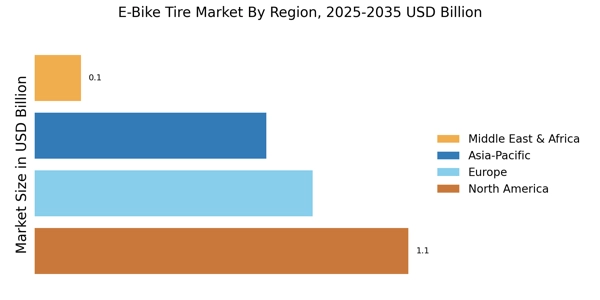
Regional Insights

North America : Growing E-Bike Adoption

The North American e-bike tire market is driven by increasing urbanization, environmental awareness, and government incentives promoting electric mobility. The region holds the largest market share at approximately 40%, with a significant rise in e-bike sales fueled by a growing preference for sustainable transportation. Regulatory support, including tax credits and infrastructure development for cycling, further catalyzes market growth. Leading countries in this region include the United States and Canada, where major players like Schwalbe and Continental are establishing a strong presence. The competitive landscape is characterized by innovation in tire technology, focusing on durability and performance. As e-bike adoption continues to rise, these companies are poised to capture a larger share of the market, enhancing their product offerings to meet consumer demands.

Europe : Innovation and Sustainability Focus

Europe is experiencing a robust growth in the e-bike tire market, driven by a strong emphasis on sustainability and innovative transportation solutions. The region holds the second-largest market share at around 30%. Government initiatives promoting cycling as a green alternative to traditional transport are key growth drivers. Regulations aimed at reducing carbon emissions are also fostering demand for e-bikes and their components, including tires. Countries like Germany, France, and the Netherlands are leading the charge, with a competitive landscape featuring key players such as Michelin and Pirelli. The presence of established manufacturers and a growing number of startups focusing on eco-friendly products are enhancing market dynamics. As consumer preferences shift towards sustainable options, the e-bike tire market in Europe is set for significant expansion.

Asia-Pacific : Emerging Market Potential

The Asia-Pacific region is rapidly emerging as a powerhouse in the e-bike tire market, driven by increasing urbanization and a growing middle class. This region holds a market share of approximately 25%, with countries like China and Japan leading the demand. Government policies promoting electric vehicles and investments in cycling infrastructure are significant catalysts for growth, enhancing the appeal of e-bikes as a viable transportation option. China is the largest market, with a plethora of local manufacturers and international players like Kenda and Maxxis competing for market share. The competitive landscape is marked by innovation in tire technology, focusing on performance and affordability. As the e-bike trend continues to gain traction, the Asia-Pacific market is expected to witness substantial growth, driven by both consumer demand and supportive government initiatives.

Middle East and Africa : Untapped Market Opportunities

The Middle East and Africa region presents untapped opportunities in the e-bike tire market, driven by increasing awareness of sustainable transportation solutions. The market share is currently around 5%, but it is poised for growth as urban areas expand and governments begin to recognize the benefits of e-bikes. Regulatory frameworks are slowly evolving to support electric mobility, which will likely enhance market dynamics in the coming years. Countries like South Africa and Kenya are beginning to see a rise in e-bike adoption, with local and international players exploring market entry. The competitive landscape is still developing, with key players like Dunlop and Vittoria looking to establish a foothold. As infrastructure improves and consumer awareness grows, the e-bike tire market in this region is expected to expand significantly, driven by both demand and regulatory support.

E Bike Tire Market Regional Image

Key Players and Competitive Insights

Major industries are adopting advanced technologies and major players operating in them are constantly innovating and launching new products to cater to the changing needs of customers. The leading players of the E-Bike Tire Market are indulged in expanding their global footprint and establishing partnerships to improve their position in the competitive marketplace. The E-Bike Tire Market Scenario is benefiting from the E-bikes, such as electric bikes demand from customers. Owing to this demand, the E-Bike Tire Market E-Bike Tire Market CAGR during the forecast period is going to be significant.

The E-Bike Tire Market Key Companies landscape is marked by players such as CST, Vee Rubber, and Schwalbe. CST uses the highest quality materials for the manufacturing of its E-Bike Tire Market. E-Bike Tires is one of the well-known companies in Asia-Pacific and has a significant presence in the same region. CST is also expanding its presence in North America and Europe. Vee Rubber, based in Thailand, operates in the E-Bike Tire Market and offers a wide range of products. Vee Rubber’s range of products includes the E-Bike Tire Market, road tire segments and off-road tire segments.

Schwalbe is also a major player in the E-Bike Tire Market. The company is based in Germany and has a presence in Europe and North America. Schwalbe provides high-performance E-Bike Tire Market tires such as road tires for E-bike, mountain tires, hybrid bike tires, etc. Both Vee Rubber and CST are strategic acquisitions of different companies to grow the volume of products.

Key Companies in the E Bike Tire Market market include

Industry Developments

The E-Bike Tire Market is projected to reach a valuation of USD 9.01 billion by 2032, expanding at a CAGR of 18.07% from 2024 to 2032. The growing popularity of e-bikes, increasing government initiatives promoting e-mobility, and rising environmental consciousness are key factors driving market growth. Asia Pacific is expected to hold the largest market share due to the high adoption of e-bikes in countries like China and India. Key industry participants include Michelin, CST, Schwalbe, and Maxxis. Recent developments include the launch of puncture-resistant and self-healing tires, indicating a focus on improving safety and convenience for e-bike riders.

Future Outlook

E Bike Tire Market Future Outlook

The E-Bike Tire Market is projected to grow at an 18.07% CAGR from 2024 to 2035, driven by increasing urbanization, environmental awareness, and advancements in tire technology.

New opportunities lie in:

  • Development of smart tire technology for real-time performance monitoring.
  • Expansion into emerging markets with tailored product offerings.
  • Partnerships with e-bike manufacturers for integrated tire solutions.

By 2035, the E-Bike Tire Market is expected to achieve substantial growth and innovation.

Market Segmentation

E Bike Tire Market Type Outlook

  • Clincher Tires
  • Tubeless Tires
  • Solid Tires

E Bike Tire Market Material Outlook

  • Rubber
  • Silicone
  • Polyurethane

E Bike Tire Market Drive Type Outlook

  • Motorized
  • Non-Motorized

E Bike Tire Market Wheel Size Outlook

  • 12 inches
  • 16 inches
  • 20 inches
  • 24 inches
  • 26 inches
  • 28 inches
  • 32 inches

E Bike Tire Market Application Outlook

  • Commuting
  • Recreational
  • Electric Cargo Bikes

Report Scope

MARKET SIZE 20242.815(USD Billion)
MARKET SIZE 20253.323(USD Billion)
MARKET SIZE 203517.5(USD Billion)
COMPOUND ANNUAL GROWTH RATE (CAGR)18.07% (2024 - 2035)
REPORT COVERAGERevenue Forecast, Competitive Landscape, Growth Factors, and Trends
BASE YEAR2024
Market Forecast Period2025 - 2035
Historical Data2019 - 2024
Market Forecast UnitsUSD Billion
Key Companies ProfiledMarket analysis in progress
Segments CoveredMarket segmentation analysis in progress
Key Market OpportunitiesGrowing demand for durable, puncture-resistant tires enhances opportunities in the E-Bike Tire Market.
Key Market DynamicsRising demand for sustainable materials drives innovation in E-Bike tire manufacturing and design.
Countries CoveredNorth America, Europe, APAC, South America, MEA

Leave a Comment

FAQs

What is the current valuation of the E-Bike Tire Market?

As of 2024, the E-Bike Tire Market was valued at 2.815 USD Billion.

What is the projected market size for the E-Bike Tire Market by 2035?

The E-Bike Tire Market is projected to reach 17.5 USD Billion by 2035.

What is the expected CAGR for the E-Bike Tire Market during the forecast period 2025 - 2035?

The expected CAGR for the E-Bike Tire Market from 2025 to 2035 is 18.07%.

Which type of tires holds the largest market share in the E-Bike Tire Market?

Tubeless Tires are anticipated to dominate the market, with a valuation of 6.5 USD Billion projected.

What materials are primarily used in the production of E-Bike Tires?

The primary materials include Rubber, which is projected to reach 9.5 USD Billion, and Silicone, expected to reach 4.5 USD Billion.

How does the wheel size segment perform in the E-Bike Tire Market?

The 26 inches wheel size segment is projected to reach 4.0 USD Billion, indicating strong demand.

What applications are driving growth in the E-Bike Tire Market?

Commuting applications are expected to lead the market, with a projected valuation of 8.5 USD Billion.

Which companies are considered key players in the E-Bike Tire Market?

Key players include Schwalbe, Continental, Michelin, Kenda, and Maxxis, among others.

What is the market outlook for motorized versus non-motorized E-Bike Tires?

Motorized E-Bike Tires are projected to reach 9.5 USD Billion, indicating a stronger growth potential compared to non-motorized tires.

What trends are influencing the E-Bike Tire Market in 2025?

The market appears to be influenced by increasing demand for sustainable transportation and advancements in tire technology.

Download Free Sample

Kindly complete the form below to receive a free sample of this Report

Compare Licence

×
Features License Type
Single User Multiuser License Enterprise User
Price $4,950 $5,950 $7,250
Maximum User Access Limit 1 User Upto 10 Users Unrestricted Access Throughout the Organization
Free Customization
Direct Access to Analyst
Deliverable Format
Platform Access
Discount on Next Purchase 10% 15% 15%
Printable Versions