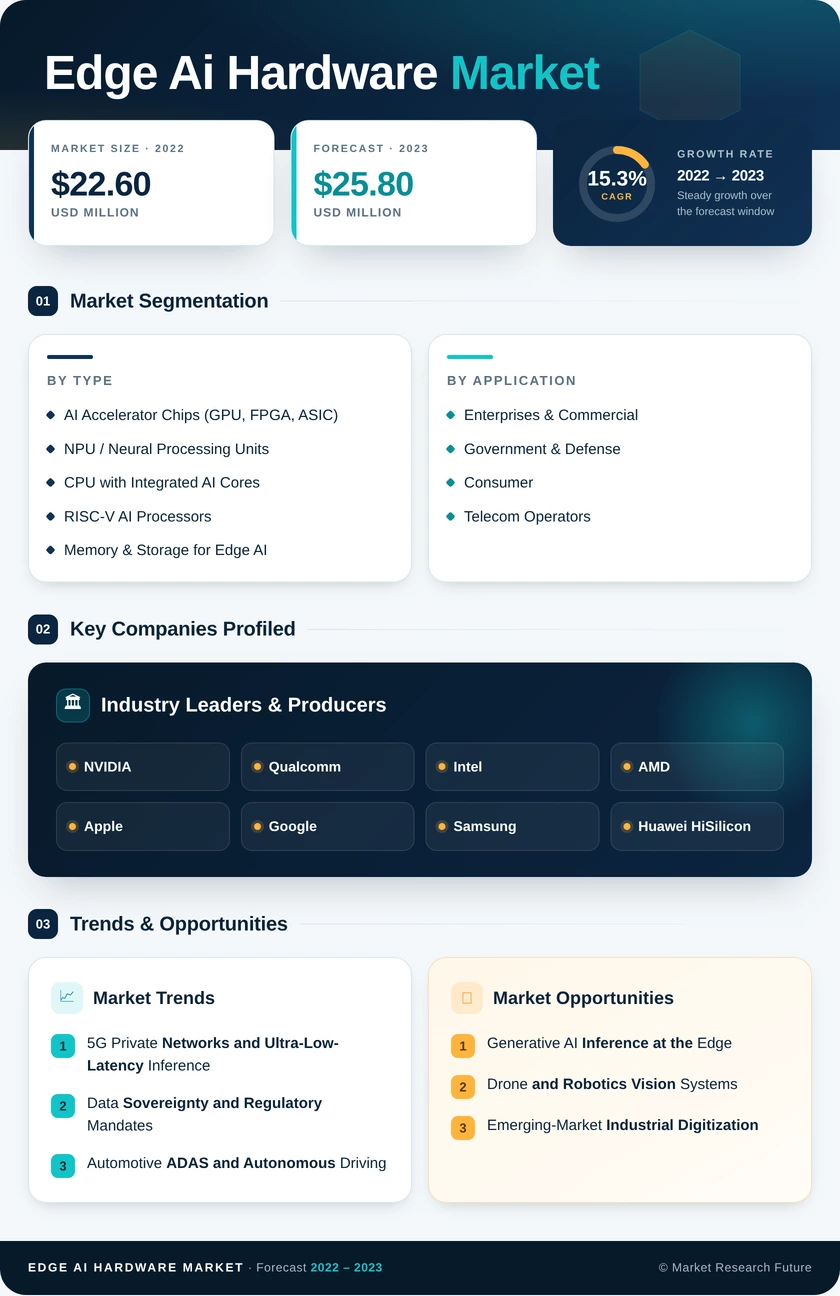
Segmentation Quick Reference
| Dimension | Sub-Segments | Dominant Segment | Fastest Growing Segment |
| By Component Type | AI Accelerator Chips (GPU, FPGA, ASIC); NPU / Neural Processing Units; CPU with Integrated AI Cores; RISC-V AI Processors; Memory & Storage for Edge AI | AI Accelerator Chips (44% share, 2025) | RISC-V AI Processors (22.1% CAGR) |
| By Application | Consumer Electronics; Automotive & Transportation; Industrial Automation; Smart Surveillance & Security; Healthcare & Edge AI hardware Markets; Drones & Robotics | Consumer Electronics (31% share, 2025) | Healthcare & Edge AI hardware Markets (17.3% CAGR) |
| By End User | Enterprises & Commercial; Government & Defense; Consumer; Telecom Operators | Enterprises & Commercial (52% share, 2025) | Government & Defense (16.1% CAGR) |
Market Segmentation Overview
By Component Type
| Sub-Segment | Key Trend |
| AI Accelerator Chips (GPU, FPGA, ASIC) | Dominates high-performance inference for autonomous vehicles and video analytics; NVIDIA Jetson and AMD Versal lead |
| NPU / Neural Processing Units | Fastest volume growth driven by smartphone and AI PC integration; Qualcomm Hexagon and Apple ANE set benchmarks |
| CPU with Integrated AI Cores | Broad enterprise adoption as Intel and AMD embed AI acceleration into mainstream CPUs |
| RISC-V AI Processors | Open-source architecture gains traction in cost-sensitive IoT and industrial embedded devices |
| Memory & Storage for Edge AI | HBM and LPDDR5X enable larger on-device model execution; Samsung and SK Hynix invest heavily |
The component landscape is shifting from discrete GPU-centric inference toward heterogeneous SoCs that integrate NPU, GPU, and CPU on a single die. This convergence reduces BOM costs and power consumption, making advanced edge AI accessible to mid-tier device OEMs and industrial system integrators.
By Application
| Sub-Segment | Key Trend |
| Consumer Electronics (Smartphones, PCs, Wearables) | On-device generative AI and always-on sensing drive NPU integration into every flagship chipset |
| Automotive & Transportation | ADAS mandates and L3+ autonomy create structural, regulation-backed demand for high-TOPS edge silicon |
| Industrial Automation | Predictive maintenance and real-time quality inspection replace cloud-dependent analytics in factory settings |
| Smart Surveillance & Security | Privacy regulations push video analytics processing to the camera edge rather than centralized servers |
| Healthcare & Edge AI hardware Markets | Point-of-care AI diagnostics and continuous patient monitoring require low-power, certified edge hardware |
| Drones & Robotics | Autonomous navigation and real-time obstacle avoidance demand on-board inference at 30+ TOPS |
Consumer electronics will remain the volume leader, but automotive and industrial applications drive higher ASPs and stickier vendor relationships due to certification requirements and long design-in cycles.
By End User
| Sub-Segment | Key Trend |
| Enterprises & Commercial | Edge data centers and retail AI analytics expand enterprise hardware budgets beyond traditional IT |
| Government & Defense | Tactical AI, border surveillance, and smart-city programs drive procurement of ruggedized edge modules |
| Consumer | Smartphone and smart-home AI features create mass-market demand for NPU-equipped consumer silicon |
| Telecom Operators | Multi-access edge computing (MEC) platforms require AI hardware co-located at cell tower sites |
Enterprise and commercial buyers represent the majority of edge AI hardware spending, but government and defense procurement is growing fastest as national security agencies prioritize AI sovereignty and edge-based intelligence processing.