Edge Data Center Market (2026 - 2035)

Edge Data Center Market Size, Share and Research Report By Component (Solutions, Services), By Data Center Size (Small, Medium, Large, Mega), By Tier Type (Tier 1 & 2, Tier 3, Tier 4), By End User (BFSI, IT & Telecom, Healthcare, Government, Manufacturing, Others) and By Regional (North America, Europe, South America, Asia Pacific, Middle East and Africa) - Industry Forecast to 2035.
ID: MRFR/ICT/2836-HCR
200 Pages
Aarti Dhapte
Last Updated: June 25, 2026
Edge Data Center Market
Market Size
Forecast Period2026-2035
CAGR (2026-2035)21.1%
2025 Market SizeUSD 19.35 Billion
2035 Market SizeUSD 131.18 Billion
Key Players
Equinix
Microsoft
Digital Realty
EdgeConneX
Vapor IO
Oracle
Opportunities
  • Edge-as-a-Service and Subscription Business Models
  • Renewable-Powered Edge Micro-Grids
  • Healthcare and Telemedicine Edge Infrastructure

Edge Data Center Market Summary

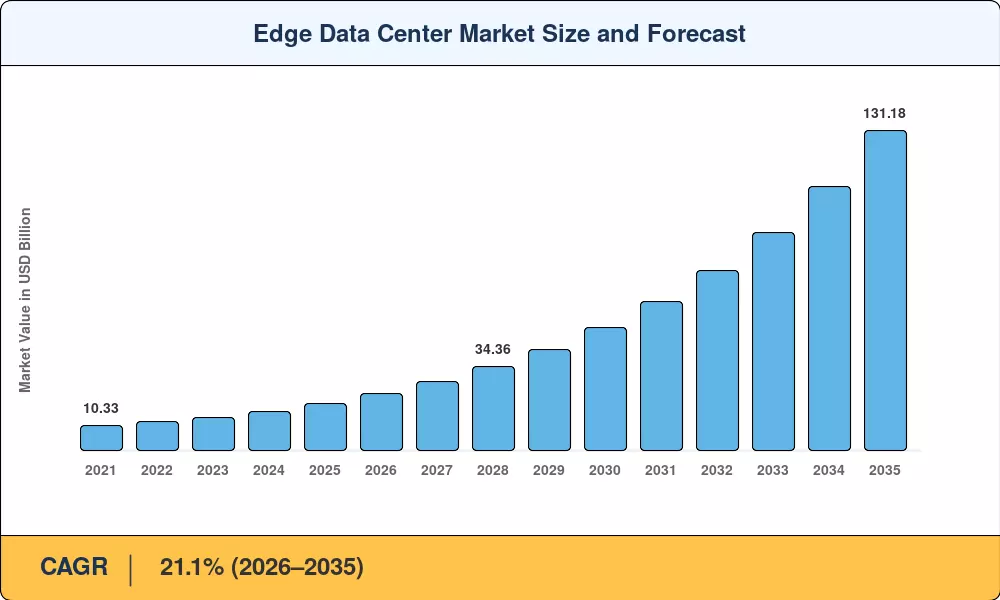
The Edge Data Center Market reached USD 19.35 billion in 2025, and this trajectory is set to accelerate — from an estimated USD 23.43 billion in 2026 to USD 131.18 billion by 2035, reflecting a compound annual growth rate of 21.1% across the forecast window [1]. Two forces are keeping construction pipelines full: data sovereignty mandates now active in more than 45 jurisdictions worldwide, and 5G radio densification programs that demand compute nodes within single-digit millisecond reach of end devices [4]. Operators that once debated the economics of distributing workloads away from centralized hyperscale campuses are now treating edge facilities as non-negotiable infrastructure.

A technology transition is underway. Legacy on-premise server closets and remote-office racks — often air-cooled, manually managed, and limited to basic file serving — are giving way to modular, liquid-cooled micro-facilities capable of running inference workloads for generative AI, autonomous vehicle mapping, and industrial digital twins [11]. The U.S. Department of Energy estimates data center power demand will rise 15–20% annually through 2030, with edge sites accounting for a growing slice of that load [3]. Capital is following: global data center construction spending surpassed USD 48 billion in 2024, and a meaningful share targeted sub-5 MW edge builds [14].

North America held the dominant position in the Edge Data Center Market with a 29.2% share in 2025, anchored by hyperscaler overflow requirements and enterprise hybrid-cloud mandates. Asia-Pacific is the fastest-growing region at a 22.2% CAGR, propelled by digital payment infrastructure build-outs and smart-city programs across India, China, and ASEAN nations. Europe commands the second-largest share at 24.3%, driven by GDPR-compliant local processing requirements and the EU's Digital Decade policy targets [8]. As AI inference shifts closer to the point of consumption, the Edge Data Center Market is positioned for a decade of compounding investment.


Key Report Takeaways

• By Component

  • Solutions accounted for 57.8% of the Edge Data Center Market in 2025, reflecting demand for integrated power, cooling, and IT enclosure systems.
  • Services will grow at a 22.0% CAGR through 2035, fueled by managed-edge and edge-as-a-service subscription models.

• By Data Center Size

  • Large facilities controlled 49.8% share of the Edge Data Center Market in 2025, serving metro-area enterprise clusters.
  • Mega-class edge sites will expand fastest at a 23.7% CAGR, driven by AI inference farm requirements at the periphery.


• By Tier

  • Large facilities controlled 49.8% share of the Edge Data Center Market in 2025, serving metro-area enterprise clusters.
  • Mega-class edge sites will expand fastest at a 23.7% CAGR, driven by AI inference farm requirements at the periphery.
  • Tier 3 configurations held 48.9% share in 2025, balancing redundancy with capital efficiency.

• By End User

  • BFSI captured 26.5% of the Edge Data Center Market share in 2025, reflecting real-time fraud detection and payment processing needs.
  • IT & Telecom will record a 21.8% CAGR through 2035 as multi-access edge computing (MEC) deployments accelerate.

• By Region

  • North America led the Edge Data Center Market with 29.2% share in 2025.
  • Asia-Pacific is on track to record a 22.2% CAGR, making it the fastest-growing region.


Edge Data Center Market Size and Forecast (2021–2035)

Market sizing draws on a triangulated methodology combining bottom-up facility-level revenue tracking, top-down macroeconomic modeling tied to GDP-weighted IT spending, and secondary validation against operator disclosures and third-party infrastructure surveys [1][6]. Historical values (2021–2024) are actuals; 2025 is the estimated base year; and 2026–2035 values are forecast projections anchored to a 21.1% CAGR.
Edge Data Center Market Size and Forecast
Our Impact
Enabled $4.3B Revenue Impact for Fortune 500 and Leading Multinationals
Partnering with 2000+ Global Organizations Each Year
30K+ Citations by Top-Tier Firms in the Industry

Driver Impact Analysis

Driver ~% Impact on CAGR Geographic Relevance Impact Timeline
5G & MEC Commercialization ~22% Global Short-term (≤2 yr)
AI & ML Inference at the Edge ~20% North America, APAC Medium-term (2–4 yr)
Data Sovereignty & Localization Laws ~18% Europe, APAC, LATAM Long-term (≥4 yr)
IoT Device Proliferation ~14% Global Medium-term (2–4 yr)
Content Delivery & Streaming Demand ~10% North America, Europe Short-term (≤2 yr)
Renewable-Powered Micro-Grid Adoption ~9% Europe, MEA Long-term (≥4 yr)
Hybrid & Multi-Cloud Enterprise Strategy ~7% North America, Europe Medium-term (2–4 yr)


5G & Multi-Access Edge Computing Commercialization

The GSMA estimates that there will be more than 5.6 billion 5G connections globally by 2030, all demanding ultra-low-latency processing nodes that cannot be served by typical centralized data centers within sub-10 ms budgets [4]. Telecom operators have allocated more than USD 1.1 trillion in cumulative 5G capex during the period to 2028, and an increasing share of those budgets is being spent on edge compute nodes co-located at base-station aggregation sites. For example, the FCC’s 5G FAST Plan in North America has made permission easier for small-cell sites, indirectly broadening the addressable footprint for adjacent edge facilities [17].


AI and Machine Learning Inference Demand

Training large language models still gravitates toward hyperscale GPU clusters, but inference — the revenue-generating side of AI — increasingly runs at the edge to minimize latency for applications such as real-time recommendation engines, industrial quality inspection, and autonomous navigation [11]. This shift has pushed average rack-power density at edge sites from 7 kW in 2022 to 15–20 kW in 2025 [12].

Data Sovereignty and Localization Mandates

There exist data residency laws in more than 45 nations requiring firms to process and retain specific categories of data within the national borders [8]. The combined reach of the EU’s GDPR, India’s DPDP Act 2023, and Brazil’s LGPD covers over 3.5 billion customers, creating a non-negotiable need for in-country edge infrastructure [9][13]. These restrictions shift the Edge Data Center Market from a performance optimization play to a compliance imperative.


IoT Device Proliferation

A market report forecasts 41.6 billion connected IoT devices by 2025, each generating data streams that overwhelm centralized backhaul architectures [6]. Manufacturing floors, smart grids, connected vehicles, and precision-agriculture platforms require local processing to reduce bandwidth costs and act on data within milliseconds. This volume effect underpins medium-term demand growth for small- and medium-sized edge deployments.


Restraints Impact Analysis

Restraint ~% Negative Impact on CAGR Geographic Relevance Impact Timeline
High Capital and Operating Costs ~−6% Global Short-term (≤2 yr)
Power Grid Constraints & Utility Bottlenecks ~−5% Europe, APAC Medium-term (2–4 yr)
Skilled Workforce Shortage ~−4% Global Long-term (≥4 yr)
Security & Physical Site Vulnerabilities ~−3% Global Medium-term (2–4 yr)
Fragmented Regulatory & Permitting Frameworks ~−2% LATAM, MEA, APAC Long-term (≥4 yr)


High Capital and Operating Costs

Building a Tier 3-equivalent edge plant can cost USD 8–12 million per megawatt, around 20–30% more per-MW than a centralized campus development, because shared infrastructure cannot be amortized across dozens of megawatts [14]. Operating costs make it tougher. Remote sites need specialists on demand, and smaller facilities have higher power use effectiveness (PUE) ratios – typically 1.5-1.8 compared with 1.1-1.3 on hyperscale campuses. These economics put pressure on margins for colocation operators and impede uptake among price-sensitive mid-market firms.


Power Grid Constraints

In key European markets — particularly Dublin, Amsterdam, and Frankfurt — utility providers have imposed moratoriums or capacity queues on new data center grid connections, creating 18- to 36-month delays for edge site energization [3]. The IEA estimates global data center electricity demand will reach 1,000 TWh by 2026, and grid upgrades are not keeping pace with permitting timelines. This constraint is especially acute for edge sites that lack the negotiating leverage of hyperscale campuses.

Skilled Workforce Shortage

Uptime Institute survey data indicates a global shortfall of approximately 300,000 data center professionals by 2030, spanning electrical engineers, cooling specialists, and network architects [1]. Edge sites, often located in secondary and tertiary markets, struggle to attract qualified technicians, pushing operators toward expensive remote-management solutions and raising the barrier for operators scaling across geographically dispersed portfolios.


Edge Data Center Market Opportunities

Edge-as-a-Service and Subscription Business Models

Mid-market adoption is being held back by capex hurdles, creating a major whitespace opportunity for edge-as-a-service (EaaS) platforms where operators supply modular compute, storage, and network capacity on a consumption-based price model. The EaaS model is following the path of cloud IaaS and potentially opens up a part of the Edge Data Center Market that is now underserved by regular colocation contracts.


Renewable-Powered Edge Micro-Grids

Operators that pair edge facilities with on-site solar, battery storage, or hydrogen fuel cells can shave 15–20% from energy costs while meeting increasingly stringent ESG reporting obligations [10]. The opportunity is acute in regions with unreliable grid infrastructure — Sub-Saharan Africa, parts of Southeast Asia, and rural South America — where off-grid edge designs can bypass utility bottlenecks entirely.

Healthcare and Telemedicine Edge Infrastructure

The post-pandemic expansion of remote diagnostics, real-time medical imaging, and connected surgical robotics demands local compute with guaranteed uptime. Hospital-adjacent edge nodes processing HIPAA- or GDPR-compliant workloads represent a growing niche within the Edge Data Center Market.

Emerging-Market Sovereign Cloud Clusters

Governments in the Middle East, Africa, and South Asia are investing in domestic digital infrastructure to reduce dependency on offshore hyperscale regions. Saudi Arabia's NEOM and India's Digital India programme have allocated multi-billion-dollar budgets for domestic compute infrastructure, creating greenfield demand for edge deployments [13].

Data Monetization via Edge Analytics Platforms

Edge facilities that offer embedded analytics, AI inference, and data-marketplace services on top of raw colocation generate higher revenue per rack than passive hosting.


Edge Data Center Market Future Outlook

AI-Native Edge Architectures

By 2030, purpose-built edge sites housing GPU and custom AI accelerator racks will constitute a distinct sub-category of the Edge Data Center Market. The IEA projects AI-specific electricity demand to double by 2030, and a meaningful share of inference workloads — particularly those involving real-time video analytics and natural-language processing — will migrate to the edge to avoid backhaul latency and reduce cloud egress costs [3][5].

Platform Economics and Edge Marketplaces

The next stage of edge maturity will be neutral-host operators aggregating computing, connectivity, and application services into marketplace platforms where corporations will acquire capacity over APIs, not lease discussions. This evolution, mirroring the cloud paradigm, will shorten sales cycles, reduce adoption hurdles, and ultimately widen the addressable Edge Data Center Market beyond conventional business IT purchasers [16].


Sustainability and Circular Infrastructure

ESG mandates from investors, regulators, and enterprise procurement teams are pushing edge operators toward circular-economy principles: modular components designed for disassembly, battery second-life programs, and on-site renewable generation [10]. Similar frameworks are emerging in Japan and South Korea.

Autonomous Operations and Remote Management

Staffing constraints and the geographic dispersion of edge sites will accelerate the adoption of AI-driven autonomous operations — self-healing power systems, predictive cooling optimization, and robotic maintenance. Uptime Institute data suggests that by 2032, approximately 40% of edge sites could operate with zero on-site staff during normal conditions, fundamentally altering the cost structure of the Edge Data Center Market [1].


Edge Data Center Market Segmentation

By Component

Segment Key Metric Primary Demand Driver
Solutions 57.8% share (2025) Integrated modular enclosures, UPS, and cooling
Services 22.0% CAGR (2026–2035) Managed edge, monitoring, EaaS subscriptions


Solutions — encompassing hardware enclosures, power distribution, cooling modules, and edge-optimized IT stacks — dominate the Edge Data Center Market because most deployments today involve greenfield builds requiring full-stack procurement. Prefabricated modular units from vendors like Schneider Electric and Vertiv have shortened deployment timelines from 18 months to under 12 weeks, boosting adoption among enterprises that lack in-house design capabilities.

Services, while a smaller share today, are the faster-growing component. Managed-edge providers offer monitoring, patching, and capacity planning under SLA-backed contracts, effectively lowering the operational expertise threshold and enabling mid-market companies to participate in edge strategies without building dedicated NOC teams [12].

By Data Center Size

Segment Key Metric Primary Demand Driver
Small USD 3.83 B (2025) Retail, branch offices, micro-cell sites
Medium 20.6% CAGR (2026–2035) Regional enterprise hubs, hospital campuses
Large 49.8% share (2025) Metro colocation, multi-tenant enterprise
Mega 23.7% CAGR (2026–2035) AI inference farms, hyperscaler edge rings


Large edge facilities — typically 1–5 MW deployments in metropolitan areas — remain the workhorse of the segment, serving multi-tenant colocation requirements where enterprises co-locate workloads near cloud on-ramps. Mega-class edge sites, although currently the smallest by installed base, are scaling fastest as AI inference demand creates appetite for 5–20 MW edge campuses positioned at strategic fiber intersections.

By Tier Type

Segment Key Metric Primary Demand Driver
Tier 1 & 2 USD 4.83 B (2025) Cost-sensitive retail, IoT aggregation
Tier 3 48.9% share (2025) Enterprise workloads, financial services
Tier 4 23.2% CAGR (2026–2035) Mission-critical healthcare, defense, and payments


Tier 3 configurations — offering concurrent maintainability with N+1 redundancy — represent the pragmatic middle ground for the Edge Data Center Market, balancing uptime guarantees with capital discipline. Tier 4, with 2N fault tolerance, is gaining momentum in end-user verticals where even minutes of downtime carry regulatory or safety consequences, such as real-time payment processing and hospital information systems.

By End User

Segment Key Metric Primary Demand Driver
BFSI 26.5% share (2025) Real-time fraud detection, payment processing
IT & Telecom 21.8% CAGR (2026–2035) MEC platforms, CDN expansion
Healthcare USD 2.76 B (2025) Telemedicine, medical imaging, and AI
Government 19.4% CAGR (2026–2035) Smart-city infrastructure, defense networks
Manufacturing USD 2.22 B (2025) Industrial IoT, quality-inspection AI
Others 18.2% CAGR (2026–2035) Retail, media, education


BFSI leads end-user adoption of the Edge Data Center Market because financial transactions demand sub-5 ms latency for algorithmic trading, fraud scoring, and real-time payment authorization — workloads that cannot tolerate the round-trip to a distant cloud region [9]. IT & Telecom is the fastest-growing vertical as operators deploy multi-access edge computing nodes directly into their radio access networks, generating both internal-use and wholesale colocation revenue.


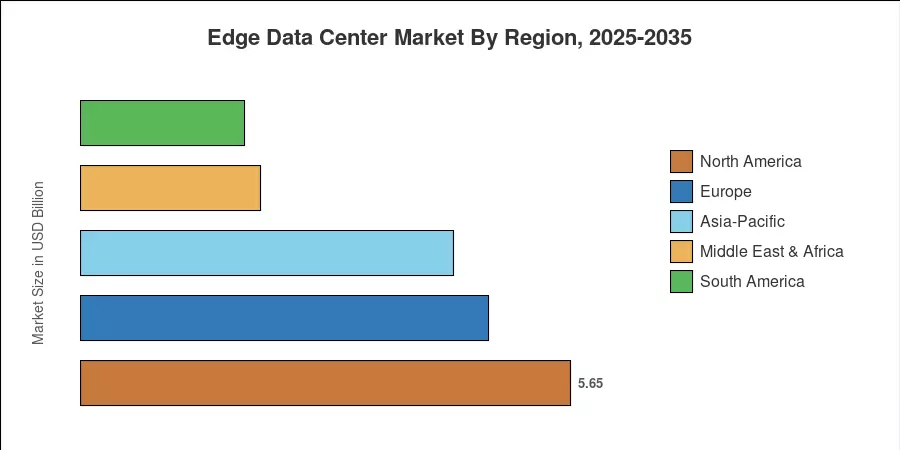
Regional Market Share Analysis

Region Key Metric Primary Investment Themes
North America 29.2% share (2025) Hyperscaler overflow, enterprise hybrid cloud
Europe 24.3% share (2025) GDPR compliance, sustainability mandates
Asia-Pacific 22.2% CAGR (2026–2035) 5G densification, smart cities, digital payments
South America USD 1.89 B (2025) Fintech infrastructure, data sovereignty
Middle East & Africa USD 2.07 B (2025) Sovereign cloud, oil-to-digital diversification
Total USD 19.35 B (2025)

The Edge Data Center Market spans five macro-regions, with investment intensity shaped by digital maturity, regulatory posture, and grid availability.


North America

Country Key Metric Key Driver
United States 72.5% of regional share Hyperscaler capex, federal AI executive orders
Canada 16.8% of regional share Toronto-Montreal data corridor expansion
Mexico 10.7% of regional share Nearshoring-driven enterprise IT demand


North America leads the Edge Data Center Market because the region hosts the headquarters and primary overflow demand of all three dominant hyperscalers, which collectively committed over USD 150 billion in 2024 capex — a portion funding edge ring architectures around top-25 metro areas [15]. The U.S. CHIPS and Science Act's adjacency to compute infrastructure investment, combined with Canada's tax incentives for green data center builds, reinforces the region's structural advantages through the forecast period.

Europe

Country Key Metric Key Driver
Germany 21.6% of the regional share Automotive edge computing, Industry 4.0
United Kingdom 19.2% of regional share Financial services, post-Brexit data adequacy
France 15.8% of regional share Nuclear-powered edge sites, government cloud
Italy 10.4% of regional share Smart-grid and telecom modernization
Spain 8.5% of regional share Subsea cable landing hubs
Nordic Countries 12.3% of regional share Renewable-powered cooling advantage
Russia 5.1% of regional share Domestic sovereignty requirements
Rest of Europe 7.1% of regional share Various localized digitization programs


Europe's growth trajectory in the Edge Data Center Market is shaped by the EU's Digital Decade programme, which targets at least 10,000 climate-neutral edge nodes by 2030 [8]. GDPR enforcement has made in-country data processing non-optional for financial and healthcare workloads, while the Nordic countries leverage cold climates and abundant hydroelectric power to deliver some of the lowest PUE ratios globally.

Asia-Pacific

Country Key Metric Key Driver
China 20.5% CAGR East-West data corridor, AI national strategy
India 23.8% CAGR Digital India, UPI payment infrastructure
Japan USD 1.42 B (2025) Factory automation, autonomous mobility
South Korea 19.8% CAGR 5G-first strategy, gaming/content delivery
ASEAN 22.6% CAGR Smart-city programs across Thailand, Indonesia, and Vietnam
Rest of Asia-Pacific 18.5% CAGR Emerging digital economies


Asia-Pacific's ascent as the fastest-growing region in the Edge Data Center Market stems from the convergence of massive 5G subscriber growth — China alone will surpass 1.5 billion 5G connections by 2030 — and aggressive government digital infrastructure programs [4]. India's DPDP Act and its mandate for in-country processing of financial and health data have opened a greenfield edge construction cycle, with cities like Hyderabad, Chennai, and Pune emerging as secondary-market hubs.

South America

Country Key Metric Key Driver
Brazil 55.3% of regional share Fintech boom, LGPD compliance
Argentina 18.7% of regional share Agricultural IoT, Buenos Aires enterprise demand
Rest of South America 26.0% of regional share Cross-border e-commerce, Colombia & Chile digitization


Brazil dominates the South American edge landscape, with São Paulo and Rio de Janeiro serving as regional interconnection hubs. The LGPD data protection law, modeled after GDPR, has catalyzed demand for in-country processing, particularly among banks and payment processors managing Pix transaction volumes that surpassed 42 billion in 2024 [13].

Middle East & Africa

Country Key Metric Key Driver
Saudi Arabia 28.5% of regional share NEOM, Vision 2030 digital transformation
UAE 24.2% of regional share Dubai Internet City, fintech hub ambitions
South Africa 18.1% of regional share Largest sub-Saharan data center market
Egypt 12.6% of regional share Suez Canal digital corridor, smart-city pilots
Rest of MEA 16.6% of regional share Nigeria and Kenya's digital economy growth


The Middle East & Africa represent the smallest but rapidly diversifying portion of the Edge Data Center Market. Saudi Arabia's PIF-backed investments in NEOM and the Riyadh digital corridor, combined with UAE initiatives positioning Dubai as a regional data hub, are channeling billions into domestic compute infrastructure [13]. Sub-Saharan Africa's opportunity hinges on solving grid reliability through solar-plus-storage edge deployments.


Edge Data Center Market By Region, 2025-2035

Competitive Benchmarking

The Edge Data Center Market exhibits moderate concentration, with an estimated HHI of approximately 650–750, and the top five players commanding a combined 30–38% revenue share. The competitive field splits between hyperscale cloud incumbents extending edge rings from their core regions and specialist edge-native operators building purpose-designed distributed networks. Capital intensity is rising, but operator diversity keeps pricing competitive.

Company Est. Revenue Share Range Key Offerings for Edge Data Center Market Strategic Positioning
Equinix ~7–10% xScale edge, Equinix Fabric, interconnection Global neutral-host interconnection leader
Microsoft (Azure) ~5–8% Azure Edge Zones, Azure Stack Edge Hyperscaler with integrated edge-cloud fabric
Digital Realty ~5–7% PlatformDIGITAL, ServiceFabric edge nodes Metro-density colocation specialist
EdgeConneX ~4–6% Purpose-built edge facilities, HyperScale range Edge-native developer, rapid build capability
Vapor IO ~3–5% Kinetic Edge, open-exchange edge platform Distributed micro-edge pioneer
Oracle ~3–5% OCI Dedicated Region, Roving Edge Infrastructure Enterprise database workloads at the edge
Schneider Electric ~3–4% EcoStruxure Micro Data Center, prefab solutions Infrastructure hardware and software supplier
Vertiv ~3–4% SmartMod, Liebert edge cooling, Vertiv Environet Power and thermal management specialist
Flexential ~2–4% FlexAnywhere, hybrid IT edge colocation Mid-market colocation and managed services
DataBank ~2–3% Edge colocation, managed cloud, compliance hosting Secondary-market colocation specialist


Recent News & Developments

  • Equinix (September 2025): Legally codified Decision (EU) 2022/2481 establishing the Digital Decade Policy Programme 2030, which explicitly mandates that member states collectively deploy at least 10,000 climate-neutral, highly secure distributed edge nodes to ensure sub-10 millisecond processing paths for European businesses.
  • Schneider Electric (June 2026): Expanded its standard EcoStruxure micro data center catalog across industrial markets, delivering pre-configured, self-contained enclosures that integrate intelligent power distribution and remote environmental management software to protect critical IT/OT conversions directly on the factory floor.
  • European Commission (July 2024): Published the EU Edge Node Roadmap under the Digital Decade programme, setting a target of 10,000 climate-neutral edge nodes across member states by 2030 [8].
  • Reserve Bank of India (April 2018): Issued updated data localization guidelines requiring payment processors to maintain primary and disaster-recovery compute within Indian borders, expanding the domestic Edge Data Center Market addressable opportunity [9].

Edge Data Center Market Report Scope

Parameter Detail
Market Scope Global Edge Data Center Market — hardware solutions, software platforms, managed services, and colocation
Study Period 2021–2035
CAGR (Forecast Period) 21.1% (2026–2035)
Base Year Market Size USD 19.35 Billion (2025)
Forecast Endpoint Market Size USD 131.18 Billion (2035)
Fastest Growing Segment Mega-class data centers (by size); Tier 4 (by tier)
Companies Profiled 10 (Equinix, Microsoft, Digital Realty, EdgeConneX, Vapor IO, Oracle, Schneider Electric, Vertiv, Flexential, DataBank)
Valuation Currency USD Billion


FAQs

What is the typical payback period for an edge data center investment?
Most enterprise edge deployments achieve payback in 3–5 years, depending on rack density, utilization rates, and whether the operator monetizes wholesale colocation alongside internal workloads [14]. Higher-density AI-ready builds can compress payback to under 3 years when inference revenue is layered in.
How does edge site selection differ from traditional data center site selection?
Edge sites prioritize network proximity to end users over land cost, placing facilities inside metro fiber rings rather than in rural power-rich zones [7]. Permitting speed and utility interconnection timelines often outweigh real-estate economics.
What cooling technologies are most viable for sub-1 MW edge facilities?
Direct-expansion and in-row cooling dominate sub-1 MW sites because they require no external chiller plant [12]. Rear-door heat exchangers and single-phase immersion cooling are emerging for higher-density edge racks exceeding 20 kW.
How do edge operators manage physical security at unmanned sites?
Operators deploy biometric access control, CCTV with AI-based anomaly detection, and environmental sensors linked to centralized NOCs [1]. Tamper-evident enclosures and remote power-kill capabilities provide additional layers for unmanned locations.
What contractual models are emerging for multi-tenant edge colocation?
Consumption-based pricing is replacing fixed-lease models, letting tenants scale power and rack space monthly [18]. Neutral-host operators increasingly offer interconnection-as-a-service add-ons that allow tenants to cross-connect without backhaul penalties.
How does the Edge Data Center Market address latency requirements for autonomous vehicles?
Autonomous-vehicle compute demands sub-5 ms round-trip processing, achievable only through roadside or near-cell-tower edge nodes [11]. Operators partner with telecom providers to co-locate inference servers at radio aggregation points along highway corridors.
What role do modular prefabricated units play in accelerating edge deployment?
Prefabricated edge modules cut deployment time from 12–18 months to 8–12 weeks by shifting construction to factory-controlled environments [12]. These units arrive pre-tested with integrated power, cooling, and fire suppression, reducing on-site commissioning risk.    
Author
Author
Author Profile
Aarti Dhapte LinkedIn
AVP - Research
A consulting professional focused on helping businesses navigate complex markets through structured research and strategic insights. I partner with clients to solve high-impact business problems across market entry strategy, competitive intelligence, and opportunity assessment. Over the course of my experience, I have led and contributed to 100+ market research and consulting engagements, delivering insights across multiple industries and geographies, and supporting strategic decisions linked to $500M+ market opportunities. My core expertise lies in building robust market sizing, forecasting, and commercial models (top-down and bottom-up), alongside deep-dive competitive and industry analysis. I have played a key role in shaping go-to-market strategies, investment cases, and growth roadmaps, enabling clients to make confident, data-backed decisions in dynamic markets.

Research Approach


Secondary Research

The secondary research process involved comprehensive analysis of technical standards databases, telecommunications regulatory filings, industry whitepapers, and peer-reviewed engineering journals. Key sources included the International Telecommunication Union (ITU-T) Study Group 13 (Future networks including 5G and edge computing), European Telecommunications Standards Institute (ETSI) Multi-access Edge Computing (MEC) specifications, American National Standards Institute (ANSI)/Telecommunications Industry Association (TIA-942) data center infrastructure standards, Uptime Institute Tier Certification databases, National Institute of Standards and Technology (NIST) cybersecurity frameworks, Federal Communications Commission (FCC) 5G and spectrum allocation filings, European Data Protection Board (EDPB) data sovereignty regulations, Cybersecurity and Infrastructure Security Agency (CISA) critical infrastructure guidelines, IEEE Communications Society publications, ASHRAE thermal guidelines for data processing environments, Mission Critical Alliance (MCA) industry reports, AFCOM State of the Data Center reports, 7x24 Exchange technical proceedings, Omdia Heavy Reading market trackers, Synergy Research Group cloud infrastructure databases, Structure Research edge colocation directories, and national telecommunications regulatory authority filings from key markets (Ofcom UK, Bundesnetzagentur Germany, MIC Japan, ACMA Australia).

The following sources were employed to gather deployment statistics, standardization timelines, certification data, power consumption metrics, latency requirement analyses, and regulatory compliance frameworks for micro data centers, hyperscale edge nodes, telecom MEC facilities, and enterprise edge deployments.


Primary Research

Qualitative and quantitative insights regarding edge infrastructure deployment patterns were obtained through interviews with supply-side and demand-side stakeholders during the primary research process on edge infrastructure. The supply-side sources consisted of CEOs, CTOs of Infrastructure, Heads of Edge Strategy, regulatory compliance officers, and commercial directors from edge data center operators (colocation providers, hyperscale cloud operators, telecom MEC divisions), critical infrastructure equipment manufacturers (power/cooling/IT hardware), and modular/prefabricated data center solution providers. Demand-side sources included procurement heads, network architecture leads, Chief Information Officers, Chief Technology Officers, and network architects from telecommunications carriers, cloud service providers, financial services institutions, healthcare systems, manufacturing enterprises (Industry 4.0 initiatives), and government/smart city agencies. Primary research has verified market segmentation across a variety of hardware components (servers, storage, networking), software platforms (orchestration, DCIM, virtualization), facility sizes (micro, small/medium, hyperscale edge), ownership models (enterprise-owned, telecom edge, hyperscale cloud, CDN edge), and vertical applications (IT & telecom, BFSI, healthcare, manufacturing, federal government).

Primary Respondent Breakdown:

By Designation: C-level Primaries (40%), Director Level (32%), Others (28%)

By Region: North America (32%), Europe (30%), Asia-Pacific (28%), Rest of World (10%)


Market Size Estimation

Capacity mapping and infrastructure investment analysis were employed to determine global market valuation. The methodology comprised the following:

Identification of over 50 key operators and infrastructure providers in North America, Europe, Asia-Pacific, Latin America, and the Middle East and Africa

Facility mapping across micro data centers (<100 racks), small/medium edge facilities (100-1,000 racks), and hyperscale edge nodes (>1,000 racks) by ownership type (telecom operator, hyperscale cloud, enterprise, CDN)

Analysis of annual revenues that are specific to edge data center portfolios, such as colocation services, managed edge services, and infrastructure equipment sales, as reported and modeled

In 2024, the coverage of operators and vendors will account for 75-80% of the global periphery data center capacity.

The following methods are employed to derive segment-specific valuations across hardware (servers, power/cooling, networking), software (DCIM, orchestration, security), and services (integration, managed services, professional services) categories: extrapolation using bottom-up (rack capacity × utilization rate × ARPU by region/ownership type) and top-down (operator revenue validation).

Cross-validation with 5G MEC rollout timelines, reported MW capacity deployments, and cloud provider edge zone expansion announcements

Download Free Sample

Kindly complete the form below to receive a free sample of this Report

Download PDF ×

We do not share your information with anyone. However, we may send you emails based on your report interest from time to time. You may contact us at any time to opt-out.