×
Request Free Sample ×

Kindly complete the form below to receive a free sample of this Report

* Please use a valid business email

Leading companies partner with us for data-driven Insights

clients tt-cursor
Hero Background

Electric Boat Ship Market

ID: MRFR/AT/40414-HCR
128 Pages
Garvit Vyas
October 2025

Electric Boat and Ship Market Research Report By Vessel Type (Electric Boats, Electric Ferries, Electric Cargo Ships, Electric Yachts), By Power Source (Battery Electric, Hybrid Electric, Fuel Cell Electric), By Application (Passenger Transport, Freight Transport, Leisure Activities, Research and Survey), By End Use (Commercial, Government, Recreational) and By Regional (North America, Europe, South America, Asia Pacific, Middle East and Africa) - Forecast to 2035

Share:
Download PDF ×

We do not share your information with anyone. However, we may send you emails based on your report interest from time to time. You may contact us at any time to opt-out.

Electric Boat Ship Market Infographic
Purchase Options

Electric Boat Ship Market Summary

As per MRFR analysis, the Electric Boat and Ship Market Size was estimated at 7.496 USD Billion in 2024. The Electric Boat and Ship industry is projected to grow from 8.301 USD Billion in 2025 to 23.0 USD Billion by 2035, exhibiting a compound annual growth rate (CAGR) of 10.73 during the forecast period 2025 - 2035.

Key Market Trends & Highlights

The Electric Boat and Ship Market is experiencing robust growth driven by technological advancements and increasing consumer demand for sustainable options.

  • Technological advancements in propulsion systems are reshaping the Electric Boat and Ship Market, particularly in North America.
  • The market for Electric Yachts is expanding rapidly, indicating a shift in consumer preferences towards luxury sustainable options in the Asia-Pacific region.
  • Battery Electric vessels remain the largest segment, while Hybrid Electric solutions are gaining traction as a viable alternative.
  • Key market drivers include technological innovations in battery systems and rising fuel prices, which enhance the economic viability of electric marine transportation.

Market Size & Forecast

2024 Market Size 7.496 (USD Billion)
2035 Market Size 23.0 (USD Billion)
CAGR (2025 - 2035) 10.73%

Major Players

ABB (CH), Siemens (DE), Rolls-Royce (GB), Wärtsilä (FI), General Dynamics (US), Thyssenkrupp (DE), Bae Systems (GB), Kongsberg Gruppen (NO), Naval Group (FR)

Electric Boat Ship Market Trends

The Electric Boat and Ship Market is currently experiencing a transformative phase, driven by advancements in technology and a growing emphasis on sustainability. As environmental concerns escalate, stakeholders are increasingly prioritizing eco-friendly alternatives to traditional marine vessels. This shift is not merely a trend but appears to be a fundamental change in how maritime operations are conducted. Innovations in battery technology and electric propulsion systems are enhancing the efficiency and performance of electric vessels, making them more appealing to both commercial and recreational users. Furthermore, regulatory frameworks are evolving to support the adoption of electric marine solutions, indicating a robust future for this sector. In addition to technological advancements, the Electric Boat and Ship Market is witnessing a surge in investment from both public and private sectors. This influx of capital is likely to accelerate research and development efforts, fostering a competitive landscape that encourages innovation. As manufacturers strive to meet the increasing demand for sustainable maritime solutions, collaboration between industry players and governmental bodies is becoming more pronounced. This collaborative approach may lead to the establishment of standardized practices and guidelines, further solidifying the market's foundation. Overall, the Electric Boat and Ship Market is poised for substantial growth, driven by a confluence of technological, regulatory, and investment factors.

Technological Advancements in Propulsion Systems

Recent innovations in electric propulsion technology are reshaping the Electric Boat and Ship Market. Enhanced battery efficiency and energy management systems are enabling vessels to operate for extended periods without the need for frequent recharging. This development not only improves operational efficiency but also broadens the scope of applications for electric vessels, making them suitable for various maritime activities.

Regulatory Support for Sustainable Practices

The Electric Boat and Ship Market is benefiting from an increasingly supportive regulatory environment. Governments worldwide are implementing policies that promote the use of electric vessels, including incentives for manufacturers and operators. This regulatory backing is likely to accelerate the transition towards greener maritime solutions, encouraging more stakeholders to invest in electric technologies.

Growing Consumer Awareness and Demand

There is a noticeable increase in consumer awareness regarding environmental issues, which is influencing purchasing decisions in the Electric Boat and Ship Market. As individuals and businesses become more conscious of their carbon footprints, the demand for electric vessels is expected to rise. This shift in consumer behavior may drive manufacturers to prioritize the development of sustainable and efficient marine solutions.

Electric Boat Ship Market Drivers

Investment in Renewable Energy Sources

The Electric Boat and Ship Market is benefiting from increased investment in renewable energy sources, which is crucial for the sustainability of electric vessels. The integration of solar and wind energy into maritime operations is becoming more prevalent, allowing vessels to harness clean energy for propulsion. This trend is supported by various governments and private entities that are funding research and development in renewable energy technologies. As a result, the Electric Boat and Ship Market is likely to see a rise in hybrid vessels that utilize both electric propulsion and renewable energy, enhancing operational efficiency and reducing reliance on fossil fuels. This shift not only aligns with global sustainability goals but also positions the industry for long-term growth.

Environmental Regulations and Compliance

The Electric Boat and Ship Market is increasingly influenced by stringent environmental regulations aimed at reducing carbon emissions and promoting sustainability. Various countries are implementing policies that mandate the reduction of greenhouse gas emissions from maritime operations. For example, the International Maritime Organization has set ambitious targets for reducing emissions by 50% by 2050. These regulations are compelling shipbuilders and operators to transition towards electric and hybrid vessels, thereby driving demand within the Electric Boat and Ship Market. Compliance with these regulations not only enhances a company's reputation but also opens up new market opportunities, as environmentally friendly vessels become a competitive advantage in the industry.

Rising Fuel Prices and Economic Viability

The Electric Boat and Ship Market is increasingly influenced by rising fuel prices, which are prompting operators to seek more economical alternatives. As traditional fuel costs continue to escalate, the operational cost advantages of electric vessels become more pronounced. Electric boats and ships typically have lower fuel and maintenance costs compared to their diesel counterparts. This economic viability is likely to drive more shipping companies to invest in electric solutions, thereby expanding the Electric Boat and Ship Market. Additionally, the potential for government subsidies and incentives for adopting electric technologies further enhances the financial attractiveness of transitioning to electric vessels, making it a compelling option for operators.

Technological Innovations in Battery Systems

The Electric Boat and Ship Market is experiencing a surge in technological innovations, particularly in battery systems. Advances in lithium-ion and solid-state batteries are enhancing energy density and reducing charging times. For instance, the energy density of lithium-ion batteries has improved significantly, allowing vessels to operate longer distances without frequent recharging. This is crucial for commercial shipping, where operational efficiency is paramount. Furthermore, the development of fast-charging infrastructure is likely to facilitate the adoption of electric vessels, making them more appealing to operators. As battery technology continues to evolve, it is anticipated that the Electric Boat and Ship Market will witness increased investment and growth, driven by the need for sustainable and efficient maritime solutions.

Consumer Demand for Sustainable Transportation

The Electric Boat and Ship Market is witnessing a notable shift in consumer demand towards sustainable transportation options. As awareness of environmental issues grows, consumers are increasingly favoring companies that prioritize sustainability in their operations. This trend is particularly evident in the tourism and recreational sectors, where electric boats are becoming more popular among eco-conscious consumers. The demand for electric vessels is likely to increase as more individuals seek environmentally friendly alternatives for leisure activities. Consequently, the Electric Boat and Ship Market is expected to expand as manufacturers respond to this consumer preference, leading to a broader range of electric vessel offerings and innovations.

Market Segment Insights

By Vessel Type: Electric Boats (Largest) vs. Electric Yachts (Fastest-Growing)

In the Electric Boat and Ship Market, Electric Boats currently hold the largest share, representing a significant portion of total vessel types. This segment benefits from widespread adoption across recreational and commercial applications, largely due to increasing environmental awareness and regulatory support. Meanwhile, Electric Yachts, although smaller in market share, are quickly gaining traction due to their appeal among affluent consumers seeking sustainable and luxurious alternatives to traditional motored vessels.

Vessel Type: Electric Boats (Dominant) vs. Electric Ferries (Emerging)

Electric Boats are recognized as the dominant force in the market, leveraging advanced technology to reduce emissions while providing reliable performance for recreational users. Their versatility caters to a wide range of applications, from personal use to commercial enterprises. Conversely, Electric Ferries are emerging as a crucial part of the sustainability agenda in public transportation, driven by investment in green technology and policies aimed at reducing urban pollution. Their operational efficiency and lower long-term costs position them favorably in the evolving maritime landscape, gradually capturing a larger share through electrification initiatives.

By Power Source: Battery Electric (Largest) vs. Hybrid Electric (Fastest-Growing)

In the Electric Boat and Ship Market, the distribution of power sources is distinctly marked by the dominance of Battery Electric systems, which currently holds the largest share. This segment has gained significant traction due to advancements in battery technologies and the growing demand for environmentally friendly alternatives in marine transportation. Meanwhile, Hybrid Electric systems are rapidly emerging as the fastest-growing category as they capitalize on flexible energy use and fuel efficiency, appealing to a broader range of maritime applications.

Battery Electric (Dominant) vs. Hybrid Electric (Emerging)

Battery Electric systems stand out in the Electric Boat and Ship Market as the dominant power source, primarily due to their ability to eliminate greenhouse gas emissions and reduce operational costs in marine settings. Their extensive use in smaller vessels and short-range operations showcases their practicality and efficiency. In contrast, Hybrid Electric systems are emerging rapidly, blending traditional propulsion with electric capabilities. This flexibility allows for decreased fuel consumption and optimized performance across various operational modes, which is increasingly attractive for the shipping industry aiming for sustainability and competitiveness.

By Application: Passenger Transport (Largest) vs. Freight Transport (Fastest-Growing)

The Electric Boat and Ship Market showcases a diverse array of applications. Passenger transport clearly leads, capturing the majority of market share thanks to increasing consumer demand for eco-friendly travel experiences. This segment benefits from advancements in electric propulsion technologies, making it a preferred choice among environmentally conscious travelers. In contrast, freight transport, while smaller in share currently, is emerging as the fastest-growing segment. This growth is driven by a shift towards sustainable logistics solutions and regulatory pressures to reduce emissions in shipping sectors.

Transport: Passenger (Dominant) vs. Freight (Emerging)

Passenger transport dominates the electric boat and ship market, positioning itself as a frontrunner as more operators launch zero-emission vessels to cater to increasing consumer expectations for sustainability. This segment is characterized by a blend of luxury and functionality, where vessels are designed to enhance user experience while minimizing environmental impact. On the other hand, freight transport is rapidly gaining traction, driven by a need for greener supply chain practices. This emerging segment benefits from innovations in electric cargo vessels which are optimized for efficiency and reduced operational costs, appealing to logistics companies seeking to meet stringent emissions regulations.

By End Use: Commercial (Largest) vs. Government (Fastest-Growing)

In the Electric Boat and Ship Market, the end use segment is primarily driven by commercial applications, which currently dominate market share due to increased investments in electric vessels for cargo transport and passenger services. This segment benefits from a rising demand for eco-friendly transportation solutions and the modernization of shipping fleets across various industries. Conversely, the government segment, while smaller in overall share, is rapidly growing as governments worldwide seek to reduce emissions and promote sustainable maritime practices through investments in electric fleets.

End Use: Commercial (Dominant) vs. Government (Emerging)

The commercial end use segment is characterized by a diverse range of applications including cargo shipping, ferries, and cruise lines, making it the dominant player in the Electric Boat and Ship Market. Businesses are increasingly adopting electric vessels to comply with environmental regulations and to appeal to eco-conscious consumers. Meanwhile, the government segment is emerging as a significant force, propelled by policy incentives and funding initiatives aimed at bolstering green technology. This segment focuses on developing electric boats for public services and research missions, highlighting the growing commitment to sustainable maritime practices.

Get more detailed insights about Electric Boat Ship Market

Regional Insights

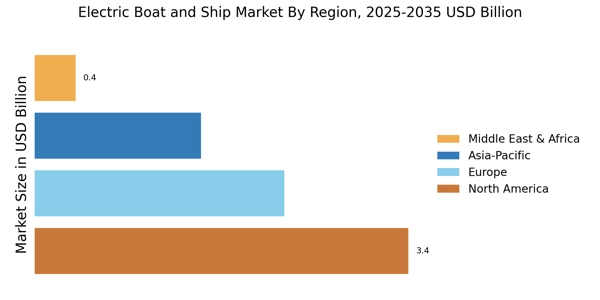
The Regional segment of the Global Electric Boat and Ship Market showcased diverse growth across various areas, with North America leading the charge, valued at 3.0 USD Billion in 2024 and projected to rise to 10.5 USD Billion by 2035, illustrating a majority holding due to its advanced marine technologies and significant investment in electric vessel innovation.

Europe followed closely behind with a valuation of 2.5 USD Billion in 2024, expected to grow to 8.7 USD Billion by 2035, driven by stringent environmental regulations and a push for sustainable shipping practices.

The APAC region, valued at 1.8 USD Billion in 2024 and anticipated to reach 5.7 USD Billion in 2035, became increasingly important in the market as countries like China and Japan enhance their electric shipping fleets in response to urbanization and pollution challenges.

South America, while smaller in size at 0.9 USD Billion in 2024, is expected to see growth to 2.0 USD Billion by 2035, reflecting the region's slow but emerging commitment to green technologies. Lastly, the MEA segment, with a valuation of 0.29 USD Billion in 2024, showed the least dominance, as it represents considerable opportunities for investment driven by rising oil prices and a strong push towards diversification in transportation methods.

The Global Electric Boat and Ship Market data depicted a fluctuating but upward trend across all regions, showcasing various growth drivers along with opportunities aligned with environmental sustainability.

Electric Boat Ship Market Regional Image

Key Players and Competitive Insights

The Global Electric Boat and Ship Market has seen a significant transformation over the past years, driven by a combination of technological advancements, increasing environmental regulations, and a heightened awareness among consumers about sustainable practices.

With a growing number of players entering the market, competition has intensified, resulting in innovative designs and improved efficiencies in electric marine vehicles. Key players in the industry are focusing on enhancing their product offerings by integrating cutting-edge technology such as battery management systems, electric propulsion systems, and smart connectivity features.

This competitive landscape showcases a diverse range of manufacturers, each striving to carve out their niche while responding to consumer preferences for cleaner, quieter, and more eco-friendly maritime transportation solutions.

X Shore has emerged as a formidable competitor within the Global Electric Boat and Ship Market due to its strong presence and commitment to innovation.

The company prides itself on its ability to blend cutting-edge technology with sustainable design practices, offering a unique approach to electric boating. X Shore is recognized for its high-performance electric boats that deliver a seamless experience while minimizing environmental impact.

The company’s investment in advanced research and development allows it to continuously refine its product lineup, ensuring that it meets the evolving needs of consumers.

With a firm focus on quality and customer satisfaction, X Shore has managed to establish a solid brand reputation, leveraging its strengths in design, engineering, and an understanding of market trends to maintain a competitive edge in the industry.

Energica Motor Company, primarily known for its electric motorcycles, is also making strides in the Global Electric Boat and Ship Market, illustrating the growing intersection between electric vehicle technology and marine applications.

Although the company initially focused on two-wheeled electric vehicles, Energica's expertise in electric powertrains and battery technology positions it favorably within the maritime sector. The firm's commitment to performance and sustainability resonates well with the current market dynamics where consumers are increasingly prioritizing energy-efficient and environmentally friendly alternatives.

Energica's strategic approach to harnessing its electric vehicle heritage allows it to innovate in boat technology, where its engineering prowess can lead to the development of powerful, reliable, and eco-conscious marine products aimed at capturing a unique segment of the market and driving the transition toward electric mobility on water.

Key Companies in the Electric Boat Ship Market market include

Industry Developments

Recent developments in the Global Electric Boat and Ship Market highlight significant technological advancements and increased investments. Companies like X Shore and Energica Motor Company are at the forefront, focusing on the production of high-performance electric vessels that promise reduced emissions and enhanced efficiency.

General Electric has been advancing its electric propulsion technology, while Wartsila and ABB are contributing by providing innovative power systems that complement electric mobility in maritime transport. Sunseeker International and Greenline Yachts have been launching new electric models catering to eco-conscious consumers, reflecting a growing consumer preference for sustainable options.

In terms of mergers and acquisitions, recent strategic consolidations have been observed, notably involving key players such as Fincantieri and Thyssenkrupp Marine Systems, aimed at expanding their electric offerings and technological capabilities.

The market valuation for electric boat and ship manufacturers is seeing a general upward trend, driven by rising environmental regulations and increasing demand for electrification in the maritime industry. Major corporations like Naval Group and Babcock International are also adapting to these shifts, which collectively propel the growth of the electric maritime sector.

Future Outlook

Electric Boat Ship Market Future Outlook

The Electric Boat and Ship Market is poised for growth at 10.73% CAGR from 2024 to 2035, driven by technological advancements, regulatory support, and increasing environmental concerns.

New opportunities lie in:

  • Development of advanced battery technologies for longer-range vessels.
  • Integration of AI for predictive maintenance and operational efficiency.
  • Expansion into emerging markets with tailored electric shipping solutions.

By 2035, the market is expected to be robust, reflecting substantial advancements and increased adoption.

Market Segmentation

Electric Boat Ship Market End Use Outlook

  • Commercial
  • Government
  • Recreational

Electric Boat Ship Market Application Outlook

  • Passenger Transport
  • Freight Transport
  • Leisure Activities
  • Research and Survey

Electric Boat Ship Market Vessel Type Outlook

  • Electric Boats
  • Electric Ferries
  • Electric Cargo Ships
  • Electric Yachts

Electric Boat Ship Market Power Source Outlook

  • Battery Electric
  • Hybrid Electric
  • Fuel Cell Electric

Report Scope

MARKET SIZE 20247.496(USD Billion)
MARKET SIZE 20258.301(USD Billion)
MARKET SIZE 203523.0(USD Billion)
COMPOUND ANNUAL GROWTH RATE (CAGR)10.73% (2024 - 2035)
REPORT COVERAGERevenue Forecast, Competitive Landscape, Growth Factors, and Trends
BASE YEAR2024
Market Forecast Period2025 - 2035
Historical Data2019 - 2024
Market Forecast UnitsUSD Billion
Key Companies ProfiledMarket analysis in progress
Segments CoveredMarket segmentation analysis in progress
Key Market OpportunitiesGrowing demand for sustainable maritime solutions drives innovation in the Electric Boat and Ship Market.
Key Market DynamicsRising demand for sustainable maritime solutions drives innovation and competition in the electric boat and ship market.
Countries CoveredNorth America, Europe, APAC, South America, MEA

Leave a Comment

FAQs

What is the current valuation of the Electric Boat and Ship Market?

As of 2024, the Electric Boat and Ship Market was valued at 7.496 USD Billion.

What is the projected market valuation for the Electric Boat and Ship Market in 2035?

The market is projected to reach a valuation of 23.0 USD Billion by 2035.

What is the expected CAGR for the Electric Boat and Ship Market during the forecast period 2025 - 2035?

The expected CAGR for the Electric Boat and Ship Market during the forecast period 2025 - 2035 is 10.73%.

Which vessel types are included in the Electric Boat and Ship Market segments?

The vessel types include Electric Boats, Electric Ferries, Electric Cargo Ships, and Electric Yachts, with valuations ranging from 1.5 to 7.0 USD Billion.

What are the different power sources utilized in the Electric Boat and Ship Market?

The market segments power sources into Battery Electric, Hybrid Electric, and Fuel Cell Electric, with valuations between 2.249 and 9.0 USD Billion.

What applications are driving growth in the Electric Boat and Ship Market?

Key applications include Passenger Transport, Freight Transport, Leisure Activities, and Research and Survey, with valuations from 1.496 to 8.0 USD Billion.

How is the Electric Boat and Ship Market segmented by end use?

The market is segmented into Commercial, Government, and Recreational end uses, with valuations ranging from 1.499 to 9.5 USD Billion.

Who are the key players in the Electric Boat and Ship Market?

Key players include ABB, Siemens, Rolls-Royce, Wärtsilä, General Dynamics, Thyssenkrupp, Bae Systems, Kongsberg Gruppen, and Naval Group.

What trends are influencing the growth of the Electric Boat and Ship Market?

Trends such as increasing environmental regulations and advancements in battery technology appear to be influencing market growth.

What is the potential impact of technological advancements on the Electric Boat and Ship Market?

Technological advancements may enhance efficiency and reduce costs, potentially accelerating market growth during the forecast period.

Download Free Sample

Kindly complete the form below to receive a free sample of this Report

Compare Licence

×
Features License Type
Single User Multiuser License Enterprise User
Price $4,950 $5,950 $7,250
Maximum User Access Limit 1 User Upto 10 Users Unrestricted Access Throughout the Organization
Free Customization
Direct Access to Analyst
Deliverable Format
Platform Access
Discount on Next Purchase 10% 15% 15%
Printable Versions