×
Request Free Sample ×

Kindly complete the form below to receive a free sample of this Report

* Please use a valid business email

Leading companies partner with us for data-driven Insights

clients tt-cursor
Hero Background

Boat Ship Telematics Market

ID: MRFR/AT/40439-HCR
200 Pages
Garvit Vyas
October 2025

Boat and Ship Telematics Market Research Report By Application (Fleet Management, Navigation and Safety, Cargo Management, Performance Monitoring), By Technology (GPS Tracking, Satellite Communication, IoT Enabled Devices, Telematics Software), By End Use (Commercial Vessels, Private Yachts, Cargo Ships, Fishing Boats), By Connectivity Type (Cellular, Satellite, Wi-Fi, Bluetooth) and By Regional (North America, Europe, South America, Asia Pacific, Middle East and Africa) - Forecast to 2035

Share:
Download PDF ×

We do not share your information with anyone. However, we may send you emails based on your report interest from time to time. You may contact us at any time to opt-out.

Boat Ship Telematics Market Infographic
Purchase Options

Boat Ship Telematics Market Summary

As per MRFR analysis, the Boat and Ship Telematics Market Size was estimated at 2.86 USD Billion in 2024. The Boat and Ship Telematics industry is projected to grow from 3.137 USD Billion in 2025 to 7.903 USD Billion by 2035, exhibiting a compound annual growth rate (CAGR) of 9.68 during the forecast period 2025 - 2035.

Key Market Trends & Highlights

The Boat and Ship Telematics Market is experiencing robust growth driven by technological advancements and regulatory demands.

  • The integration of IoT technologies is transforming operational capabilities in the telematics sector.
  • North America remains the largest market, while Asia-Pacific is emerging as the fastest-growing region for boat and ship telematics.
  • Fleet management continues to dominate the market, whereas performance monitoring is witnessing rapid growth.
  • Rising demand for enhanced safety features and advancements in communication technologies are key drivers propelling market expansion.

Market Size & Forecast

2024 Market Size 2.86 (USD Billion)
2035 Market Size 7.903 (USD Billion)
CAGR (2025 - 2035) 9.68%

Major Players

VesselFinder (US), MarineTraffic (GR), Kongsberg Gruppen (NO), Furuno Electric (JP), Navico (NO), Raymarine (GB), Satcom Global (GB), Teledyne Marine (US), Maretron (US)

Boat Ship Telematics Market Trends

The Boat and Ship Telematics Market is currently experiencing a transformative phase, driven by advancements in technology and increasing demand for enhanced safety and operational efficiency. The integration of Internet of Things (IoT) devices and satellite communication systems is reshaping how vessels are monitored and managed. This evolution not only facilitates real-time tracking but also enables predictive maintenance, thereby reducing operational costs and improving overall performance. As stakeholders recognize the value of data analytics, the market is likely to witness a surge in the adoption of telematics solutions that provide actionable insights for decision-making. Moreover, environmental regulations are becoming more stringent, prompting the maritime industry to seek innovative solutions that ensure compliance while optimizing resource usage. The Boat and Ship Telematics Market appears poised for growth as companies invest in sustainable technologies. This shift towards eco-friendly practices, coupled with the increasing focus on safety and efficiency, suggests a promising future for telematics applications in the maritime sector. As the industry evolves, collaboration among technology providers, shipbuilders, and regulatory bodies will be crucial in shaping the trajectory of this market.

Integration of IoT Technologies

The incorporation of Internet of Things devices is revolutionizing the Boat and Ship Telematics Market. These technologies enable seamless communication between vessels and shore-based systems, enhancing monitoring capabilities and operational efficiency.

Focus on Regulatory Compliance

With the rise of environmental regulations, the Boat and Ship Telematics Market is witnessing a shift towards solutions that ensure compliance. Companies are increasingly adopting telematics systems that help in tracking emissions and optimizing fuel consumption.

Emphasis on Data Analytics

The growing importance of data analytics in the Boat and Ship Telematics Market is evident. Stakeholders are leveraging data to gain insights into vessel performance, leading to improved decision-making and operational strategies.

Boat Ship Telematics Market Drivers

Growing Environmental Regulations

The Boat and Ship Telematics Market is increasingly influenced by growing environmental regulations aimed at reducing the ecological impact of maritime operations. Governments and regulatory bodies are implementing stringent measures to monitor emissions and ensure compliance with environmental standards. Telematics systems provide essential data that helps operators track fuel consumption and emissions, facilitating adherence to these regulations. The market is expected to expand as companies invest in telematics solutions that not only enhance compliance but also promote sustainable practices. Recent statistics indicate that vessels equipped with telematics systems have shown a 20% improvement in fuel efficiency, underscoring the potential benefits of these technologies in meeting regulatory requirements.

Increased Focus on Operational Efficiency

The Boat and Ship Telematics Market is witnessing an increased focus on operational efficiency among maritime operators. Companies are seeking ways to optimize their operations, reduce costs, and enhance productivity. Telematics solutions provide valuable insights into vessel performance, enabling operators to make data-driven decisions that improve efficiency. For instance, the use of telematics has been linked to a 25% reduction in operational costs for some shipping companies. This emphasis on efficiency is likely to drive further investments in telematics technologies, as operators recognize the potential for significant cost savings and improved service delivery in a competitive market.

Advancements in Communication Technologies

The Boat and Ship Telematics Market is being propelled by advancements in communication technologies. Innovations such as satellite communication and 5G networks are enhancing connectivity for vessels, enabling seamless data transmission and real-time communication. This improved connectivity is crucial for operational efficiency and safety, as it allows for better coordination among crew members and shore-based operations. The market has seen a significant increase in the adoption of these technologies, with a projected growth rate of 15% annually over the next five years. As communication technologies continue to evolve, they are likely to play a pivotal role in shaping the future of telematics in the maritime sector.

Rising Demand for Enhanced Safety Features

The Boat and Ship Telematics Market is experiencing a notable surge in demand for enhanced safety features. As maritime activities increase, stakeholders are prioritizing safety to mitigate risks associated with navigation and operations. The integration of telematics systems allows for real-time monitoring of vessel conditions, which can significantly reduce accidents and improve response times during emergencies. According to recent data, the implementation of advanced telematics solutions has led to a 30% reduction in maritime accidents over the past few years. This trend indicates a growing recognition of the importance of safety in the industry, driving investments in telematics technologies that provide comprehensive safety solutions.

Expansion of the Recreational Boating Sector

The Boat and Ship Telematics Market is benefiting from the expansion of the recreational boating sector. As more individuals engage in boating activities, there is a growing demand for telematics solutions that enhance the boating experience. Features such as GPS tracking, weather updates, and emergency alerts are becoming increasingly popular among recreational boaters. This trend is reflected in market data, which indicates a 10% annual growth in the recreational boating segment. As the number of recreational vessels increases, the demand for telematics systems that provide safety and convenience features is expected to rise, further propelling the market forward.
Market Segment Insights

By Application: Fleet Management (Largest) vs. Performance Monitoring (Fastest-Growing)

In the Boat and Ship Telematics Market, the application segment is primarily dominated by Fleet Management, which holds the largest market share due to its critical role in ensuring operational efficiency for shipping companies. This segment facilitates tracking and managing fleets effectively, helping companies reduce operational costs and improve service delivery. Performance Monitoring has emerged as a significant player within this segment, attracting increasing investments as companies seek to optimize vessel performance by leveraging real-time data analytics and insights.

Fleet Management (Dominant) vs. Performance Monitoring (Emerging)

Fleet Management is a critical application within the Boat and Ship Telematics Market, focusing on optimizing the operations and management of maritime fleets. This segment leverages advanced telematics solutions to streamline logistics, improve fleet utilization, and minimize fuel consumption. In contrast, Performance Monitoring has emerged as an innovative segment, driven by the need for real-time performance data. This application allows operators to analyze vessel efficiency, identify maintenance needs promptly, and enhance safety measures, thus positioning itself as a vital tool for modern maritime operations.

By Technology: GPS Tracking (Largest) vs. Telematics Software (Fastest-Growing)

In the Boat and Ship Telematics Market, GPS Tracking leads the segment with the largest share, reflecting widespread adoption due to its critical role in navigation and safety. This technology has become an essential tool for ship operators, allowing for real-time location tracking and route optimization, which offers significant operational efficiencies. Following closely are Telematics Software and Satellite Communication, which also hold substantial positions in the market, providing complementary functionalities and enhancing decision-making processes within vessel management.

Technology: GPS Tracking (Dominant) vs. Telematics Software (Emerging)

GPS Tracking technology remains the dominant force in the Boat and Ship Telematics Market, characterized by its reliability and essential role in modern maritime operations. It offers critical benefits such as enhanced safety, regulatory compliance, and operational efficiency. In contrast, Telematics Software is an emerging player, rapidly gaining traction with its capabilities to integrate data analytics and improve fleet management. This software facilitates advanced monitoring of vessel performance, crew activities, and environmental impact, pushing the boundaries of traditional telematics, making it an essential tool for forward-thinking maritime organizations.

By End Use: Commercial Vessels (Largest) vs. Private Yachts (Fastest-Growing)

In the Boat and Ship Telematics Market, the segment values exhibit diverse characteristics in terms of market share. Commercial Vessels hold the largest share among the end-use categories, driven by the increasing demand for enhanced operational efficiency and safety. Conversely, Private Yachts are witnessing rapid growth, primarily fueled by the rising affluence of individuals and a growing interest in luxury recreational boating experiences.  As the market evolves, the growth trends indicate that Commercial Vessels will continue to dominate, supported by advancements in telematics technology that improve navigation, tracking, and maintenance. Private Yachts are set to experience the fastest growth due to innovations in luxury features, user-friendly interfaces, and an increasing emphasis on sustainability in private boating practices. This dynamic landscape signifies a shift toward integrated technology solutions for varied boating needs.

Commercial Vessels (Dominant) vs. Fishing Boats (Emerging)

Commercial Vessels represent the dominant segment within the Boat and Ship Telematics Market, characterized by their extensive deployment of advanced telematics solutions that enhance operational efficiency, safety, and compliance. These vessels include cargo ships, tankers, and ferries, all of which rely heavily on real-time data to optimize performance and reduce operational costs. On the other hand, Fishing Boats are emerging within this landscape, increasingly adopting telematics systems to improve catch management and safety measures. While traditionally less tech-intensive, innovations such as electronic monitoring systems and GPS tracking are gradually being implemented to drive productivity. As fish stocks become more regulated, the demand for smart telematics in Fishing Boats is anticipated to rise significantly, underscoring a notable transformation in this segment.

By Connectivity Type: Cellular (Largest) vs. Satellite (Fastest-Growing)

The Boat and Ship Telematics Market is predominantly driven by the Cellular connectivity type, which holds a significant market share due to its widespread availability and reliability. Cellular technology continues to dominate the market landscape, supported by advancements in mobile networks and improved data transmission capabilities. In contrast, Satellite connectivity has emerged as a crucial player, especially in remote areas where cellular coverage is limited. This segment has seen notable adoption rates, influenced by the growing need for global connectivity and enhanced coverage options for maritime operations.

Cellular (Dominant) vs. Satellite (Emerging)

Cellular connectivity stands as the dominant force in the Boat and Ship Telematics Market thanks to its high-speed data transfer capabilities and extensive infrastructure. It is favored for its lower operational costs and accessibility, making it the go-to choice for many maritime operators. Meanwhile, Satellite connectivity is rapidly emerging as a vital solution, particularly for vessels operating in offshore and remote areas where terrestrial networks fail to reach. Its advantages include global coverage, reliability in harsh environment conditions, and the ability to transmit data from anywhere in the ocean, catering to a diverse range of applications from navigation to fleet tracking.

Get more detailed insights about Boat Ship Telematics Market

Regional Insights

North America : Leading Innovation and Adoption

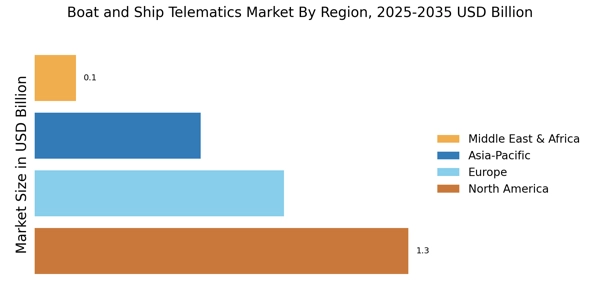
The North American boat and ship telematics market is driven by technological advancements and increasing demand for safety and efficiency in maritime operations. The region holds the largest market share at approximately 45%, fueled by stringent regulations and a growing emphasis on environmental sustainability. The U.S. Coast Guard's initiatives to enhance maritime safety further catalyze market growth, encouraging the adoption of telematics solutions. Key players like VesselFinder and Teledyne Marine dominate the competitive landscape, supported by a robust infrastructure and investment in R&D. The U.S. leads in telematics adoption, while Canada follows closely, focusing on enhancing maritime safety and operational efficiency. The presence of established companies and innovative startups fosters a dynamic market environment, ensuring continuous growth and technological advancements.

Europe : Emerging Regulatory Frameworks

Europe is witnessing significant growth in the boat and ship telematics market, driven by regulatory frameworks aimed at enhancing maritime safety and environmental protection. The region holds the second-largest market share at around 30%, with countries like Germany and the UK leading the charge. The European Maritime Safety Agency's regulations promote the adoption of telematics solutions, ensuring compliance and safety in maritime operations. Leading players such as MarineTraffic and Kongsberg Gruppen are at the forefront, leveraging advanced technologies to meet regulatory demands. The competitive landscape is characterized by innovation and collaboration among key stakeholders, including government bodies and private enterprises. This synergy fosters a conducive environment for market growth, with a focus on sustainability and efficiency in maritime operations.

Asia-Pacific : Rapid Growth and Adoption

The Asia-Pacific region is rapidly emerging as a significant player in the boat and ship telematics market, driven by increasing maritime activities and a growing focus on safety and efficiency. The region holds a market share of approximately 20%, with countries like Japan and Australia leading in telematics adoption. Government initiatives aimed at modernizing maritime infrastructure and enhancing safety standards are key growth drivers in this region. Competitive dynamics are evolving, with key players like Furuno Electric and Navico making substantial investments in technology and innovation. The presence of a diverse range of maritime activities, from commercial shipping to recreational boating, creates a vibrant market landscape. As the region continues to embrace telematics solutions, the focus on regulatory compliance and operational efficiency will further propel market growth.

Middle East and Africa : Emerging Market Potential

The Middle East and Africa region is gradually recognizing the potential of the boat and ship telematics market, driven by increasing maritime trade and the need for enhanced safety measures. The market share is currently around 5%, with countries like South Africa and the UAE showing promising growth trends. Government initiatives aimed at improving maritime safety and infrastructure are pivotal in driving demand for telematics solutions in this region. The competitive landscape is still developing, with a mix of local and international players entering the market. Companies are focusing on providing tailored solutions to meet the unique needs of the region's maritime sector. As awareness of telematics benefits grows, the market is expected to expand, supported by investments in technology and infrastructure development.

Boat Ship Telematics Market Regional Image

Key Players and Competitive Insights

The Global Boat and Ship Telematics Market has been undergoing significant evolution, driven by advancements in technology and increasing awareness of the benefits of real-time data monitoring and management for maritime operations.

This market encompasses a wide array of services and solutions, including satellite communications, GPS tracking, fleet management systems, and data analytics, which collectively contribute to enhancing the operational efficiency and safety of vessels.

Competitive dynamics in this landscape are characterized by a variety of players ranging from traditional maritime companies to tech-driven firms specializing in telematics solutions.

As the demand for smart solutions in navigation, fuel consumption tracking, and predictive maintenance grows, understanding the competitive positioning and innovations offered by key market players becomes essential for stakeholders aiming to stay ahead in this rapidly changing environment.

Verizon has established a prominent presence in the Global Boat and Ship Telematics Market through its robust telecommunications infrastructure and expertise in data services. The company leverages its extensive network capabilities to provide reliable connectivity and seamless integration of telematics solutions for boat and ship operators.

By offering a comprehensive suite of telematics services, Verizon empowers users with essential insights into vessel performance, facilitating effective decision-making and operational optimization.

The company's commitment to innovation is evident in its continuous development of advanced telemetry systems, which support not only tracking and monitoring functionalities but also enhance safety protocols. Strengths such as a well-recognized brand, an extensive service network, and a focus on customer needs allow Verizon to maintain a competitive edge in this rapidly evolving market.

Navico, a key player in the Global Boat and Ship Telematics Market, has positioned itself as a leader in marine electronics and telematics solutions through its innovative offerings tailored for recreational and commercial boating. The company is renowned for its advanced marine navigation systems that integrate telemetry and data analytics, enabling vessel operators to achieve greater efficiency and safety on the water.

Navico's strengths lie in its ability to deliver cutting-edge technology combined with intuitive user experiences, which resonate well with modern boaters seeking to optimize their maritime activities. By focusing on developing solutions that address specific challenges faced by the boating community, Navico has successfully created a loyal customer base.

The company's commitment to continuous research and development ensures that it remains at the forefront of marine telematics trends, providing users with state-of-the-art technologies that enhance onboard experience and operational performance.

Key Companies in the Boat Ship Telematics Market market include

Industry Developments

Recent developments in the Global Boat and Ship Telematics Market indicate a significant push towards advanced connectivity solutions. Companies such as Verizon and Inmarsat are enhancing their telematics offerings to improve vessel tracking and fleet management.

Meanwhile, Marlink and Kongsberg Gruppen have announced partnerships aimed at integrating artificial intelligence into maritime operations, highlighting a trend towards smart shipping technologies. Regarding mergers and acquisitions, Zebra Technologies has successfully acquired a key player in remotely monitored fleet systems, which is expected to bolster its market presence.

Additionally, Furuno has expanded its reach through a strategic acquisition that solidifies its position in the marine electronics industry. The interconnection of technologies from organizations like Navico and Adept Technology further drives growth in IoT solutions for vessel monitoring.

Growth projections show that increasing demand for efficient fleet management and improved maritime safety standards are positively impacting market valuations across these companies. Overall, the ongoing advancements and strategic initiatives in the sector reflect a robust evolution towards enhanced telematics systems in the boating and shipping industries.

Future Outlook

Boat Ship Telematics Market Future Outlook

The Boat and Ship Telematics Market is projected to grow at a 9.68% CAGR from 2024 to 2035, driven by advancements in IoT, regulatory compliance, and demand for operational efficiency.

New opportunities lie in:

  • Integration of AI-driven predictive maintenance solutions
  • Development of real-time data analytics platforms for fleet management
  • Expansion of telematics services into emerging maritime markets

By 2035, the market is expected to be robust, driven by innovation and increased adoption of telematics solutions.

Market Segmentation

Boat Ship Telematics Market End Use Outlook

  • Commercial Vessels
  • Private Yachts
  • Cargo Ships
  • Fishing Boats

Boat Ship Telematics Market Technology Outlook

  • GPS Tracking
  • Satellite Communication
  • IoT Enabled Devices
  • Telematics Software

Boat Ship Telematics Market Application Outlook

  • Fleet Management
  • Navigation and Safety
  • Cargo Management
  • Performance Monitoring

Boat Ship Telematics Market Connectivity Type Outlook

  • Cellular
  • Satellite
  • Wi-Fi
  • Bluetooth

Report Scope

MARKET SIZE 20242.86(USD Billion)
MARKET SIZE 20253.137(USD Billion)
MARKET SIZE 20357.903(USD Billion)
COMPOUND ANNUAL GROWTH RATE (CAGR)9.68% (2024 - 2035)
REPORT COVERAGERevenue Forecast, Competitive Landscape, Growth Factors, and Trends
BASE YEAR2024
Market Forecast Period2025 - 2035
Historical Data2019 - 2024
Market Forecast UnitsUSD Billion
Key Companies ProfiledMarket analysis in progress
Segments CoveredMarket segmentation analysis in progress
Key Market OpportunitiesIntegration of advanced analytics and IoT for enhanced operational efficiency in the Boat and Ship Telematics Market.
Key Market DynamicsRising demand for real-time data analytics drives innovation in boat and ship telematics solutions.
Countries CoveredNorth America, Europe, APAC, South America, MEA

Leave a Comment

FAQs

What is the projected market valuation of the Boat and Ship Telematics Market by 2035?

The projected market valuation for the Boat and Ship Telematics Market is expected to reach 7.903 USD Billion by 2035.

What was the market valuation of the Boat and Ship Telematics Market in 2024?

The overall market valuation was 2.86 USD Billion in 2024.

What is the expected CAGR for the Boat and Ship Telematics Market during the forecast period 2025 - 2035?

The expected CAGR for the Boat and Ship Telematics Market during the forecast period 2025 - 2035 is 9.68%.

Which application segment is projected to have the highest valuation by 2035?

The Navigation and Safety application segment is projected to reach 2.5 USD Billion by 2035.

What are the key players in the Boat and Ship Telematics Market?

Key players in the market include VesselFinder, MarineTraffic, Kongsberg Gruppen, and Furuno Electric.

How does the Cargo Management segment perform in terms of valuation by 2035?

The Cargo Management segment is expected to reach a valuation of 1.8 USD Billion by 2035.

What is the projected valuation for IoT Enabled Devices in the Boat and Ship Telematics Market by 2035?

The IoT Enabled Devices segment is projected to reach 2.1 USD Billion by 2035.

Which connectivity type is anticipated to have the highest growth by 2035?

The Cellular connectivity type is anticipated to reach 2.4 USD Billion by 2035.

What is the expected valuation for Commercial Vessels in 2035?

The Commercial Vessels segment is expected to reach a valuation of 2.36 USD Billion by 2035.

How does the performance of Private Yachts compare to Fishing Boats by 2035?

By 2035, Private Yachts are projected to reach 1.54 USD Billion, while Fishing Boats are expected to reach 2.0 USD Billion.

Download Free Sample

Kindly complete the form below to receive a free sample of this Report

Compare Licence

×
Features License Type
Single User Multiuser License Enterprise User
Price $4,950 $5,950 $7,250
Maximum User Access Limit 1 User Upto 10 Users Unrestricted Access Throughout the Organization
Free Customization
Direct Access to Analyst
Deliverable Format
Platform Access
Discount on Next Purchase 10% 15% 15%
Printable Versions