Electrical Enclosure Market
Electrical Enclosure Market Summary
As per Market Research Future analysis, the Electrical Enclosure Market Size was estimated at 6.902 USD Billion in 2024. The Electrical Enclosure industry is projected to grow from 7.168 USD Billion in 2025 to 10.47 USD Billion by 2035, exhibiting a compound annual growth rate (CAGR) of 3.86% during the forecast period 2025 - 2035
Key Market Trends & Highlights
The Electrical Enclosure Market is poised for growth driven by technological advancements and increasing demand for customized solutions.
- The integration of smart technologies is transforming the Electrical Enclosure Market, enhancing functionality and user experience.
- Customization and modular solutions are becoming increasingly prevalent, catering to diverse industrial needs.
- Sustainability and eco-friendly materials are gaining traction, reflecting a broader commitment to environmental responsibility.
- Rising demand for renewable energy solutions and expansion of industrial automation are key drivers propelling market growth.
Market Size & Forecast
| 2024 Market Size | 6.902 (USD Billion) |
| 2035 Market Size | 10.47 (USD Billion) |
| CAGR (2025 - 2035) | 3.86% |
Major Players
Schneider Electric (FR), Eaton Corporation (US), ABB Ltd (CH), Siemens AG (DE), Rittal GmbH & Co. KG (DE), Pentair plc (GB), Emerson Electric Co. (US), General Electric (US), Hammond Manufacturing (CA)
Electrical Enclosure Market Trends
The Electrical Enclosure Market is currently experiencing a dynamic evolution, driven by various factors that influence its growth trajectory. Increasing demand for protection against environmental factors, such as dust, moisture, and extreme temperatures, is propelling the adoption of electronic equipment enclosure and wiring enclosure across multiple industries. Furthermore, the rise of automationand smart technologies necessitates robust electrical solutions, thereby enhancing the relevance of power enclosure, low voltage enclosure, and electronic cabinets and enclosures in safeguarding sensitive equipment. As industries strive for greater efficiency and safety, the market appears poised for substantial advancements in design and functionality.
In addition, the ongoing emphasis on sustainability and energy efficiency is shaping the Electrical Enclosure Market. Manufacturers are increasingly focusing on eco-friendly materials and energy-efficient designs, which not only meet regulatory standards but also appeal to environmentally conscious consumers. This shift towards sustainable practices may lead to innovative solutions that align with global efforts to reduce carbon footprints. Overall, the Electrical Enclosure Market seems to be on a promising path, with trends indicating a blend of technological innovation and environmental responsibility that could redefine industry standards in the near future.
Integration of Smart Technologies
The Electrical Enclosure Market is witnessing a notable trend towards the integration of smart technologies. This development involves the incorporation of IoT devices and sensorswithin enclosure electric solutions, enabling real-time monitoring and data collection. Such advancements enhance operational efficiency and facilitate predictive maintenance, thereby reducing downtime and operational costs.
Focus on Customization and Modular Solutions
Customization is becoming increasingly prevalent in the Electrical Enclosure Market. Clients are seeking tailored solutions that meet specific requirements, leading manufacturers to offer modular designs. This flexibility allows for easier upgrades and modifications, catering to diverse applications across various sectors, expanding electrical enclosure applications.
Sustainability and Eco-Friendly Materials
Sustainability is emerging as a critical consideration in the Electrical Enclosure Market. Manufacturers are prioritizing the use of eco-friendly materials and sustainable production processes. This trend not only addresses environmental concerns but also aligns with the growing consumer demand for responsible and sustainable products.
Electrical Enclosure Market Drivers
Expansion of Industrial Automation
The ongoing expansion of industrial automation across various sectors is a key driver for the Electrical Enclosure Market. As industries increasingly adopt automated systems to enhance efficiency and productivity, the demand for electrical enclosures that can house control panels, sensors, and other critical components rises. In 2025, the industrial automation market is expected to witness substantial growth, with a compound annual growth rate (CAGR) of over 10%. This growth translates into a heightened need for durable and reliable electrical enclosures that can protect sensitive equipment from environmental factors. Consequently, the Electrical Enclosure Market is poised to experience increased demand as manufacturers cater to the evolving needs of automated systems.
Growing Infrastructure Development Projects
The surge in infrastructure development projects worldwide is a significant driver for the Electrical Enclosure Market. Governments and private entities are investing heavily in building and upgrading infrastructure, including transportation, utilities, and telecommunications. This trend is expected to continue in 2025, with infrastructure spending projected to reach unprecedented levels. As these projects require extensive electrical systems, the demand for high-quality electrical enclosures to protect critical components is likely to increase. The Electrical Enclosure Market stands to gain from this trend, as manufacturers provide tailored solutions to meet the specific needs of various infrastructure applications.
Rising Demand for Renewable Energy Solutions
The increasing emphasis on renewable energy sources, such as solar and wind power, is driving the Electrical Enclosure Market. As more companies and governments invest in sustainable energy infrastructure, the need for robust electrical enclosures to protect sensitive equipment becomes paramount. In 2025, the renewable energy sector is projected to grow significantly, with investments reaching trillions of dollars. This growth necessitates the use of high-quality electrical enclosures that can withstand harsh environmental conditions while ensuring safety and reliability. The Electrical Enclosure Market is likely to benefit from this trend, as manufacturers develop enclosures specifically designed for renewable energy applications, thereby enhancing their market presence.
Technological Advancements in Enclosure Design
Technological advancements in enclosure design are significantly influencing the Electrical Enclosure Market. Innovations such as advanced materials, improved thermal management, and enhanced protection features are becoming increasingly prevalent. In 2025, the market is expected to see a rise in the adoption of enclosures that incorporate smart technologies, allowing for real-time monitoring and control. These advancements not only improve the functionality of electrical enclosures but also enhance their appeal to end-users. As industries seek to optimize their operations, the Electrical Enclosure Market is likely to benefit from the demand for cutting-edge designs that offer superior performance and reliability.
Increased Focus on Safety and Compliance Standards
The heightened focus on safety and compliance standards across industries is driving the Electrical Enclosure Market. Regulatory bodies are implementing stricter guidelines to ensure the safety of electrical installations, which necessitates the use of reliable enclosures. In 2025, compliance with these standards is expected to become even more stringent, prompting companies to invest in high-quality electrical enclosures that meet or exceed regulatory requirements. This trend not only enhances safety but also mitigates risks associated with electrical failures. As a result, the Electrical Enclosure Market is likely to experience growth as manufacturers develop enclosures that align with evolving safety standards.
Market Segment Insights
By Material: Metal (Largest) vs. Composite (Fastest-Growing)
In the Electrical Enclosure Market, the material segment exhibits varying shares among its constituents. Metal enclosures dominate the market due to their durability, strength, and high resistance to environmental conditions, making them widely preferred across industrial applications, alongside electronic enclosure manufacturer solutions. On the other hand, plastic, fiberglass, and composite materials hold significant shares but differ in performance and application suitability, with each type catering to specific user needs such as weight concerns, aesthetic preferences, and electrical enclosure sizes suitable for different equipment requirements.
Growth trends in the electrical enclosure material segment are closely tied to advancements in technology and increasing demand for energy efficiency. Composite materials are emerging as the fastest-growing segment, driven by their lightweight nature and resistance to corrosion, pitting them against the traditional dominance of metal. The shift towards lightweight and sustainable materials across various industries is propelling this growth, fostering innovation in the market.
Metal (Dominant) vs. Fiberglass (Emerging)
Metal enclosures are the dominant force in the electrical enclosure market due to their unparalleled strength, durability, and security features. They are commonly utilized in heavy-duty applications where protection from environmental factors is critical. Conversely, fiberglass enclosures are gaining traction as an emerging alternative, particularly in applications requiring lightweight yet robust solutions. Fiberglass offers high resistance to corrosion and chemicals, making it suitable for harsh environments. The growing preference for materials that reduce weight while maintaining strength is positioning fiberglass as an increasingly popular choice in the market, appealing to sectors focused on innovation and efficiency.
By Type: Wall-Mounted Enclosures (Largest) vs. Free-Standing Enclosures (Fastest-Growing)
In the Electrical Enclosure Market, Wall-Mounted Enclosures hold the largest market share, driven by their versatile applications in both commercial and residential sectors. These enclosures provide ample protection and are favored for installations where space is limited. On the other hand, Free-Standing Enclosures are rapidly gaining traction, especially in industrial settings where equipment needs require larger, more flexible design solutions. The demand for these enclosures is growing as industries invest in larger machinery and more complex electrical systems, expanding electrical enclosure applications.
Wall-Mounted Enclosures (Dominant) vs. Underground Enclosures (Emerging)
Wall-Mounted Enclosures are characterized by their ability to optimize space and provide a robust protective structure for electrical equipment. Their popularity stems from their ease of installation and accessibility, making them a go-to choice for various applications. Conversely, Underground Enclosures are emerging as a crucial solution for urban infrastructure projects, providing optimal safety and protection for utilities buried beneath the surface. These enclosures are designed to withstand harsh conditions and are increasingly being adopted in smart city developments, indicating a shift in market dynamics.
By Protection Level: NEMA (Largest) vs. IP Ratings (Fastest-Growing)
In the Electrical Enclosure Market, the segment values of Protection Level, particularly NEMA and IP Ratings, exhibit distinct market share distributions. NEMA ratings dominate the market, primarily due to their longstanding acceptance and regulatory standards in various industries. The demand for NEMA-rated enclosures has been robust, particularly in applications requiring reliable protection against dust, water, and corrosive environments. Meanwhile, IP Ratings are experiencing rapid growth as industries evolve, highlighting the increasing need for enclosures that can withstand more stringent environmental challenges while delivering enhanced performance in diverse settings.
NEMA (Dominant) vs. IP Ratings (Emerging)
NEMA-rated enclosures are recognized for their rigorous testing standards and versatility, making them a go-to choice for many sectors like HVAC, manufacturing, and oil and gas. Their dominant position is bolstered by long-term regulatory compliance requirements and the need for robust protection in harsh environments. Conversely, IP Ratings are emerging as a preferred choice in technologically advanced settings, particularly where electronics are involved. This shift is attributed to the demand for enhanced protection against environmental factors, such as water and dust. As industries seek to adapt to future challenges, both rating systems will continue to evolve, though NEMA remains firmly established, whereas IP Ratings gain traction.
By End Use Industry: Telecommunications (Largest) vs. Automotive (Fastest-Growing)
The Electrical Enclosure Market is significantly influenced by various end-use industries, with telecommunications commanding a substantial share due to the expansion of communication infrastructure and data centers. This sector's reliance on sturdy enclosures for equipment protection has established it as a leading segment. In contrast, the automotive industry has been gaining traction, focused on the integration of electronic systems in vehicles, positioning it as a rapidly expanding segment within the market.
Telecommunications (Dominant) vs. Automotive (Emerging)
In the Electrical Enclosure Market, telecommunications stands out as the dominant segment, driven by an ever-increasing demand for robust solutions that protect vital equipment from environmental factors. The growing deployment of 5G infrastructure and advancements in data center technologies underscore its market leadership. Conversely, the automotive sector is emerging as a key player, primarily due to the electrification of vehicles and the rising implementation of autonomous technology. This shift necessitates specialized enclosures that not only safeguard sensitive components but also comply with stricter regulatory standards, enabling manufacturers to innovate and capture market share.
Regional Insights
North America : Innovation and Demand Surge
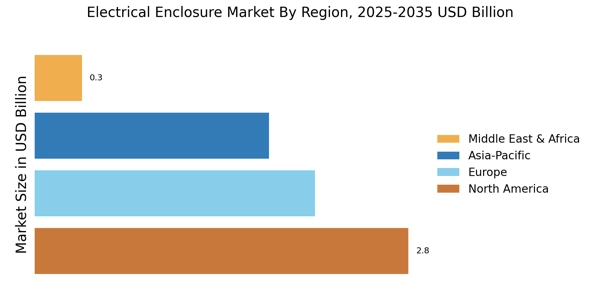
North America is witnessing robust growth in the electrical enclosure market, driven by increasing investments in infrastructure and renewable energy projects. The region holds approximately 40% of the global market share, making it the largest market. Regulatory support for energy efficiency and safety standards further fuels demand, particularly in the United States and Canada, where modernization of electrical systems is a priority. The competitive landscape is dominated by key players such as Schneider Electric, Eaton Corporation, and General Electric. This region also hosts leading electrical enclosure manufacturers Canada and eldon enclosures usa, highlighting its prominence as a hub for electrical enclosure supplier networks. The presence of these industry leaders ensures innovation and quality, catering to diverse applications across sectors like manufacturing, telecommunications, and utilities. This strong presence has positioned the North American enclosure segment as a key driver in the global market. Eldon enclosures distributors play a key role in ensuring timely delivery and accessibility of products to customers across North America, further strengthening the supply chain and market reach.
Europe : Regulatory Framework Drives Growth
Europe is emerging as a significant player in the electrical enclosure market, driven by stringent regulations and a focus on sustainability. The region accounts for approximately 30% of the global market share, making it the second-largest market. The European Union's directives on energy efficiency and safety standards are key catalysts for growth, encouraging investments in modern electrical infrastructure and smart grid technologies. Leading countries in this region include Germany, France, and the UK, with major companies like Siemens AG and Rittal GmbH leading the charge. The competitive landscape is characterized by innovation and collaboration among manufacturers to meet regulatory requirements. The presence of established players ensures a steady supply of high-quality enclosures, catering to various industries, including automotive, telecommunications, and renewable energy.
Asia-Pacific : Rapid Industrialization and Growth
The Asia-Pacific region is experiencing rapid growth in the electrical enclosure market, fueled by industrialization and urbanization. This region holds approximately 25% of the global market share, with countries like China and India leading the charge. The increasing demand for electricity and the expansion of manufacturing sectors are significant growth drivers, alongside government initiatives promoting infrastructure development and renewable energy adoption. China is the largest market in the region, followed by India and Japan. The competitive landscape features key players such as ABB Ltd and Schneider Electric, who are investing in local manufacturing capabilities to meet rising demand. The presence of these companies ensures a diverse range of products tailored to various applications, from industrial to commercial sectors, enhancing the overall market landscape.
Middle East and Africa : Emerging Markets and Opportunities
The Middle East and Africa region is witnessing emerging opportunities in the electrical enclosure market, driven by infrastructural developments and increasing energy demands. This region holds approximately 5% of the global market share, with significant growth potential in countries like South Africa and the UAE. Government initiatives aimed at enhancing energy efficiency and expanding electrical infrastructure are key growth drivers, fostering a favorable environment for market expansion. South Africa leads the market in this region, followed by the UAE, with a growing presence of international players like Pentair and Emerson Electric. The competitive landscape is evolving, with local manufacturers also entering the market to cater to specific regional needs. This dynamic environment presents opportunities for innovation and collaboration, particularly in renewable energy and smart grid solutions.
Key Players and Competitive Insights
In August Schneider Electric (FR) announced the launch of its new EcoStruxure platform, which integrates IoT technology into electrical enclosures, enhancing monitoring and control capabilities. This strategic move is significant as it aligns with the growing trend towards smart infrastructure, allowing customers to optimize energy usage and improve operational efficiency. The introduction of such advanced solutions positions Schneider Electric (FR) as a leader in the digital transformation of the electrical enclosure market.
In September Eaton Corporation (US) completed the acquisition of a leading manufacturer of modular enclosures, which is expected to bolster its product offerings and market presence. This acquisition reflects Eaton's commitment to expanding its capabilities in providing customized solutions for diverse applications. By integrating these new products, Eaton Corporation (US) aims to enhance its competitive edge and respond more effectively to the evolving needs of its customers.
In July ABB Ltd (CH) unveiled a new range of environmentally friendly enclosures designed to meet stringent sustainability standards. This initiative not only addresses regulatory pressures but also caters to the increasing demand for sustainable solutions in the electrical sector. By prioritizing eco-friendly designs, ABB Ltd (CH) is likely to attract environmentally conscious customers and strengthen its market position.

As of October current competitive trends in the Electrical Enclosure Market are heavily influenced by digitalization, sustainability, and the integration of artificial intelligence. Strategic alliances among key players are shaping the landscape, fostering innovation and enhancing product offerings. The shift from price-based competition to a focus on technological differentiation and supply chain reliability is evident. Companies that prioritize innovation and sustainability are likely to emerge as leaders in this evolving market.
Key Companies in the Electrical Enclosure Market include
Industry Developments
- Q2 2024: Schneider Electric launches new IP66-rated enclosures for automated manufacturing facilities Schneider Electric introduced a new line of IP66-rated electrical enclosures designed specifically for automated manufacturing environments, offering enhanced protection against harsh industrial conditions and supporting Industry 4.0 initiatives.
Future Outlook
Electrical Enclosure Market Future Outlook
The Electrical Enclosure Market is projected to grow at a 3.86% CAGR from 2025 to 2035, driven by increasing demand for safety and efficiency in electrical installations.
New opportunities lie in:
- Expansion into renewable energy sector enclosures Development of smart enclosures with IoT integration Customization of enclosures for specific industrial applications
By 2035, the market is expected to achieve robust growth, reflecting evolving industry needs.
Market Segmentation
Electrical Enclosure Market Type Outlook
- Wall-Mounted Enclosures
- Free-Standing Enclosures
- Underground Enclosures
Electrical Enclosure Market Material Outlook
- Metal
- Plastic
- Fiberglass
- Composite
Electrical Enclosure Market End Use Industry Outlook
- Telecommunications
- Automotive
- Energy and Utilities
- Manufacturing
Electrical Enclosure Market Protection Level Outlook
- NEMA
- IP Ratings
- UL Listed
Report Scope
| MARKET SIZE 2024 | 6.902(USD Billion) |
| MARKET SIZE 2025 | 7.168(USD Billion) |
| MARKET SIZE 2035 | 10.47(USD Billion) |
| COMPOUND ANNUAL GROWTH RATE (CAGR) | 3.86% (2025 - 2035) |
| REPORT COVERAGE | Revenue Forecast, Competitive Landscape, Growth Factors, and Trends |
| BASE YEAR | 2024 |
| Market Forecast Period | 2025 - 2035 |
| Historical Data | 2019 - 2024 |
| Market Forecast Units | USD Billion |
| Key Companies Profiled | Schneider Electric (FR), Eaton Corporation (US), ABB Ltd (CH), Siemens AG (DE), Rittal GmbH & Co. KG (DE), Pentair plc (GB), Emerson Electric Co. (US), General Electric (US), Hammond Manufacturing (CA) |
| Segments Covered | Material, Type, Protection Level, End Use Industry, Regional |
| Key Market Opportunities | Integration of smart technologies in Electrical Enclosure Market enhances efficiency and safety in industrial applications. |
| Key Market Dynamics | Rising demand for sustainable materials drives innovation and competition in the Electrical Enclosure Market. |
| Countries Covered | North America, Europe, APAC, South America, MEA |
FAQs
What is the projected market valuation of the Electrical Enclosure Market by 2035?
The Electrical Enclosure Market is projected to reach a valuation of 10.47 USD Billion by 2035.
What was the market valuation of the Electrical Enclosure Market in 2024?
In 2024, the Electrical Enclosure Market was valued at 6.902 USD Billion.
What is the expected CAGR for the Electrical Enclosure Market during the forecast period 2025 - 2035?
The expected CAGR for the Electrical Enclosure Market during the forecast period 2025 - 2035 is 3.86%.
Which materials are expected to dominate the Electrical Enclosure Market by 2035?
By 2035, metal enclosures are expected to dominate the market, with a projected valuation of 3.8 USD Billion.
What are the projected valuations for different types of electrical enclosures by 2035?
By 2035, free-standing enclosures are projected to reach 5.12 USD Billion, while wall-mounted enclosures may reach 3.12 USD Billion.
Which end-use industries are driving growth in the Electrical Enclosure Market?
The energy and utilities sector is anticipated to drive growth, with a projected valuation of 3.5 USD Billion by 2035.
Who are the key players in the Electrical Enclosure Market?
Key players in the Electrical Enclosure Market include Schneider Electric, Eaton Corporation, ABB Ltd, and Siemens AG.
What is the projected growth for fiberglass electrical enclosures by 2035?
Fiberglass electrical enclosures are projected to grow to 1.8 USD Billion by 2035.
How do protection levels impact the Electrical Enclosure Market?
Protection levels such as IP ratings are projected to reach 4.12 USD Billion by 2035, indicating their importance in market growth.
What is the expected market trend for plastic electrical enclosures by 2035?
Plastic electrical enclosures are expected to grow to 2.5 USD Billion by 2035, reflecting a steady demand in the market.
Research Approach
Secondary Research
The secondary research process involved comprehensive analysis of regulatory databases, industry standards publications, technical journals, and authoritative electrical engineering organizations. Key sources included the US National Electrical Manufacturers Association (NEMA), International Electrotechnical Commission (IEC), Underwriters Laboratories (UL), US Department of Energy (DOE), European Committee for Electrotechnical Standardization (CENELEC), International Organization for Standardization (ISO), National Electrical Code (NEC/NFPA 70), US Energy Information Administration (EIA), International Energy Agency (IEA), US Federal Communications Commission (FCC), European Telecommunications Standards Institute (ETSI), US Occupational Safety and Health Administration (OSHA), National Institute of Standards and Technology (NIST), US Bureau of Labor Statistics (BLS), EU Eurostat Industrial Production Database, and national energy ministry reports from key markets. These sources were used to collect industrial automation statistics, electrical safety compliance data, NEMA/IP certification requirements, infrastructure investment trends, and market landscape analysis for metal enclosures, plastic enclosures, fiberglass solutions, and composite material technologies.
Primary Research
In order to gather both qualitative and quantitative insights, supply-side and demand-side stakeholders were interviewed during the primary research process. CEOs, VPs of manufacturing, engineering directors, and heads of regulatory compliance from suppliers of components and makers of electrical enclosures were examples of supply-side sources. Electrical engineers, project managers, procurement directors from utilities and energy firms, telecommunications infrastructure managers, automotive plant engineers, and facility managers from manufacturing and industrial facilities were examples of demand-side sources. Market segmentation, product development schedules, material adoption trends, pricing tactics, and regulatory compliance dynamics were all confirmed by primary research.
Primary Respondent Breakdown:
By Designation: C-level Primaries (32%), Director Level (31%), Others (37%)
By Region: North America (32%), Europe (30%), Asia-Pacific (33%), Rest of World (5%)
Market Size Estimation
Global market valuation was derived through revenue mapping and installation volume analysis. The methodology included:
Identification of 50+ key manufacturers across North America, Europe, Asia-Pacific, and Latin America
Product mapping across metal, plastic, fiberglass, and composite material categories
Analysis of reported and modeled annual revenues specific to electrical enclosure portfolios
Coverage of manufacturers representing 72-78% of global market share in 2024
Extrapolation using bottom-up (installation volume × ASP by country/region) and top-down (manufacturer revenue validation) approaches to derive segment-specific valuations
Kindly complete the form below to receive a free sample of this Report
Customer Stories
“This is really good guys. Excellent work on a tight deadline. I will continue to use you going forward and recommend you to others. Nice job”
“Thanks. It’s been a pleasure working with you, please use me as reference with any other Intel employees.”
“Thanks for sending the report it gives us a good global view of the Betaïne market.”
“Thank you, this will be very helpful for OQS.”
“We found the report very insightful! we found your research firm very helpful. I'm sending this email to secure our future business.”
“I am very pleased with how market segments have been defined in a relevant way for my purposes (such as "Portable Freezers & refrigerators" and "last-mile"). In general the report is well structured. Thanks very much for your efforts.”
“I have been reading the first document or the study, ,the Global HVAC and FP market report 2021 till 2026. Must say, good info! I have not gone in depth at all parts, but got a good indication of the data inside!”
“We got the report in time, we really thank you for your support in this process. I also thank to all of your team as they did a great job.”