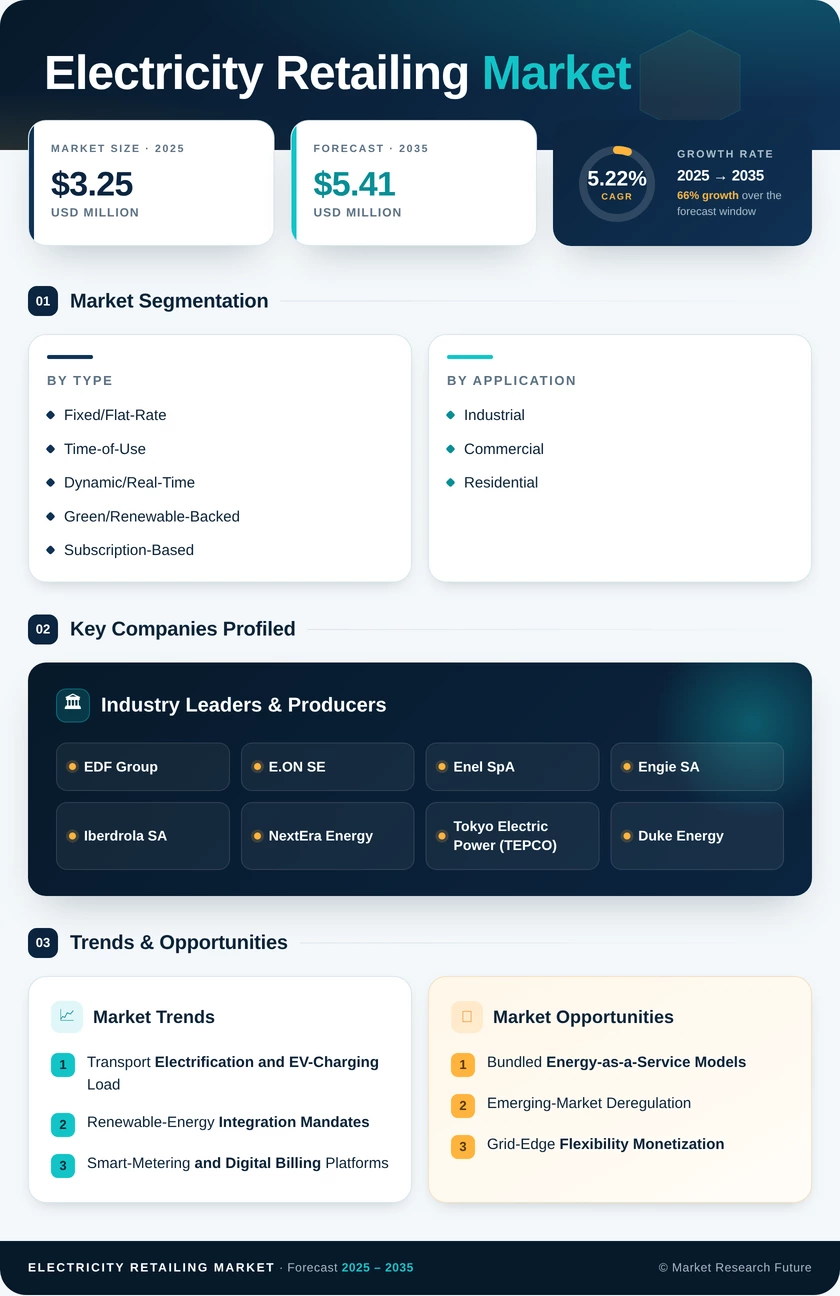
Electricity Retailing Market

ID: MRFR/EnP/33199-HCR
100 Pages
Chitranshi Jaiswal
Last Updated: June 19, 2026
Electricity Retailing Market Size, Share & Growth Analysis Report By Tariff Type (Fixed/Flat-Rate, Time-of-Use, Dynamic/Real-Time, Green/Renewable-Backed, Subscription-Based), By End-User (Residential, Commercial, Industrial) and By Regional (North America, Europe, South America, Asia-Pacific, Middle East and Africa) - Trends & Industry Forecast to 2035
Download PDF ×

We do not share your information with anyone. However, we may send you emails based on your report interest from time to time. You may contact us at any time to opt-out.

  1. 1 Market Overview |
    1. 1.1 Study Assumptions & Market Definition |
    2. 1.2 Scope of the Study |
    3. 1.3 Research Methodology
  2. 2 Market Summary & Key Takeaways
  3. 3 Market Dynamics |
    1. 3.1 Market Drivers Analysis | |
      1. 3.1.1 Transport Electrification & EV-Charging Load | |
      2. 3.1.2 Renewable-Energy Integration Mandates | |
      3. 3.1.3 Smart-Metering & Digital Billing Platforms | |
      4. 3.1.4 Data-Center Hyperscale Demand | |
      5. 3.1.5 Power-Sector Deregulation & Retail Competition | |
      6. 3.1.6 Corporate Renewable PPA Growth | |
      7. 3.1.7 Prosumer & Distributed-Energy Expansion |
    2. 3.2 Market Restraints Analysis | |
      1. 3.2.1 Regulated Default-Tariff Caps | |
      2. 3.2.2 Wholesale-Price Volatility & Margin Squeeze | |
      3. 3.2.3 Prosumer Self-Consumption Erosion | |
      4. 3.2.4 Customer-Switching Inertia in Monopoly Regions | |
      5. 3.2.5 Cybersecurity & Data-Privacy Compliance Costs |
    3. 3.3 Market Opportunity Analysis | |
      1. 3.3.1 Bundled Energy-as-a-Service Models | |
      2. 3.3.2 Emerging-Market Deregulation | |
      3. 3.3.3 Grid-Edge Flexibility Monetization | |
      4. 3.3.4 AI-Driven Customer Analytics and Dynamic Pricing | |
      5. 3.3.5 Cross-Border Renewable Certificate Trading |
    4. 3.4 Industry Value Chain Analysis |
    5. 3.5 Porter's Five Forces Analysis
  4. 4 Global Electricity Retailing Market Size & Forecast (2021–2035) |
    1. 4.1 Historical Market Size (2021–2025) |
    2. 4.2 Current & Forecast Market Size (2026–2035) |
    3. 4.3 Market Size by Revenue (USD Trillion) |
    4. 4.4 Year-over-Year Growth Analysis
  5. 5 Segmentation Analysis |
    1. 5.1 By Tariff Type | |
      1. 5.1.1 Fixed/Flat-Rate | |
      2. 5.1.2 Time-of-Use | |
      3. 5.1.3 Dynamic/Real-Time | |
      4. 5.1.4 Green/Renewable-Backed | |
      5. 5.1.5 Subscription-Based |
    2. 5.2 By End-User | |
      1. 5.2.1 Residential | |
      2. 5.2.2 Commercial | |
      3. 5.2.3 Industrial
  6. 6 Regional Analysis |
    1. 6.1 North America | |
      1. 6.1.1 United States | |
      2. 6.1.2 Canada | |
      3. 6.1.3 Mexico |
    2. 6.2 Europe | |
      1. 6.2.1 Germany | |
      2. 6.2.2 United Kingdom | |
      3. 6.2.3 France | |
      4. 6.2.4 Italy | |
      5. 6.2.5 Spain | |
      6. 6.2.6 Nordic Countries | |
      7. 6.2.7 Russia | |
      8. 6.2.8 Rest of Europe |
    3. 6.3 Asia-Pacific | |
      1. 6.3.1 China | |
      2. 6.3.2 India | |
      3. 6.3.3 Japan | |
      4. 6.3.4 South Korea | |
      5. 6.3.5 ASEAN | |
      6. 6.3.6 Rest of Asia-Pacific |
    4. 6.4 South America | |
      1. 6.4.1 Brazil | |
      2. 6.4.2 Argentina | |
      3. 6.4.3 Rest of South America |
    5. 6.5 Middle East & Africa | |
      1. 6.5.1 Saudi Arabia | |
      2. 6.5.2 UAE | |
      3. 6.5.3 South Africa | |
      4. 6.5.4 Egypt | |
      5. 6.5.5 Rest of MEA
  7. 7 Competitive Landscape |
    1. 7.1 Market Share Analysis (2025) |
    2. 7.2 Competitive Benchmarking Matrix |
    3. 7.3 Company Profiles | |
      1. 7.3.1 EDF Group | |
      2. 7.3.2 E.ON SE | |
      3. 7.3.3 Enel SpA | |
      4. 7.3.4 Engie SA | |
      5. 7.3.5 Iberdrola SA | |
      6. 7.3.6 NextEra Energy | |
      7. 7.3.7 Tokyo Electric Power Company (TEPCO) | |
      8. 7.3.8 Duke Energy | |
      9. 7.3.9 Origin Energy | |
      10. 7.3.10 AGL Energy
  8. 8 Future Outlook & Strategic Recommendations (2026–2035) |
    1. 8.1 AI-Optimized Retail Operations |
    2. 8.2 Platform Economics and Energy Aggregation |
    3. 8.3 Electrification Supercycle |
    4. 8.4 ESG Reporting and Scope 2 Compliance
  9. 9 Recent Developments & News
  10. 10 Frequently Asked Questions (FAQs)
  11. 11 Report Scope & Methodology |
    1. 11.1 Study Period & Base Year |
    2. 11.2 Data Sources & Citations |
    3. 11.3 Abbreviations
  12. 1 LIST OF TABLES |
  13. TABLE 1 Global Electricity Retailing Market Size & Forecast, by Revenue (USD Trillion), 2021–2035 |
  14. TABLE 2 Global Electricity Retailing Market — Year-over-Year Growth Analysis, 2021–2035 |
  15. TABLE 3 Global Electricity Retailing Market — Driver Impact Analysis |
  16. TABLE 4 Global Electricity Retailing Market — Restraint Impact Analysis |
  17. TABLE 5 Global Electricity Retailing Market Size, by Tariff Type, 2021–2035 (USD Trillion) |
  18. TABLE 6 Global Electricity Retailing Market Size, by End-User, 2021–2035 (USD Trillion) |
  19. TABLE 7 Global Electricity Retailing Market Size, by Region, 2021–2035 (USD Trillion) |
  20. TABLE 8 North America Electricity Retailing Market Size, by Country, 2021–2035 (USD Billion) |
  21. TABLE 9 Europe Electricity Retailing Market Size, by Country, 2021–2035 (USD Billion) |
  22. TABLE 10 Asia-Pacific Electricity Retailing Market Size, by Country, 2021–2035 (USD Billion) |
  23. TABLE 11 South America Electricity Retailing Market Size, by Country, 2021–2035 (USD Billion) |
  24. TABLE 12 Middle East & Africa Electricity Retailing Market Size, by Country, 2021–2035 (USD Billion) |
  25. TABLE 13 Competitive Benchmarking Matrix — Global Electricity Retailing Market, 2025 |
  26. TABLE 14 Company Profiles — Key Players, Global Electricity Retailing Market |
  27. TABLE 15 Recent Developments & Strategic Announcements, 2023–2025 |
  28. TABLE 16 North America Electricity Retailing Market Size, by Tariff Type, 2021–2035 (USD Billion) |
  29. TABLE 17 North America Electricity Retailing Market Size, by End-User, 2021–2035 (USD Billion) |
  30. TABLE 18 Europe Electricity Retailing Market Size, by Tariff Type, 2021–2035 (USD Billion) |
  31. TABLE 19 Europe Electricity Retailing Market Size, by End-User, 2021–2035 (USD Billion) |
  32. TABLE 20 Asia-Pacific Electricity Retailing Market Size, by Tariff Type, 2021–2035 (USD Billion) |
  33. TABLE 21 Asia-Pacific Electricity Retailing Market Size, by End-User, 2021–2035 (USD Billion) |
  34. TABLE 22 South America Electricity Retailing Market Size, by Tariff Type, 2021–2035 (USD Billion) |
  35. TABLE 23 South America Electricity Retailing Market Size, by End-User, 2021–2035 (USD Billion) |
  36. TABLE 24 Middle East & Africa Electricity Retailing Market Size, by Tariff Type, 2021–2035 (USD Billion) |
  37. TABLE 25 Middle East & Africa Electricity Retailing Market Size, by End-User, 2021–2035 (USD Billion) |
  38. TABLE 26 Report Scope & Methodology Summary |
  39. TABLE 27 Detailed Sources and Citations
  40. 2 LIST OF FIGURES |
  41. FIGURE 1 Global Electricity Retailing Market Dynamics — Drivers, Restraints, and Opportunities |
  42. FIGURE 2 Value Chain Analysis — Electricity Retailing Market |
  43. FIGURE 3 Porter's Five Forces Analysis — Electricity Retailing Market |
  44. FIGURE 4 Global Electricity Retailing Market Size Trend & Forecast (USD Trillion), 2021–2035 |
  45. FIGURE 5 Global Electricity Retailing Market Share, by Tariff Type (%), 2025 |
  46. FIGURE 6 Global Electricity Retailing Market Share, by End-User (%), 2025 |
  47. FIGURE 7 Global Electricity Retailing Market Share, by Region (%), 2025 |
  48. FIGURE 8 North America Electricity Retailing Market Size, by Country (USD Billion), 2025 vs 2035 |
  49. FIGURE 9 Europe Electricity Retailing Market Size, by Country (USD Billion), 2025 vs 2035 |
  50. FIGURE 10 Asia-Pacific Electricity Retailing Market Size, by Country (USD Billion), 2025 vs 2035 |
  51. FIGURE 11 South America Electricity Retailing Market Size, by Country (USD Billion), 2025 vs 2035 |
  52. FIGURE 12 Middle East & Africa Electricity Retailing Market Size, by Country (USD Billion), 2025 vs 2035 |
  53. FIGURE 13 Competitive Landscape — Market Share Analysis, 2025

Segmentation Quick Reference

DimensionSub-SegmentsDominant SegmentFastest Growing Segment
By Tariff TypeFixed/Flat-Rate, Time-of-Use, Dynamic/Real-Time, Green/Renewable-Backed, Subscription-BasedFixed/Flat-Rate (47.5% share, 2025)Green/Renewable-Backed (7.92% CAGR)
By End-UserResidential, Commercial, IndustrialIndustrial (46.0% share, 2025)Commercial (6.35% CAGR)
By GeographyNorth America, Europe, Asia-Pacific, South America, Middle East & AfricaAsia-Pacific (49.0% share, 2025)Asia-Pacific (6.14% CAGR)


Market Segmentation Overview

By Tariff Type

Sub-SegmentKey Trend
Fixed/Flat-RateRemains default in regulated markets; gradual erosion as smart-meter penetration enables variable products.
Time-of-UseGrowing adoption driven by utility-side load management and EV off-peak charging incentives
Dynamic/Real-TimeFavored by industrial and data-center customers seeking cost optimization through wholesale-price exposure
Green/Renewable-BackedFastest-growing tariff segment, propelled by corporate ESG commitments and consumer environmental awareness
Subscription-BasedEmerging model offering flat monthly fees for unlimited consumption, pioneered in Nordic markets.


Tariff-type segmentation reflects the ongoing transition from static, cost-plus pricing toward flexible, customer-centric energy products. Retailers are increasingly layering tariff innovation onto smart-metering infrastructure to differentiate their offerings and reduce customer churn in competitive markets.

By End-User

Sub-SegmentKey Trend
ResidentialVolume growth tied to housing electrification, heat-pump adoption, and EV home-charging
CommercialFastest-growing segment driven by building-level energy management and fleet electrification
IndustrialLargest segment by revenue; long-term bilateral contracts dominate, with increasing PPA adoption


End-user segmentation underscores the distinct procurement behaviors across customer classes. Industrial buyers negotiate bespoke multi-year contracts, commercial customers seek bundled energy-management solutions, and residential consumers increasingly respond to digital engagement and tariff-comparison platforms that simplify switching.