Request Free Sample ×

Kindly complete the form below to receive a free sample of this Report

* Please use a valid business email

Leading companies partner with us for data-driven Insights

clients tt-cursor
Hero Background

Email Encryption Market

ID: MRFR/ICT/6577-HCR
111 Pages
Ankit Gupta
Last Updated: May 28, 2026
Email Encryption Market Research Report Information by Type (End-to-End Encryption, Gateway Email Encryption, Boundary Email Encryption, Hybrid Encryption and Client Plugins), by Organization Size (SMEs and Large Enterprises), by Deployment (Cloud and On-Premise), by Vertical (BFSI, Government & Defense, IT & Telecom, Healthcare, Manufacturing, Retail and Others) and By Region (North America, Europe, Asia-Pacific, and Rest of the World) –Market Forecast Till 2035.
Download PDF ×

We do not share your information with anyone. However, we may send you emails based on your report interest from time to time. You may contact us at any time to opt-out.

  1. 1 Market Overview |
    1. 1.1 Study Assumptions & Market Definition |
    2. 1.2 Scope of the Study |
    3. 1.3 Research Methodology
  2. 2 Market Summary & Key Takeaways
  3. 3 Market Dynamics |
    1. 3.1 Market Drivers Analysis | |
      1. 3.1.1 Regulatory Compliance Mandates (GDPR, HIPAA, DPDPA) | |
      2. 3.1.2 Zero-Trust Architecture Adoption | |
      3. 3.1.3 Cloud Email Platform Native Encryption Integration | |
      4. 3.1.4 Ransomware and Business Email Compromise Threat Escalation | |
      5. 3.1.5 Post-Quantum Cryptography Migration | |
      6. 3.1.6 Remote and Hybrid Work Permanence | |
      7. 3.1.7 AI-Powered Threat Detection Integration |
    2. 3.2 Market Restraints Analysis | |
      1. 3.2.1 End-User Complexity and Key Management Friction | |
      2. 3.2.2 Interoperability Gaps Across Encryption Standards | |
      3. 3.2.3 Performance Latency in High-Volume Environments | |
      4. 3.2.4 Budget Constraints Among SMEs | |
      5. 3.2.5 Regulatory Fragmentation Across Jurisdictions |
    3. 3.3 Market Opportunity Analysis | |
      1. 3.3.1 Post-Quantum Cryptography Migration Wave | |
      2. 3.3.2 Managed Encryption Services for the Mid-Market | |
      3. 3.3.3 Emerging Market Regulatory Catalysts | |
      4. 3.3.4 AI-Augmented Encryption Policy Automation | |
      5. 3.3.5 Data Sovereignty and Sovereign Cloud Encryption |
    4. 3.4 Industry Value Chain Analysis |
    5. 3.5 Porter's Five Forces Analysis
  4. 4 Global Email Encryption Market Size & Forecast (2021–2035) |
    1. 4.1 Historical Market Size (2021–2025) |
    2. 4.2 Current & Forecast Market Size (2026–2035) |
    3. 4.3 Market Size by Revenue (USD Billion) |
    4. 4.4 Year-over-Year Growth Analysis
  5. 5 Segmentation Analysis |
    1. 5.1 By Component | |
      1. 5.1.1 Solutions (Software) | |
      2. 5.1.2 Services (Managed + Professional) |
    2. 5.2 By Deployment Mode | |
      1. 5.2.1 Cloud | |
      2. 5.2.2 On-Premises |
    3. 5.3 By End-User Vertical | |
      1. 5.3.1 BFSI | |
      2. 5.3.2 Healthcare | |
      3. 5.3.3 Government & Defense | |
      4. 5.3.4 IT & Telecom | |
      5. 5.3.5 Energy & Utilities | |
      6. 5.3.6 Others (Retail, Education, Manufacturing)
  6. 6 Regional Analysis |
    1. 6.1 North America | |
      1. 6.1.1 United States | |
      2. 6.1.2 Canada | |
      3. 6.1.3 Mexico |
    2. 6.2 Europe | |
      1. 6.2.1 United Kingdom | |
      2. 6.2.2 Germany | |
      3. 6.2.3 France | |
      4. 6.2.4 Rest of Europe |
    3. 6.3 Asia-Pacific | |
      1. 6.3.1 China | |
      2. 6.3.2 India | |
      3. 6.3.3 Japan | |
      4. 6.3.4 South Korea | |
      5. 6.3.5 Australia | |
      6. 6.3.6 Rest of Asia-Pacific |
    4. 6.4 South America | |
      1. 6.4.1 Brazil | |
      2. 6.4.2 Argentina | |
      3. 6.4.3 Rest of South America |
    5. 6.5 Middle East & Africa | |
      1. 6.5.1 Saudi Arabia | |
      2. 6.5.2 UAE | |
      3. 6.5.3 South Africa | |
      4. 6.5.4 Rest of Middle East & Africa
  7. 7 Competitive Landscape |
    1. 7.1 Market Share Analysis (2025) |
    2. 7.2 Competitive Benchmarking Matrix |
    3. 7.3 Company Profiles | |
      1. 7.3.1 Proofpoint (Thoma Bravo) | |
      2. 7.3.2 Cisco Systems | |
      3. 7.3.3 Broadcom (Symantec) | |
      4. 7.3.4 OpenText (Zix) | |
      5. 7.3.5 Mimecast | |
      6. 7.3.6 Trend Micro | |
      7. 7.3.7 Virtru | |
      8. 7.3.8 Echoworx | |
      9. 7.3.9 Tutanota (Tuta) | |
      10. 7.3.10 Voltage Security (OpenText)
  8. 8 Future Outlook & Strategic Recommendations (2026–2035) |
    1. 8.1 Post-Quantum Cryptography and the Encryption Reset |
    2. 8.2 AI-Native Email Security Convergence |
    3. 8.3 Sovereign Cloud and Data Localization Acceleration |
    4. 8.4 Zero-Trust Maturity and Continuous Authentication
  9. 9 Recent Developments & News
  10. 10 Frequently Asked Questions (FAQs)
  11. 11 Report Scope & Methodology |
    1. 11.1 Study Period & Base Year |
    2. 11.2 Data Sources & Citations |
    3. 11.3 Abbreviations
  12. 12 LIST OF TABLES |
  13. TABLE 1 Global Email Encryption Market Size & Forecast, by Revenue (USD Billion), 2021–2035 |
  14. TABLE 2 Global Email Encryption Market — Year-over-Year Growth Analysis, 2021–2035 |
  15. TABLE 3 Global Email Encryption Market — Driver Impact Analysis |
  16. TABLE 4 Global Email Encryption Market — Restraints Impact Analysis |
  17. TABLE 5 Global Email Encryption Market Size, by Component, 2021–2035 (USD Billion) |
  18. TABLE 6 Global Email Encryption Market Size, by Deployment Mode, 2021–2035 (USD Billion) |
  19. TABLE 7 Global Email Encryption Market Size, by End-User Vertical, 2021–2035 (USD Billion) |
  20. TABLE 8 Global Email Encryption Market Size, by Region, 2021–2035 (USD Billion) |
  21. TABLE 9 North America Email Encryption Market Size, by Country, 2021–2035 (USD Billion) |
  22. TABLE 10 Europe Email Encryption Market Size, by Country, 2021–2035 (USD Billion) |
  23. TABLE 11 Asia-Pacific Email Encryption Market Size, by Country, 2021–2035 (USD Billion) |
  24. TABLE 12 South America Email Encryption Market Size, by Country, 2021–2035 (USD Billion) |
  25. TABLE 13 Middle East & Africa Email Encryption Market Size, by Country, 2021–2035 (USD Billion) |
  26. TABLE 14 North America Email Encryption Market Size, by Component, 2021–2035 (USD Billion) |
  27. TABLE 15 North America Email Encryption Market Size, by Deployment Mode, 2021–2035 (USD Billion) |
  28. TABLE 16 North America Email Encryption Market Size, by End-User Vertical, 2021–2035 (USD Billion) |
  29. TABLE 17 Europe Email Encryption Market Size, by Component, 2021–2035 (USD Billion) |
  30. TABLE 18 Europe Email Encryption Market Size, by Deployment Mode, 2021–2035 (USD Billion) |
  31. TABLE 19 Europe Email Encryption Market Size, by End-User Vertical, 2021–2035 (USD Billion) |
  32. TABLE 20 Asia-Pacific Email Encryption Market Size, by Component, 2021–2035 (USD Billion) |
  33. TABLE 21 Asia-Pacific Email Encryption Market Size, by Deployment Mode, 2021–2035 (USD Billion) |
  34. TABLE 22 Asia-Pacific Email Encryption Market Size, by End-User Vertical, 2021–2035 (USD Billion) |
  35. TABLE 23 South America Email Encryption Market Size, by Component, 2021–2035 (USD Billion) |
  36. TABLE 24 South America Email Encryption Market Size, by Deployment Mode, 2021–2035 (USD Billion) |
  37. TABLE 25 South America Email Encryption Market Size, by End-User Vertical, 2021–2035 (USD Billion) |
  38. TABLE 26 Middle East & Africa Email Encryption Market Size, by Component, 2021–2035 (USD Billion) |
  39. TABLE 27 Middle East & Africa Email Encryption Market Size, by Deployment Mode, 2021–2035 (USD Billion) |
  40. TABLE 28 Middle East & Africa Email Encryption Market Size, by End-User Vertical, 2021–2035 (USD Billion) |
  41. TABLE 29 Competitive Benchmarking Matrix — Global Email Encryption Market, 2025 |
  42. TABLE 30 Company Profiles — Key Players, Global Email Encryption Market |
  43. TABLE 31 Recent Developments & Strategic Announcements, 2024–2025 |
  44. TABLE 32 Report Scope & Methodology Summary |
  45. TABLE 33 Detailed Sources and Citations
  46. 13 LIST OF FIGURES |
  47. FIGURE 1 Email Encryption Market Dynamics — Drivers, Restraints, and Opportunities |
  48. FIGURE 2 Industry Value Chain Analysis — Email Encryption Market |
  49. FIGURE 3 Porter's Five Forces Analysis — Email Encryption Market |
  50. FIGURE 4 Global Email Encryption Market Size Trend & Forecast (USD Billion), 2021–2035 |
  51. FIGURE 5 Email Encryption Market Share, by Component (%), 2025 |
  52. FIGURE 6 Email Encryption Market Share, by Deployment Mode (%), 2025 |
  53. FIGURE 7 Email Encryption Market Share, by End-User Vertical (%), 2025 |
  54. FIGURE 8 Email Encryption Market Share, by Region (%), 2025 |
  55. FIGURE 9 North America Email Encryption Market Size Trend (USD Billion), 2021–2035 |
  56. FIGURE 10 Europe Email Encryption Market Size Trend (USD Billion), 2021–2035 |
  57. FIGURE 11 Asia-Pacific Email Encryption Market Size Trend (USD Billion), 2021–2035 |
  58. FIGURE 12 South America Email Encryption Market Size Trend (USD Billion), 2021–2035 |
  59. FIGURE 13 Middle East & Africa Email Encryption Market Size Trend (USD Billion), 2021–2035 |
  60. FIGURE 14 Competitive Landscape — Market Share Analysis (%), 2025 |
  61. FIGURE 15 Competitive Positioning Matrix — Email Encryption Market, 2025

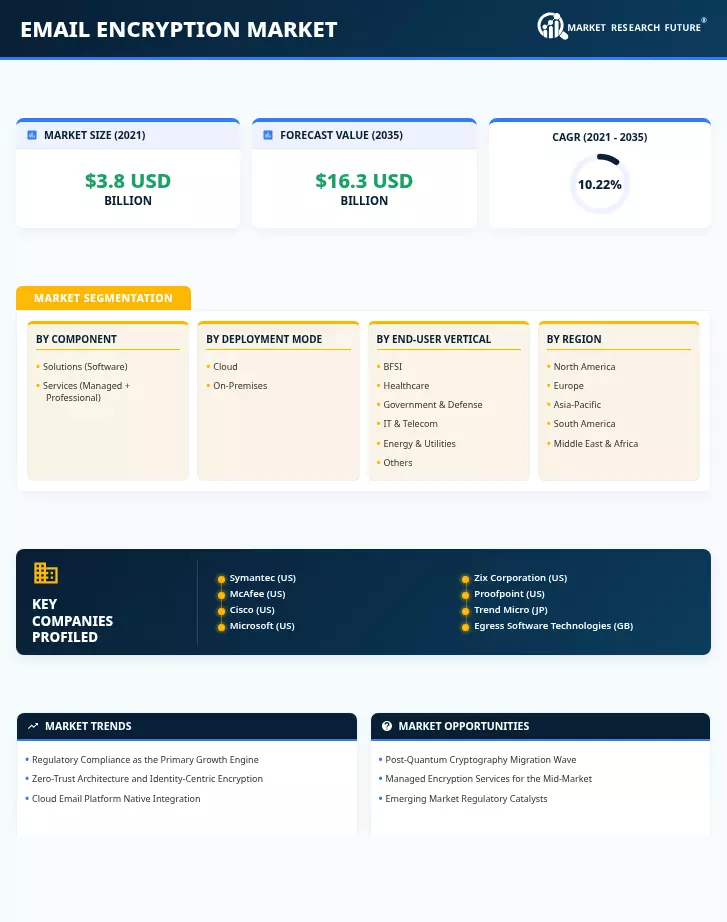
Segmentation Quick Reference

Dimension Sub-Segments Dominant Segment Fastest Growing Segment
By Component Solutions (Software), Services (Managed + Professional) Solutions (~64% share, 2025) Services (11.8% CAGR)
By Deployment Mode Cloud, On-Premises Cloud (USD 3.6 B, 2025) Cloud (higher absolute growth)
By End-User Vertical BFSI, Healthcare, Government & Defense, IT & Telecom, Energy & Utilities, Others BFSI (~26% share, 2025) Healthcare (12.6% CAGR)
By Region North America, Europe, Asia-Pacific, South America, Middle East & Africa North America (~38% share, 2025) Asia-Pacific (13.8% CAGR)


Market Segmentation Overview

By Component

Sub-Segment Key Trend
Solutions (Software) Gateway encryption platforms consolidating with native Microsoft 365 and Google Workspace integration; growing demand for policy-driven automatic encryption
Services (Managed + Professional) Rise of encryption-as-a-service models targeting mid-market; increasing PKI outsourcing and compliance reporting consulting


The component split reflects enterprise preference for licensed or subscription-based software products as the primary purchasing vehicle, with services growing as deployment complexity and compliance requirements drive demand for external expertise and managed key lifecycle operations.

By Deployment Mode

Sub-Segment Key Trend
Cloud Dominance driven by SaaS email migration, API-based integration, and elastic key management infrastructure
On-Premises Persistent demand from government, defense, and regulated financial institutions requiring sovereign key custody


Cloud deployment continues to gain share as organizations move email infrastructure to hosted platforms, though on-premises solutions retain a critical role in high-security environments where encryption key material must remain within physically controlled boundaries.

By End-User Vertical

Sub-Segment Key Trend
BFSI Regulatory-driven adoption across banking, insurance, and capital markets for customer data and transaction email protection
Healthcare Rapid growth driven by HIPAA enforcement, telehealth correspondence, and PHI-containing email volumes
Government & Defense Zero-trust mandates, CMMC requirements, and classified information handling driving end-to-end encryption adoption
IT & Telecom Customer data protection obligations and SLA-driven encryption for service provider communications
Energy & Utilities NERC CIP compliance and OT/IT convergence extending encryption requirements to operational email systems
Others (Retail, Education, Manufacturing) Growing awareness of data breach risks and emerging regulations in retail PCI compliance and educational data privacy


Vertical adoption patterns mirror regulatory intensity — sectors with the most prescriptive data protection mandates demonstrate the highest encryption penetration rates, while less-regulated verticals are in earlier stages of adoption driven primarily by breach risk awareness and cyber insurance requirements.