Email Security Market (2026 - 2035)

Email Security Market Size, Share and Trends Analysis Report By Type (Boundary Email Encryption, End-to-End Email Encryption, Gateway Email Encryption, Hybrid Email encryption), Component (Solution, Services (Support, Maintenance and Training Education), Deployment (Cloud and On-Premise), Organization Size (Large Enterprise and Small & Medium Enterprise); Industry Vertical (BFSI, IT and Telecom, Government, Healthcare, Retail, Manufacturing, and Energy and Utilities), Region (North America, Europe, Asia Pacific, Middle East, Africa) Forecast Till 2035
ID: MRFR/ICT/2247-HCR
100 Pages
Aarti Dhapte
Last Updated: July 03, 2026
Email Security Market
Market Size
Forecast Period2026-2035
CAGR (2026-2035)13.4%
2025 Market SizeUSD 5.54 Billion
2035 Market SizeUSD 19.38 Billion
Key Players
Microsoft
Proofpoint
Mimecast
Cisco
Barracuda Networks
Check Point
Opportunities
  • API-Based ICES Expansion
  • Emerging Market SME Adoption
  • AI-Native Behavioral Detection

Email Security Market Summary

The Email Security Market stood at USD 5.54 billion in 2025 and is set to open the forecast window at roughly USD 6.24 billion in 2026, climbing to USD 19.38 billion by 2035 at a 13.4% CAGR. That trajectory owes a lot to the EU's NIS2 Directive, which pulled thousands of mid-sized firms into mandatory incident-reporting regimes overnight. Boards that once treated email filtering as a checkbox now fund it as a board-level risk line item.

Cloud-native platforms coupled with APIs are replacing legacy secure email gateways developed for on-premises exchange servers, inspecting messages inside Microsoft 365 and Google Workspace instead of the network perimeter. Vendors have put a lot of money into this change, with Cisco’s $28 billion acquisition of Splunk in 2023 specifically positioned around the idea of merging email, endpoint and SIEM telemetry into a single detection fabric. Buyers are rewarding that consolidation by signing longer contracts.

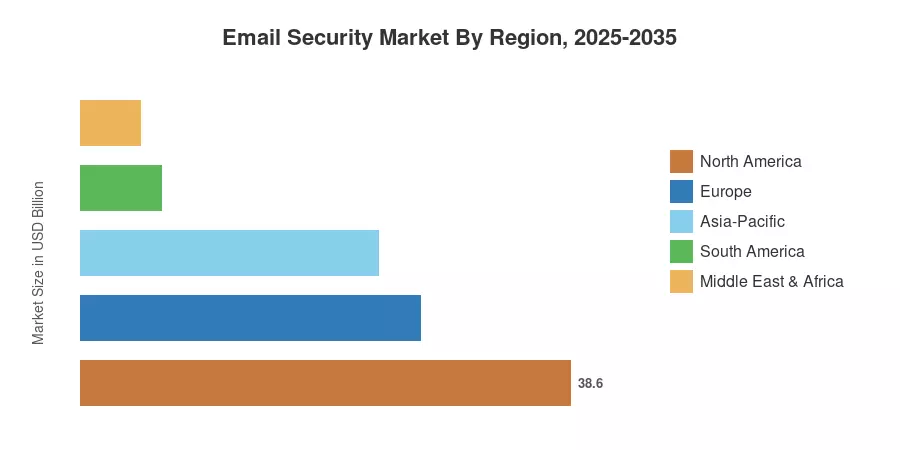
North America continues to lead, accounting for around 38.6% of 2025 revenue, driven by extensive regulatory duties in financial services and healthcare. Asia-Pacific is the fastest growing market with digitization plans in India, China and Southeast Asia driving first-time purchasers to cloud email security. Europe is the second largest, with the push for NIS2 compliance dates. In the coming decade, manufacturers that can integrate detection and response will be differentiated from vendors that still provide single filters.


Key Report Takeaways

• By Technology

  • Solutions (as opposed to services) held roughly 65.2% share of the Email Security Market in 2025
  • Integrated Cloud Email Security (ICES) is expanding at a 22.5% CAGR, the fastest of any security-type segment.
  • Cloud deployment accounted for about 55.0% of the Email Security Market in 2025

• By Ens-Use

  • BFSI held roughly 25.4% share of end-user revenue in 2025
  • Healthcare is the fastest-growing vertical at an 18.1% CAGR through 2035
  • Large enterprises captured about 64.2% share, though SMEs are closing the gap

• By Region

  • North America led the Email Security Market with roughly 38.6% revenue share in 2025
  • Asia-Pacific is projected to post a 15.4% CAGR through 2035
  • Europe holds the second-largest regional position, driven by regulatory mandates

Market Size and Forecast (2021–2035)

Figures below are calibrated from historical vendor disclosures and public market-sizing benchmarks, then projected forward using a consistent compound growth methodology.
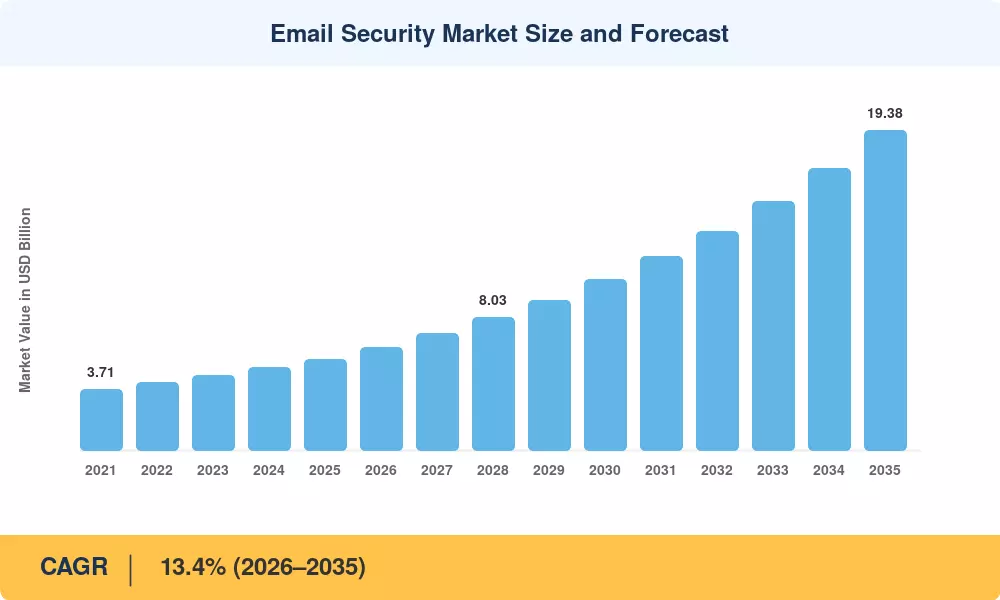
Email Security Market Size and Forecast
Our Impact
Enabled $4.3B Revenue Impact for Fortune 500 and Leading Multinationals
Partnering with 2000+ Global Organizations Each Year
30K+ Citations by Top-Tier Firms in the Industry

Driver Impact Analysis

Driver ~% Impact on CAGR Geographic Relevance Impact Timeline
Rising BEC and phishing sophistication 3.5% Global Short-term (≤2 yr)
NIS2 and regional regulatory mandates 2.0% Europe Medium-term (2–4 yr)
Microsoft 365 / Google Workspace migration 2.5% Global Short-term (≤2 yr)
AI-driven detection accuracy gains 2.2% Global Medium-term (2–4 yr)
Platform consolidation (email + endpoint + SIEM) 1.5% North America Long-term (≥4 yr)
SME cloud-delivery adoption 1.8% Asia-Pacific Medium-term (2–4 yr)
Ransomware-as-a-service proliferation 1.2% Global Short-term (≤2 yr)


Regulatory Pressure from NIS2

The EU NIS2 Directive (2022/2555) mandates stringent cybersecurity obligations, expanding coverage to approximately 160,000 entities. By classifying organizations as either "essential" or "important," the directive forces mid-market firms into rigorous procurement cycles. Compliance officers now view comprehensive email filtering logs as critical audit evidence, ensuring that entities meet standardized incident reporting and risk management requirements.


Workspace Migration

Enterprise migration to cloud productivity suites is accelerating globally, with nearly 94% of companies now adopting cloud-based operations. This shift renders legacy on-premises mail servers obsolete, necessitating a move toward API-based inspection tools. As organizations abandon traditional infrastructure, procurement roadmaps are being reshaped to support scalable, cloud-native security environments that align with modern digital workflows.


AI Detection Accuracy

Artificial intelligence is rapidly becoming the standard for modern cybersecurity, driven by the need to manage massive alert volumes. Advanced machine-learning models—analyzing sender cadence and behavioral anomalies—are significantly reducing false-positive rates that once overwhelmed operations centers. This measurable improvement in detection accuracy serves as a primary catalyst for the widespread adoption of intelligent security platforms.


Platform Consolidation

Organizations are increasingly favoring unified telemetry fabrics that integrate email, endpoint, and SIEM data over fragmented point solutions. This trend toward consolidation is designed to simplify incident response and reduce the substantial integration overhead associated with disparate security tools. Streamlined platforms enable security teams to maintain better visibility across complex, multi-layered digital network infrastructures.


Restraints Impact Analysis

Restraint impacts are similarly directional estimates, not subtracted linearly from base CAGR.

Restraint ~% Impact on CAGR Geographic Relevance Impact Timeline
SOC alert fatigue from false positives -1.5% Global Short-term (≤2 yr)
Budget constraints among SMEs -1.2% Emerging markets Medium-term (2–4 yr)
Legacy on-premises integration complexity. -1.0% North America, Europe Medium-term (2–4 yr)
Data residency and sovereignty requirements -0.8% Europe, Asia-Pacific Long-term (≥4 yr)
Vendor consolidation is reducing price competition. -0.6% Global Long-term (≥4 yr)


Alert Fatigue

Security teams face an operational crisis as the average security operations center receives 2,992 daily alerts, with 63% of these signals remaining uninvestigated and 46% of all alerts identified as false positives. Analysts suffer from severe fatigue. Buyers now mandate verified detection-accuracy benchmarks, as vendors unable to substantiate low false-positive rates fail during critical procurement stages.


SME Budget Pressure

Small and medium-sized enterprises frequently struggle to prioritize standalone email security due to limited capital and a lack of in-house expertise. Many opt for cheaper, bundled offerings from productivity-suite providers to manage costs. This trend remains particularly pronounced outside North America and Western Europe, where budget constraints significantly impede the adoption of advanced, specialized security.


Legacy Integration Drag

Organizations operating complex hybrid cloud and on-premises mail environments face significant integration hurdles. With 54.59% of global business operations shifting to cloud-native models, connecting legacy gateways to modern API-based tooling creates substantial operational friction. Consequently, systems integration services have become an essential expenditure, often extending sales cycles as firms address the technical debt of legacy infrastructure.


Email Security Market Opportunities

API-Based ICES Expansion

Integrated Cloud Email Security (ICES) is the fastest-growing security architecture, as 70% of enterprises replace traditional gateways with API-connected platforms. By integrating directly with cloud productivity suites, these tools inspect internal and external mail traffic without network bottlenecks. This transition is essential, as API-driven solutions deliver a 30% improvement in detecting sophisticated social-engineering and phishing attacks.


Emerging Market SME Adoption

SMEs in Southeast Asia and Latin America represent a significant growth frontier, with the ASEAN cybersecurity market projected to reach USD 14.1 billion by 2031. Cloud delivery removes legacy infrastructure barriers, enabling Managed Service Providers to bundle security packages. This shift allows smaller organizations to access enterprise-grade protection, achieving an 18.55% annual growth rate.


AI-Native Behavioral Detection

Modern security platforms now leverage Zero Trust architectures and AI-driven behavioral scoring to defend against advanced threats. These models analyze continuous authentication signals and linguistic anomalies to outperform commodity spam filters. As organizations face AI-powered phishing campaigns with 24% higher success rates than human-crafted variants, these premium detection tiers provide a necessary defense against evolving automated threats.


Threat Intelligence Subscriptions

Vendors are increasingly monetizing anonymized threat telemetry, transforming raw incident data into actionable intelligence feeds for SIEM and MSSP platforms. This revenue model creates a scalable, data-driven layer beyond core licensing. As global incident reporting improves—with 177 countries now mandating data breach notification—these aggregated intelligence subscriptions are becoming vital for broader, automated, and proactive security operations


Email Security Market Future Outlook

AI-Native Autonomous Defense

Detection engines are shifting from rule-based filtering to autonomous, self-tuning models that adjust to sender behavior in real-time. By utilizing behavioral analytics, these systems detect up to 95% of unknown malware variants. Consequently, AI-augmented security operations centers report a 60% reduction in manual triage workloads, alleviating the burden on teams managing 4,484 daily alerts.


Platform Economics

Consolidation is fundamentally altering market pricing, moving from per-mailbox licensing toward bundled platform subscriptions. Organizations now integrate email, endpoint, and identity security into unified telemetry fabrics to improve efficiency. As the global cybersecurity services market is projected to reach USD 328.32 billion by 2035, vendors are increasingly capturing wallet share through comprehensive, service-oriented ecosystem offerings.


Identity-Centric Zero Trust

Email security is evolving into an identity-verification challenge rather than a simple content-filtering task. Adopting the "never trust, always verify" principle, 69% of federal access environments now utilize identity-based controls. By incorporating continuous authentication signals and biometric assurance into mail-flow decisions, organizations effectively reduce the probability of successful breaches and lateral movement attacks by 50% globally.


Regulatory Harmonization

Over the next decade, global regulations will converge toward unified standards, requiring multinational entities to demonstrate compliance-as-a-service. With over 25 countries enacting AI-specific legislation since 2023, firms are prioritizing interoperable governance frameworks. By 2030, the International Telecommunication Union’s (ITU) Connect 2030 Agenda aims to ensure universal, secure connectivity, further driving the need for standardized cross-jurisdictional security compliance.


Email Security Market Segmentation

By Component

Segment Share (2025) Primary Demand Driver
Solutions 65.2% Core detection and filtering technology spend
Services 34.8% (16.1% CAGR) Outsourced security operations demand


Solutions retain the larger revenue base as enterprises continue licensing core detection platforms. However, services are the faster-growing line as mid-market buyers outsource operations to MSSPs rather than build in-house SOC capacity.

By Deployment Mode

Segment Share (2025) Primary Demand Driver
Cloud 55.0% Workspace migration, infrastructure simplicity
On-Premises 45.0% Regulated-industry data-residency requirements


Cloud deployment now represents the majority of new bookings, though regulated industries in banking and government continue to sustain meaningful on-premises demand.

By Enterprise Size

Segment Share (2025) Primary Demand Driver
Large Enterprises 64.2% Regulatory compliance budgets
SMEs 35.8% (16.6% CAGR) Affordable cloud-delivered controls


In the enterprise type segment, the market landscape is dominated by large enterprises with over 64% market share. SMEs are the fastest growing segments with a CAGR of 16.6%.

By Security Type

Segment Share (2025) Primary Demand Driver
Secure Email Gateways 33.6% Legacy install-base renewal
Integrated Cloud Email Security Fastest-growing (22.5% CAGR) API-native mailbox inspection
Email Encryption & Other 42.9% (residual) Compliance-driven encryption mandates


Secure Email Gateways still anchor the installed base, but ICES is capturing nearly all net-new spend as buyers prioritize API-level integration over perimeter appliances.

By End-User Industry

Segment Share / Growth (2025) Primary Demand Driver
BFSI 25.4% Regulatory audit requirements
Healthcare Fastest-growing (18.1% CAGR) PHI protection, ransomware exposure
IT and Telecom 16.8% Client-mandated security certifications
Government and Defense 14.2% National cybersecurity mandates
Retail and E-Commerce 12.9% Payment data protection
Manufacturing 10.4% OT/IT convergence risk
Energy and Utilities 5.6% Critical-infrastructure mandates
Other 14.7%


Healthcare's growth reflects both a wave of ransomware incidents targeting patient records and tightening breach-notification timelines that make rapid detection a compliance necessity rather than a discretionary upgrade.

Regional Market Share Analysis

Region Share (2025) Primary Investment Themes
North America 38.6% Financial-services compliance, platform consolidation
Europe 26.8% NIS2 compliance, data sovereignty
Asia-Pacific 23.5% SME cloud adoption, digitization programs
South America 6.4% MSSP-bundled offerings
Middle East & Africa 4.7% Government and energy-sector modernization
Total 100.0%


North America

Country Share of Region Key Driver
United States 84.5% BFSI and healthcare compliance density
Canada 11.2% Federal cybersecurity modernization programs
Mexico 4.3% Nearshoring-driven enterprise IT expansion


North America's lead rests on dense regulatory obligations across financial services and healthcare, where breach-notification rules push continuous investment in detection tooling regardless of macro conditions.

Europe

Country Share of Region Key Driver
Germany 22.1% Manufacturing-sector NIS2 exposure
United Kingdom 19.8% Financial-services compliance
France 15.4% Public-sector modernization
Italy 9.6% SME digitization incentives
Spain 8.2% Cloud migration programs
Nordic Countries 10.1% Early ICES adoption
Russia 3.5% Limited vendor access
Rest of Europe 11.3% Gradual compliance catch-up


NIS2 enforcement is the dominant narrative across the region, with Germany's manufacturing base facing some of the steepest compliance exposure due to operational-technology email dependencies.

Asia-Pacific

Country Share of Region Key Driver
China 28.4% Domestic cloud-security vendor growth
India 24.7% IT/BPO sector digitization
Japan 18.9% Enterprise ransomware defense spend
South Korea 11.2% Government cybersecurity mandates
ASEAN 12.5% MSSP-led SME onboarding
Rest of Asia-Pacific 4.3% Nascent adoption


India's IT and BPO sectors are onboarding cloud email security fastest, driven by client-mandated security certifications tied to outsourcing contracts.

South America

Country Share of Region Key Driver
Brazil 58.2% LGPD data-protection enforcement
Argentina 21.4% Financial-sector modernization
Rest of South America 20.4% MSSP bundling


Brazil's LGPD data-protection framework mirrors GDPR-style obligations, pushing enterprises toward auditable email security controls.

Middle East & Africa

Country Share of Region Key Driver
Saudi Arabia 34.6% Government digital-transformation programs
UAE 29.8% Financial hub compliance requirements
South Africa 16.2% POPIA data-protection alignment
Egypt 9.7% Public-sector IT modernization
Rest of MEA 9.7% Early-stage adoption


Gulf-state government digitization initiatives are the clearest near-term growth lever, with Saudi Arabia and the UAE leading regional procurement.

Email Security Market By Region, 2025-2035

Competitive Benchmarking

The Email Security Market is moderately concentrated, with an estimated top-5 combined share in the 35–45% range and no single vendor commanding dominant control — a structure consistent with a mid-HHI, fragmented-but-consolidating market.

Company Est. Revenue Share Range Key Offerings for the Email Security Market Strategic Positioning
Microsoft ~14–18% Defender for Office 365, native Workspace integration Bundled into M365 licensing
Proofpoint ~9–12% Threat protection, DLP, security awareness Enterprise-focused pure-play
Mimecast ~7–10% Email security, archiving and continuity Mid-market and enterprise
Cisco ~6–9% Secure Email, integrated with Splunk telemetry Platform consolidation strategy
Barracuda Networks ~5–8% Email protection, backup and network security SME and mid-market focus
Check Point (Avanan) ~4–7% API-based ICES, cloud-native inspection ICES specialist
Trend Micro ~4–6% Cloud App Security, XDR integration APAC-strong presence
Broadcom (Symantec) ~4–6% Email Security. cloud, enterprise DLP Legacy enterprise install base
Abnormal Security ~3–5% Behavioral AI detection, BEC protection AI-native challenger
Fortinet ~3–5% FortiMail, integrated security fabric Fabric/platform bundling


Recent News & Developments

  • Cisco (September 2023): Announced a USD 28 billion acquisition of Splunk, explicitly framed around fusing email, endpoint, and SIEM telemetry into a unified detection platform; the deal closed in 2024 [5]


  • European Union (2023): NIS2 Directive (EU 2022/2555) entered into force, expanding cybersecurity obligations to a substantially larger pool of mid-sized and essential-service entities across member states [2]


Email Security Market Report Scope

Field Detail
Market Scope Global Email Security Market by component, deployment mode, enterprise size, security type, end-user industry, and region
Study Period 2021–2035
CAGR 13.4% (2026–2035)
Market Size Checkpoints 2025: USD 5.54B; 2026: USD 6.24B; 2035: USD 19.38B
Fastest Growing Segments Integrated Cloud Email Security; Healthcare end-user vertical; Asia-Pacific region
Companies Profiled 10 (see Section 10)
Valuation Currency USD Billion


FAQs

How should buyers decide between a Secure Email Gateway and an Integrated Cloud Email Security (ICES) platform?
SEGs suit organizations still routing mail through on-premises infrastructure. ICES fits cloud-native environments needing API-level inspection inside Microsoft 365 or Workspace. Most buyers now run both during transition.
What integration challenges arise when connecting email security tools to existing SIEM platforms?
Log-format mismatches and alert-volume overload are common. Vendors offering native SIEM connectors reduce integration timelines significantly [3]. Budget extra implementation time for hybrid on-prem environments.
Does NIS2 compliance overlap with GDPR obligations for email data handling?
Partially — NIS2 covers incident-reporting and security-control requirements, while GDPR governs personal-data processing. Organizations often need separate compliance workstreams despite overlapping email-security controls [2].
How much does AI reduce false-positive rates in modern email filters?
Behavioral AI models typically outperform static rule sets, though exact reduction varies by vendor and deployment maturity. Buyers should request documented benchmarks before purchase [4].
What should procurement teams watch for regarding vendor lock-in?
Favor vendors supporting open API standards and portable policy configurations. Bundled platform deals (email + endpoint + SIEM) can simplify operations but raise switching costs later.
Is post-quantum email encryption relevant to buyers today?
Not urgently, but enterprises in regulated sectors should ask vendors about cryptographic-agility roadmaps now. Early movers avoid costly retrofits once post-quantum standards mature.
How do MSSPs factor into email security procurement for mid-market firms?
MSSPs bundle email security into broader managed-services contracts, lowering the barrier for firms without in-house SOC capacity. This is a primary adoption path in emerging markets.
Author
Author
Author Profile
Aarti Dhapte LinkedIn
AVP - Research
A consulting professional focused on helping businesses navigate complex markets through structured research and strategic insights. I partner with clients to solve high-impact business problems across market entry strategy, competitive intelligence, and opportunity assessment. Over the course of my experience, I have led and contributed to 100+ market research and consulting engagements, delivering insights across multiple industries and geographies, and supporting strategic decisions linked to $500M+ market opportunities. My core expertise lies in building robust market sizing, forecasting, and commercial models (top-down and bottom-up), alongside deep-dive competitive and industry analysis. I have played a key role in shaping go-to-market strategies, investment cases, and growth roadmaps, enabling clients to make confident, data-backed decisions in dynamic markets.

Research Approach


Secondary Research

The secondary research process involved comprehensive analysis of cybersecurity databases, government threat advisories, regulatory compliance frameworks, and authoritative IT security publications. Key sources included the US Cybersecurity & Infrastructure Security Agency (CISA), National Institute of Standards and Technology (NIST), Federal Bureau of Investigation Internet Crime Complaint Center (FBI IC3), European Union Agency for Cybersecurity (ENISA), UK Information Commissioner's Office (ICO), International Organization for Standardization (ISO/IEC 27001), Payment Card Industry Security Standards Council (PCI SSC), Health Insurance Portability and Accountability Act (HIPAA) Security Rule Database, Verizon Data Breach Investigations Report (DBIR), Ponemon Institute Cost of Data Breach Study, ISC² Cybersecurity Workforce Study, ISACA State of Cybersecurity Report, SANS Institute Email Security Controls Survey, Spamhaus Project Blocklist Data, Anti-Phishing Working Group (APWG) Trends Reports, and national cybersecurity center publications from key markets. These sources were used to collect threat landscape statistics, regulatory compliance requirements, breach incident data, adoption trends across enterprise verticals, and competitive intelligence for boundary encryption, end-to-end encryption, gateway solutions, and cloud email security technologies.


Primary Research

Qualitative and quantitative insights were obtained by interviewing supply-side and demand-side stakeholders during the primary research process. The supply-side sources consisted of CEOs, CTOs, Chief Information Security Officers (CISOs), VPs of Product Development, and Heads of Threat Intelligence from cybersecurity OEMs, email gateway providers, and email security solution vendors. BFSI institutions, healthcare organizations, government agencies, IT and telecommunications enterprises, and manufacturing entities constituted demand-side sources, which included CISOs, Chief Information Officers (CIOs), IT Security Directors, Email Administrators, and compliance officers. Market segmentation was validated across deployment models (cloud vs. on-premise), product innovation roadmaps were confirmed, and insights on enterprise adoption patterns, pricing strategies per user/seat, integration challenges with Microsoft 365/Google Workspace, and compliance-driven procurement dynamics were gathered through primary research.

Primary Respondent Breakdown:

By Designation: C-level Primaries (38%), Director Level (30%), Others (32%)

By Region: North America (38%), Europe (25%), Asia-Pacific (28%), Rest of World (9%)


Market Size Estimation

Global market valuation was derived through revenue mapping and enterprise deployment volume analysis. The methodology included:

Identification of 50+ key solution providers across North America, Europe, Asia-Pacific, and Latin America, encompassing multinational cybersecurity vendors (Microsoft, Cisco, Palo Alto Networks, Symantec), specialized email security vendors (Proofpoint, Mimecast, Barracuda), and emerging AI-native security startups

Product mapping across gateway encryption, boundary encryption, end-to-end encryption, hybrid deployment models, and integrated cloud email security suites

Analysis of reported and modeled annual revenues specific to email security portfolios, including SaaS subscription revenues, perpetual license sales, and managed security service (MSS) contracts

Coverage of vendors representing 75-80% of global market share in 2024

Extrapolation using bottom-up (enterprise seat count × ASP by organization size and vertical) and top-down (vendor revenue validation and managed services attach rates) approaches to derive segment-specific valuations across BFSI, healthcare, government, IT/telecom, and manufacturing verticals

Download Free Sample

Kindly complete the form below to receive a free sample of this Report

Download PDF ×

We do not share your information with anyone. However, we may send you emails based on your report interest from time to time. You may contact us at any time to opt-out.