×
Request Free Sample ×

Kindly complete the form below to receive a free sample of this Report

Leading companies partner with us for data-driven Insights

clients tt-cursor
Hero Background

Employee Fraud Detection Market

ID: MRFR/ICT/37149-HCR
100 Pages
Aarti Dhapte
October 2025

Employee Fraud Detection Market Research Report: By Technology (Artificial Intelligence, Machine Learning, Data Analytics, Behavioral Analytics), By Deployment Mode (On-Premises, Cloud-Based), By End User Industry (Banking, Insurance, Retail, Healthcare, Hospitality), By Fraud Type (Financial Fraud, Operational Fraud, Asset Misappropriation, Corruption) and By Regional (North America, Europe, South America, Asia Pacific, Middle East and Africa) - Forecast to 2035.

Share:
Download PDF ×

We do not share your information with anyone. However, we may send you emails based on your report interest from time to time. You may contact us at any time to opt-out.

Employee Fraud Detection Market Infographic
Purchase Options

Employee Fraud Detection Market Summary

As per MRFR analysis, the Employee Fraud Detection Market Size was estimated at 3.015 USD Billion in 2024. The Employee Fraud Detection industry is projected to grow from 3.286 USD Billion in 2025 to 7.758 USD Billion by 2035, exhibiting a compound annual growth rate (CAGR) of 8.97 during the forecast period 2025 - 2035.

Key Market Trends & Highlights

The Employee Fraud Detection Market is experiencing robust growth driven by technological advancements and increasing regulatory compliance.

  • North America remains the largest market for employee fraud detection solutions, driven by heightened awareness and regulatory scrutiny.
  • The Asia-Pacific region is emerging as the fastest-growing market, fueled by rapid digital transformation and increasing incidences of fraud.
  • Artificial Intelligence continues to dominate the market as the largest segment, while Behavioral Analytics is recognized as the fastest-growing segment.
  • Rising incidence of employee fraud and regulatory pressures are key drivers propelling the demand for advanced detection solutions.

Market Size & Forecast

2024 Market Size 3.015 (USD Billion)
2035 Market Size 7.758 (USD Billion)
CAGR (2025 - 2035) 8.97%

Major Players

SAS Institute (US), IBM (US), Oracle (US), SAP (DE), FICO (US), Verafin (CA), ACFE (US), Kroll (US), LexisNexis Risk Solutions (US), Fraud.net (US)

Employee Fraud Detection Market Trends

The Employee Fraud Detection Market is currently experiencing a notable evolution, driven by the increasing need for organizations to safeguard their assets and maintain integrity within their operations. As businesses become more aware of the potential risks associated with employee misconduct, there is a growing emphasis on implementing robust detection mechanisms. This shift is influenced by advancements in technology, which enable more sophisticated monitoring and analysis of employee behavior. Furthermore, the rise of remote work arrangements has introduced new challenges, prompting companies to adapt their fraud detection strategies accordingly. In addition, regulatory pressures are intensifying, compelling organizations to adopt comprehensive compliance measures. This environment fosters innovation in fraud detection solutions, as firms seek to leverage data analytics and artificial intelligence to enhance their capabilities. The Employee Fraud Detection Market appears poised for continued growth, as organizations recognize the importance of proactive measures in mitigating risks. As the landscape evolves, the integration of advanced technologies and a focus on employee training will likely play crucial roles in shaping the future of fraud detection efforts.

Technological Advancements

The integration of advanced technologies, such as artificial intelligence and machine learning, is transforming the Employee Fraud Detection Market. These innovations enable organizations to analyze vast amounts of data, identify patterns, and detect anomalies that may indicate fraudulent activities. As technology continues to evolve, the capabilities of fraud detection systems are expected to become more sophisticated, allowing for real-time monitoring and response.

Increased Regulatory Compliance

With the growing emphasis on corporate governance and ethical practices, organizations are facing heightened regulatory scrutiny. This trend is driving the demand for comprehensive fraud detection solutions that ensure compliance with legal standards. Companies are increasingly investing in systems that not only detect fraud but also provide documentation and reporting capabilities to meet regulatory requirements.

Focus on Employee Training and Awareness

Organizations are recognizing that technology alone cannot eliminate fraud risks. There is a noticeable shift towards enhancing employee training and awareness programs. By educating staff about the signs of fraud and the importance of ethical behavior, companies aim to create a culture of integrity. This proactive approach is seen as a vital component in the overall strategy for fraud prevention and detection.

Employee Fraud Detection Market Drivers

Growing Demand for Data Security

As data breaches and cyber threats become more prevalent, the demand for data security solutions is driving the Employee Fraud Detection Market. Organizations are increasingly aware of the need to protect sensitive information from both external and internal threats. This awareness has led to a surge in investments in fraud detection technologies that not only identify fraudulent activities but also safeguard data integrity. The market is expected to expand as companies prioritize data security measures, recognizing that effective fraud detection is integral to maintaining customer trust and compliance with regulations. Consequently, the Employee Fraud Detection Market is poised for growth as businesses seek comprehensive solutions to address these challenges.

Rising Incidence of Employee Fraud

The increasing prevalence of employee fraud is a primary driver for the Employee Fraud Detection Market. Organizations are witnessing a surge in fraudulent activities, which can lead to substantial financial losses. According to recent estimates, employee fraud can cost companies millions annually, prompting a heightened focus on detection mechanisms. This trend is particularly evident in sectors such as finance and retail, where the risk of internal fraud is notably high. As a result, businesses are investing in advanced detection technologies to mitigate these risks. The Employee Fraud Detection Market is thus experiencing growth as companies seek to implement robust systems that can identify and prevent fraudulent activities before they escalate.

Integration of Artificial Intelligence

The integration of artificial intelligence (AI) into fraud detection systems is transforming the Employee Fraud Detection Market. AI technologies enable organizations to analyze vast amounts of data in real-time, identifying patterns and anomalies that may indicate fraudulent behavior. This capability is particularly valuable in sectors where large volumes of transactions occur daily. The market for AI-driven fraud detection solutions is projected to grow significantly, as businesses recognize the efficiency and accuracy that AI brings to the table. By leveraging machine learning algorithms, organizations can enhance their fraud detection capabilities, making the Employee Fraud Detection Market more competitive and innovative.

Emphasis on Employee Training and Awareness

The emphasis on employee training and awareness is emerging as a crucial driver for the Employee Fraud Detection Market. Organizations are recognizing that well-informed employees are less likely to engage in fraudulent activities. Consequently, many companies are investing in training programs that educate staff about the implications of fraud and the importance of ethical behavior. This proactive approach not only helps in preventing fraud but also enhances the effectiveness of detection systems. As businesses prioritize employee education, the Employee Fraud Detection Market is expected to benefit from a more informed workforce, leading to a reduction in fraudulent incidents and a stronger overall fraud prevention strategy.

Regulatory Pressures and Compliance Requirements

Regulatory pressures are compelling organizations to adopt stringent fraud detection measures, thereby influencing the Employee Fraud Detection Market. Various industries are subject to regulations that mandate the implementation of effective fraud prevention strategies. Non-compliance can result in severe penalties, prompting businesses to invest in advanced detection systems. The increasing complexity of regulatory frameworks necessitates that organizations stay ahead of compliance requirements, which in turn fuels the demand for sophisticated fraud detection solutions. As regulatory bodies continue to enforce compliance, the Employee Fraud Detection Market is likely to see sustained growth as companies strive to meet these obligations.
Market Segment Insights

By Technology: Artificial Intelligence (Largest) vs. Behavioral Analytics (Fastest-Growing)

The Employee Fraud Detection Market exhibits a clear dominance of Artificial Intelligence (AI), which significantly leads in market share among technologies. AI has proven to enhance fraud detection capabilities by leveraging large datasets and predictive algorithms. Behavioral Analytics is rapidly gaining traction, driven by its ability to analyze employee behavior patterns in real-time, providing organizations with actionable insights to preemptively detect fraudulent activities. This duality in technology allocation underscores the diversification of technology in the fraud detection landscape, catering to a wide array of organizational needs.

Technology: Artificial Intelligence (Dominant) vs. Behavioral Analytics (Emerging)

Artificial Intelligence has established itself as the dominant force in the Employee Fraud Detection Market, due to its robust capabilities in processing vast amounts of data and identifying potential anomalies. Its sophisticated algorithms are crucial for real-time fraud detection and prevention. Conversely, Behavioral Analytics, as an emerging technology, is making strides as it focuses on understanding the psychological and behavioral aspects of employees. It enables organizations to identify patterns of suspicious behavior, allowing for timely interventions. As companies increasingly recognize the importance of behavioral insights, this technology is expected to witness rapid adoption and growth, positioning it as a pivotal element in the future of fraud detection.

By Deployment Mode: On-Premises (Largest) vs. Cloud-Based (Fastest-Growing)

In the Employee Fraud Detection Market, the deployment mode segment is primarily divided into two categories: On-Premises and Cloud-Based solutions. On-Premises solutions continue to maintain the largest market share as organizations favor having direct control over their security systems and data. This preference is particularly prevalent among larger enterprises with established IT infrastructures that can accommodate such systems, thus reinforcing the dominance of the On-Premises deployment model in this sector. Conversely, Cloud-Based solutions are witnessing rapid growth due to the increasing adoption of software-as-a-service (SaaS) models and the demand for flexible, scalable solutions. Organizations are progressively recognizing the benefits of the cloud, such as cost-effectiveness, ease of deployment, and enhanced accessibility, which are critical in the wake of remote working trends and heightened security concerns catalyzed by the digital transformation of businesses.

On-Premises (Dominant) vs. Cloud-Based (Emerging)

On-Premises deployment in the Employee Fraud Detection Market is characterized by its capability to offer enhanced control and security over sensitive data, making it the preferred choice for larger organizations that prioritize stringent regulatory compliance and data protection. This traditional model allows companies to customize their fraud detection systems extensively and integrate them deeply within their existing IT frameworks. In contrast, Cloud-Based solutions represent an emerging trend that appeals to a new generation of enterprises that value agility and innovation. These cloud offerings provide scalability and flexibility, allowing organizations to quickly adapt to changing needs and leverage advanced analytics and machine learning capabilities without substantial upfront investments. As businesses increasingly shift toward digital solutions, the Cloud-Based segment is expected to surge, attracting companies looking for efficient and cost-effective fraud detection capabilities.

By End User Industry: Banking (Largest) vs. Healthcare (Fastest-Growing)

The Employee Fraud Detection Market demonstrates diverse preferences across various end-user industries. Banking and financial services hold a significant share, showcasing a strong demand for fraud detection solutions due to regulatory compliance and high-stakes transactions. Conversely, the retail sector exhibits a gradual rise, driven by e-commerce growth and the need for enhanced security measures. Healthcare is also evolving, influenced by rising patient data concerns and fraud prevalence, making it a key player in the market.

Banking (Dominant) vs. Healthcare (Emerging)

The banking sector remains the dominant player in the Employee Fraud Detection Market, heavily investing in advanced analytics and machine learning technologies to combat internal fraud risks and safeguard customer data. This segment benefits from stringent regulations and a high volume of financial transactions, necessitating robust fraud prevention measures. On the other hand, the healthcare industry is emerging rapidly, driven by increasing awareness of fraud risks in patient billing and insurance claims. As healthcare organizations prioritize data integrity and compliance, they are adopting innovative fraud detection solutions, addressing vulnerabilities that could potentially disrupt service delivery and compromise patient trust.

By Fraud Type: Asset Misappropriation (Largest) vs. Financial Fraud (Fastest-Growing)

In the Employee Fraud Detection Market, the segment distribution reveals that Asset Misappropriation holds a significant share as the largest category. This segment encompasses various forms of employee theft and misuse of company resources, showcasing its substantial impact on organizations. Financial Fraud follows closely, fueled by the increasing complexity of financial transactions and the growing need for thorough monitoring and detection strategies. Growth trends indicate that Financial Fraud is emerging as the fastest-growing segment due to heightened regulatory scrutiny and technological advancements that enable better detection methods. Companies increasingly prioritize this area to mitigate risks, influenced by recent high-profile cases that underline the importance of effective fraud management systems. As businesses adopt sophisticated technologies, Financial Fraud detection solutions are anticipated to witness rapid adoption.

Asset Misappropriation: Dominant vs. Financial Fraud: Emerging

Asset Misappropriation stands out as the dominant force in the Employee Fraud Detection Market due to its direct impact on organizational losses. This segment includes various fraudulent activities such as theft of cash, inventory, or intellectual property, making it a major concern for employers. Organizations are increasingly investing in robust detection mechanisms to prevent such incidents, reflecting the segment's established position. In contrast, Financial Fraud is emerging rapidly in response to evolving market dynamics and technology-driven solutions. As companies face new challenges in managing financial transactions, the emphasis on detecting fraudulent activities related to falsified financial records and misrepresentation is increasing. This segment’s growth is further supported by the demand for integrated software solutions that harness data analytics and machine learning for more effective fraud prevention.

Get more detailed insights about Employee Fraud Detection Market

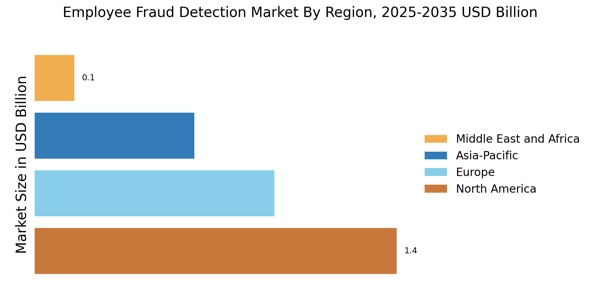
Regional Insights

North America : Fraud Detection Leader

North America is the largest market for employee fraud detection, holding approximately 45% of the global market share. The region's growth is driven by increasing regulatory scrutiny, technological advancements, and a rising awareness of fraud risks among organizations. The demand for sophisticated fraud detection solutions is further fueled by the growing incidence of cybercrime and internal fraud, prompting companies to invest in robust detection systems. The United States and Canada are the leading countries in this market, with major players like SAS Institute, IBM, and Oracle establishing a strong presence. The competitive landscape is characterized by continuous innovation and strategic partnerships among key players. As organizations increasingly adopt AI and machine learning technologies, the market is expected to witness significant growth, enhancing the capabilities of fraud detection solutions.

Europe : Regulatory Framework Strengthens Market

Europe is the second-largest market for employee fraud detection, accounting for approximately 30% of the global market share. The region's growth is driven by stringent regulations such as GDPR and anti-fraud laws, which compel organizations to adopt effective fraud detection measures. The increasing complexity of fraud schemes and the need for compliance with regulatory standards are significant factors driving demand for advanced detection solutions. Leading countries in this region include Germany, the UK, and France, where companies are increasingly investing in fraud detection technologies. The competitive landscape features key players like SAP and FICO, who are innovating to meet the evolving needs of businesses. The presence of regulatory bodies ensures that organizations prioritize compliance, further propelling the market for employee fraud detection solutions.

Asia-Pacific : Emerging Market Potential

Asia-Pacific is witnessing rapid growth in the employee fraud detection market, holding approximately 20% of the global market share. The region's expansion is driven by increasing digitalization, a rise in fraudulent activities, and growing awareness among businesses about the importance of fraud prevention. Governments are also implementing regulations to combat fraud, which is further stimulating market demand for detection solutions. Countries like China, India, and Japan are leading the charge in adopting advanced fraud detection technologies. The competitive landscape is becoming increasingly dynamic, with both local and international players vying for market share. Companies are focusing on integrating AI and machine learning into their solutions to enhance detection capabilities, making the region a hotbed for innovation in fraud detection.

Middle East and Africa : Untapped Market Opportunities

The Middle East and Africa region is gradually emerging in the employee fraud detection market, currently holding about 5% of the global market share. The growth is driven by increasing awareness of fraud risks, coupled with a rise in regulatory frameworks aimed at combating financial crimes. As businesses in this region recognize the importance of fraud detection, investments in technology are expected to increase significantly in the coming years. Leading countries such as South Africa and the UAE are beginning to adopt advanced fraud detection solutions. The competitive landscape is still developing, with a mix of local and international players entering the market. As organizations prioritize fraud prevention, the demand for innovative solutions is likely to grow, presenting significant opportunities for key players in the region.

Employee Fraud Detection Market Regional Image

Key Players and Competitive Insights

The Employee Fraud Detection Market has seen significant growth in recent years, driven by increasing awareness of the risks associated with employee fraud and the need for organizations to protect their financial and reputational integrity. As businesses face a myriad of challenges, including technological advancements and evolving fraudulent tactics, the competition within this market has intensified. Companies specializing in employee fraud detection are leveraging cutting-edge technologies such as artificial intelligence, machine learning, and data analytics to improve their offerings and provide innovative solutions to their clients. 

The market is characterized by a diverse range of service providers, each aiming to enhance their product capabilities and differentiation through unique approaches to fraud detection.Hewlett Packard Enterprise has established a formidable presence in the Employee Fraud Detection Market, standing out due to its robust technological infrastructure and extensive experience in delivering enterprise solutions. The company's strengths lie in its ability to integrate security measures within existing IT frameworks, enabling organizations to effectively monitor and detect fraudulent activities. 

Hewlett Packard Enterprise leverages advanced analytics and cloud-based solutions to provide real-time insights, ensuring that businesses can respond proactively to potential threats. Its commitment to ongoing research and development allows it to stay ahead of emerging fraud trends while maintaining flexibility in adapting to the specific needs of various industries, thereby enhancing its competitive edge in the market.Infinita is another key player in the Employee Fraud Detection Market, recognized for its specialization in customized fraud detection solutions tailored to meet individual client needs. 

The company has built a reputation for developing user-friendly platforms that empower organizations to efficiently track and manage potential fraud risks with minimal disruption to their operations. Infinita's strength lies in its focus on customer collaboration, allowing it to refine its services based on direct feedback and industry requirements. Its innovative use of automated controls and proactive monitoring systems enables clients to mitigate fraud exposure effectively, establishing Infinita as a trusted partner in the fight against employee fraud.

By continually enhancing its technology and maintaining strong relationships with its user base, Infinita is well-positioned to navigate the competitive landscape of this dynamic market.

Key Companies in the Employee Fraud Detection Market market include

Industry Developments

The Employee Fraud Detection Market is experiencing significant developments, driven by the increasing need for advanced security measures amid rising incidents of internal fraud. Recent advancements have been made by major players such as IBM and SAP, focusing on integrating artificial intelligence and machine learning to enhance fraud detection capabilities. 

Companies like Workday and Oracle are expanding their solutions to include comprehensive analytics and user behavior monitoring, which are essential in identifying anomalies indicative of fraud. Moreover, notable mergers and acquisitions have been observed, particularly with Riskonnect acquiring Kroll, aiming to strengthen its fraud detection services and expand its market reach. Similarly, ADP has been broadening its portfolio through strategic collaborations designed to bolster its employee fraud detection offerings. 

The market valuation for these companies is on the rise, reflecting an increased investment in fraud detection technologies as organizations recognize their importance in risk management and compliance. This growth suggests a robust demand for proactive measures and innovative solutions in the employee fraud detection domain, driving technological advancements and creating opportunities for further developments in the market landscape.

Future Outlook

Employee Fraud Detection Market Future Outlook

The Employee Fraud Detection Market is projected to grow at an 8.97% CAGR from 2024 to 2035, driven by technological advancements, regulatory compliance, and increasing fraud awareness.

New opportunities lie in:

  • Integration of AI-driven analytics for real-time fraud detection
  • Development of mobile applications for employee monitoring
  • Expansion of training programs on fraud prevention strategies

By 2035, the market is expected to be robust, reflecting substantial growth and innovation.

Market Segmentation

Employee Fraud Detection Market Fraud Type Outlook

  • Financial Fraud
  • Operational Fraud
  • Asset Misappropriation
  • Corruption

Employee Fraud Detection Market Technology Outlook

  • Artificial Intelligence
  • Machine Learning
  • Data Analytics
  • Behavioral Analytics

Employee Fraud Detection Market Deployment Mode Outlook

  • On-Premises
  • Cloud-Based

Employee Fraud Detection Market End User Industry Outlook

  • Banking
  • Insurance
  • Retail
  • Healthcare
  • Hospitality

Report Scope

MARKET SIZE 20243.015(USD Billion)
MARKET SIZE 20253.286(USD Billion)
MARKET SIZE 20357.758(USD Billion)
COMPOUND ANNUAL GROWTH RATE (CAGR)8.97% (2024 - 2035)
REPORT COVERAGERevenue Forecast, Competitive Landscape, Growth Factors, and Trends
BASE YEAR2024
Market Forecast Period2025 - 2035
Historical Data2019 - 2024
Market Forecast UnitsUSD Billion
Key Companies ProfiledMarket analysis in progress
Segments CoveredMarket segmentation analysis in progress
Key Market OpportunitiesIntegration of artificial intelligence enhances detection capabilities in the Employee Fraud Detection Market.
Key Market DynamicsRising technological advancements drive innovation in employee fraud detection solutions, enhancing security and compliance measures.
Countries CoveredNorth America, Europe, APAC, South America, MEA

Leave a Comment

FAQs

What is the projected market valuation of the Employee Fraud Detection Market by 2035?

The Employee Fraud Detection Market is projected to reach a valuation of 7.758 USD Billion by 2035.

What was the market valuation of the Employee Fraud Detection Market in 2024?

In 2024, the market valuation of the Employee Fraud Detection Market was 3.015 USD Billion.

What is the expected CAGR for the Employee Fraud Detection Market during the forecast period 2025 - 2035?

The expected CAGR for the Employee Fraud Detection Market during the forecast period 2025 - 2035 is 8.97%.

Which technology segment is anticipated to grow the most in the Employee Fraud Detection Market?

The Artificial Intelligence segment is anticipated to grow from 0.905 USD Billion in 2024 to 1.925 USD Billion by 2035.

How does the Cloud-Based deployment mode compare to On-Premises in terms of market valuation?

Both Cloud-Based and On-Premises deployment modes had equal valuations of 1.5075 USD Billion in 2024, with slight differences projected by 2035.

What are the key end-user industries driving the Employee Fraud Detection Market?

Key end-user industries include Banking, Insurance, Retail, Healthcare, and Hospitality, with Banking expected to grow from 0.905 USD Billion in 2024 to 2.275 USD Billion by 2035.

Which fraud type is projected to have the highest market growth in the Employee Fraud Detection Market?

Financial Fraud is projected to grow from 0.905 USD Billion in 2024 to 2.295 USD Billion by 2035.

Who are the leading players in the Employee Fraud Detection Market?

Leading players in the Employee Fraud Detection Market include SAS Institute, IBM, Oracle, SAP, and FICO.

What is the projected growth of the Behavioral Analytics segment in the Employee Fraud Detection Market?

The Behavioral Analytics segment is projected to grow from 0.75 USD Billion in 2024 to 1.808 USD Billion by 2035.

How does the market for Operational Fraud compare to other fraud types in terms of growth?

Operational Fraud is expected to grow from 0.603 USD Billion in 2024 to 1.547 USD Billion by 2035, indicating a robust growth trajectory.

Download Free Sample

Kindly complete the form below to receive a free sample of this Report

Compare Licence

×
Features License Type
Single User Multiuser License Enterprise User
Price $4,950 $5,950 $7,250
Maximum User Access Limit 1 User Upto 10 Users Unrestricted Access Throughout the Organization
Free Customization
Direct Access to Analyst
Deliverable Format
Platform Access
Discount on Next Purchase 10% 15% 15%
Printable Versions

















