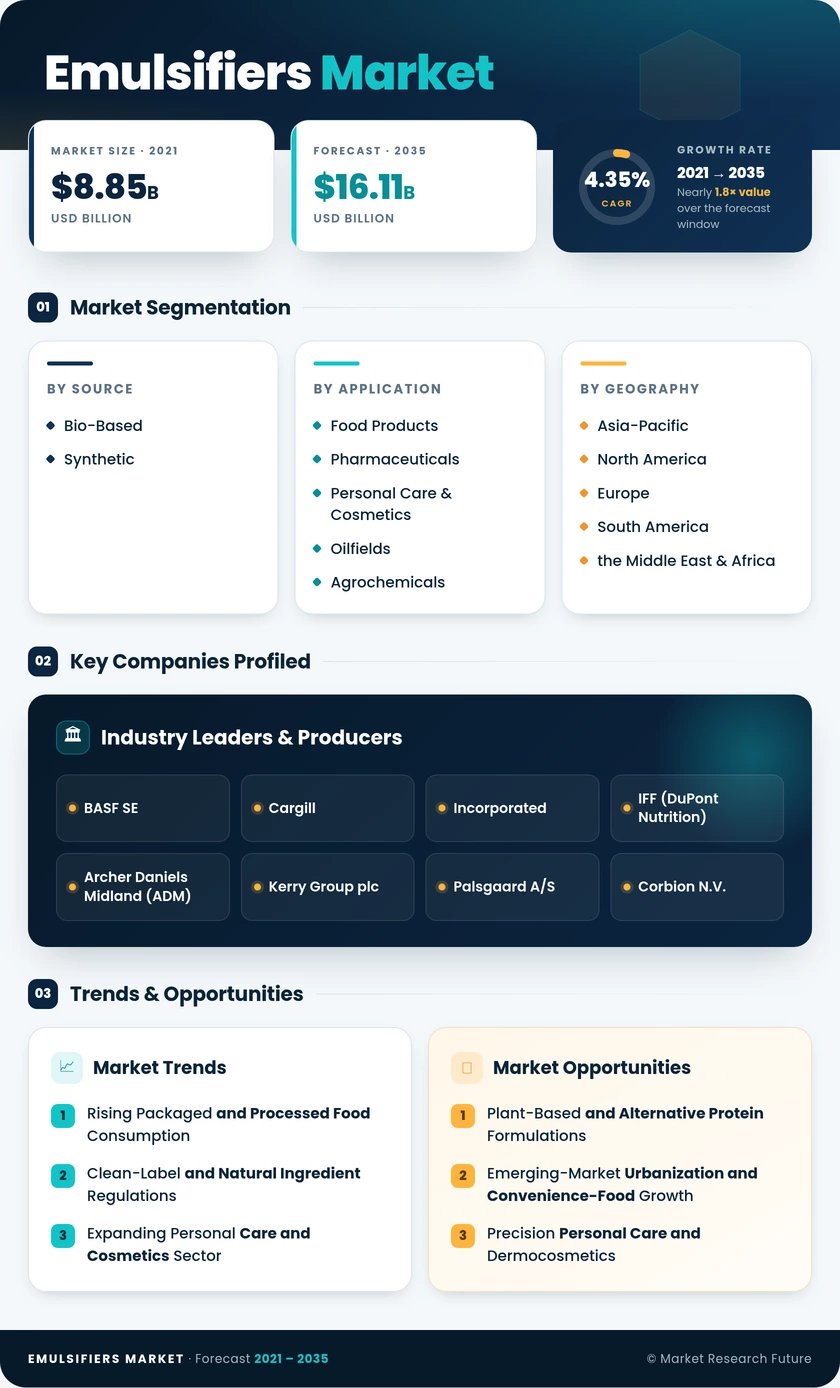
Emulsifiers Market

ID: MRFR/CnM/1185-HCR
200 Pages
Chitranshi Jaiswal
Last Updated: June 22, 2026
Emulsifiers Market Research Report By Application (Food Beverage, Cosmetics, Pharmaceuticals, Household Products, Industrial Applications), By Type (Natural Emulsifiers, Synthetic Emulsifiers, Semi-Synthetic Emulsifiers), By Source (Plant-Based, Animal-Based, Chemical Synthesis), By Form (Liquid, Powder, Granular) and By Regional (North America, Europe, South America, Asia Pacific, Middle East and Africa)-Forecast to 2035
Download PDF ×

We do not share your information with anyone. However, we may send you emails based on your report interest from time to time. You may contact us at any time to opt-out.

  1. 1 Market Overview |
    1. 1.1 Study Assumptions & Market Definition |
    2. 1.2 Scope of the Study |
    3. 1.3 Research Methodology
  2. 2 Market Summary & Key Takeaways
  3. 3 Market Dynamics |
    1. 3.1 Market Drivers Analysis | |
      1. 3.1.1 Rising Packaged & Processed Food Consumption | |
      2. 3.1.2 Clean-Label & Natural Ingredient Regulations | |
      3. 3.1.3 Expanding Personal Care & Cosmetics Sector | |
      4. 3.1.4 Bio-Based Surfactant R&D Investment | |
      5. 3.1.5 Urbanization-Driven Diet Shifts in Emerging Markets | |
      6. 3.1.6 Pharmaceutical Drug-Delivery Innovation | |
      7. 3.1.7 Oilfield Enhanced Oil Recovery Applications |
    2. 3.2 Market Restraints Analysis | |
      1. 3.2.1 Enzyme-Based Substitution Pressure | |
      2. 3.2.2 Volatile Raw-Material Pricing | |
      3. 3.2.3 Regulatory Approval Complexity | |
      4. 3.2.4 Consumer Pushback on Synthetic Additives | |
      5. 3.2.5 Supply-Chain Concentration Risks |
    3. 3.3 Market Opportunity Analysis | |
      1. 3.3.1 Plant-Based and Alternative Protein Formulations | |
      2. 3.3.2 Emerging-Market Urbanization and Convenience-Food Growth | |
      3. 3.3.3 Precision Personal Care and Dermocosmetics | |
      4. 3.3.4 Digital Formulation Platforms and Data Monetization | |
      5. 3.3.5 Oilfield Chemistry and Enhanced Oil Recovery |
    4. 3.4 Industry Value Chain Analysis |
    5. 3.5 Porter's Five Forces Analysis
  4. 4 Global Emulsifiers Market Size & Forecast (2021–2035) |
    1. 4.1 Historical Market Size (2021–2025) |
    2. 4.2 Current & Forecast Market Size (2026–2035) |
    3. 4.3 Market Size by Revenue (USD Billion) |
    4. 4.4 Year-over-Year Growth Analysis
  5. 5 Segmentation Analysis |
    1. 5.1 By Source | |
      1. 5.1.1 Bio-Based | |
      2. 5.1.2 Synthetic |
    2. 5.2 By Application | |
      1. 5.2.1 Food Products | |
      2. 5.2.2 Pharmaceuticals | |
      3. 5.2.3 Personal Care & Cosmetics Products | |
      4. 5.2.4 Oilfields | |
      5. 5.2.5 Agrochemicals | |
      6. 5.2.6 Other Applications |
    3. 5.3 By Geography | |
      1. 5.3.1 Asia-Pacific | |
      2. 5.3.2 North America | |
      3. 5.3.3 Europe | |
      4. 5.3.4 South America | |
      5. 5.3.5 Middle East & Africa
  6. 6 Regional Analysis |
    1. 6.1 North America | |
      1. 6.1.1 United States | |
      2. 6.1.2 Canada | |
      3. 6.1.3 Mexico |
    2. 6.2 Europe | |
      1. 6.2.1 Germany | |
      2. 6.2.2 United Kingdom | |
      3. 6.2.3 France | |
      4. 6.2.4 Italy | |
      5. 6.2.5 Spain | |
      6. 6.2.6 Nordic Countries | |
      7. 6.2.7 Russia | |
      8. 6.2.8 Rest of Europe |
    3. 6.3 Asia-Pacific | |
      1. 6.3.1 China | |
      2. 6.3.2 India | |
      3. 6.3.3 Japan | |
      4. 6.3.4 South Korea | |
      5. 6.3.5 ASEAN | |
      6. 6.3.6 Rest of Asia-Pacific |
    4. 6.4 South America | |
      1. 6.4.1 Brazil | |
      2. 6.4.2 Argentina | |
      3. 6.4.3 Rest of South America |
    5. 6.5 Middle East & Africa | |
      1. 6.5.1 Saudi Arabia | |
      2. 6.5.2 UAE | |
      3. 6.5.3 South Africa | |
      4. 6.5.4 Egypt | |
      5. 6.5.5 Rest of MEA
  7. 7 Competitive Landscape |
    1. 7.1 Market Share Analysis (2025) |
    2. 7.2 Competitive Benchmarking Matrix |
    3. 7.3 Company Profiles | |
      1. 7.3.1 BASF SE | |
      2. 7.3.2 Cargill, Incorporated | |
      3. 7.3.3 IFF (DuPont Nutrition) | |
      4. 7.3.4 Archer Daniels Midland (ADM) | |
      5. 7.3.5 Kerry Group plc | |
      6. 7.3.6 Palsgaard A/S | |
      7. 7.3.7 Corbion N.V. | |
      8. 7.3.8 Evonik Industries AG | |
      9. 7.3.9 Lonza Group AG | |
      10. 7.3.10 Dow Inc.
  8. 8 Future Outlook & Strategic Recommendations (2026–2035) |
    1. 8.1 Bio-Refinery Integration and Circular Feedstock Models |
    2. 8.2 AI-Accelerated Formulation and Digital Twins |
    3. 8.3 Sustainability Reporting and ESG-Driven Procurement |
    4. 8.4 Convergence of Food, Pharma, and Cosmetic Emulsification Platforms
  9. 9 Recent Developments & News
  10. 10 Frequently Asked Questions (FAQs)
  11. 11 Report Scope & Methodology |
    1. 11.1 Study Period & Base Year |
    2. 11.2 Data Sources & Citations |
    3. 11.3 Abbreviations
  12. 12 LIST OF TABLES |
  13. TABLE 1 Global Emulsifiers Market Size & Forecast, by Revenue (USD Billion), 2021–2035 |
  14. TABLE 2 Global Emulsifiers Market — Year-over-Year Growth Analysis, 2021–2035 |
  15. TABLE 3 Global Emulsifiers Market — Driver Impact Analysis, 2026–2035 |
  16. TABLE 4 Global Emulsifiers Market — Restraint Impact Analysis, 2026–2035 |
  17. TABLE 5 Global Emulsifiers Market Size, by Source, 2021–2035 (USD Billion) |
  18. TABLE 6 Global Emulsifiers Market Size, by Application, 2021–2035 (USD Billion) |
  19. TABLE 7 Global Emulsifiers Market Size, by Region, 2021–2035 (USD Billion) |
  20. TABLE 8 North America Emulsifiers Market Size, by Country, 2021–2035 (USD Billion) |
  21. TABLE 9 Europe Emulsifiers Market Size, by Country, 2021–2035 (USD Billion) |
  22. TABLE 10 Asia-Pacific Emulsifiers Market Size, by Country, 2021–2035 (USD Billion) |
  23. TABLE 11 South America Emulsifiers Market Size, by Country, 2021–2035 (USD Billion) |
  24. TABLE 12 Middle East & Africa Emulsifiers Market Size, by Country, 2021–2035 (USD Billion) |
  25. TABLE 13 Competitive Benchmarking Matrix — Global Emulsifiers Market, 2025 |
  26. TABLE 14 Company Profiles — Key Players, Global Emulsifiers Market |
  27. TABLE 15 Recent Developments & Strategic Announcements, 2023–2025 |
  28. TABLE 16 Report Scope & Methodology Summary |
  29. TABLE 17 Detailed Sources and Citations
  30. 13 LIST OF FIGURES |
  31. FIGURE 1 Global Emulsifiers Market Dynamics — Drivers, Restraints, and Opportunities |
  32. FIGURE 2 Industry Value Chain Analysis — Emulsifiers Market |
  33. FIGURE 3 Porter's Five Forces Analysis — Emulsifiers Market |
  34. FIGURE 4 Global Emulsifiers Market Size Trend (USD Billion), 2021–2035 |
  35. FIGURE 5 Global Emulsifiers Market Share, by Source (%), 2025 |
  36. FIGURE 6 Global Emulsifiers Market Share, by Application (%), 2025 |
  37. FIGURE 7 Global Emulsifiers Market Share, by Region (%), 2025 |
  38. FIGURE 8 North America Emulsifiers Market Share, by Country (%), 2025 |
  39. FIGURE 9 Europe Emulsifiers Market Share, by Country (%), 2025 |
  40. FIGURE 10 Asia-Pacific Emulsifiers Market Share, by Country (%), 2025 |
  41. FIGURE 11 South America Emulsifiers Market Share, by Country (%), 2025 |
  42. FIGURE 12 Middle East & Africa Emulsifiers Market Share, by Country (%), 2025 |
  43. FIGURE 13 Competitive Landscape — Market Share Distribution, 2025

Segmentation Quick Reference

DimensionSub-SegmentsDominant SegmentFastest Growing Segment
By SourceBio-Based, SyntheticBio-Based (~58% share)Bio-Based (CAGR ~4.7%)
By ApplicationFood Products, Pharmaceuticals, Personal Care & Cosmetics, Oilfields, Agrochemicals, Other ApplicationsFood Products (~55% share)Personal Care & Cosmetics (CAGR ~5.4%)
By GeographyAsia-Pacific, North America, Europe, South America, the Middle East & AfricaAsia-Pacific (~43% share)Asia-Pacific (CAGR ~5.1%)


Market Segmentation Overview

By Source

Sub-SegmentKey Trend
Bio-BasedClean-label mandates and consumer preference for plant-derived ingredients are driving reformulation across food and cosmetics
SyntheticSustained demand from oilfield, agrochemical, and industrial coatings applications, where performance under extreme conditions is critical


Bio-based emulsifiers are expanding rapidly as food manufacturers, personal care brands, and pharmaceutical formulators pursue renewable, transparent ingredient profiles. Synthetic variants remain essential in industrial and oilfield contexts where cost and high-temperature performance are the primary selection criteria.

By Application

Sub-SegmentKey Trend
Food ProductsVolume-leader driven by bakery, dairy, confectionery, and plant-based alternatives, requiring texture and shelf-life management
PharmaceuticalsNano-emulsion and microencapsulation technologies enhancing drug-delivery efficiency
Personal Care & CosmeticsPEG-free and silicone-free formulation trends fueling premium emulsifier adoption
OilfieldsTertiary enhanced oil recovery maintaining steady demand for high-performance surfactants
AgrochemicalsAdjuvant systems improving crop-protection efficacy and spray coverage
Other ApplicationsIndustrial coatings, textile processing, and construction chemicals contribute to niche demand


Food products dominate the application landscape, while personal care and cosmetics represent the fastest-growing end-use segment as beauty brands pursue minimalist, science-backed formulations.

By Geography

Sub-SegmentKey Trend
Asia-PacificChina and India are driving volume growth through urbanization-led packaged food demand and cost-advantaged manufacturing
North AmericaClean-label regulation and the expanding plant-based food sector are creating reformulation demand
EuropeEU Green Deal and EFSA re-evaluations accelerating transition to bio-based and sustainable emulsifier platforms
South AmericaSoy feedstock advantage supporting competitive lecithin and mono-diglyceride production
Middle East & AfricaDual demand pillars of food-security manufacturing programs and oilfield chemistry applications


Asia-Pacific leads the global market by both share and growth rate, while the Middle East & Africa region shows the strongest acceleration trajectory outside Asia, driven by food-manufacturing investments and hydrocarbon-sector demand.