×
Request Free Sample ×

Kindly complete the form below to receive a free sample of this Report

* Please use a valid business email

Leading companies partner with us for data-driven Insights

clients tt-cursor
Hero Background

Enterprise IoT Market

ID: MRFR/SEM/2892-HCR
100 Pages
Aarti Dhapte
October 2025

Enterprise IoT Market Research Report By Application (Smart Manufacturing, Smart Logistics, Smart Energy Management, Connected Healthcare, Smart Building), By Connectivity Technology (Cellular, Satellite, Wi-Fi, Bluetooth, LPWAN), By Industry (Manufacturing, Transportation, Energy and Utilities, Healthcare, Retail), By Device Type (Sensors, Actuators, Smart Meters, Wearables, Connected Machines) and By Regional (North America, Europe, South America, Asia Pacific, Middle East and Africa) - Forecast to 2035.

Share:
Download PDF ×

We do not share your information with anyone. However, we may send you emails based on your report interest from time to time. You may contact us at any time to opt-out.

Enterprise IoT Market Infographic
Purchase Options

Enterprise IoT Market Summary

As per MRFR analysis, the Enterprise IoT Market Size was estimated at 271.29 USD Billion in 2024. The Enterprise IoT industry is projected to grow from 319.36 USD Billion in 2025 to 1632.22 USD Billion by 2035, exhibiting a compound annual growth rate (CAGR) of 17.72 during the forecast period 2025 - 2035.

Key Market Trends & Highlights

The Enterprise IoT Market is poised for substantial growth driven by technological advancements and evolving consumer demands.

  • North America remains the largest market for Enterprise IoT Market, showcasing robust investment in smart infrastructure.
  • Asia-Pacific is emerging as the fastest-growing region, propelled by rapid urbanization and technological adoption.
  • Smart Manufacturing continues to dominate the market, while Connected Healthcare is witnessing the most rapid growth.
  • The rising demand for automation and increased investment in cybersecurity are key drivers shaping the market landscape.

Market Size & Forecast

2024 Market Size 271.29 (USD Billion)
2035 Market Size 1632.22 (USD Billion)
CAGR (2025 - 2035) 17.72%

Major Players

Cisco Systems (US), IBM (US), Microsoft (US), Siemens (DE), GE (US), Honeywell (US), Oracle (US), SAP (DE), Schneider Electric (FR)

Enterprise IoT Market Trends

The Enterprise IoT Market is currently experiencing a transformative phase, characterized by the integration of advanced technologies and the increasing adoption of connected devices across various sectors. Organizations are recognizing the potential of IoT solutions to enhance operational efficiency, improve decision-making, and drive innovation. As businesses strive to remain competitive, the demand for smart devices and data analytics tools is on the rise, leading to a more interconnected ecosystem. This shift is not merely a trend but appears to be a fundamental change in how enterprises operate, leveraging real-time data to optimize processes and enhance customer experiences. Moreover, the focus on security and data privacy is becoming increasingly paramount within the Enterprise IoT Market. As more devices connect to networks, the potential for vulnerabilities grows, prompting organizations to invest in robust security measures. This heightened awareness of cybersecurity risks is likely to shape the development of IoT solutions, as companies seek to protect sensitive information while maximizing the benefits of connectivity. The convergence of these factors suggests that the Enterprise IoT Market is poised for sustained growth, driven by innovation and a commitment to secure, efficient operations.

Increased Focus on Security Solutions

As the number of connected devices expands, the emphasis on security within the Enterprise IoT Market intensifies. Organizations are prioritizing the implementation of advanced security measures to safeguard their networks and data from potential threats. This trend indicates a shift towards more secure IoT architectures, ensuring that enterprises can leverage connectivity without compromising their integrity.

Integration of Artificial Intelligence

The incorporation of artificial intelligence into IoT systems is becoming more prevalent, enhancing the capabilities of devices and applications. This integration allows for smarter decision-making processes, predictive analytics, and improved automation. Consequently, the Enterprise IoT Market is likely to witness a surge in AI-driven solutions that optimize operations and drive efficiency.

Sustainability and Energy Efficiency Initiatives

There is a growing emphasis on sustainability within the Enterprise IoT Market, as organizations seek to reduce their environmental impact. IoT solutions are being leveraged to monitor energy consumption and optimize resource usage, aligning with global sustainability goals. This trend suggests that enterprises are increasingly recognizing the importance of eco-friendly practices in their operational strategies.

Enterprise IoT Market Drivers

Rising Demand for Automation

The Enterprise IoT Market is experiencing a notable surge in demand for automation across various sectors. Organizations are increasingly adopting IoT solutions to streamline operations, enhance productivity, and reduce operational costs. According to recent data, the automation segment within the Enterprise IoT Market is projected to grow at a compound annual growth rate of approximately 25% over the next five years. This growth is driven by the need for real-time data analytics and decision-making capabilities, which IoT devices facilitate. As businesses seek to optimize their processes, the integration of IoT technologies becomes essential, leading to a more interconnected and efficient operational landscape. Consequently, the Enterprise IoT Market is likely to witness a significant transformation as automation becomes a core component of business strategies.

Expansion of Smart Infrastructure

The Enterprise IoT Market is witnessing an expansion in smart infrastructure initiatives, which are reshaping urban environments and industrial settings. Governments and private entities are investing heavily in smart city projects, integrating IoT technologies to improve public services, transportation, and energy management. For instance, the smart infrastructure segment is expected to account for a substantial share of the Enterprise IoT Market, with estimates suggesting it could reach USD 200 billion by 2026. This trend indicates a shift towards more sustainable and efficient urban planning, where IoT devices play a crucial role in monitoring and managing resources. As cities evolve into smart ecosystems, the Enterprise IoT Market is poised for growth, driven by the demand for innovative solutions that enhance quality of life and operational efficiency.

Growing Emphasis on Data Analytics

The Enterprise IoT Market is increasingly characterized by a growing emphasis on data analytics. Organizations are recognizing the value of the vast amounts of data generated by IoT devices and are investing in analytics solutions to derive actionable insights. This trend is reflected in the market, where the data analytics segment is projected to grow at a rate of 30% annually. By harnessing data analytics, businesses can enhance decision-making processes, improve customer experiences, and optimize resource allocation. The integration of advanced analytics tools with IoT technologies enables organizations to monitor performance in real-time and respond proactively to emerging trends. As data becomes a pivotal asset, the Enterprise IoT Market is likely to evolve, with analytics playing a central role in shaping business strategies.

Increased Investment in Cybersecurity

The Enterprise IoT Market is witnessing increased investment in cybersecurity measures as organizations become more aware of the vulnerabilities associated with IoT devices. With the proliferation of connected devices, the risk of cyber threats has escalated, prompting businesses to prioritize security solutions. Recent studies indicate that the cybersecurity segment within the Enterprise IoT Market is expected to grow by over 20% in the coming years. This heightened focus on security is essential for maintaining consumer trust and ensuring the integrity of data transmitted across networks. As organizations implement robust cybersecurity frameworks, the Enterprise IoT Market is likely to see a shift towards more secure and resilient IoT ecosystems, fostering innovation while mitigating risks.

Advancements in Connectivity Technologies

The Enterprise IoT Market is significantly influenced by advancements in connectivity technologies, such as 5G and LPWAN (Low Power Wide Area Network). These technologies enable faster data transmission and improved device connectivity, which are critical for the effective deployment of IoT solutions. The introduction of 5G is expected to revolutionize the Enterprise IoT Market, with projections indicating that it could support up to one million devices per square kilometer. This enhanced connectivity allows for real-time data processing and analytics, which are essential for industries such as manufacturing, healthcare, and logistics. As connectivity continues to evolve, the Enterprise IoT Market is likely to expand, offering new opportunities for businesses to leverage IoT technologies for competitive advantage.
Market Segment Insights

By Application: Smart Manufacturing (Largest) vs. Connected Healthcare (Fastest-Growing)

In the Enterprise IoT Market, the application segment is diverse, with smart manufacturing leading the way in terms of market share. This segment has capitalized on automation and data-driven decision-making practices, positioning itself as a frontrunner. Other notable segments include smart logistics and smart energy management, which are experiencing steady uptake due to operational efficiency and sustainability objectives respectively. Connected healthcare, while smaller in market share, has rapidly gained traction due to the increasing demand for telehealth solutions and remote monitoring systems. Looking at growth trends, smart manufacturing continues to dominate with its advanced technologies, while connected healthcare is emerging as the fastest-growing segment, fueled by technological advancements and the ongoing global health concerns. Smart logistics and smart energy management are also poised for growth as organizations seek integrated solutions for supply chain efficiency and energy conservation. The overlapping benefits of IoT applications across these sectors further enhance their appeal and investment potential.

Smart Manufacturing (Dominant) vs. Smart Logistics (Emerging)

Smart manufacturing stands as the dominant force in the Enterprise IoT Market application landscape, integrating advanced technologies such as automation, AI, and data analytics to optimize production processes and enhance operational efficiency. Manufacturers are increasingly leveraging IoT solutions for predictive maintenance, quality control, and supply chain optimization. Meanwhile, smart logistics is emerging within the market, focusing on real-time tracking, data analytics, and improved operational efficiencies. The rise of e-commerce and global supply chain complexities are driving investments in smart logistics, as firms seek to minimize delays and optimize delivery routes. Together, these applications illustrate the transformative capabilities of IoT, with smart manufacturing leading and smart logistics quickly catching up.

By Connectivity Technology: Wi-Fi (Largest) vs. LPWAN (Fastest-Growing)

In the Enterprise IoT Market, the distribution of connectivity technologies is a critical factor shaping operational efficiencies. Wi-Fi holds the largest market share due to its widespread adoption and robust performance in local area networks, making it the preferred choice for many businesses. Cellular and Bluetooth technologies also contribute significantly, thanks to their reliability and ease of use in various applications, while Satellite and LPWAN are emerging as influential players within niche segments.

Technology: Wi-Fi (Dominant) vs. LPWAN (Emerging)

Wi-Fi is the dominant connectivity technology in the Enterprise IoT Market, valued for its high-speed internet access and compatibility with a multitude of devices. It facilitates seamless communication in smart office environments, industrial applications, and real-time data sharing among connected devices. Conversely, LPWAN is rapidly emerging as a key player, especially in applications requiring long-range connectivity with low power consumption. LPWAN solutions, such as LoRa and Sigfox, are becoming vital for smart city initiatives, asset tracking, and environmental monitoring, catering to the growing need for efficient data transmission over extensive areas.

By Industry: Manufacturing (Largest) vs. Healthcare (Fastest-Growing)

In the Enterprise IoT Market, Manufacturing holds a significant share, driven by the industry's push towards automation and smart manufacturing solutions. The integration of IoT technologies allows manufacturers to optimize processes, enhance operational efficiency, and reduce costs. In contrast, Healthcare is rapidly gaining momentum as an essential sector for IoT deployment, focusing on improving patient care and streamlining operations through connected devices and real-time data analytics. Growth trends in the Enterprise IoT Market reveal a robust expansion within the Healthcare segment, spurred by increasing demand for remote monitoring solutions and telehealth services. The advancement of IoT applications in manufacturing continues, but the healthcare sector is emerging as a dynamic area fueled by technological innovations, regulatory support, and growing investments in digital health initiatives that enhance patient outcomes.

Manufacturing (Dominant) vs. Transportation (Emerging)

The Manufacturing sector is a dominant player in the Enterprise IoT Market, leveraging smart technologies to improve efficiency and productivity on the factory floor. IoT solutions such as predictive maintenance, supply chain tracking, and real-time data analysis play a vital role in transforming manufacturing processes. On the other hand, the Transportation segment is deemed emerging, propelled by advancements in IoT that enhance fleet management, logistics, and supply chain efficiency. As more companies adopt IoT-based solutions, transportation is evolving rapidly, addressing the increasing need for connectivity and data-driven decision-making. This interplay between manufacturing's established position and transportation's evolving capabilities underlines the significant growth potential and strategic importance of IoT in these industries.

By Device Type: Sensors (Largest) vs. Wearables (Fastest-Growing)

In the Enterprise IoT Market, the distribution of market share among different device types reveals that sensors dominate the landscape. They serve as essential components in collecting data from various environments and conditions, making them indispensable for enterprise operations. Following sensors, connected machines and smart meters hold significant portions of the market, while wearables, although currently smaller in share, are rapidly gaining traction due to evolving applications in workplace safety and employee monitoring.

Sensors (Dominant) vs. Wearables (Emerging)

Sensors play a crucial role in the Enterprise IoT Market as they enable real-time data collection, crucial for analytics and informed decision-making. Their dominant market position stems from widespread applications across industries, powering automation, predictive maintenance, and efficiency improvements. In contrast, wearables are emerging rapidly, driven by increased focus on employee health and productivity. These devices provide valuable insights into worker conditions and can significantly enhance operational safety. As the market evolves, the integration of wearables with other IoT systems promises to add layers of connectivity and functionality that are currently shaping the future of enterprise solutions.

Get more detailed insights about Enterprise IoT Market

Regional Insights

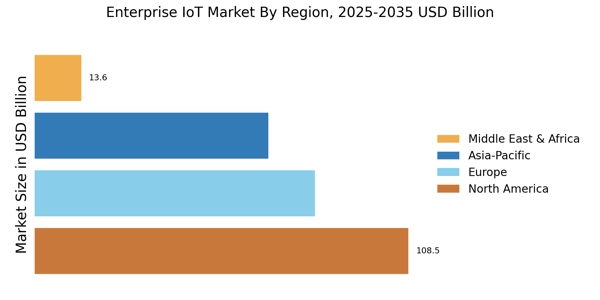
The Enterprise IoT Market is prominently segmented regionally, reflecting varying degrees of adoption and growth across different areas. In 2023, the market's valuation stood at 230.45 USD Billion, with North America holding the majority, valued at 100.0 USD Billion, and projected to reach 420.0 USD Billion by 2032, indicating its dominance. Europe follows as a significant player, initially valued at 70.0 USD Billion in 2023 and expected to rise to 280.0 USD Billion by 2032, showcasing strong growth prospects.

The APAC region is also noteworthy, starting at 50.0 USD Billion and reaching 200.0 USD Billion by 2032, emphasizing its increasing role in the IoT space.Conversely, South America and MEA are comparatively smaller markets, with valuations of 5.0 and 5.45 USD Billion in 2023, respectively, yet both present opportunities for growth, particularly as IoT adoption expands. This regional segmentation underscores the varying dynamics in the Enterprise IoT Market, revealing key trends and potential areas for investment and development.

Enterprise IoT Market Regional Image

Key Players and Competitive Insights

The Enterprise IoT Market has experienced dynamic growth driven by advancements in technology, increased connectivity, and the growing demand for data-driven decision-making across industries. This market is characterized by the integration of various devices and systems that collect, analyze, and transmit data, enabling organizations to enhance their operational efficiency and improve overall productivity. As businesses increasingly adopt IoT solutions to streamline processes, reduce costs, and foster innovation, competition among key players has intensified.

Major corporations, startups, and technology providers are continuously vying for market share, leveraging strategic partnerships, investments in research and development, and innovative product offerings to establish a strong presence in this rapidly evolving landscape. The competitive environment is marked by a focus on enhancing scalability, connectivity, and security features of IoT solutions to meet the diverse needs of enterprises across multiple sectors.General Electric has solidified its position as a formidable competitor in the Enterprise IoT Market, leveraging its extensive experience in industrial solutions and advanced technology.

The company has been proactive in incorporating IoT capabilities into its product offerings, particularly in sectors such as energy management, aviation, and manufacturing. By utilizing data analytics and machine learning, General Electric has developed robust IoT platforms that enable organizations to monitor asset performance, predict maintenance needs, and optimize operational processes. The company's strong brand reputation, combined with its established infrastructure and customer base, enhances its competitive edge.

Moreover, General Electric's commitment to sustainability and reducing operational costs aligns well with emerging market trends, positioning it favorably among enterprises seeking to adopt IoT solutions for long-term growth and efficiency .PTC has emerged as a leading player in the Enterprise IoT Market, focusing on providing innovative software solutions that facilitate the digital transformation of organizations. The company is renowned for its ThingWorx platform, which fosters seamless integration of IoT devices and provides powerful analytics capabilities to drive informed decision-making.

PTC's strength lies in its ability to cater to various industries, including manufacturing, healthcare, and energy, helping businesses to leverage IoT technologies to enhance productivity and operational efficiency. Through strategic partnerships and a commitment to innovation, PTC continues to expand its offerings and maintain a competitive advantage. Its expertise in augmented reality and model-based systems engineering further differentiates the company, enabling clients to visualize data in real-time and create more informed strategies in their IoT implementations.

Key Companies in the Enterprise IoT Market market include

Industry Developments

The Enterprise IoT Market has seen significant advancements, with various companies innovating and expanding their services. General Electric is focusing on enhancing its digital industrial solutions, promoting efficiency through IoT. Siemens has been actively integrating IoT technologies into its manufacturing processes, allowing better operational insight and automation. Amazon continues to invest in IoT, strengthening its AWS platform with new services tailored for enterprises. Bosch and AT&T have expanded their collaboration to enhance IoT connectivity solutions for smart cities and industries. 

In recent months, honeywell has made strides in AI and IoT integration, providing smart building technologies. Oracle and SAP are fostering partnerships to develop integrated solutions that leverage IoT data analytics. Notably, Cisco Systems and Microsoft have announced a strategic alliance to drive enterprise-scale IoT deployments. The Enterprise IoT Market valuation is on an upward trajectory, influenced by increased demand for smart devices and connected solutions. Additionally, merger and acquisition activities have been reported, particularly as companies seek to strengthen their positions in this competitive landscape.

The ongoing investments and innovations are shaping a robust ecosystem that is expected to evolve rapidly as technologies advance.

Future Outlook

Enterprise IoT Market Future Outlook

The Enterprise IoT Market is projected to grow at a 17.72% CAGR from 2024 to 2035, driven by advancements in connectivity, data analytics, and automation technologies.

New opportunities lie in:

  • Development of AI-driven predictive maintenance solutions
  • Integration of IoT with blockchain for enhanced security
  • Expansion of smart supply chain management platforms

By 2035, the Enterprise IoT Market is expected to be a cornerstone of digital transformation across industries.

Market Segmentation

Enterprise IoT Market Industry Outlook

  • Manufacturing
  • Transportation
  • Energy and Utilities
  • Healthcare
  • Retail

Enterprise IoT Market Application Outlook

  • Smart Manufacturing
  • Smart Logistics
  • Smart Energy Management
  • Connected Healthcare
  • Smart Building

Enterprise IoT Market Device Type Outlook

  • Sensors
  • Actuators
  • Smart Meters
  • Wearables
  • Connected Machines

Enterprise IoT Market Connectivity Technology Outlook

  • Cellular
  • Satellite
  • Wi-Fi
  • Bluetooth
  • LPWAN

Report Scope

MARKET SIZE 2024271.29(USD Billion)
MARKET SIZE 2025319.36(USD Billion)
MARKET SIZE 20351632.22(USD Billion)
COMPOUND ANNUAL GROWTH RATE (CAGR)17.72% (2024 - 2035)
REPORT COVERAGERevenue Forecast, Competitive Landscape, Growth Factors, and Trends
BASE YEAR2024
Market Forecast Period2025 - 2035
Historical Data2019 - 2024
Market Forecast UnitsUSD Billion
Key Companies ProfiledMarket analysis in progress
Segments CoveredMarket segmentation analysis in progress
Key Market OpportunitiesIntegration of artificial intelligence in Enterprise IoT solutions enhances operational efficiency and decision-making capabilities.
Key Market DynamicsRising demand for real-time data analytics drives innovation and competition in the Enterprise Internet of Things market.
Countries CoveredNorth America, Europe, APAC, South America, MEA

Market Highlights

Author
Aarti Dhapte
Team Lead - Research

She holds an experience of about 6+ years in Market Research and Business Consulting, working under the spectrum of Information Communication Technology, Telecommunications and Semiconductor domains. Aarti conceptualizes and implements a scalable business strategy and provides strategic leadership to the clients. Her expertise lies in market estimation, competitive intelligence, pipeline analysis, customer assessment, etc.

Leave a Comment

FAQs

What is the projected market valuation of the Enterprise IoT Market by 2035?

The Enterprise IoT Market is projected to reach approximately 1632.22 USD Billion by 2035.

What was the market valuation of the Enterprise IoT Market in 2024?

In 2024, the Enterprise IoT Market was valued at 271.29 USD Billion.

What is the expected CAGR for the Enterprise IoT Market from 2025 to 2035?

The expected CAGR for the Enterprise IoT Market during the forecast period 2025 - 2035 is 17.72%.

Which application segment holds the highest valuation in the Enterprise IoT Market?

The Smart Building application segment holds the highest valuation at 462.22 USD Billion.

What are the key players in the Enterprise IoT Market?

Key players in the Enterprise IoT Market include Cisco Systems, IBM, Microsoft, Siemens, GE, Honeywell, Oracle, SAP, and Schneider Electric.

Which connectivity technology segment is projected to have the highest market size by 2035?

The LPWAN connectivity technology segment is projected to reach 612.22 USD Billion by 2035.

What is the valuation of the Smart Manufacturing segment in the Enterprise IoT Market?

The Smart Manufacturing segment was valued at 270.0 USD Billion in 2024.

How does the Connected Healthcare segment perform in terms of market valuation?

The Connected Healthcare segment is projected to reach 360.0 USD Billion by 2035.

What is the projected market size for the Retail industry within the Enterprise IoT Market?

The Retail industry segment is expected to grow to 642.22 USD Billion by 2035.

Which device type segment is anticipated to dominate the Enterprise IoT Market?

The Connected Machines device type segment is anticipated to dominate with a projected valuation of 812.22 USD Billion by 2035.

Download Free Sample

Kindly complete the form below to receive a free sample of this Report

Compare Licence

×
Features License Type
Single User Multiuser License Enterprise User
Price $4,950 $5,950 $7,250
Maximum User Access Limit 1 User Upto 10 Users Unrestricted Access Throughout the Organization
Free Customization
Direct Access to Analyst
Deliverable Format
Platform Access
Discount on Next Purchase 10% 15% 15%
Printable Versions