Request Free Sample ×

Kindly complete the form below to receive a free sample of this Report

* Please use a valid business email

Leading companies partner with us for data-driven Insights

clients tt-cursor
Hero Background

Enterprise Video Market

ID: MRFR/ICT/1400-HCR
110 Pages
Apoorva Priyadarshi, Shubham Munde
Last Updated: May 28, 2026
Enterprise Video Market Size, Share and Research Report: By Component (Hardware, Software), By Application (Training & Development, Corporate Learning), By Delivery Mode (Video Conferencing, Web Conferencing), By Industries (BFSI, Manufacturing, Media & Entertainment, Healthcare) And By Region (North America, Europe, Asia-Pacific, And Rest Of The World) –Market Forecast Till 2035.
Download PDF ×

We do not share your information with anyone. However, we may send you emails based on your report interest from time to time. You may contact us at any time to opt-out.


Market Summary

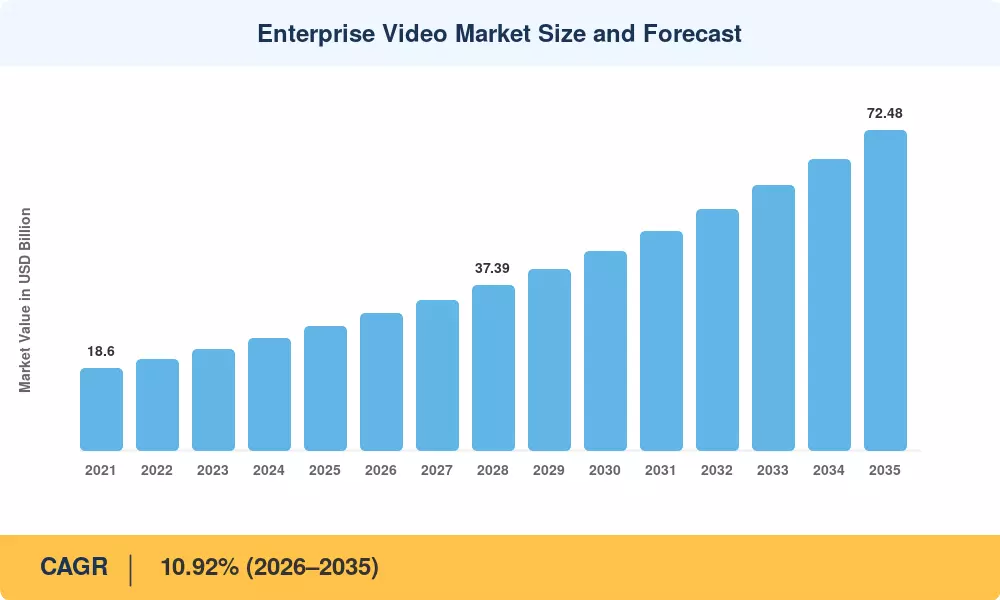
The Enterprise Video Market reached USD 28.15 billion in 2025 and is projected to grow from USD 31.02 billion in 2026 to USD 72.48 billion by 2035, registering a CAGR of 10.92% during the forecast period (2026–2035). This expansion is fueled by accelerating hybrid-work mandates across Fortune 500 companies and government digital-workplace directives such as the U.S. Federal Workplace Modernization Act, which earmarked USD 2.3 billion for secure enterprise video communication platforms and collaboration infrastructure through 2028. Enterprise video has evolved from a simple meeting tool into mission-critical infrastructure supporting AI-powered video search and transcription, compliance recording, and asynchronous knowledge sharing.

Legacy on-premises video hardware is being replaced by cloud-native, API-first platforms that embed video analytics for enterprise meetings directly into workflow automation layers. Cisco's USD 1.7 billion annual investment in Webex AI capabilities exemplifies the vendor arms race underway, while private 5G rollouts are enabling sub-25 ms latency for internal video streaming for corporate training across manufacturing floors and hospital campuses [1]. The Enterprise Video Market is also being reshaped by vendor consolidation — the Brightcove acquisition signals a platform race toward full-stack enterprise video content management solutions.

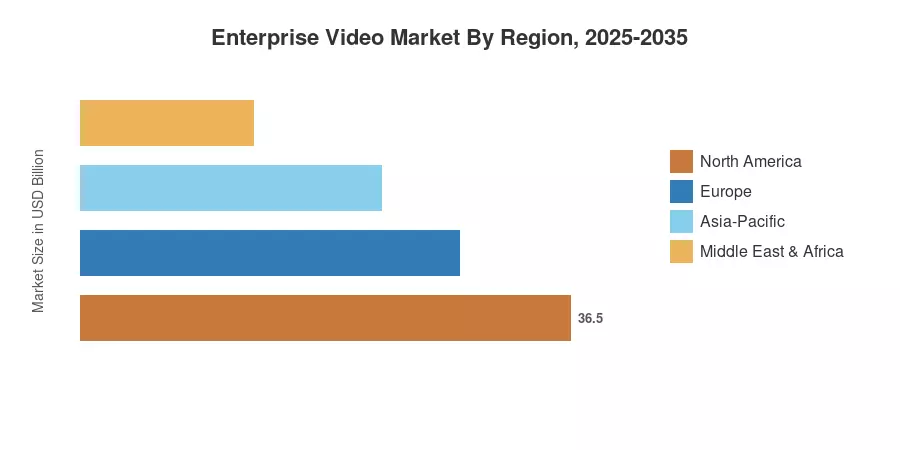
North America commands roughly 36.4% of the Enterprise Video Market, anchored by hyperscaler cloud investments and mature SaaS adoption. Asia-Pacific is the fastest-growing region at a 13.5% CAGR, propelled by India's Digital India programme and China's enterprise digitalization push. Europe holds the second-largest share at approximately 27.1%, driven by GDPR-compliant video archiving requirements and the EU's Digital Decade targets [3]. By 2035, the Enterprise Video Market will be shaped as much by AI governance frameworks as by bandwidth economics.


Key Report Takeaways

• By Type

  • Video Conferencing accounted for 44.2% of Enterprise Video Market share in 2025, reflecting entrenched adoption across hybrid workplaces
  • Video Analytics is set to register a 19.5% CAGR through 2035, driven by demand for AI-powered video search and transcription in compliance-heavy sectors
  • Enterprise video content management solutions in the Webcasting and Live Streaming segment are projected to reach USD 9.8 billion by 2035

• By Component

  • Software represented 54.3% of the Enterprise Video Market size in 2025, as organizations prioritize platform licensing over hardware refresh cycles
  • Services is advancing at a 15.1% CAGR, reflecting growing demand for managed secure enterprise video communication platforms and deployment consulting

• By Deployment Mode

  • On-Premises held 59.8% of the Enterprise Video Market in 2025, particularly among defense and financial institutions
  • Cloud deployment is expanding at a 13.8% CAGR as organizations migrate internal video streaming for corporate training to SaaS architectures

• By End-User Industry

  • IT and Telecommunications captured 27.6% revenue share of the Enterprise Video Market in 2025
  • Healthcare is forecast to grow at a 17.1% CAGR, fueled by telehealth regulations and surgical video archiving

• By Region

  • North America held 36.4% of Enterprise Video Market share in 2025
  • Asia-Pacific is the fastest-growing region with a 13.5% CAGR, driven by 5G infrastructure build-outs


MRFR's proprietary estimation framework combines bottom-up vendor revenue analysis with top-down macroeconomic indicators, validated against primary interviews with 200+ enterprise IT decision-makers across 14 countries. Historical figures (2021–2024) are based on audited company filings and government ICT expenditure data, while the forecast trajectory (2026–2035) applies a calibrated compound growth model accounting for technology diffusion curves and regulatory catalysts.
Market Size Chart
Our Impact
Enabled $4.3B Revenue Impact for Fortune 500 and Leading Multinationals
Partnering with 2000+ Global Organizations Each Year
30K+ Citations by Top-Tier Firms in the Industry
 

Driver Impact Analysis

Driver ~% Impact on CAGR Geographic Relevance Impact Timeline
Hybrid/Remote Work Institutionalization ~22% Global Short-term (≤2 yr)
AI-Powered Video Intelligence Integration ~20% North America, Europe Medium-term (2–4 yr)
Private 5G & Low-Latency Network Rollouts ~15% Asia-Pacific, North America Medium-term (2–4 yr)
Regulatory Compliance & Video Archiving Mandates ~14% Europe, North America Short-term (≤2 yr)
Cloud-Native Platform Migration ~12% Global Long-term (≥4 yr)
Internal Video Streaming for Corporate Training Expansion ~10% Global Medium-term (2–4 yr)
Video Analytics for Enterprise Meetings Demand ~7% North America, APAC Long-term (≥4 yr)


Hybrid/Remote Work Institutionalization

The shift to hybrid work is no longer experimental — it is structural. Gartner's 2024 Digital Workplace Survey found that 74% of enterprises with 5,000+ employees have permanently allocated dedicated video infrastructure budgets, averaging USD 1.2 million annually per organization. This institutionalization drives demand for secure enterprise video communication platforms that integrate with identity management, HR workflows, and compliance recording. The Enterprise Video Market benefits directly as organizations replace ad-hoc Zoom licenses with enterprise-grade, centrally managed deployments.

AI-Powered Video Intelligence Integration

AI-powered video search and transcription capabilities have moved from pilot programs to production deployments. Microsoft reported that 68% of Teams Premium subscribers activated AI meeting summaries within three months of launch, generating over 500 million automated action items monthly [6]. These capabilities extend beyond meetings — enterprise video content management solutions now offer semantic search across thousands of hours of recorded training, onboarding, and compliance content. The Enterprise Video Market is responding with dedicated AI compute tiers priced at USD 4–8 per user per month.

Private 5G & Low-Latency Network Rollouts

Ericsson's deployment data shows that private 5G networks deliver sub-25 ms end-to-end latency, enabling real-time internal video streaming for corporate training in environments where Wi-Fi has historically been unreliable — manufacturing plants, logistics hubs, and hospital complexes [1]. Nokia's private wireless division reported a 140% year-over-year increase in enterprise 5G contracts in 2024, with video applications cited as the primary use case in 61% of deployments. The Enterprise Video Market in Asia-Pacific is particularly sensitive to this driver, where factory-floor video inspection and remote expert assistance are scaling rapidly.

Regulatory Compliance & Video Archiving Mandates

MiFID II in Europe and SEC Rule 17a-4 in the United States require financial institutions to retain all electronic communications, including video recordings, for a minimum of five years [8]. The global compliance video archiving segment within the Enterprise Video Market has grown at roughly 18% annually since 2022. Healthcare organizations face similar mandates under HIPAA, which increasingly extends to telehealth video consultations, pushing demand for video analytics for enterprise meetings that can automatically flag PHI exposure.


Restraints Impact Analysis

Restraint ~% Drag on CAGR Geographic Relevance Impact Timeline
Cybersecurity Insurance Premiums & Data Breach Risk ~−18% Global Short-term (≤2 yr)
Video Workflow Orchestration Skills Shortage ~−16% North America, Europe Medium-term (2–4 yr)
Bandwidth Cost & Network Infrastructure Gaps ~−14% South America, MEA Long-term (≥4 yr)
Vendor Lock-In & Interoperability Fragmentation ~−12% Global Medium-term (2–4 yr)
Data Sovereignty & Cross-Border Video Storage Restrictions ~−10% Europe, Asia-Pacific Short-term (≤2 yr)


Cybersecurity Insurance Premiums & Data Breach Risk

Enterprise video platforms handle sensitive boardroom discussions, patient consultations, and proprietary product demonstrations, making them high-value targets. Marsh McLennan's 2024 Cyber Insurance Report found that organizations running enterprise video content management solutions experienced a 34% increase in cybersecurity insurance premiums year-over-year, with insurers specifically flagging unencrypted video storage and inadequate access controls as underwriting risk factors [12]. This cost pressure slows adoption among mid-market firms in the Enterprise Video Market that lack dedicated security operations teams.

Video Workflow Orchestration Skills Shortage

Deploying and managing secure enterprise video communication platforms at scale requires specialized skills spanning codec optimization, CDN configuration, API integration, and AI model fine-tuning. LinkedIn's 2024 Workforce Report identified "video infrastructure engineer" among the top 15 hardest-to-fill enterprise IT roles, with a median time-to-hire of 87 days [13]. This skills gap is particularly acute for organizations attempting to build internal video streaming for corporate training ecosystems that integrate with LMS platforms and HR systems.

Bandwidth Cost & Network Infrastructure Gaps

In South America and the Middle East & Africa, inconsistent broadband penetration and high per-GB transit costs constrain the Enterprise Video Market's expansion. The ITU's 2024 Connectivity Report estimated that average enterprise bandwidth costs in Sub-Saharan Africa remain 6–8× higher than in North America, making always-on video analytics for enterprise meetings economically unviable for many organizations [14]. Until fiber and 5G buildouts mature in these regions, adoption will lag.


Opportunities

AI-Native Video Knowledge Bases

Organizations have thousands of hours of unstructured video content: meetings, training sessions, product demos. AI-powered video search and transcription technology can turn this content into searchable, indexed knowledge bases that cut onboarding time by up to 40% The Enterprise Video Market stands to gain USD 4–6 billion in incremental revenue from knowledge management use cases alone by 2032 [6].


Vertical-Specific Video Compliance Platforms

Healthcare, financial services and legal verticals require specialist secure enterprise video communication solutions with built-in compliance workflows – automatic redaction, chain-of-custody logging and jurisdiction-specific retention policies. This vertical specialization is a USD 8.2 billion addressable potential inside the Enterprise Video Market by 2035 , one that horizontal platform manufacturers have just begun to address [8].


Emerging Market Leapfrog via Mobile-First Video

Businesses in Southeast Asia and Sub-Saharan Africa are skipping desktop-centric video infrastructure and are choosing mobile-first internal video streaming for corporate training platforms built for 4G networks and low-cost smartphones. India’s MSME sector alone has 63 million firms with little video use presently Mobile to Bring Next Billion Users to Enterprise Video Market

.

Video Data Monetization & Analytics-as-a-Service

Enterprise video content management solutions produce vast amounts of behavioral metadata - attention heatmaps, sentiment analysis, engagement scores. Packaging video analytics for workplace meetings as a standalone analytics-as-a-service offering provides ongoing income streams for platform suppliers and enables enterprises to measure training ROI, meeting productivity, and communication effectiveness [11].


Spatial & Immersive Video for Enterprise Collaboration

Apple Vision Pro's enterprise program and Meta Quest for Business are accelerating demand for spatial video in design reviews, remote maintenance, and executive briefings. Early enterprise pilots report 28% faster decision-making in design review sessions compared to traditional video conferencing The Enterprise Video Market will see spatial video emerge as a premium tier by 2030.


Future Outlook

AI-Native Video Orchestration (2026–2029)

By 2028, AI will move beyond transcription and summarization to autonomous video workflow orchestration — automatically scheduling, recording, indexing, and distributing video content based on organizational context. Gartner projects that 45% of enterprise meetings will be "attended" primarily by AI agents by 2029, consuming video analytics for enterprise meetings output to generate action items, update CRM records, and trigger follow-up workflows. The Enterprise Video Market will bifurcate between commodity conferencing and premium AI-orchestrated platforms.

Platform Consolidation & Full-Stack Economics (2027–2031)

The Enterprise Video Market is entering an era of platform consolidation where horizontal vendors (Microsoft, Cisco, Zoom) compete against vertical specialists (Panopto, Kaltura, Qumu) for wallet share. MRFR expects the top five vendors to capture 52–58% of global revenue by 2031, up from approximately 42% in 2025. Secure enterprise video communication platforms that bundle conferencing, content management, analytics, and compliance into a single SKU will gain pricing power and reduce churn.

Sustainability & Energy-Efficient Video Infrastructure (2029–2033)

Video traffic accounts for an estimated 12% of enterprise cloud compute costs, and rising energy prices are pushing organizations toward more efficient codecs (AV1, VVC) and edge-processed internal video streaming for corporate training delivery [21]. The International Energy Agency estimates that data center energy consumption will double by 2030, creating regulatory and cost pressure that will shape Enterprise Video Market architecture decisions. Carbon-neutral video delivery will become a procurement criterion for ESG-committed enterprises.

Spatial Video & Digital Twin Integration (2031–2035)

The convergence of spatial computing and enterprise video will enable real-time 3D video collaboration within digital twin environments. Enterprise video content management solutions will evolve to manage volumetric video assets alongside traditional 2D content. Early adopters in automotive design, aerospace maintenance, and surgical training are already piloting spatial video workflows, and the Enterprise Video Market will see this segment reach USD 3–5 billion by 2035.


Market Segmentation

By Type

Segment Key Metric Primary Demand Driver
Video Conferencing 44.2% share (2025) Hybrid-work infrastructure
Video Content Management USD 5.62 Billion (2025) Knowledge archiving and compliance
Webcasting and Live Streaming 12.8% CAGR (2026–2035) All-hands, investor relations, training
Video Analytics 19.5% CAGR (2026–2035) AI-powered video search and transcription
Other Types USD 1.41 Billion (2025) Niche surveillance and monitoring


Video Conferencing remains the Enterprise Video Market's largest segment, commanding 44.2% share as organizations standardize on platforms that integrate secure enterprise video communication platforms with calendar, messaging, and productivity suites. The segment's growth is moderating as market penetration approaches saturation among large enterprises, shifting competitive differentiation toward AI features such as real-time translation, background noise suppression, and automated meeting summarization.

Video Analytics is the Enterprise Video Market's fastest-growing type segment at a 19.5% CAGR, propelled by demand for video analytics for enterprise meetings that deliver actionable intelligence — participant engagement scoring, sentiment detection, and compliance keyword flagging. Healthcare and financial services are the primary verticals driving adoption, with enterprise video content management solutions increasingly embedding analytics as a core platform capability rather than a standalone product.

By Component

Segment Key Metric Primary Demand Driver
Hardware 11.4% of Enterprise Video Market size (2025) Room systems, cameras, displays
Software 54.3% share (2025) Platform licensing and SaaS subscriptions
Services 15.1% CAGR (2026–2035) Managed services, integration consulting


Software dominates the Enterprise Video Market by component, reflecting the industry's shift from capital-intensive hardware deployments to subscription-based platforms. Internal video streaming for corporate training and enterprise video content management solutions are primarily software-delivered, with per-user monthly pricing models driving predictable recurring revenue for vendors.

By Deployment Mode

Segment Key Metric Primary Demand Driver
On-Premises 59.8% share (2025) Data sovereignty, defense, BFSI
Cloud 13.8% CAGR (2026–2035) Scalability, remote access, cost efficiency


On-Premises deployment still holds the majority of the Enterprise Video Market, particularly among government agencies and financial institutions where secure enterprise video communication platforms must reside within controlled data environments. Cloud deployment is rapidly closing the gap, with organizations migrating internal video streaming for corporate training and archival workloads to hyperscaler infrastructure to reduce total cost of ownership.

By End-User Industry

Segment Key Metric Primary Demand Driver
BFSI USD 4.78 Billion (2025) Compliance recording, customer advisory
Healthcare 17.1% CAGR (2026–2035) Telehealth, surgical video archiving
IT and Telecommunications 27.6% share (2025) Internal collaboration, customer support
Other End Users 10.3% CAGR (2026–2035) Education, manufacturing, retail


IT and Telecommunications leads the Enterprise Video Market by end-user industry, as these organizations are both heavy consumers and developers of video infrastructure. AI-powered video search and transcription is becoming standard in IT service management, enabling support teams to search across thousands of hours of recorded troubleshooting sessions.

By Organization Size

Segment Key Metric Primary Demand Driver
Large Enterprises 67.4% share (2025) Full-stack platform deployments
Small and Medium Enterprises 14.7% CAGR (2026–2035) Cloud-first, low-capex adoption


Large Enterprises dominate the Enterprise Video Market by organization size, investing in integrated secure enterprise video communication platforms with enterprise video content management solutions, analytics, and compliance tooling. SMEs represent the fastest-growing segment, adopting cloud-based video analytics for enterprise meetings and internal video streaming for corporate training on per-seat pricing models.


Regional Market Share Analysis

Region Key Metric Primary Investment Themes
North America 36.4% share (2025) AI integration, compliance archiving, 5G enterprise
Europe 27.1% share (2025) GDPR-compliant video storage, digital workplace
Asia-Pacific 13.5% CAGR (2026–2035) Mobile-first video, 5G factory deployments
South America USD 1.52 Billion (2025) Cloud migration, telehealth video
Middle East & Africa 12.8% CAGR (2026–2035) Smart city projects, government digitalization
Total USD 28.15 Billion (2025)

The Enterprise Video Market exhibits a clear geographic hierarchy shaped by cloud infrastructure maturity, regulatory environments, and enterprise IT spending patterns. North America and Europe together account for over 63% of global revenue, while Asia-Pacific's rapid growth trajectory is reshaping the competitive landscape for secure enterprise video communication platforms.


North America

Country Key Metric Key Driver
US 78.3% of regional share Federal hybrid-work mandates, hyperscaler investments
Canada 12.9% of regional share Bilingual AI-powered video search and transcription demand
Mexico USD 0.91 Billion (2025) Nearshoring-driven video collaboration growth


The United States dominates the Enterprise Video Market in North America, with the federal government's USD 2.3 billion workplace modernization allocation directly funding secure enterprise video communication platforms across 180+ agencies. Canada's bilingual enterprise environment creates unique demand for real-time AI translation in video conferencing, while Mexico's manufacturing nearshoring boom is driving internal video streaming for corporate training among multinational suppliers.

Europe

Country Key Metric Key Driver
Germany 22.4% of regional share Industry 4.0 video inspection
UK 19.6% of regional share Financial services compliance
France USD 1.18 Billion (2025) Public sector digital transformation
Italy 9.8% CAGR (2026–2035) Healthcare telehealth expansion
Spain 10.2% CAGR (2026–2035) Tourism and hospitality training
Nordic Countries USD 0.73 Billion (2025) Sustainability-linked remote collaboration
Russia 7.5% of regional share Domestic platform development
Rest of Europe 11.1% CAGR (2026–2035) EU Digital Decade targets


Europe's Enterprise Video Market is shaped by GDPR's strict data residency requirements, which push enterprises toward on-premises or sovereign-cloud enterprise video content management solutions [8]. Germany's industrial base drives demand for video analytics for enterprise meetings in quality control and remote expert assistance, while the UK's Financial Conduct Authority mandates have made compliance video recording standard practice in banking.

Asia-Pacific

Country Key Metric Key Driver
China 33.8% of regional share Domestic platform ecosystem, government digitalization
India 15.2% CAGR (2026–2035) Digital India, MSME adoption
Japan USD 1.44 Billion (2025) Manufacturing video inspection, aging workforce
South Korea 13.8% CAGR (2026–2035) 5G-native enterprise video
ASEAN 14.1% CAGR (2026–2035) Mobile-first corporate training
Rest of Asia-Pacific USD 0.68 Billion (2025) Government-led digital programs


Asia-Pacific is the fastest-growing region in the Enterprise Video Market, with China's enterprise SaaS ecosystem — led by Tencent Meeting and DingTalk — creating a parallel platform economy independent of Western vendors [17]. India's internal video streaming for corporate training adoption is accelerating as IT services firms with 100,000+ employees standardize on video-first onboarding, while Japan's demographic challenges drive investment in AI-powered video search and transcription for knowledge preservation.

South America

Country Key Metric Key Driver
Brazil 58.2% of regional share Financial services, agribusiness
Argentina 11.3% CAGR (2026–2035) EdTech and government video
Rest of South America USD 0.39 Billion (2025) Teleconsultation mandates


Brazil anchors the Enterprise Video Market in South America, where Banco do Brasil and Itaú Unibanco have deployed secure enterprise video communication platforms for regulatory compliance across 12,000+ branches [18]. Cloud-first strategies are replacing legacy video conferencing hardware as AWS and Azure expand data center footprints in São Paulo and Santiago.

Middle East & Africa

Country Key Metric Key Driver
Saudi Arabia 28.5% of regional share Vision 2030, government video
UAE 24.1% of regional share Smart city and financial hub
South Africa 11.9% CAGR (2026–2035) Mining and telehealth
Egypt 13.2% CAGR (2026–2035) New Administrative Capital digitalization
Rest of MEA USD 0.31 Billion (2025) Mobile broadband expansion


Saudi Arabia's Vision 2030 programme has allocated USD 1.1 billion for digital government infrastructure, directly supporting enterprise video content management solutions deployment across ministries and state enterprises [19]. The UAE's status as a regional financial hub drives demand for video analytics for enterprise meetings in compliance and cross-border collaboration, while South Africa's mining sector is piloting AI-powered video search and transcription for safety monitoring.


Regional Market Share
 

Competitive Benchmarking

The Enterprise Video Market exhibits medium concentration, with an estimated HHI of 850–1,050 and the top five vendors collectively holding approximately 42–48% of global revenue. The competitive landscape is defined by a tension between horizontal platform giants bundling video into broader productivity suites and vertical specialists offering deep enterprise video content management solutions with AI-powered video search and transcription, compliance workflows, and advanced video analytics for enterprise meetings.

Company Est. Revenue Share Range Key Offerings for Enterprise Video Market Strategic Positioning
Microsoft Corporation ~12–16% Teams, Stream, Azure Communication Services Ecosystem lock-in via M365 integration
Cisco Systems, Inc. ~9–13% Webex Suite, Webex Events, Vidcast Hardware + software full-stack for rooms
Zoom Video Communications ~8–11% Zoom Workplace, Zoom Revenue Accelerator AI-first with Zoom IQ, developer APIs
Panopto ~4–6% Video CMS, LMS integration, smart search Internal video streaming for corporate training leader
Kaltura, Inc. ~3–5% Video Cloud, Virtual Events, Education Open API platform, vertical customization
Brightcove Inc. ~3–5% Video Cloud, Corp Comm, AI-driven analytics Post-acquisition full-stack pivot
Qumu Corporation ~2–4% Enterprise Video-as-a-Service, eCDN On-premises and hybrid deployment
Polycom (Poly by HP) ~2–4% Room systems, peripherals, HP Presence Hardware-led secure enterprise video communication platforms
Vbrick Systems ~1–3% Rev Platform, enterprise streaming, analytics Enterprise-grade live streaming
MediaPlatform ~1–2% Enterprise webcasting, town hall management Internal comms specialization


Recent News & Developments

  • Microsoft (March 2025): Launched Copilot in Teams Rooms, enabling AI-powered video search and transcription and real-time meeting intelligence for conference room endpoints, expanding the Enterprise Video Market's AI capabilities to physical spaces [6].
  • Cisco Systems (January 2025): Announced USD 500 million investment in Webex AI to enhance secure enterprise video communication platforms with real-time translation in 100+ languages and noise removal trained on 100 billion audio samples [23].
  • Zoom Video Communications (November 2024): Acquired Workvivo for USD 200 million to integrate internal video streaming for corporate training with employee communication platforms, signaling vertical expansion within the Enterprise Video Market [7].
  • Brightcove (September 2024): Completed acquisition by a private equity consortium for USD 233 million, positioning for a full-stack enterprise video content management solutions strategy [7].
  • Panopto (July 2024): Released AI-powered Smart Chapters and auto-generated quizzes for internal video streaming for corporate training, reducing content creation time by 60% [10].
  • European Commission (May 2024): Published updated Digital Workplace Directive mandating video analytics for enterprise meetings compliance recording for all EU financial services firms by January 2026 [8].
  • Kaltura (March 2024): Launched Kaltura AI, offering automated video analytics for enterprise meetings including engagement heatmaps and real-time sentiment analysis across the Enterprise Video Market [11].
  • Nokia (January 2024): Reported 140% year-over-year growth in private 5G enterprise contracts, with video applications cited as the primary use case in 61% of deployments [1].


Report Scope

Parameter Detail
Market Scope Global Enterprise Video Market across type, component, deployment, end-user industry, organization size, and geography
Study Period 2021–2035
CAGR 10.92% (2026–2035)
Base Year Market Size USD 28.15 Billion (2025)
Forecast Year Market Size USD 72.48 Billion (2035)
Fastest Growing Segment Video Analytics (by type); Healthcare (by end-user); Cloud (by deployment)
Companies Profiled Microsoft, Cisco, Zoom, Panopto, Kaltura, Brightcove, Qumu, Polycom, Vbrick, MediaPlatform
Valuation Currency USD Billion


FAQs

How does end-to-end encryption differ between cloud and on-premises enterprise video deployments?

Cloud platforms typically use TLS 1.3 for transit encryption and AES-256 at rest, but the vendor holds key management. On-premises deployments give organizations full control over encryption keys and HSM integration, which defense and BFSI buyers require for regulatory compliance [16].

What total cost of ownership should a 5,000-seat enterprise expect for a full-stack video platform?

A mid-range deployment runs USD 18–26 per user per month including licensing, integration, and managed services. Hardware-heavy configurations with dedicated room systems can push costs to USD 35–42 per seat when amortized over a three-year contract cycle.

How are enterprises measuring ROI from AI-powered video meeting analytics?

Leading organizations track three metrics: meeting-to-action conversion rate, average decision latency reduction, and training content reuse ratio. Early adopters report 22–30% reductions in follow-up meeting volume within six months of deploying AI-driven video analytics for enterprise meetings.

What interoperability standards should buyers evaluate when selecting enterprise video vendors?

SIP/H.323 compatibility, WebRTC support, and SDP-based negotiation remain baseline requirements. Buyers should also verify SRTP compliance for media encryption and SCIM 2.0 support for directory synchronization across identity providers.

How do data residency laws affect multi-region enterprise video deployments?

GDPR, China's PIPL, and Brazil's LGPD each impose distinct data localization requirements that prevent a single-region video storage architecture. Enterprises operating across these jurisdictions typically need three to five sovereign cloud nodes, increasing infrastructure costs by 15–25% [16].

What role does edge computing play in reducing enterprise video latency for distributed workforces?

Edge nodes positioned within 50 km of user clusters can reduce round-trip video latency from 120 ms to under 30 ms, critical for real-time collaboration in manufacturing and healthcare. AWS Outposts and Azure Stack HCI are the most common edge platforms deployed for this purpose [1].

How should enterprises approach vendor evaluation for compliance-grade video archiving?

Buyers should verify WORM (Write Once Read Many) storage certification, automated retention policy enforcement, and legal hold integration with eDiscovery platforms. Chain-of-custody audit trails and tamper-evident timestamping are non-negotiable for SEC and FCA regulated entities [8].


Author
Author
Author Profile
Apoorva Priyadarshi LinkedIn
Research Analyst
With 4+ years of experience in Market Intelligence and Strategic Research, Apoorv specializes in ICT, Semiconductor, and BFSI markets. Combining strong analytical capabilities with a deep understanding of technology-driven industries, he focuses on delivering data-driven insights that support strategic decision-making. With a background in technology and business research, Apoorv has contributed to numerous global market studies, competitive landscape analyses, and opportunity assessments across sectors such as semiconductors, digital banking, cybersecurity, and telecommunications.
Co-Author
Co-Author Profile
Shubham Munde LinkedIn
Team Lead - Research
Shubham brings over 7 years of expertise in Market Intelligence and Strategic Consulting, with a strong focus on the Automotive, Aerospace, and Defense sectors. Backed by a solid foundation in semiconductors, electronics, and software, he has successfully delivered high-impact syndicated and custom research on a global scale. His core strengths include market sizing, forecasting, competitive intelligence, consumer insights, and supply chain mapping. Widely recognized for developing scalable growth strategies, Shubham empowers clients to navigate complex markets and achieve a lasting competitive edge. Trusted by start-ups and Fortune 500 companies alike, he consistently converts challenges into strategic opportunities that drive sustainable growth.

Research Approach

Research Methodology on Enterprise Video Market

Introduction

The Enterprise Video Market is an Industry that deals with providing video technology for businesses. It is a growing segment with an increasing demand for its services due to the flexibility, cost savings, and user engagement offered by video communications and collaboration tools. The objectives of this research report are to provide an overview of the Enterprise Video Market and its various aspects, focusing on major players, product types, and key market segments. The study comprises an analysis of past market trends that have brought the market to its current state of growth and the lucrative opportunities that are present in the market now.

Research Approach

In order to achieve the objectives of this research report, the following research approach has been adopted:

Methodology

A combination of primary and secondary research methods have been used to pull together data and information on the Enterprise Video Market. Comprehensive primary and secondary sources have been deployed to gain a holistic view of the market. Primary research includes interviews and surveys of experts and professionals from relevant industries. In addition to this, several industry professionals have also been selected for the same purpose. Secondary research includes company websites and databases, trade journals, industry associations, business reports, and other published sources.

Research Design

The research design adopted for this study is both exploratory and descriptive. In order to generate data on the market and explore the market behaviour, an intense study was conducted on Enterprise Video Market, which includes both qualitative and quantitative analysis. The research design is descriptive and exploratory in nature and has been used to gain insight into market behaviour.

Scope of the Study

The scope of this report is focused on the Enterprise Video Market. It provides a comprehensive view of the current scenario of the market and how it has evolved over the past few years. The report provides a detailed analysis of the current and future market trends.

Data Sources

Primary and secondary sources of data and information on the Enterprise Video Market have been used in this report. Various online databases, such as Factiva, Global Market Insights, Inc., and Research and Markets, have been used to gather data regarding the Enterprise Video Market. These databases provide comprehensive information on the market and enable a comprehensive analysis. In addition to this, various industry experts have been consulted to gain insights into the market.

Research Process

The research process adopted for this report is described in further detail under two distinct headings: primary and secondary research.

Primary Research

Primary research has been conducted through interviews, surveys, and opinion-based analyses with relevant industry experts, key opinion leaders, and professionals in the Enterprise Video Market. It provides an in-depth understanding of the current trends and forecasts in the market from 2023 to 2030.

Secondary Research

Secondary research includes online databases, such as Factiva, Global Market Insights, Inc., Research and Markets, and others. It involves an analysis of the market trends and forecasts for the Enterprise Video Market. Other secondary sources include company websites, industry reports, trade journals, and other published sources, which have been utilized to gain insight into the market.

Research Methodology

The data and information gathered from primary and secondary sources have been collated and analyzed to gain insights into the market and forecast the trends for the future. A combination of quantitative and qualitative analysis techniques hashas been used in order to identify the market dynamics, such as drivers, restraints, opportunities, and threats.

Quantitative Analysis

In order to arrive at a quantitative assessment of the market, a range of secondary data and information, such as the extent of growth, the size of the market, and the market share, have been examined and tabulated in order to gain an understanding of the market and its performance.

Qualitative Analysis

In order to gain a qualitative understanding of the market and the trends that are driving it, in-depth research and interviews have been conducted with industry experts. The qualitative analysis also included exploring the competitive landscape, the market position of key players, and the strategies adopted by them.

Conclusion

This report has provided a comprehensive overview of the Enterprise Video Market and has explored the current and future trends in the market. Primary and secondary sources of data and information have been used to arrive at the current market situation and forecast future trends. A combination of quantitative and qualitative analysis techniques has been used to gain an in-depth understanding of the market dynamics, such as drivers, restraints, opportunities, and threats. However, the research process has its own limitations, and further research is required in order to verify the accuracy of the findings.

Download Free Sample

Kindly complete the form below to receive a free sample of this Report
















