Request Free Sample ×

Kindly complete the form below to receive a free sample of this Report

* Please use a valid business email

Leading companies partner with us for data-driven Insights

clients tt-cursor
Hero Background

Essential Oils Market

ID: MRFR/CG/1492-HCR
200 Pages
Snehal Singh
Last Updated: June 01, 2026
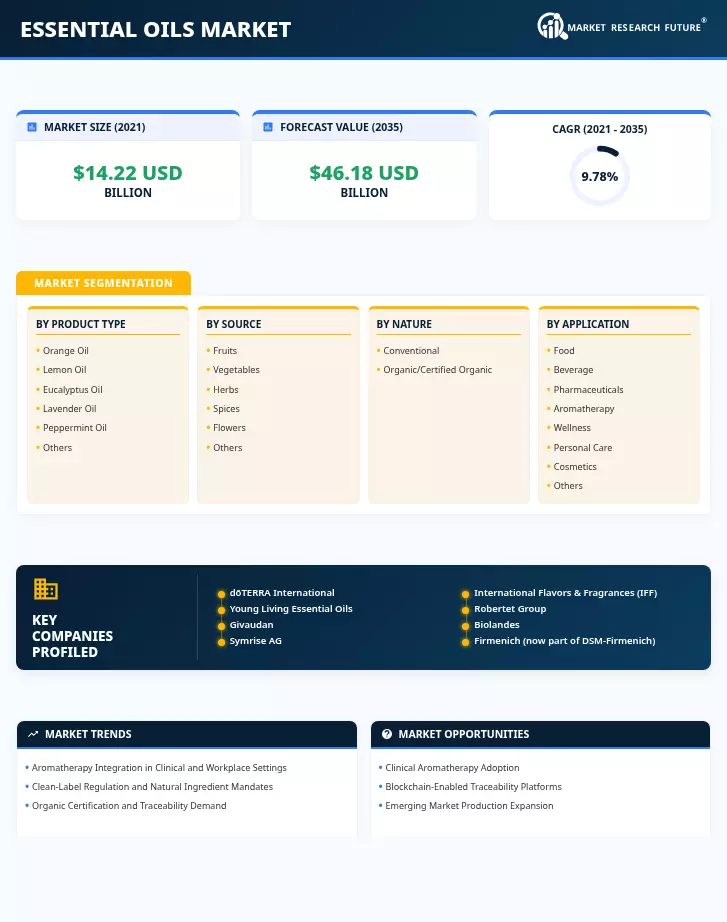
Essential Oils Market Size, Share, Industry Trend & Analysis Research Report By Product Type (Orange Oil, Lemon Oil, Eucalyptus Oil, Lavender Oil, Peppermint Oil, Others), By Source (Fruits and Vegetables, Herbs and Spices, Flowers, Others), By Nature (Conventional, Organic/Certified Organic), By Application (Food and Beverage, Pharmaceuticals, Aromatherapy and Wellness, Personal Care and Cosmetics, Others), By Geography (North America, Europe, Asia-Pacific, South America, Middle East & Africa) -Forecast to 2035
Download PDF ×

We do not share your information with anyone. However, we may send you emails based on your report interest from time to time. You may contact us at any time to opt-out.

  1. 1 Market Overview |
    1. 1.1 Study Assumptions & Market Definition |
    2. 1.2 Scope of the Study |
    3. 1.3 Research Methodology
  2. 2 Market Summary & Key Takeaways
  3. 3 Market Dynamics |
    1. 3.1 Market Drivers Analysis | |
      1. 3.1.1 Aromatherapy Integration in Clinical and Workplace Settings | |
      2. 3.1.2 Clean-Label Regulation and Natural Ingredient Mandates | |
      3. 3.1.3 Organic Certification and Traceability Demand | |
      4. 3.1.4 E-Commerce and Direct-to-Consumer Distribution | |
      5. 3.1.5 Pharmaceutical Antimicrobial Research | |
      6. 3.1.6 Personal Care and Cosmetics Reformulation | |
      7. 3.1.7 Expansion of Cold-Pressed Extraction Technology |
    2. 3.2 Market Restraints Analysis | |
      1. 3.2.1 Adulteration and Quality Control Challenges | |
      2. 3.2.2 Raw Material Price Volatility | |
      3. 3.2.3 Climate Change and Agricultural Risk | |
      4. 3.2.4 Regulatory Fragmentation Across Markets | |
      5. 3.2.5 Allergenic Risk and Safety Concerns |
    3. 3.3 Market Opportunity Analysis | |
      1. 3.3.1 Clinical Aromatherapy Adoption | |
      2. 3.3.2 Blockchain-Enabled Traceability Platforms | |
      3. 3.3.3 Emerging Market Production Expansion | |
      4. 3.3.4 AI-Powered Blending and Personalization | |
      5. 3.3.5 Functional Food and Nutraceutical Integration |
    4. 3.4 Industry Value Chain Analysis |
    5. 3.5 Porter's Five Forces Analysis
  4. 4 Global Essential Oils Market Size & Forecast (2021–2035) |
    1. 4.1 Historical Market Size (2021–2025) |
    2. 4.2 Current & Forecast Market Size (2026–2035) |
    3. 4.3 Market Size by Revenue (USD Billion) |
    4. 4.4 Year-over-Year Growth Analysis
  5. 5 Segmentation Analysis |
    1. 5.1 By Product Type | |
      1. 5.1.1 Orange Oil | |
      2. 5.1.2 Lemon Oil | |
      3. 5.1.3 Eucalyptus Oil | |
      4. 5.1.4 Lavender Oil | |
      5. 5.1.5 Peppermint Oil | |
      6. 5.1.6 Others (Tea Tree, Rosemary, Frankincense, etc.) |
    2. 5.2 By Source | |
      1. 5.2.1 Fruits and Vegetables | |
      2. 5.2.2 Herbs and Spices | |
      3. 5.2.3 Flowers | |
      4. 5.2.4 Others (Wood, Bark, Resin) |
    3. 5.3 By Nature | |
      1. 5.3.1 Conventional | |
      2. 5.3.2 Organic/Certified Organic |
    4. 5.4 By Application | |
      1. 5.4.1 Food and Beverage | |
      2. 5.4.2 Pharmaceuticals | |
      3. 5.4.3 Aromatherapy and Wellness | |
      4. 5.4.4 Personal Care and Cosmetics | |
      5. 5.4.5 Others (Home Care, Animal Care, Agriculture)
  6. 6 Regional Analysis |
    1. 6.1 North America | |
      1. 6.1.1 United States | |
      2. 6.1.2 Canada | |
      3. 6.1.3 Mexico |
    2. 6.2 Europe | |
      1. 6.2.1 Germany | |
      2. 6.2.2 United Kingdom | |
      3. 6.2.3 France | |
      4. 6.2.4 Italy | |
      5. 6.2.5 Spain | |
      6. 6.2.6 Nordic Countries | |
      7. 6.2.7 Russia | |
      8. 6.2.8 Rest of Europe |
    3. 6.3 Asia-Pacific | |
      1. 6.3.1 China | |
      2. 6.3.2 India | |
      3. 6.3.3 Japan | |
      4. 6.3.4 South Korea | |
      5. 6.3.5 ASEAN | |
      6. 6.3.6 Rest of Asia-Pacific |
    4. 6.4 South America | |
      1. 6.4.1 Brazil | |
      2. 6.4.2 Argentina | |
      3. 6.4.3 Rest of South America |
    5. 6.5 Middle East & Africa | |
      1. 6.5.1 Saudi Arabia | |
      2. 6.5.2 UAE | |
      3. 6.5.3 South Africa | |
      4. 6.5.4 Egypt | |
      5. 6.5.5 Rest of MEA
  7. 7 Competitive Landscape |
    1. 7.1 Market Share Analysis (2025) |
    2. 7.2 Competitive Benchmarking Matrix |
    3. 7.3 Company Profiles | |
      1. 7.3.1 dōTERRA International | |
      2. 7.3.2 Young Living Essential Oils | |
      3. 7.3.3 Givaudan | |
      4. 7.3.4 Symrise AG | |
      5. 7.3.5 International Flavors & Fragrances (IFF) | |
      6. 7.3.6 Robertet Group | |
      7. 7.3.7 Biolandes | |
      8. 7.3.8 dsm-firmenich | |
      9. 7.3.9 Mane SA | |
      10. 7.3.10 Plant Therapy
  8. 8 Future Outlook & Strategic Recommendations (2026–2035) |
    1. 8.1 AI-Driven Formulation and Personalization |
    2. 8.2 Sustainability and Regenerative Agriculture |
    3. 8.3 Pharmaceutical and Nutraceutical Convergence |
    4. 8.4 Digital Commerce and Supply Chain Transparency
  9. 9 Recent Developments & News
  10. 10 Frequently Asked Questions (FAQs)
  11. 11 Report Scope & Methodology |
    1. 11.1 Study Period & Base Year |
    2. 11.2 Data Sources & Citations |
    3. 11.3 Abbreviations
  12. 12 LIST OF TABLES |
  13. TABLE 1 Global Essential Oils Market Size & Forecast, by Revenue (USD Billion), 2021–2035 |
  14. TABLE 2 Global Essential Oils Market – Year-over-Year Growth Analysis, 2021–2035 |
  15. TABLE 3 Global Essential Oils Market – Driver Impact Analysis, 2026–2035 |
  16. TABLE 4 Global Essential Oils Market – Restraint Impact Analysis, 2026–2035 |
  17. TABLE 5 Global Essential Oils Market Size, by Product Type, 2021–2035 (USD Billion) |
  18. TABLE 6 Global Essential Oils Market Size, by Source, 2021–2035 (USD Billion) |
  19. TABLE 7 Global Essential Oils Market Size, by Nature, 2021–2035 (USD Billion) |
  20. TABLE 8 Global Essential Oils Market Size, by Application, 2021–2035 (USD Billion) |
  21. TABLE 9 Global Essential Oils Market Size, by Region, 2021–2035 (USD Billion) |
  22. TABLE 10 North America Essential Oils Market Size, by Country, 2021–2035 (USD Billion) |
  23. TABLE 11 Europe Essential Oils Market Size, by Country, 2021–2035 (USD Billion) |
  24. TABLE 12 Asia-Pacific Essential Oils Market Size, by Country, 2021–2035 (USD Billion) |
  25. TABLE 13 South America Essential Oils Market Size, by Country, 2021–2035 (USD Billion) |
  26. TABLE 14 Middle East & Africa Essential Oils Market Size, by Country, 2021–2035 (USD Billion) |
  27. TABLE 15 Competitive Benchmarking Matrix – Global Essential Oils Market, 2025 |
  28. TABLE 16 Company Profiles – Key Players, Global Essential Oils Market |
  29. TABLE 17 Recent Developments & Strategic Announcements, 2023–2025 |
  30. TABLE 18 Report Scope & Methodology Summary |
  31. TABLE 19 Detailed Sources and Citations
  32. 13 LIST OF FIGURES |
  33. FIGURE 1 Essential Oils Market Dynamics – Drivers, Restraints, and Opportunities |
  34. FIGURE 2 Essential Oils Industry Value Chain Analysis |
  35. FIGURE 3 Porter's Five Forces Analysis – Essential Oils Market |
  36. FIGURE 4 Global Essential Oils Market Size Trend (USD Billion), 2021–2035 |
  37. FIGURE 5 Essential Oils Market Share, by Product Type (%), 2025 |
  38. FIGURE 6 Essential Oils Market Share, by Source (%), 2025 |
  39. FIGURE 7 Essential Oils Market Share, by Nature (%), 2025 |
  40. FIGURE 8 Essential Oils Market Share, by Application (%), 2025 |
  41. FIGURE 9 Essential Oils Market Share, by Region (%), 2025 |
  42. FIGURE 10 North America Essential Oils Market – Country Share (%), 2025 |
  43. FIGURE 11 Europe Essential Oils Market – Country Share (%), 2025 |
  44. FIGURE 12 Asia-Pacific Essential Oils Market – Country Share (%), 2025 |
  45. FIGURE 13 South America Essential Oils Market – Country Share (%), 2025 |
  46. FIGURE 14 Middle East & Africa Essential Oils Market – Country Share (%), 2025 |
  47. FIGURE 15 Competitive Landscape – Market Concentration Chart, 2025 |
  48. FIGURE 16 Competitive Benchmarking Spider Chart – Top 10 Players

Segmentation Quick Reference

DimensionSub-SegmentsDominant SegmentFastest Growing Segment
Product TypeOrange Oil, Lemon Oil, Eucalyptus Oil, Lavender Oil, Peppermint Oil, OthersOrange OilEucalyptus Oil
SourceFruits and Vegetables, Herbs and Spices, Flowers, OthersFruits and VegetablesHerbs and Spices
NatureConventional, Organic/Certified OrganicConventionalOrganic/Certified Organic
ApplicationFood and Beverage, Pharmaceuticals, Aromatherapy and Wellness, Personal Care and Cosmetics, OthersFood and BeverageAromatherapy and Wellness
GeographyNorth America, Europe, Asia-Pacific, South America, Middle East & AfricaEuropeAsia-Pacific


Market Segmentation Overview

By Product Type

Sub-SegmentKey Trend
Orange OilSustained demand from beverage flavoring and eco-friendly household cleaning formulations
Lemon OilGrowing use in cosmetics preservation and food-grade antimicrobial coatings
Eucalyptus OilPost-pandemic respiratory wellness awareness is driving pharmaceutical and aromatherapy uptake.
Lavender OilClinical aromatherapy validation expanding hospital and spa procurement channels
Peppermint OilOral care innovation and therapeutic headache relief applications
OthersDiversification into tea tree, rosemary, and frankincense for specialized wellness products


Orange oil continues to lead the Essential Oils Market by product type, driven by scale economics in citrus processing and broad applicability across food, beverage, and home care categories. Eucalyptus oil is emerging as the fastest-growing product segment, benefiting from heightened consumer focus on respiratory health and expanding pharmaceutical formulation pipelines.

By Source

Sub-SegmentKey Trend
Fruits and VegetablesIndustrial-scale citrus peel processing in Brazil and the United States
Herbs and SpicesRapid expansion of mint, basil, and oregano cultivation for therapeutic applications
FlowersPremium positioning of rose, jasmine, and lavender oils in luxury fragrance and cosmetics
OthersNiche growth in sandalwood, cedarwood, and vetiver from sustainable forestry programs


Fruits and vegetables remain the dominant source category, anchored by orange and lemon oil production infrastructure. Herbs and spices represent the highest-growth source, with cold-pressed essential oil extraction and steam distillation methods optimized for volatile compound preservation.

By Nature

Sub-SegmentKey Trend
ConventionalCost-competitive processing for food-grade and industrial applications
Organic/Certified OrganicRetailer mandates and consumer premiums are driving organic essential oil certification adoption.


Conventional essential oils dominate current volumes, but organic variants are capturing disproportionate growth as retailers and brands commit to certified supply chains. Organic essential oil certification standards from USDA, EU Organic, and COSMOS are becoming prerequisites for premium shelf placement.

By Application

Sub-SegmentKey Trend
Food and BeverageNatural flavoring mandates replacing synthetic additives globally
PharmaceuticalsAntimicrobial and anti-inflammatory compound research is accelerating clinical adoption.
Aromatherapy and WellnessHospital, workplace, and home diffuser programs are expanding rapidly.
Personal Care and CosmeticsClean beauty movement redirecting formulation budgets toward botanical ingredients
OthersEmerging use in animal care, agriculture, pest management, and air purification


Food and beverage remains the largest application category, while aromatherapy and wellness are the fastest-growing, fueled by clinical validation of therapeutic-grade essential oils and broadening adoption of aromatherapy diffuser blend protocols in healthcare and corporate settings.