×
Request Free Sample ×

Kindly complete the form below to receive a free sample of this Report

Leading companies partner with us for data-driven Insights

clients tt-cursor
Hero Background

Europe Virtual Networking Market

ID: MRFR/ICT/63325-HCR
200 Pages
Aarti Dhapte
October 2025

Europe Virtual Networking Market Research Report By Technology (Software-Defined Networking, Virtual Private Network, Network Function Virtualization, Cloud Networking), By Deployment Model (Public Cloud, Private Cloud, Hybrid Cloud), By End User (Small and Medium Enterprises, Large Enterprises, Government), By Application (Data Center Virtualization, Remote Access, Disaster Recovery) and By Regional (Germany, UK, France, Russia, Italy, Spain, Rest of Europe) - Forecast to 2035

Share:
Download PDF ×

We do not share your information with anyone. However, we may send you emails based on your report interest from time to time. You may contact us at any time to opt-out.

Europe Virtual Networking Market Infographic
Purchase Options

Europe Virtual Networking Market Summary

As per MRFR analysis, the Europe virtual networking market Size was estimated at 15.09 USD Billion in 2024. The Europe virtual networking market is projected to grow from 16.48 USD Billion in 2025 to 39.62 USD Billion by 2035, exhibiting a compound annual growth rate (CAGR) of 9.17% during the forecast period 2025 - 2035.

Key Market Trends & Highlights

The Europe virtual networking market is experiencing robust growth driven by technological advancements and evolving work dynamics.

  • Germany remains the largest market for virtual networking solutions, reflecting a strong demand for enhanced connectivity.
  • The UK is emerging as the fastest-growing region, propelled by increasing investments in digital transformation initiatives.
  • There is a notable emphasis on cybersecurity enhancements as organizations prioritize the protection of their digital assets.
  • Rising adoption of cloud solutions and regulatory compliance are key drivers fueling the expansion of the virtual networking market.

Market Size & Forecast

2024 Market Size 15.09 (USD Billion)
2035 Market Size 39.62 (USD Billion)
CAGR (2025 - 2035) 9.17%

Major Players

Cisco Systems (US), VMware (US), Microsoft (US), Amazon Web Services (US), Oracle (US), Nokia (FI), Arista Networks (US), Juniper Networks (US), Hewlett Packard Enterprise (US)

Europe Virtual Networking Market Trends

The virtual networking market is currently experiencing a transformative phase, driven by advancements in technology and the increasing demand for seamless connectivity. As organizations across various sectors seek to enhance their operational efficiency, the adoption of virtual networking solutions has surged. This trend is particularly evident in Europe, where businesses are leveraging these technologies to facilitate remote work, improve collaboration, and optimize resource allocation. The integration of artificial intelligence and machine learning into networking solutions is also reshaping the landscape, enabling more intelligent and adaptive systems that can respond to changing demands in real-time. Moreover, the regulatory environment in Europe is evolving to support the growth of the virtual networking market. Initiatives aimed at enhancing digital infrastructure and promoting cybersecurity are gaining traction, which may further bolster the adoption of virtual networking solutions. As organizations navigate the complexities of digital transformation, the emphasis on secure and efficient networking solutions is likely to intensify. This environment presents both challenges and opportunities for stakeholders in the virtual networking market, as they strive to meet the diverse needs of their clients while adhering to regulatory standards.

Increased Demand for Remote Connectivity

The shift towards remote work has led to a heightened need for reliable virtual networking solutions. Organizations are increasingly investing in technologies that facilitate seamless communication and collaboration among distributed teams.

Focus on Cybersecurity Enhancements

As the reliance on virtual networking grows, so does the emphasis on cybersecurity. Companies are prioritizing secure networking solutions to protect sensitive data and maintain compliance with stringent regulations.

Integration of Advanced Technologies

The incorporation of artificial intelligence and machine learning into virtual networking solutions is becoming more prevalent. These technologies enable smarter network management and enhance overall performance, catering to the evolving needs of businesses.

Europe Virtual Networking Market Drivers

Emergence of 5G Technology

The advent of 5G technology is poised to revolutionize the virtual networking market in Europe. With its promise of ultra-fast data speeds and low latency, 5G enables more efficient and reliable virtual networking solutions. As of 2025, it is projected that 5G coverage will reach approximately 80% of urban areas in Europe, facilitating the deployment of advanced networking applications. This technological advancement not only enhances connectivity but also supports the growing demand for IoT devices and smart applications, which rely on robust virtual networking capabilities. Consequently, the virtual networking market is likely to witness substantial growth as businesses leverage 5G to optimize their operations and improve customer experiences.

Growth of Remote Work Culture

The virtual networking market is significantly impacted by the growth of remote work culture across Europe. As organizations embrace flexible work arrangements, the need for reliable virtual networking solutions becomes paramount. Recent studies indicate that around 50% of the European workforce engages in remote work, necessitating secure and efficient networking tools to facilitate collaboration and communication. This shift has led to an increased investment in virtual networking technologies, as companies seek to maintain productivity and connectivity among distributed teams. The demand for virtual private networks (VPNs) and other secure networking solutions is expected to rise, further propelling the growth of the virtual networking market in Europe.

Rising Adoption of Cloud Solutions

The virtual networking market in Europe experiences a notable surge due to the increasing adoption of cloud solutions. Organizations are migrating their operations to cloud-based platforms, which necessitates robust virtual networking capabilities. As of 2025, it is estimated that around 70% of European enterprises utilize cloud services, driving demand for virtual networking solutions that ensure seamless connectivity and data transfer. This trend is further supported by the European Union's initiatives to enhance digital infrastructure, which aim to bolster cloud adoption across various sectors. Consequently, the virtual networking market is poised for growth as businesses seek to optimize their cloud environments, enhance collaboration, and improve operational efficiency.

Regulatory Compliance and Data Privacy

In the context of the virtual networking market, regulatory compliance and data privacy concerns are increasingly influencing market dynamics in Europe. The implementation of stringent regulations, such as the General Data Protection Regulation (GDPR), compels organizations to adopt secure networking solutions that protect sensitive data. As of 2025, approximately 60% of European companies prioritize compliance with data protection laws, which drives the demand for virtual networking solutions that offer enhanced security features. This regulatory landscape not only shapes the purchasing decisions of enterprises but also encourages innovation within the virtual networking market, as providers develop solutions that align with compliance requirements while ensuring data integrity and confidentiality.

Increased Investment in Digital Transformation

The virtual networking market in Europe is experiencing a surge in investment driven by the ongoing digital transformation initiatives across various sectors. Organizations are increasingly recognizing the importance of digital technologies in enhancing operational efficiency and customer engagement. As of 2025, it is estimated that European companies will allocate over €200 billion towards digital transformation efforts, which includes upgrading their networking infrastructure. This investment trend is likely to bolster the demand for advanced virtual networking solutions that support seamless integration of digital tools and platforms. As businesses strive to remain competitive in a rapidly evolving landscape, the virtual networking market is expected to benefit from this influx of capital aimed at fostering innovation and improving connectivity.

Market Segment Insights

By Technology: Software-Defined Networking (Largest) vs. Virtual Private Network (Fastest-Growing)

In the Europe virtual networking market, Software-Defined Networking (SDN) commands a significant share due to its ability to provide flexibility and automation in network management. This segment enables organizations to efficiently allocate resources and optimize their network infrastructure, resulting in increased operational efficiency. Virtual Private Network (VPN) follows closely, gaining traction as businesses prioritize secure remote access and data protection in an increasingly digital workspace. The growth trends in this market are driven by the rising demand for flexible network solutions, particularly as remote work becomes a norm. Network Function Virtualization (NFV) also plays a key role, with organizations looking to reduce hardware dependencies and improve scalability. Simultaneously, Cloud Networking is witnessing a rise among enterprises migrating towards cloud-based solutions, ensuring enhanced collaboration and resource sharing across geographical boundaries.

Technology: Software-Defined Networking (Dominant) vs. Virtual Private Network (Emerging)

Software-Defined Networking (SDN) stands out as the dominant technology in the Europe virtual networking landscape, offering unparalleled flexibility and control over network operations. Its capability to centralize control and automate processes allows businesses to react swiftly to changing demands and improve efficiency. Conversely, Virtual Private Network (VPN) is emerging strongly, particularly in the face of increasing cybersecurity concerns. While SDN is preferred for its broad application across various industries, VPN continues to grow due to its focus on securing data transmissions and enabling secure remote access for users. This dynamic interplay between a mature dominant technology and a swiftly rising emerging segment signifies the evolving priorities of organizations in the region.

By Deployment Model: Public Cloud (Largest) vs. Hybrid Cloud (Fastest-Growing)

The deployment model segment in the Europe virtual networking market showcases a competitive distribution of market share. Public Cloud holds the largest share, driven by its scalability and cost-effectiveness. Organizations are increasingly adopting Public Cloud solutions for their flexibility and ease of access. In contrast, Hybrid Cloud is rapidly gaining traction, appealing to businesses that require both public and private environments to meet specific operational needs. Growth trends indicate a strong shift towards Hybrid Cloud solutions, reflecting a demand for enhanced security and control. Enterprises are seeking a balance between public scalability and private security, thus driving Hybrid Cloud adoption. Factors such as digital transformation, increased remote work, and regulatory compliance are further fueling the growth of Hybrid Cloud, making it a focal point for future investments.

Public Cloud (Dominant) vs. Hybrid Cloud (Emerging)

Public Cloud serves as the dominant model in the deployment landscape, characterized by its vast scalability and the ability to meet on-demand resource needs without significant upfront investment. This model appeals particularly to small and medium enterprises looking to minimize costs while accessing advanced networking technologies. Hybrid Cloud, on the other hand, is emerging as a strong contender, combining the best features of both public and private clouds. It allows organizations to maintain sensitive data securely while still leveraging public cloud services for less critical workloads. This flexibility is particularly attractive as businesses navigate the complexities of data management and regulatory requirements in a rapidly evolving digital landscape.

By End User: Large Enterprises (Largest) vs. Government (Fastest-Growing)

In the Europe virtual networking market, Large Enterprises hold a significant share, capitalizing on the need for robust, scalable solutions that support their complex infrastructures. Small and Medium Enterprises, while crucial, capture a smaller market share due to limited resources and specific requirements that are often met by tailored networking solutions. Government entities are increasingly recognizing the importance of virtual networking for enhancing operational efficiency and cybersecurity, contributing to their market presence. The growth trends in this segment are influenced by an ongoing digital transformation where both Large Enterprises and Governments prioritize investments in technology to bolster their network capabilities. Factors such as remote work, the rise of cloud services, and a heightened focus on security are driving adoption. Emerging technologies like AI and machine learning are also reshaping networking strategies, presenting opportunities for both Large Enterprises and Government bodies to innovate further.

Large Enterprises (Dominant) vs. Government (Emerging)

Large Enterprises in the Europe virtual networking market are characterized by their need for comprehensive, adaptive solutions that can handle large volumes of data and complex operations. These organizations typically benefit from substantial budgets, allowing them to implement cutting-edge technologies that enhance connectivity and efficiency. They often prioritize scalability and integration capabilities, ensuring that their networks can evolve in line with business growth and technological advancements. On the other hand, Government entities are emerging as crucial players, motivated by the need for secure and reliable infrastructures that support public services. With an increasing focus on digital transformation, Governments are investing in networking solutions that not only improve internal operations but also facilitate better service delivery to citizens.

By Application: Data Center Virtualization (Largest) vs. Remote Access (Fastest-Growing)

In the Application segment of the virtual networking market, Data Center Virtualization holds the largest share, driven by an increasing demand for efficient data management and cost-reduction strategies among enterprises. On the other hand, Remote Access is emerging as a rapidly growing segment, fueled by the rising trend of remote work and the need for seamless connectivity across diverse locations. Disaster Recovery plays a critical role in this landscape, albeit with a smaller share, as businesses prioritize data security and continuity planning. Growth trends indicate an increasing reliance on cloud-based solutions, with organizations seeking robust Disaster Recovery plans. The demand for flexible networking solutions that cater to varying operational needs underscores the evolving dynamics in this segment.

Data Center Virtualization: Dominant vs. Remote Access: Emerging

Data Center Virtualization is a dominant force in the Application segment, primarily due to its ability to optimize existing IT infrastructure and reduce operational costs. Organizations leverage virtualization to enhance scalability and improve resource allocation efficiency. This segment appeals to enterprises seeking to streamline their operations and reduce downtime. Conversely, Remote Access is an emerging segment, characterized by its rapid uptake as businesses adapt to hybrid working models. It provides employees with secure and flexible connectivity options, a necessity in today’s fast-paced environment. Both segments underscore the shift towards innovative and adaptive networking solutions, reflecting the growing need for responsive digital infrastructures.

Get more detailed insights about Europe Virtual Networking Market

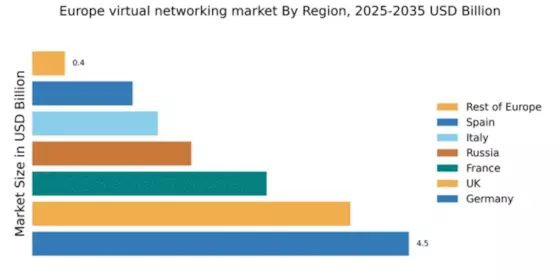
Regional Insights

Germany : Strong Infrastructure and Innovation Hub

Germany holds a commanding 4.5% market share in the virtual networking sector, driven by robust industrial growth and a strong emphasis on digital transformation. Key growth drivers include government initiatives promoting smart cities and Industry 4.0, alongside increasing demand for secure remote work solutions. The regulatory environment is supportive, with policies aimed at enhancing cybersecurity and data protection, fostering a conducive atmosphere for innovation and investment in infrastructure.

UK : Innovation and Investment at Forefront

The UK boasts a 3.8% market share in the virtual networking landscape, fueled by a surge in remote work and digital collaboration tools. Key growth drivers include significant investments in 5G infrastructure and a vibrant tech startup ecosystem. The government has introduced various initiatives to support digital innovation, including funding for tech research and development, which has positively influenced consumption patterns and demand trends across sectors.

France : Strong Government Support and Growth

France captures a 2.8% market share in the virtual networking market, bolstered by government initiatives aimed at enhancing digital infrastructure. The growth is driven by increasing demand for cloud services and remote collaboration tools, particularly in urban centers like Paris and Lyon. Regulatory policies promoting data sovereignty and cybersecurity are pivotal, creating a favorable environment for local and international players.

Russia : Regulatory Landscape and Growth Potential

Russia holds a 1.9% market share in the virtual networking sector, with growth driven by increasing internet penetration and demand for digital services. However, the market faces challenges due to regulatory restrictions and geopolitical factors. Key cities like Moscow and St. Petersburg are central to market dynamics, with local players competing alongside international giants, creating a complex competitive landscape.

Italy : Focus on Digital Transformation Initiatives

Italy's virtual networking market accounts for 1.5%, with growth fueled by a focus on digital transformation across various sectors. Government initiatives aimed at enhancing broadband access and promoting smart city projects are key drivers. The competitive landscape features both local and international players, with cities like Milan and Rome leading in demand for innovative networking solutions.

Spain : Investment in Digital Infrastructure Rising

Spain captures a 1.2% market share in the virtual networking market, driven by increasing investments in digital infrastructure and cloud services. The government has launched initiatives to support digitalization across industries, enhancing demand for virtual networking solutions. Key cities like Madrid and Barcelona are pivotal markets, with a growing presence of major players and a vibrant startup ecosystem.

Rest of Europe : Opportunities Across Multiple Nations

The Rest of Europe holds a modest 0.39% market share in the virtual networking sector, characterized by diverse market conditions and varying growth rates. Countries in this category are increasingly adopting digital solutions, driven by local government initiatives and EU regulations promoting digital transformation. The competitive landscape is fragmented, with both local and international players vying for market share in different sectors.

Europe Virtual Networking Market Regional Image

Key Players and Competitive Insights

The virtual networking market in Europe is characterized by a dynamic competitive landscape, driven by rapid technological advancements and increasing demand for seamless connectivity. Major players such as Cisco Systems (US), VMware (US), and Microsoft (US) are at the forefront, each adopting distinct strategies to enhance their market positioning. Cisco Systems (US) emphasizes innovation through its robust portfolio of networking solutions, focusing on security and cloud integration. VMware (US) is strategically investing in partnerships to bolster its hybrid cloud offerings, while Microsoft (US) leverages its Azure platform to integrate networking capabilities with its extensive software ecosystem. Collectively, these strategies contribute to a competitive environment that is increasingly focused on digital transformation and customer-centric solutions.

Key business tactics within this market include localized manufacturing and supply chain optimization, which are essential for meeting the diverse needs of European customers. The competitive structure appears moderately fragmented, with several key players exerting influence over various segments. This fragmentation allows for niche players to thrive, while larger companies consolidate their market share through strategic acquisitions and partnerships.

In October 2025, Cisco Systems (US) announced a significant partnership with a leading European telecommunications provider to enhance its 5G networking capabilities. This move is likely to strengthen Cisco's position in the rapidly evolving 5G landscape, enabling it to offer more comprehensive solutions to enterprise customers. The partnership underscores Cisco's commitment to innovation and its focus on expanding its footprint in the European market.

In September 2025, VMware (US) launched a new initiative aimed at integrating artificial intelligence (AI) into its networking solutions. This initiative is expected to enhance operational efficiency and provide customers with advanced analytics capabilities. By incorporating AI, VMware positions itself as a leader in the digital transformation space, potentially attracting a broader customer base seeking cutting-edge technology.

In August 2025, Microsoft (US) unveiled a new suite of networking tools designed to optimize cloud connectivity for businesses. This strategic move aligns with the growing trend of cloud adoption among enterprises, suggesting that Microsoft is keen on solidifying its role as a comprehensive provider of cloud-based solutions. The introduction of these tools may enhance customer loyalty and drive further adoption of Microsoft's services.

As of November 2025, current competitive trends in the virtual networking market are heavily influenced by digitalization, sustainability, and AI integration. Strategic alliances are increasingly shaping the landscape, as companies recognize the value of collaboration in driving innovation. Looking ahead, competitive differentiation is likely to evolve, with a shift from price-based competition to a focus on technological innovation and supply chain reliability. This transition may redefine how companies engage with customers, emphasizing the importance of delivering value through advanced solutions.

Key Companies in the Europe Virtual Networking Market market include

Industry Developments

The Europe Virtual Networking Market has seen significant developments recently, particularly among major players such as Oracle, Ericsson, VMware, and Microsoft. In August 2023, Oracle announced the expansion of its cloud infrastructure services in Europe, focusing on enhancing its Virtual Networking capabilities to meet the growing demand for secure and scalable networking solutions.

The European Partnership for Virtual Worlds started in July 2025 to encourage cooperation between businesses, universities, and government agencies. Its goals are to stimulate the creation of virtual worlds that are centered on people and to promote Web 4.0 innovation throughout the EU ecosystem.In early 2024, Virgin Media O2 teamed up with Hiya to improve fraud protection across its network and its MVNOs, such as Giffgaff. 

This made the European virtual networking ecosystem safer. Germany, France, and the UK are still the leaders in embracing green technologies and digital transformation. This is because the EU wants to be more environmentally friendly, which pushes virtual networking companies to come up with more environmentally friendly solutions and automation by mid-2025.

Growth in market valuations has been notable; companies like AT&T and Cisco Systems reported increased revenue attributed to growing cloud networking needs driven by digital transformation initiatives. Government initiatives supporting the digital economy in various European countries have also contributed to the accelerated adoption of virtual networking technologies, particularly in sectors such as education and healthcare, over the past two years, reflecting the demanding need for robust and flexible networking solutions in post-pandemic recovery plans.


Future Outlook

Europe Virtual Networking Market Future Outlook

The virtual networking market is projected to grow at a 9.17% CAGR from 2024 to 2035, driven by increasing demand for remote collaboration and enhanced cybersecurity solutions.

New opportunities lie in:

  • Development of AI-driven network optimization tools
  • Expansion of secure virtual private networks (VPNs) for enterprises
  • Integration of IoT devices into virtual networking solutions

By 2035, the market is expected to achieve substantial growth, reflecting evolving technological demands.

Market Segmentation

Europe Virtual Networking Market End User Outlook

  • Small and Medium Enterprises
  • Large Enterprises
  • Government

Europe Virtual Networking Market Technology Outlook

  • Software-Defined Networking
  • Virtual Private Network
  • Network Function Virtualization
  • Cloud Networking

Europe Virtual Networking Market Application Outlook

  • Data Center Virtualization
  • Remote Access
  • Disaster Recovery

Europe Virtual Networking Market Deployment Model Outlook

  • Public Cloud
  • Private Cloud
  • Hybrid Cloud

Report Scope

MARKET SIZE 2024 15.09(USD Billion)
MARKET SIZE 2025 16.48(USD Billion)
MARKET SIZE 2035 39.62(USD Billion)
COMPOUND ANNUAL GROWTH RATE (CAGR) 9.17% (2024 - 2035)
REPORT COVERAGE Revenue Forecast, Competitive Landscape, Growth Factors, and Trends
BASE YEAR 2024
Market Forecast Period 2025 - 2035
Historical Data 2019 - 2024
Market Forecast Units USD Billion
Key Companies Profiled ["Cisco Systems (US)", "VMware (US)", "Microsoft (US)", "Amazon Web Services (US)", "Oracle (US)", "Nokia (FI)", "Arista Networks (US)", "Juniper Networks (US)", "Hewlett Packard Enterprise (US)"]
Segments Covered Technology, Deployment Model, End User, Application
Key Market Opportunities Integration of advanced artificial intelligence in virtual networking platforms enhances user engagement and connectivity.

Key Market Dynamics Rising demand for secure virtual networking solutions driven by regulatory compliance and evolving cybersecurity threats in Europe.
Countries Covered Germany, UK, France, Russia, Italy, Spain, Rest of Europe

Leave a Comment

FAQs

What is the expected market size of the Europe Virtual Networking Market in 2024?

The Europe Virtual Networking Market is expected to be valued at 15.03 billion USD in 2024.

What is the projected market size of the Europe Virtual Networking Market by 2035?

By 2035, the Europe Virtual Networking Market is projected to reach a value of 52.74 billion USD.

What is the expected compound annual growth rate (CAGR) for the Europe Virtual Networking Market from 2025 to 2035?

The expected CAGR for the Europe Virtual Networking Market from 2025 to 2035 is 12.092%.

Which region is expected to dominate the Europe Virtual Networking Market in 2024?

In 2024, Germany is expected to dominate the Europe Virtual Networking Market with a valuation of 4.373 billion USD.

What is the market size for Software-Defined Networking in the Europe Virtual Networking Market in 2024?

The market size for Software-Defined Networking in 2024 is valued at 5.0 billion USD within the Europe Virtual Networking Market.

What are the projected values for Virtual Private Network technology within the market by 2035?

By 2035, the Virtual Private Network technology segment is projected to be valued at 12.3 billion USD.

Who are the major players in the Europe Virtual Networking Market?

Major players in the Europe Virtual Networking Market include Oracle, Ericsson, VMware, AT&T, and Cisco Systems.

What is the expected market value of the Europe Virtual Networking Market in Italy in 2024?

In 2024, the Europe Virtual Networking Market in Italy is expected to be valued at 1.287 billion USD.

What is the market growth potential for Network Function Virtualization in the Europe Virtual Networking Market by 2035?

The Network Function Virtualization segment is projected to grow to 10.55 billion USD by 2035.

How much is the UK market for Virtual Networking expected to be worth in 2035?

The UK market for Virtual Networking is expected to reach a value of 13.272 billion USD by 2035.

Download Free Sample

Kindly complete the form below to receive a free sample of this Report

Compare Licence

×
Features License Type
Single User Multiuser License Enterprise User
Price $4,950 $5,950 $7,250
Maximum User Access Limit 1 User Upto 10 Users Unrestricted Access Throughout the Organization
Free Customization
Direct Access to Analyst
Deliverable Format
Platform Access
Discount on Next Purchase 10% 15% 15%
Printable Versions