Download Free Sample
Kindly complete the form below to receive a free sample of this Report
Facial Makeup Market Size, Share, Industry Trend & Analysis Research Report By Product Type (Foundation, Concealer, Powder, Blush, Bronzer, Highlighter), By Application (Liquid, Cream, Powder, Stick, Cushion), By Form (Liquid, Cream, Powder, Stick, Cushion), By Coverage (Full Coverage, Medium Coverage, Light Coverage), By Finish (Matte, Satin, Dewy) and By Regional (North America, Europe, South America, Asia Pacific, Middle East and Africa) - Forecast to 2035
As per Market Research Future analysis, the Facial Makeup Market Size was estimated at 87.14 USD Billion in 2024. The Facial Makeup industry is projected to grow from 91.13 USD Billion in 2025 to 142.64 USD Billion by 2035, exhibiting a compound annual growth rate (CAGR) of 4.58% during the forecast period 2025 - 2035
The Facial Makeup Market is experiencing a dynamic shift towards clean beauty and personalization.
| 2024 Market Size | 87.14 (USD Billion) |
| 2035 Market Size | 142.64 (USD Billion) |
| CAGR (2025 - 2035) | 4.58% |
L'Oreal (FR), Estée Lauder (US), Procter & Gamble (US), Revlon (US), Shiseido (JP), Coty (US), Mary Kay (US), Avon (GB), Unilever (GB)
Our Impact
Enabled $4.3B Revenue Impact for Fortune 500 and Leading Multinationals
Partnering with 2000+ Global Organizations Each Year
30K+ Citations by Top-Tier Firms in the Industry
The Facial Makeup Market is currently experiencing a dynamic evolution, driven by shifting consumer preferences and the increasing influence of social media. As individuals seek to express their identities and enhance their appearances, the demand for diverse and innovative products continues to rise. This market encompasses a wide range of items, including foundations, concealers, blushes, and lip products, each designed to cater to various skin types and tones. The growing awareness of beauty standards and the desire for inclusivity are reshaping product offerings, prompting brands to expand their ranges to accommodate a broader audience. Furthermore, the rise of clean beauty trends is prompting consumers to seek formulations that are not only effective but also environmentally friendly and ethically sourced. In addition to these shifts, the Facial Makeup Market is witnessing a surge in online shopping, as consumers increasingly prefer the convenience of purchasing products from the comfort of their homes. This trend is further fueled by the proliferation of beauty influencers and online tutorials, which provide consumers with guidance and inspiration. As brands adapt to this digital landscape, they are investing in e-commerce platforms and social media marketing strategies to engage with their audiences more effectively. Overall, the Facial Makeup Market appears poised for continued growth, driven by innovation, inclusivity, and the evolving preferences of consumers.
The demand for clean beauty products is gaining momentum within the Facial Makeup Market. Consumers are increasingly prioritizing formulations that are free from harmful chemicals and are environmentally sustainable. This trend reflects a broader societal shift towards health-conscious choices and ethical consumption.
Social media platforms are playing a pivotal role in shaping consumer behavior in the Facial Makeup Market. The rise of beauty influencers and user-generated content is driving trends and product popularity, as consumers seek recommendations and inspiration from their online communities.
There is a growing trend towards personalization in the Facial Makeup Market, with brands offering customizable products tailored to individual preferences. This shift allows consumers to create unique looks that reflect their personal style, enhancing their overall makeup experience.
The rise of e-commerce platforms has transformed the retail landscape for the Facial Makeup Market. Online shopping offers consumers convenience and access to a wider range of products than traditional brick-and-mortar stores. Recent statistics reveal that online sales of beauty products have surged, accounting for nearly 25% of total sales in the industry. This shift towards digital shopping is particularly appealing to younger consumers, who prefer the ease of purchasing products online. As a result, brands are increasingly focusing on enhancing their online presence and optimizing their e-commerce strategies. This trend is likely to continue, further driving growth and accessibility within the Facial Makeup Market.
Celebrity endorsements play a pivotal role in shaping consumer preferences within the Facial Makeup Market. The association of well-known personalities with specific brands can significantly enhance brand visibility and credibility. Recent data indicates that products endorsed by celebrities experience a sales increase of up to 30% compared to those without such endorsements. This phenomenon is particularly pronounced among younger demographics, who are more likely to purchase products promoted by their favorite stars. As a result, brands are increasingly investing in partnerships with influencers and celebrities to leverage their reach and impact. This strategy not only boosts sales but also fosters brand loyalty among consumers in the Facial Makeup Market.
The Facial Makeup Market is witnessing a notable shift towards eco-friendly and sustainable products. Consumers are increasingly prioritizing brands that offer natural ingredients and environmentally responsible packaging. This trend is reflected in the rising sales of organic makeup products, which have seen a growth rate of approximately 10% annually. As awareness of environmental issues escalates, companies are adapting their product lines to meet this demand, thereby enhancing their market presence. The emphasis on sustainability not only appeals to environmentally conscious consumers but also positions brands favorably in a competitive market. This growing demand for eco-friendly products is likely to drive innovation and investment in sustainable practices within the Facial Makeup Market.
The Facial Makeup Market is increasingly embracing inclusivity and diversity, responding to the demand for products that cater to a wide range of skin tones and types. Brands are expanding their shade ranges and formulating products that address the unique needs of diverse consumers. This shift is not merely a trend; it reflects a broader societal movement towards representation and acceptance. Data suggests that brands that prioritize inclusivity experience higher customer loyalty and engagement. As the market evolves, companies that fail to adapt to this demand may risk losing relevance. Thus, the focus on inclusivity and diversity is likely to be a driving force in the growth of the Facial Makeup Market.
Technological advancements are revolutionizing the Facial Makeup Market, leading to the introduction of innovative products that cater to diverse consumer needs. The integration of augmented reality (AR) in makeup applications allows consumers to virtually try on products before purchasing, enhancing the shopping experience. Furthermore, advancements in formulation technology have led to the development of long-lasting and high-performance makeup products. The market for such innovative solutions is projected to grow at a compound annual growth rate of 8% over the next five years. These technological innovations not only attract tech-savvy consumers but also encourage traditional brands to adapt and evolve, thereby driving growth in the Facial Makeup Market.
The Facial Makeup Market is primarily driven by product types such as foundation, concealer, powder, blush, bronzer, and highlighter. Among these, foundation holds the largest market share, renowned for its critical role in creating a flawless base, while concealer is recognized as the fastest-growing segment, catering to an increasing demand for targeted skin perfection solutions. This distribution illustrates how consumers prioritize achieving an even skin tone while also seeking effective methods for concealing imperfections. The growth trends within this segment are largely influenced by evolving beauty standards and an uptick in makeup application tutorials on social media platforms. The rising awareness of skincare benefits in makeup products is pushing consumers towards multifunctional items, particularly in the concealer segment, thus fueling its rapid expansion. Furthermore, advancements in formula technology and diversity in shade ranges are enhancing both foundation and concealer's appeal, attracting a broader customer base with varying skin needs and preferences.
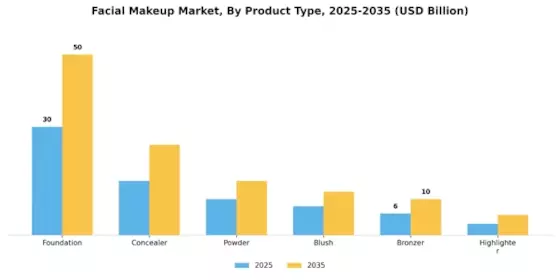
Foundation (Dominant) vs. Concealer (Emerging)
Foundation is a cornerstone product in the Facial Makeup Market, serving as the primary base for the makeup application routine. It is characterized by a wide array of formulations, including liquid, cream, and stick varieties, catering to diverse skin types and preferences. As the dominant force in the market, foundation's significance is reinforced by its ability to provide coverage and enhance skin texture, thus making it an essential makeup item for consumers. Conversely, concealer stands out as an emerging product, gaining traction for its ability to address specific concerns such as blemishes, dark circles, and redness. Its rapid growth is propelled by consumers' desire for localized skin solutions, as well as innovative formulations that offer high coverage without feeling heavy. Enhanced marketing strategies and influencer endorsements have contributed to concealer's rising popularity, positioning it as a must-have supplement to foundation in modern makeup routines.
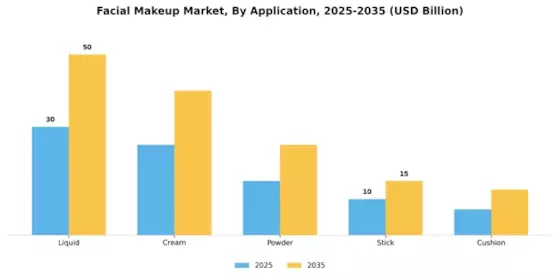
In the Facial Makeup Market, the application segment is primarily led by liquid formulations, which dominate the market share due to their versatility and ease of use. Liquid makeup products such as foundations and concealers remain popular among consumers of various demographics, driven by their ability to provide buildable coverage and hydration. Cream products follow closely behind, characterized by their creamy texture that appeals to those seeking a more moisturizing makeup option.
Liquid (Dominant) vs. Cream (Emerging)
Liquid makeup products have established themselves as the dominant force in the market, known for their wide range of shades and textures to cater to diverse skin types. They are favored for daily use due to their lightweight, breathable formulas that blend easily into the skin. On the other hand, cream formulations are gaining traction among consumers looking for products that offer a dewy finish and skincare benefits. With their rise in popularity, brands are innovating with rich pigments and nourishing ingredients, thus positioning cream makeup as an emerging favorite that competes effectively with liquid products.
In the Facial Makeup Market, the segment distribution is diverse, with Liquid Makeup currently holding the largest share. This segment appeals to consumers seeking versatility and ease of application, making it a favored choice among various demographics. Cream formulations are emerging as the fastest-growing segment, driven by their ability to provide a dewy finish and moisturizing benefits, appealing particularly to younger consumers looking for multi-functional products.
The growth trends in the Form segment are significantly influenced by changing consumer preferences and advancements in product formulations. Liquid and Cream products are reacting well to the rising demand for natural and organic ingredients, with brands innovating to incorporate such components. Additionally, the increasing trend of virtual cosmetic testing spurs growth as consumers engage with these products in digital spaces before purchasing. Companies are investing in marketing strategies to highlight these product benefits, catering to a more conscious and digitally-savvy consumer base.
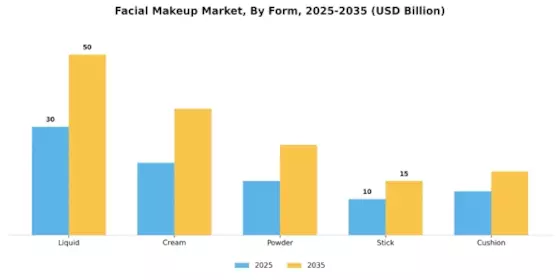
Liquid (Dominant) vs. Cream (Emerging)
Liquid makeup has established itself as a dominant force in the Facial Makeup Market, characterized by its fluid consistency and wide-ranging applications. Its versatility allows for customizable coverage, appealing to consumers across various age groups and preferences. Many brands offer innovative liquid formulations infused with skincare benefits, enhancing their appeal. On the other hand, Cream makeup is emerging rapidly, favored for its creamy texture that provides a flawless, radiant finish. This formulation is particularly popular among consumers who desire a natural look while also benefiting from added hydration. The market dynamics indicate a growing interest in Cream products, especially as they adapt to meet the demands for clean beauty and sustainability.
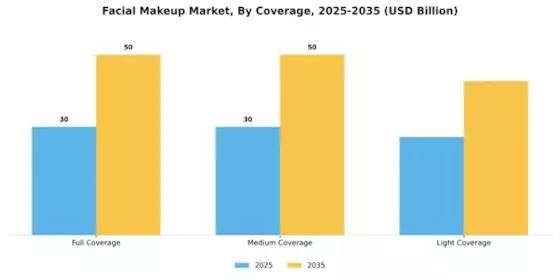
In the Facial Makeup Market, coverage types play a critical role in consumer preference, with Full Coverage standing out as the largest segment due to its ability to provide a flawless, polished look. Consumers seeking full concealing effects consistently favor this category, influencing its substantial market share. Conversely, Medium Coverage is gaining traction as a popular choice for those desiring a balance between finish and natural appearance, appealing especially to younger demographics looking for versatile, everyday makeup options.
Full Coverage: Dominant vs. Medium Coverage: Emerging
Full Coverage is characterized by its heavyweight formulation that effectively hides imperfections, offering a matte or dewy finish according to product choice. This segment is highly favored for special occasions and by those in the beauty industry due to its photogenic qualities. On the other hand, Medium Coverage is emerging as a favorite among consumers prioritizing a natural look while still achieving an even skin tone. This versatility caters to diversity in skin types and occasions, making Medium Coverage a significant trend driven by the shift towards more breathable makeup formulations that allow for skin visibility while providing coverage.
The Facial Makeup Market exhibits a diverse finish segment, primarily dominated by Matte products, appealing to consumers who favor a long-lasting, shine-free look. This segment garners significant attention, attributed to its popularity among various demographics, especially in professional settings. Satin finishes also hold a notable share, attracting those seeking balanced effects between matte and dewy looks. On the other hand, Dewy finishes are gaining traction, driven by rising trends in natural, skin-like appearances, making them increasingly appealing to younger consumers who prefer a radiant glow.
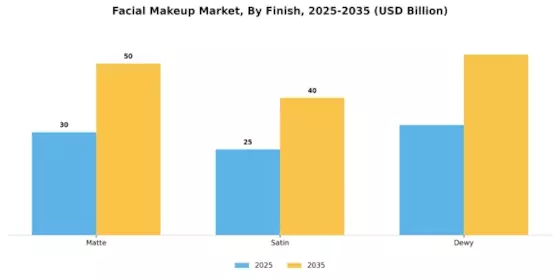
Matte (Dominant) vs. Dewy (Emerging)
Matte finishes represent the dominant force in the Facial Makeup Market, known for their ability to control shine and provide a sophisticated look. This finish is favored by individuals who want their makeup to last without the need for touch-ups, making it a staple in both everyday wear and special occasions. In contrast, Dewy finishes are emerging rapidly, resonating particularly with those seeking a fresh, hydrated appearance. This finish appeals to consumers prioritizing skincare and natural looks, contributing to its growing popularity. As brands innovate and expand their offerings, the contrast between Matte's classic appeal and Dewy's modern, youthful charm highlights the evolving dynamics within the market.
Get more detailed insights about Facial Makeup Market Request Free Sample
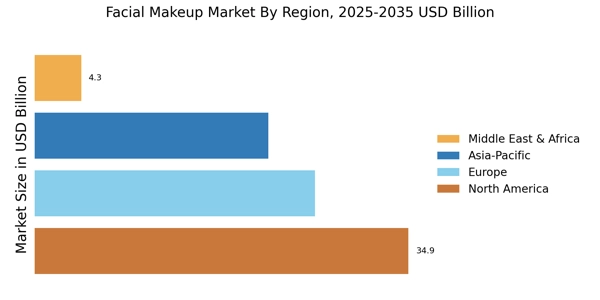
North America is the largest market for facial makeup, holding approximately 40% of the global share, driven by high consumer spending and a strong preference for premium products. The region benefits from a robust retail infrastructure and increasing demand for organic and cruelty-free products. Regulatory support for cosmetic safety and labeling further enhances market growth, with initiatives promoting transparency in ingredient sourcing. The United States and Canada are the leading countries in this region, with major players like Estée Lauder, Procter & Gamble, and Revlon dominating the landscape. The competitive environment is characterized by continuous innovation and marketing strategies targeting diverse consumer segments. The presence of e-commerce platforms has also expanded market reach, allowing brands to connect with consumers more effectively.
Europe is the second-largest market for facial makeup, accounting for around 30% of the global market share. The region's growth is fueled by increasing consumer awareness regarding product safety and sustainability, leading to a demand for high-quality, eco-friendly products. Stringent regulations, such as the EU Cosmetics Regulation, ensure that products meet safety standards, which boosts consumer confidence and drives market expansion. Leading countries in Europe include France, Germany, and the United Kingdom, where brands like L'Oreal and Coty are prominent. The competitive landscape is marked by a mix of established brands and emerging players focusing on niche markets. The rise of online retailing and social media marketing has also transformed how consumers engage with brands, enhancing market dynamics.
Asia-Pacific is witnessing rapid growth in the facial makeup market, holding approximately 25% of the global share. The region's expansion is driven by increasing disposable incomes, urbanization, and a growing middle class that is more inclined towards beauty products. Additionally, the influence of social media and beauty influencers is significantly shaping consumer preferences, leading to a surge in demand for innovative and trendy products. Key players in this region include Shiseido and local brands that cater to diverse consumer needs. Countries like China, Japan, and South Korea are at the forefront, with a competitive landscape that encourages innovation and collaboration. The market is characterized by a blend of traditional and modern beauty practices, creating unique opportunities for brands to engage with consumers.
The Middle East and Africa region is emerging as a significant player in the facial makeup market, holding about 5% of the global share. The growth is primarily driven by a young and dynamic population that is increasingly adopting beauty and personal care products. Urbanization and rising disposable incomes are also contributing to the demand for high-quality makeup products. Additionally, cultural shifts towards beauty standards are influencing purchasing behaviors in this region. Countries like the UAE and South Africa are leading the market, with a mix of international and local brands competing for consumer attention. The competitive landscape is evolving, with brands focusing on customization and inclusivity to cater to diverse consumer preferences. E-commerce is gaining traction, providing brands with new avenues to reach consumers effectively.
The Facial Makeup Market is currently characterized by a dynamic competitive landscape, driven by innovation, sustainability, and digital transformation. Major players such as L'Oreal (France), Estée Lauder (US), and Shiseido (Japan) are actively shaping the market through strategic initiatives that emphasize product differentiation and consumer engagement. L'Oreal (France) has positioned itself as a leader in sustainability, focusing on eco-friendly formulations and packaging, which resonates with the growing consumer demand for environmentally responsible products. Meanwhile, Estée Lauder (US) continues to leverage its strong brand equity and extensive distribution networks to enhance its market presence, particularly in emerging markets. Shiseido (Japan) is also making strides in digital innovation, utilizing augmented reality to enhance the consumer shopping experience, thereby reinforcing its competitive edge in the market.The business tactics employed by these companies reflect a concerted effort to optimize supply chains and localize manufacturing processes. The Facial Makeup Market appears moderately fragmented, with a mix of established brands and emerging players vying for market share. The collective influence of key players is significant, as they not only set industry standards but also drive trends that smaller companies often follow. This competitive structure fosters an environment where innovation and responsiveness to consumer preferences are paramount.
In August L'Oreal (France) announced a partnership with a leading tech firm to develop AI-driven beauty solutions that personalize makeup recommendations for consumers. This strategic move underscores L'Oreal's commitment to integrating technology into its product offerings, enhancing customer engagement and satisfaction. By leveraging AI, L'Oreal aims to create a more tailored shopping experience, which could potentially increase customer loyalty and drive sales.
In September Estée Lauder (US) launched a new line of vegan makeup products, reflecting a growing trend towards cruelty-free and sustainable beauty options. This initiative not only aligns with consumer preferences but also positions Estée Lauder as a forward-thinking brand in the competitive landscape. The introduction of vegan products may attract a broader customer base, particularly among environmentally conscious consumers, thereby enhancing the brand's market share.
In July Shiseido (Japan) expanded its digital marketing efforts by incorporating virtual try-on technology across its e-commerce platforms. This strategic action aims to enhance the online shopping experience, allowing consumers to visualize products before purchase. By investing in such technology, Shiseido is likely to improve conversion rates and customer satisfaction, which are critical in today's digital-first retail environment.
As of October the competitive trends in the Facial Makeup Market are increasingly defined by digitalization, sustainability, and the integration of advanced technologies such as AI. Strategic alliances among key players are shaping the landscape, fostering innovation and enhancing product offerings. The shift from price-based competition to a focus on technological advancement and supply chain reliability is evident, suggesting that future competitive differentiation will hinge on the ability to innovate and respond to evolving consumer demands.

The facial makeup market is expected to grow from USD 79.67 billion in 2023 to USD 119.2 billion by 2032, exhibiting a CAGR of 4.58% during the forecast period. This growth can be attributed to increasing awareness about personal grooming and rising disposable income levels. Additionally, the growing popularity of social media platforms and the influence of celebrities and beauty bloggers have further fueled the demand for facial makeup products.Recent market developments include the launch of innovative products such as multi-tasking makeup products and sustainable makeup lines.
Key market players are also focusing on expanding their product portfolios and entering new markets to gain a competitive edge. Emerging trends like the clean beauty movement and the growing demand for personalized makeup products are also shaping the market landscape.
The Facial Makeup Market is projected to grow at a 4.58% CAGR from 2025 to 2035, driven by innovation, sustainability, and changing consumer preferences.
New opportunities lie in:
By 2035, the market is expected to achieve robust growth, reflecting evolving consumer demands and technological advancements.
| MARKET SIZE 2024 | 87.14(USD Billion) |
| MARKET SIZE 2025 | 91.13(USD Billion) |
| MARKET SIZE 2035 | 142.64(USD Billion) |
| COMPOUND ANNUAL GROWTH RATE (CAGR) | 4.58% (2025 - 2035) |
| REPORT COVERAGE | Revenue Forecast, Competitive Landscape, Growth Factors, and Trends |
| BASE YEAR | 2024 |
| Market Forecast Period | 2025 - 2035 |
| Historical Data | 2019 - 2024 |
| Market Forecast Units | USD Billion |
| Key Companies Profiled | L'Oreal (FR), Estée Lauder (US), Procter & Gamble (US), Revlon (US), Shiseido (JP), Coty (US), Mary Kay (US), Avon (GB), Unilever (GB) |
| Segments Covered | Product Type, Application, Form, Coverage, Finish, Regional |
| Key Market Opportunities | Integration of sustainable ingredients and innovative formulations in the Facial Makeup Market. |
| Key Market Dynamics | Rising consumer demand for sustainable and cruelty-free facial makeup products drives innovation and competitive differentiation. |
| Countries Covered | North America, Europe, APAC, South America, MEA |
The Facial Makeup Market is valued at approximately 87.14 USD Billion in 2024.



Kindly complete the form below to receive a free sample of this Report

“This is really good guys. Excellent work on a tight deadline. I will continue to use you going forward and recommend you to others. Nice job”


“Thanks. It’s been a pleasure working with you, please use me as reference with any other Intel employees.”


“Thanks for sending the report it gives us a good global view of the Betaïne market.”


“Thank you, this will be very helpful for OQS.”


“We found the report very insightful! we found your research firm very helpful. I'm sending this email to secure our future business.”


“I am very pleased with how market segments have been defined in a relevant way for my purposes (such as "Portable Freezers & refrigerators" and "last-mile"). In general the report is well structured. Thanks very much for your efforts.”


“I have been reading the first document or the study, ,the Global HVAC and FP market report 2021 till 2026. Must say, good info! I have not gone in depth at all parts, but got a good indication of the data inside!”


“We got the report in time, we really thank you for your support in this process. I also thank to all of your team as they did a great job.”


“The Automotive 48V ECU Components Procurement Intelligence Study” was a complex project, but the Market Research Future (MRFR) team handled it with quality, agility, and customer-centricity. They delivered all requested data on time and within the agreed scope. The team, including Shubhendra Anand and Rahul Gotadki, was always readily available to clarify questions and swiftly implement necessary adjustments, driving the project to a successful conclusion within a very demanding timeframe.
I would also like to specifically commend Akshay Agarwal for his responsiveness and support at every stage—from our initial inquiry on May 6th through to final delivery on June 18th. His dedication made the entire process seamless.”


.png?v=1775475707)
