×
Request Free Sample ×

Kindly complete the form below to receive a free sample of this Report

* Please use a valid business email

Leading companies partner with us for data-driven Insights

clients tt-cursor
Hero Background

Fast Attack Craft Market

ID: MRFR/AD/3181-HCR
111 Pages
Sejal Akre
October 2025

Fast Attack Craft Market Research Report Information By Application (Missile armed FAC and Non-missile armed FAC), by End User (National Defense, Fighting, and Others), and Region (North America, Europe, Asia-Pacific, Middle East and Africa, and Latin America)-Forecast till 2035

Share:
Download PDF ×

We do not share your information with anyone. However, we may send you emails based on your report interest from time to time. You may contact us at any time to opt-out.

Fast Attack Craft Market Infographic
Purchase Options

Fast Attack Craft Market Summary

As per MRFR analysis, the Fast Attack Craft Market Size was estimated at 3.2 USD Million in 2024. The Fast Attack Craft industry is projected to grow from 3.5 in 2025 to 8.2 by 2035, exhibiting a compound annual growth rate (CAGR) of 8.89 during the forecast period 2025 - 2035.

Key Market Trends & Highlights

The Fast Attack Craft Market is poised for substantial growth driven by technological advancements and increasing maritime security concerns.

  • Technological advancements are reshaping the capabilities of fast attack crafts, enhancing their operational effectiveness.
  • North America remains the largest market, while the Asia-Pacific region is emerging as the fastest-growing area for fast attack craft.
  • The naval warfare segment dominates the market, whereas the search and rescue segment is witnessing rapid growth.
  • Increasing maritime security concerns and rising defense budgets are key drivers propelling the market forward.

Market Size & Forecast

2024 Market Size 3.2 (USD Million)
2035 Market Size 8.2 (USD Million)
CAGR (2025 - 2035) 8.89%

Major Players

Lockheed Martin (US), Northrop Grumman (US), BAE Systems (GB), ThyssenKrupp Marine Systems (DE), Navantia (ES), Huntington Ingalls Industries (US), Lürssen (DE), Fincantieri (IT), DCNS (FR)

Fast Attack Craft Market Trends

The Fast Attack Craft Market is currently experiencing a dynamic evolution, driven by various geopolitical factors and advancements in naval technology. Nations are increasingly recognizing the strategic importance of fast attack craft, which are designed for rapid response and versatile operations. These vessels are particularly valued for their agility, speed, and ability to operate in shallow waters, making them suitable for a range of missions, including coastal defense, anti-piracy, and surveillance. As regional tensions rise, the demand for such craft is likely to increase, prompting governments to invest in modernizing their naval fleets. Moreover, the integration of advanced technologies such as unmanned systems, artificial intelligence, and enhanced weaponry is reshaping the capabilities of fast attack craft. This technological infusion not only improves operational efficiency but also enhances the effectiveness of missions. The market appears poised for growth as countries seek to bolster their maritime security and maintain a competitive edge in naval warfare. The ongoing development of hybrid propulsion systems and stealth features may further influence the design and functionality of these vessels, indicating a shift towards more sophisticated naval assets in the coming years.

Technological Advancements

The Fast Attack Craft Market is witnessing a surge in technological innovations, particularly in the areas of weaponry and navigation systems. Enhanced radar capabilities and advanced missile systems are becoming standard, allowing for improved targeting and engagement in various operational scenarios. This trend suggests that manufacturers are focusing on integrating cutting-edge technologies to meet the evolving demands of modern naval warfare.

Geopolitical Influences

Geopolitical tensions across various regions are significantly impacting the Fast Attack Craft Market. Nations are increasingly investing in their naval capabilities to address potential threats and assert their presence in contested waters. This trend indicates a growing recognition of the strategic value of fast attack craft in maintaining maritime security and deterring adversaries.

Sustainability Initiatives

There is a noticeable shift towards sustainability within the Fast Attack Craft Market, with manufacturers exploring eco-friendly technologies and materials. The emphasis on reducing the environmental impact of naval operations is becoming more pronounced, suggesting that future designs may incorporate hybrid propulsion systems and sustainable practices. This trend reflects a broader commitment to environmental stewardship in military operations.

Fast Attack Craft Market Drivers

Market Growth Projections

The Global Fast Attack Craft Industry is projected to experience substantial growth over the coming years. With a market value anticipated to reach 12.5 USD Billion in 2024 and further increase to 20.3 USD Billion by 2035, the industry is poised for a robust expansion. This growth trajectory is supported by various factors, including rising defense budgets, technological advancements, and geopolitical tensions. The compound annual growth rate of 4.51% from 2025 to 2035 underscores the increasing demand for fast attack crafts as nations prioritize maritime security and modernize their naval fleets. This upward trend reflects the evolving landscape of naval warfare and the strategic importance of fast attack crafts.

Increasing Naval Defense Budgets

The Global Fast Attack Craft Industry is experiencing a surge in demand due to rising naval defense budgets across various nations. Countries are prioritizing maritime security, leading to increased investments in naval capabilities. For instance, nations like India and the United States have significantly boosted their defense spending, which is projected to reach 12.5 USD Billion in 2024. This trend indicates a growing recognition of the importance of fast attack craft in modern naval warfare, as these vessels provide agility and speed in coastal defense operations. Consequently, the Global Fast Attack Craft Industry is likely to benefit from these enhanced budgets.

Geopolitical Tensions and Maritime Security

The Global Fast Attack Craft Industry is significantly influenced by geopolitical tensions and the need for enhanced maritime security. Ongoing territorial disputes in regions such as the South China Sea and the Arctic have prompted nations to bolster their naval forces. Fast attack crafts play a crucial role in asserting territorial claims and conducting surveillance operations. As nations respond to these challenges, the demand for fast attack crafts is expected to rise, driven by the need for rapid response capabilities. This dynamic environment suggests that the Global Fast Attack Craft Industry will continue to expand in response to evolving security threats.

Technological Advancements in Naval Warfare

Technological innovations are reshaping the Global Fast Attack Craft Industry, enhancing the capabilities of these vessels. Advancements in stealth technology, weapon systems, and communication systems are making fast attack crafts more effective in combat scenarios. For example, the integration of advanced radar and missile systems allows for precision strikes and improved situational awareness. As nations seek to modernize their fleets, the demand for technologically advanced fast attack crafts is expected to rise. This trend is likely to contribute to the market's growth, with projections indicating a market value of 20.3 USD Billion by 2035, reflecting the increasing reliance on sophisticated naval assets.

Emerging Markets and Regional Naval Developments

Emerging markets are playing a pivotal role in the Global Fast Attack Craft Industry, as nations in Asia, the Middle East, and Africa invest in their naval capabilities. Countries such as Vietnam and Saudi Arabia are expanding their fleets, recognizing the strategic importance of fast attack crafts in regional security. This trend is expected to contribute to a compound annual growth rate of 4.51% from 2025 to 2035, as these nations seek to modernize their naval forces. The growing interest in fast attack crafts among emerging economies indicates a shift in global naval dynamics, further propelling the market's expansion.

Growing Demand for Asymmetric Warfare Capabilities

The Global Fast Attack Craft Industry is witnessing an increased focus on asymmetric warfare capabilities, which are essential for modern naval operations. Fast attack crafts are particularly suited for unconventional warfare, allowing smaller nations to challenge larger naval forces effectively. This trend is evident in regions where smaller states are investing in fast attack crafts to enhance their maritime defense strategies. The ability of these vessels to conduct hit-and-run tactics and engage in guerrilla warfare makes them valuable assets. As a result, the market is likely to see sustained growth, driven by the strategic advantages offered by fast attack crafts.
Market Segment Insights

By Application: Naval Warfare (Largest) vs. Search and Rescue (Fastest-Growing)

The Fast Attack Craft Market is significantly shaped by various applications, each with unique contributions to the overall landscape. Among these applications, Naval Warfare stands out as the largest segment, commanding a substantial share. Comparatively, the Search and Rescue segment is emerging as the fastest-growing area, driven by an increasing need for rapid response during emergencies and disasters. Coastal Patrol, Counter-Terrorism, and Surveillance follow as important contributors, evolving to meet the diverse challenges in the maritime domain.

Naval Warfare: Dominant vs. Search and Rescue: Emerging

Naval Warfare remains the dominant application within the Fast Attack Craft Market, characterized by advanced combat capabilities and strategic importance in maritime defense. These vessels are optimized for speed and agility, allowing for quick strike operations against threats. Conversely, the Search and Rescue segment, while emerging, is gaining momentum due to rising maritime activity and heightened awareness of safety and rescue operations. Fast Attack Crafts designed for this purpose are equipped with sonar, medical facilities, and rapid deployment features, making them essential for saving lives at sea. This growing recognition of the need for emergency response capabilities propels Search and Rescue into a prominent position.

By End Use: Military (Largest) vs. Coast Guard (Fastest-Growing)

The Fast Attack Craft market showcases a diverse array of end-use segments, with the Military sector representing the largest share. This segment is heavily invested in advanced naval capabilities, reflecting the strategic importance of fast attack vessels in modern warfare. Meanwhile, the Coast Guard segment is gaining traction, driven by increasing maritime security needs and national regulations aimed at safeguarding coastal waters and resources. Growth trends in this market segment are largely influenced by geopolitical tensions and the rising importance of maritime law enforcement. Paramilitary organizations are also advancing their capabilities, while demand from Private Security firms reflects a growing trend towards non-state actors utilizing fast attack craft for operational efficiency. Research Institutions contribute by developing innovative technologies to enhance performance and adaptability in diverse missions.

Military: Dominant vs. Coast Guard: Emerging

The Military segment stands out as the dominant force in the Fast Attack Craft market, characterized by significant investment in high-tech naval vessels equipped for various combat situations. This segment emphasizes speed, stealth, and flexibility, meeting the operational needs of modern naval warfare. In contrast, the Coast Guard sector represents an emerging player, increasingly adopting fast attack crafts to enhance their capabilities in patrolling and protecting territorial waters. The growing focus on maritime security and anti-smuggling operations drives this segment's development. Coast Guard fast attack crafts are typically equipped with surveillance technologies and can operate efficiently in a variety of scenarios, establishing themselves as crucial assets for national security.

By Propulsion Type: Internal Combustion Engine (Largest) vs. Gas Turbine (Fastest-Growing)

The propulsion type segment in the Fast Attack Craft Market is characterized by diverse technologies, with Internal Combustion Engine (ICE) systems holding the largest market share. This dominance is attributed to their reliability, efficiency, and long-standing presence in military operations. Gas Turbines, while less common, have garnered a notable share due to their high power-to-weight ratio and application in modern naval vessels, thus reflecting a growing trend towards this propulsion method. The trend in propulsion technologies indicates a progressive shift towards more advanced systems. Gas Turbines are recognized as the fastest-growing segment, driven by advancements in design and efficiency, making them suitable for high-speed operations and responsive maneuvers. Furthermore, the introduction and integration of Hybrid and Electric Propulsion systems signifies the industry's focus on reducing emissions and achieving greater operational flexibility, reshaping the market landscape.

Gas Turbine (Dominant) vs. Hybrid Propulsion (Emerging)

Gas Turbine propulsion systems currently exhibit dominance in the Fast Attack Craft Market due to their unparalleled speed and agility in naval warfare. Their advanced engineering allows for rapid acceleration and high maneuverability, factors essential for tactical operations. In contrast, Hybrid Propulsion systems represent an emerging segment, offering a blend of traditional and modern technology. These systems are gaining traction due to their operational versatility and reduced environmental impact, making them appealing for future naval contracts. As energy efficiency becomes increasingly relevant, Hybrid systems are gradually being favored for missions requiring stealth and reduced operational costs, enhancing their attractiveness in the competitive market.

By Material Type: Aluminum (Largest) vs. Composite Materials (Fastest-Growing)

The Fast Attack Craft Market shows a multifaceted distribution of material types, with aluminum taking the lead as the largest segment. Renowned for its lightweight yet robust characteristics, aluminum is preferred for many manufacturers looking to enhance speed and agility. Meanwhile, composite materials are emerging with significant momentum, attracting attention due to their advanced properties such as resistance to corrosion and reduced weight. This shift towards composites points to evolving preferences in naval engineering aimed at optimizing performance in challenging maritime conditions. Growth trends within the material type segment are driven by innovations in manufacturing processes and material science. The increasing emphasis on fuel efficiency and sustainability is steering manufacturers toward high-performance composite materials. Additionally, advancements in technology have enabled the production of composites that meet stringent military standards, making them an appealing choice for fast attack crafts. The dynamic interplay between traditional materials like aluminum and modern composites is shaping the future landscape of this market.

Aluminum (Dominant) vs. Steel (Emerging)

Aluminum holds a significant position as the dominant material in the Fast Attack Craft Market, attributed to its favorable strength-to-weight ratio, which significantly enhances speed and operational efficiency. Its resistance to marine corrosion adds to its longevity and reduces maintenance costs, making it a cost-effective choice for naval architecture. Conversely, steel is viewed as an emerging option due to its durability and ease of repair, appealing to military applications where robustness is critical. While it may not provide the same weight advantages as aluminum, innovations in steel technology, such as high-strength variants, are gaining traction. This makes the comparison interesting as both materials vie for market share amidst evolving naval demands.

By Size Class: Small (Largest) vs. Medium (Fastest-Growing)

In the Fast Attack Craft Market, the distribution of size class segments reveals that the Small size class holds the largest market share, owing to its versatility and operational efficiency. Small craft are predominantly utilized in coastal defense and asymmetric warfare, capturing a significant portion of procurement budgets. Meanwhile, the Medium size class is rapidly gaining traction, reflecting a growing inclination towards crafts that balance firepower, maneuverability, and range. This segment is particularly appealing to navies modernizing their fleets and seeking effective solutions for extended operational capabilities.

Small (Dominant) vs. Medium (Emerging)

The Small size class of fast attack crafts is characterized by its agility and ease of deployment, making it a favored choice for patrol and surveillance missions. These crafts are often equipped with advanced weaponry and surveillance systems, enabling them to adapt swiftly to various operational demands. Conversely, the Medium size class represents an emerging segment, steadily rising in popularity due to its enhanced capabilities. Medium crafts typically offer better armament, increased crew capacity, and extended operational range compared to their smaller counterparts, appealing to a broader range of naval operations, including anti-surface and anti-air roles.

Get more detailed insights about Fast Attack Craft Market

Regional Insights

North America : Defense Innovation and Investment

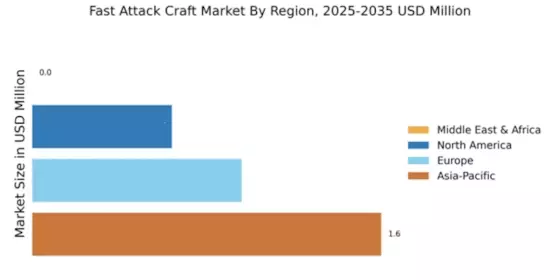
The North American Fast Attack Craft market is poised for growth, driven by increased defense budgets and a focus on naval capabilities. With a market size of $0.64 billion, the region is witnessing a surge in demand for advanced maritime security solutions. Regulatory support and partnerships with defense contractors are further catalyzing this growth, as nations prioritize modernization of their naval fleets to address emerging threats. The United States leads the North American market, with key players like Lockheed Martin and Northrop Grumman spearheading innovation. The competitive landscape is characterized by significant investments in R&D and collaborations with government agencies. As the region focuses on enhancing its maritime defense capabilities, the presence of established firms ensures a robust supply chain and technological advancement in Fast Attack Craft production.

Europe : Strategic Naval Developments

Europe's Fast Attack Craft market, valued at $0.96 billion, is experiencing significant growth due to geopolitical tensions and the need for enhanced maritime security. Countries are investing in modern naval fleets, driven by regulatory frameworks that emphasize defense readiness. The region's focus on collaborative defense initiatives and joint exercises is also a key growth driver, as nations seek to bolster their naval capabilities in response to evolving threats. Leading countries such as the UK, Germany, and France are at the forefront of this market, with companies like BAE Systems and ThyssenKrupp Marine Systems playing pivotal roles. The competitive landscape is marked by innovation and strategic partnerships, ensuring that European nations remain competitive in The Fast Attack Craft. As the region prioritizes defense spending, the demand for advanced naval vessels is expected to rise significantly.

Asia-Pacific : Emerging Market Leader

The Asia-Pacific region is the largest market for Fast Attack Craft, with a market size of $1.6 billion. This growth is fueled by rising defense budgets, territorial disputes, and a focus on enhancing naval capabilities. Countries in this region are increasingly investing in advanced maritime technologies, supported by government initiatives aimed at strengthening national security and maritime sovereignty. The demand for Fast Attack Craft is expected to continue rising as nations prioritize their naval modernization efforts. China, India, and Japan are leading players in this market, with significant investments in indigenous shipbuilding programs. The competitive landscape is characterized by a mix of established defense contractors and emerging players, ensuring a dynamic market environment. Key companies like Lürssen and Fincantieri are also expanding their presence in the region, contributing to the overall growth of the Fast Attack Craft market.

Middle East and Africa : Untapped Potential

The Middle East and Africa region currently shows minimal activity in the Fast Attack Craft market, with a market size of $0.0 billion. However, there is significant potential for growth as countries in this region begin to recognize the importance of maritime security. Factors such as geopolitical tensions and the need for enhanced naval capabilities are driving interest in Fast Attack Craft. As nations prioritize defense spending, the market is expected to evolve, albeit slowly, in the coming years. Countries like Saudi Arabia and South Africa are beginning to invest in naval capabilities, with a focus on acquiring advanced maritime vessels. The competitive landscape is still developing, with few established players in the region. However, as defense budgets increase and partnerships with global defense contractors strengthen, the Fast Attack Craft market in the Middle East and Africa is likely to see gradual growth in the future.

Key Players and Competitive Insights

The Fast Attack Craft Market is characterized by a dynamic competitive landscape, driven by technological advancements, increasing defense budgets, and the rising need for maritime security. Key players such as Lockheed Martin (US), BAE Systems (GB), and ThyssenKrupp Marine Systems (DE) are strategically positioned to leverage innovation and regional expansion. Lockheed Martin (US) focuses on integrating advanced technologies into its craft, enhancing operational capabilities. BAE Systems (GB) emphasizes partnerships with regional navies to tailor solutions that meet specific operational requirements, while ThyssenKrupp Marine Systems (DE) is investing in digital transformation to optimize its manufacturing processes and product offerings. Collectively, these strategies shape a competitive environment that is increasingly focused on technological superiority and customer-centric solutions.

In terms of business tactics, companies are localizing manufacturing to reduce costs and enhance supply chain resilience. The market appears moderately fragmented, with several players vying for market share, yet the influence of major companies remains substantial. This competitive structure allows for a diverse range of offerings, catering to various naval requirements across different regions.

In November 2025, Lockheed Martin (US) announced a partnership with a Southeast Asian nation to develop a new class of fast attack craft, aimed at enhancing regional maritime security. This strategic move not only underscores Lockheed Martin's commitment to innovation but also reflects a growing trend of nations seeking advanced naval capabilities to address emerging threats. The collaboration is expected to bolster the local defense industry while providing Lockheed Martin with a foothold in a strategically important region.

In October 2025, BAE Systems (GB) secured a contract with the Royal Navy to upgrade its existing fleet of fast attack craft, focusing on integrating cutting-edge surveillance and combat systems. This initiative highlights BAE's strategy of enhancing the operational effectiveness of current assets rather than solely pursuing new builds. Such upgrades are crucial in maintaining a competitive edge in an evolving threat landscape, ensuring that existing platforms remain relevant and capable.

In September 2025, ThyssenKrupp Marine Systems (DE) launched a new digital platform aimed at streamlining the design and production processes of fast attack craft. This initiative is indicative of the broader trend towards digitalization within the defense sector, allowing for greater efficiency and reduced time-to-market for new vessels. By embracing digital tools, ThyssenKrupp positions itself as a forward-thinking player in the market, likely enhancing its competitive standing.

As of December 2025, current trends in the Fast Attack Craft Market are increasingly defined by digitalization, sustainability, and the integration of artificial intelligence (AI) into naval operations. Strategic alliances are becoming more prevalent, as companies recognize the need to collaborate to enhance technological capabilities and market reach. Looking ahead, competitive differentiation is expected to evolve, shifting from price-based competition to a focus on innovation, advanced technology, and supply chain reliability. This transition may redefine how companies approach market entry and product development, emphasizing the importance of agility and responsiveness to changing defense needs.

Key Companies in the Fast Attack Craft Market market include

Industry Developments

  • On 29 August 2012, KRIKlewang (model number X3K) was launched by PT Lundin for the Indonesian Navy.

Future Outlook

Fast Attack Craft Market Future Outlook

The Fast Attack Craft Market is projected to grow at an 8.89% CAGR from 2024 to 2035, driven by technological advancements, increasing defense budgets, and rising maritime threats.

New opportunities lie in:

  • Development of advanced stealth technologies for enhanced operational capabilities.
  • Integration of unmanned systems for improved reconnaissance and combat efficiency.
  • Expansion into emerging markets with tailored fast attack craft solutions.

By 2035, the Fast Attack Craft Market is expected to be robust, reflecting substantial growth and innovation.

Market Segmentation

Fast Attack Craft Market End Use Outlook

  • Military
  • Paramilitary
  • Coast Guard
  • Private Security
  • Research Institutions

Fast Attack Craft Market Size Class Outlook

  • Small
  • Medium
  • Large
  • Extra Large
  • Micro

Fast Attack Craft Market Application Outlook

  • Naval Warfare
  • Coastal Patrol
  • Counter-Terrorism
  • Search and Rescue
  • Surveillance

Fast Attack Craft Market Material Type Outlook

  • Aluminum
  • Steel
  • Composite Materials
  • Fiberglass
  • Carbon Fiber

Fast Attack Craft Market Propulsion Type Outlook

  • Internal Combustion Engine
  • Gas Turbine
  • Hybrid Propulsion
  • Electric Propulsion
  • Nuclear Propulsion

Report Scope

MARKET SIZE 20243.2(USD Million)
MARKET SIZE 20253.5(USD Million)
MARKET SIZE 20358.2(USD Million)
COMPOUND ANNUAL GROWTH RATE (CAGR)8.89% (2024 - 2035)
REPORT COVERAGERevenue Forecast, Competitive Landscape, Growth Factors, and Trends
BASE YEAR2024
Market Forecast Period2025 - 2035
Historical Data2019 - 2024
Market Forecast UnitsUSD Million
Key Companies ProfiledLockheed Martin (US), Northrop Grumman (US), BAE Systems (GB), ThyssenKrupp Marine Systems (DE), Navantia (ES), Huntington Ingalls Industries (US), Lürssen (DE), Fincantieri (IT), DCNS (FR)
Segments CoveredApplication, End Use, Propulsion Type, Material Type, Size Class
Key Market OpportunitiesIntegration of advanced surveillance systems enhances operational capabilities in the Fast Attack Craft Market.
Key Market DynamicsRising demand for advanced surveillance capabilities drives innovation in Fast Attack Craft design and technology.
Countries CoveredNorth America, Europe, APAC, South America, MEA

Market Highlights

Author
Sejal Akre
Senior Research Analyst

She has over 5 years of rich experience, in market research and consulting providing valuable market insights to client. Hands on expertise in management consulting, and extensive knowledge in domain including ICT, Automotive & Transportation and Aerospace & Defense. She is skilled in Go-to market strategy, industry analysis, market sizing, in depth company profiling, competitive intelligence & benchmarking and value chain amongst others.

Leave a Comment

FAQs

Fast Attack Craft Market is anticipated to procure what CAGR during the review period?

Fast Attack Craft Market is anticipated to procure a CAGR of 4.51% by2035

What are the key applications covered in the report?

The market has been segmented by missile armed FAC and non-missile armed FAC missile-armed FAC, in terms of applications.

What share in the global Fast Attack Craft Market did North America own in 2018?

In 2018, the Fast Attack Craft Market was led by North America with 36.68% share.

Why is APAC a lucrative Fast Attack Craft Market?

APAC is a lucrative market for the companies that offer naval laser defense eyewear firms, due to the modernization of naval systems and rising demand from countries such as China, India, Japan, and South Korea.

Who are the top Fast Attack Craft Market end-users?

The top Fast Attack Craft Market end-users are National Defense, Fighting, and more.

Download Free Sample

Kindly complete the form below to receive a free sample of this Report

Compare Licence

×
Features License Type
Single User Multiuser License Enterprise User
Price $4,950 $5,950 $7,250
Maximum User Access Limit 1 User Upto 10 Users Unrestricted Access Throughout the Organization
Free Customization
Direct Access to Analyst
Deliverable Format
Platform Access
Discount on Next Purchase 10% 15% 15%
Printable Versions