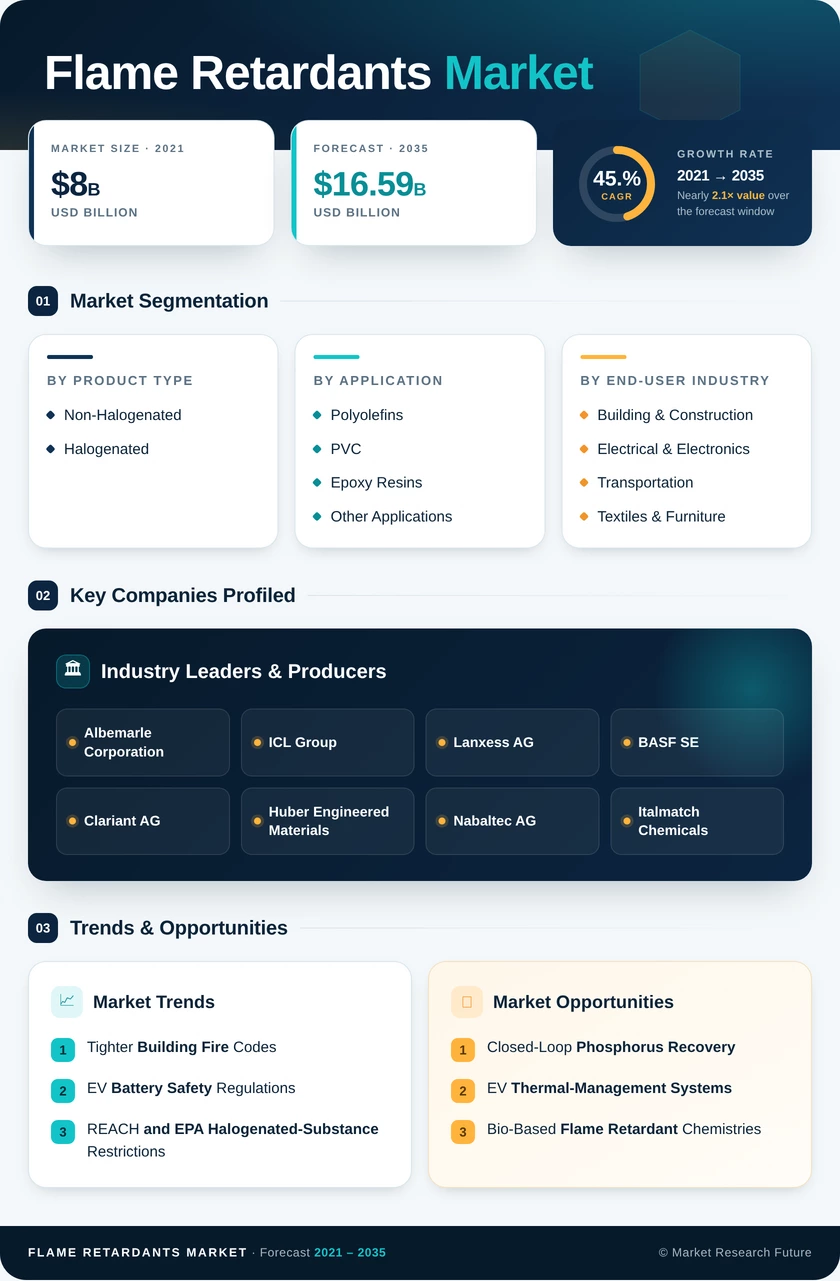
Segmentation Quick Reference
| Dimension | Sub-Segments | Dominant Segment | Fastest Growing Segment |
| By Product Type | Non-Halogenated, Halogenated | Non-Halogenated (69.6% share, 2025) | Non-Halogenated (CAGR 5.56%) |
| By Application | Polyolefins, PVC, Epoxy Resins, Other Applications | Polyolefins (USD 3.88B, 2025) | Epoxy Resins (CAGR 5.48%) |
| By End-User Industry | Building & Flame Retardants Market, Electrical & Electronics, Transportation, Textiles & Furniture | Building & Flame Retardants Market (37.0% share, 2025) | Electrical & Electronics (CAGR 5.66%) |
| By Geography | Asia-Pacific, Europe, North America, South America, Middle East & Africa | Asia-Pacific (47.1% share, 2025) | Asia-Pacific (CAGR 6.09%) |
Market Segmentation Overview
By Product Type
| Sub-Segment | Key Trend |
| Non-Halogenated | Regulatory mandates driving substitution from brominated and chlorinated systems; ATH and phosphorus-based chemistries dominate |
| Halogenated | Retained in cost-sensitive commodity polymer applications facing phase-out pressure in the EU and select US states. |
Non-halogenated flame retardants encompass a broad chemistry portfolio — aluminum hydroxide, magnesium hydroxide, phosphorus esters, melamine derivatives, and nitrogen synergists. Regulatory restrictions on halogenated compounds continue to shift procurement patterns across all major end-user industries, making this the structurally faster-growing product-type segment through 2035.
By Application
| Sub-Segment | Key Trend |
| Polyolefins | High mineral-filler loadings for cable insulation and automotive wire harnesses drive the largest volume base. |
| PVC | Stable demand in construction piping, flooring, and flexible films |
| Epoxy Resins | Rapid expansion in 5G PCB laminates and aerospace composite prepregs |
| Other Applications | Includes polyurethane foam insulation, engineering thermoplastics, and elastomers |
Polyolefin applications consume the highest tonnage of flame retardants due to the sheer volume of polyethylene and polypropylene processed globally for wire-and-cable and packaging end uses. Epoxy resins, while smaller in volume terms, represent the highest-growth application driven by electronics miniaturization and advanced composite adoption.
By End-User Industry
| Sub-Segment | Key Trend |
| Building & Flame Retardants Market | Code-driven demand for flame-retardant insulation, cladding, and cable management systems |
| Electrical & Electronics | 5G infrastructure, data centers, and EV power electronics drive premium-grade additive demand |
| Transportation | Automotive lightweighting composites and EV battery enclosures expand the addressable market. |
| Textiles & Furniture | Contract-furnishing fire codes and personal protective equipment standards to sustain demand. |
Building and construction remains the largest end-user segment, supported by global infrastructure spending and post-disaster fire-code tightening. Electrical and electronics are positioned for the strongest growth trajectory as digitalization and electrification accelerate demand for high-performance, UL-certified additive systems across the forecast period.
By Geography
| Sub-Segment | Key Trend |
| Asia-Pacific | Manufacturing density, infrastructure of mega-projects, and EV production underpin the dominant position. |
| Europe | Strictest regulatory environment globally; CPR and REACH drive non-halogenated adoption |
| North America | Data-center construction boom and IBC code cycles support steady growth. |
| South America | Social housing programs and industrial expansion create emerging demand. |
| Middle East & Africa | Vision 2030 mega-projects and urbanization open new market corridors |
Asia-Pacific commands nearly half of global flame-retardant consumption, led by China's enormous polymer-processing base and India's accelerating industrialization. Europe and North America remain in high-value markets where regulatory complexity drives product premiums and innovation investment across the value chain.