Flexible Hybrid Electronics Market

ID: MRFR/SEM/22555-HCR
100 Pages
Aarti Dhapte
Last Updated: June 17, 2026
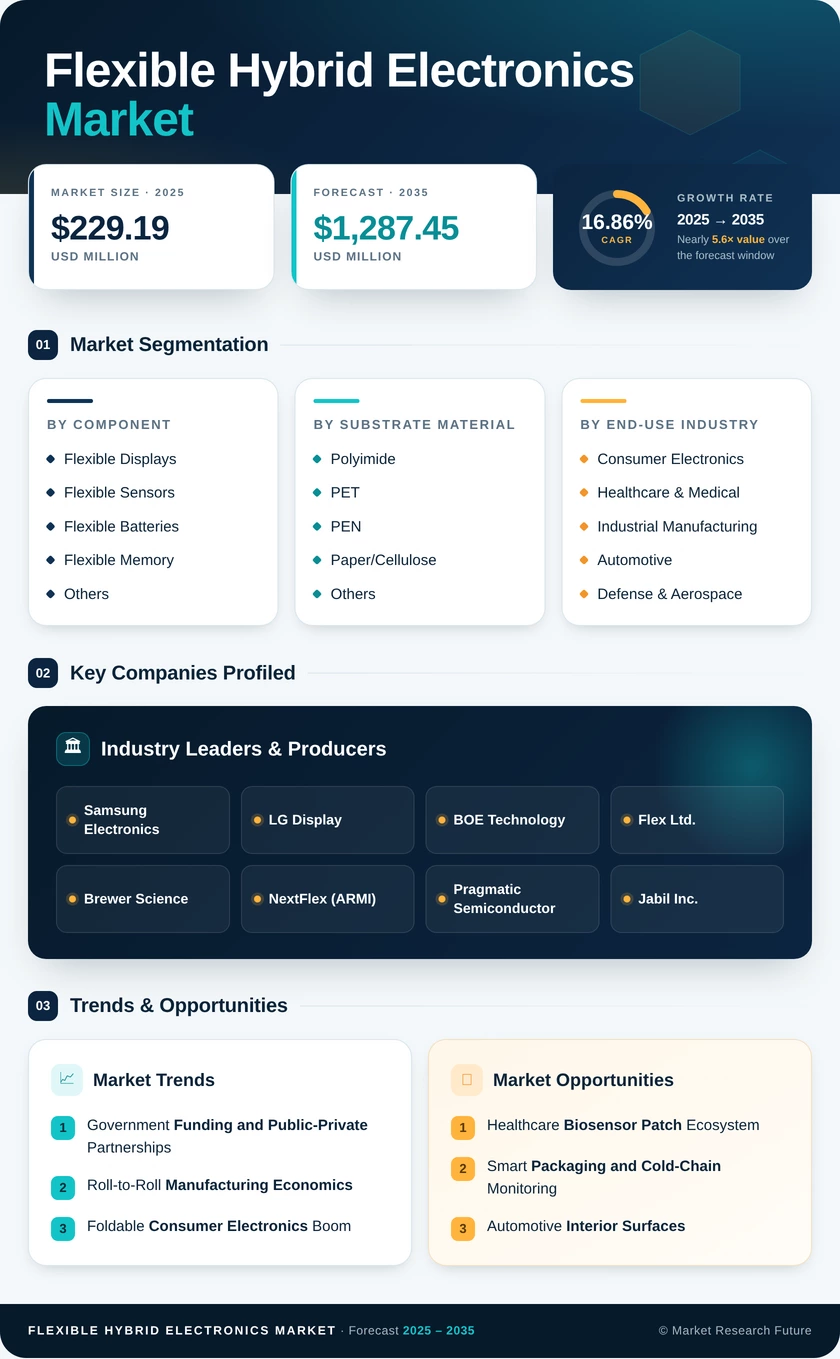
Flexible Hybrid Electronics Market Size, Share and Research Report By Component (Flexible Displays, Flexible Sensors, Flexible Batteries, Flexible Memory, Others), By Substrate Material (Polyimide, PET, PEN, Paper/Cellulose, Others), By End-Use Industry (Consumer Electronics, Healthcare & Medical, Industrial Manufacturing, Automotive, Defense & Aerospace, Others), By Manufacturing Process (Sheet-to-Sheet (S2S), Roll-to-Roll (R2R), Transfer Printing, Others) and By Region (North America, Europe, South America, Asia Pacific, Middle East and Africa) - Industry Forecast to 2035.
Download PDF ×

We do not share your information with anyone. However, we may send you emails based on your report interest from time to time. You may contact us at any time to opt-out.

  1. 1 Market Overview
  2. 1 Study Assumptions & Market Definition
  3. 2 Scope of the Study
  4. 3 Research Methodology
  5. 2 Market Summary & Key Takeaways
  6. 3 Market Size and Forecast (2021–2035)
  7. 1 Historical Market Size (2021–2025)
  8. 2 Current & Forecast Market Size (2026–2035)
  9. 3 Market Size by Revenue (USD Million)
  10. 4 Year-over-Year Growth Analysis
  11. 4 Driver Impact Analysis
  12. 1 Government Funding and Public-Private Partnerships
  13. 2 Roll-to-Roll Manufacturing Economics
  14. 3 Foldable Consumer Electronics Boom
  15. 4 Medical Wearable Sensor Proliferation
  16. 5 Restraints Impact Analysis
  17. 1 Flex-Life Reliability Challenges
  18. 2 Tooling and Substrate Qualification Barriers
  19. 3 Standardization Gaps
  20. 6 Opportunities
  21. 1 Healthcare Biosensor Patch Ecosystem
  22. 2 Smart Packaging and Cold-Chain Monitoring
  23. 3 Automotive Interior Surfaces
  24. 4 Emerging-Market Manufacturing Hubs
  25. 5 Foundry-as-a-Service Business Models
  26. 7 Regional Market Share and Country-Level Analysis
  27. 1 North America |
    1. 1.1 United States |
    2. 1.2 Canada |
    3. 1.3 Mexico
  28. 2 Europe |
    1. 2.1 Germany |
    2. 2.2 United Kingdom |
    3. 2.3 France |
    4. 2.4 Italy |
    5. 2.5 Spain |
    6. 2.6 Nordic Countries |
    7. 2.7 Russia |
    8. 2.8 Rest of Europe
  29. 3 Asia-Pacific |
    1. 3.1 China |
    2. 3.2 India |
    3. 3.3 Japan |
    4. 3.4 South Korea |
    5. 3.5 ASEAN |
    6. 3.6 Rest of Asia-Pacific
  30. 4 South America |
    1. 4.1 Brazil |
    2. 4.2 Argentina |
    3. 4.3 Rest of South America
  31. 5 Middle East & Africa |
    1. 5.1 Saudi Arabia |
    2. 5.2 UAE |
    3. 5.3 South Africa |
    4. 5.4 Egypt |
    5. 5.5 Rest of MEA
  32. 8 Future Outlook (2026–2035)
  33. 1 AI-Driven Sensor Fusion and Edge Intelligence
  34. 2 Platform Economics and Open-Access Foundries
  35. 3 Sustainability-Driven Substrate Innovation
  36. 4 Electrification and Automotive Integration Supercycle
  37. 9 Market Segmentation Analysis
  38. 1 By Component |
    1. 1.1 Flexible Displays |
    2. 1.2 Flexible Sensors |
    3. 1.3 Flexible Batteries |
    4. 1.4 Flexible Memory |
    5. 1.5 Others
  39. 2 By Substrate Material |
    1. 2.1 Polyimide |
    2. 2.2 PET |
    3. 2.3 PEN |
    4. 2.4 Paper/Cellulose |
    5. 2.5 Others
  40. 3 By End-Use Industry |
    1. 3.1 Consumer Electronics |
    2. 3.2 Healthcare & Medical |
    3. 3.3 Industrial Manufacturing |
    4. 3.4 Automotive |
    5. 3.5 Defense & Aerospace |
    6. 3.6 Others
  41. 4 By Manufacturing Process |
    1. 4.1 Sheet-to-Sheet (S2S) |
    2. 4.2 Roll-to-Roll (R2R) |
    3. 4.3 Transfer Printing |
    4. 4.4 Others
  42. 10 Competitive Landscape
  43. 1 Market Share Analysis (2025)
  44. 2 Competitive Benchmarking Matrix
  45. 3 Company Profiles |
    1. 3.1 Samsung Electronics |
    2. 3.2 LG Display |
    3. 3.3 BOE Technology |
    4. 3.4 Flex Ltd. |
    5. 3.5 Brewer Science |
    6. 3.6 NextFlex (ARMI) |
    7. 3.7 Pragmatic Semiconductor |
    8. 3.8 Jabil Inc. |
    9. 3.9 Cambrios Advanced Materials |
    10. 3.10 Enfucell Oy
  46. 11 Recent News & Developments
  47. 12 Report Scope & Methodology
  48. 1 Study Period & Base Year
  49. 2 Data Sources & Citations
  50. 3 Abbreviations
  51. 13 Detailed Sources and Citations
  52. 14 Frequently Asked Questions (FAQs)
  53. 4 LIST OF TABLES |
  54. TABLE 1 Global Flexible Hybrid Electronics Market Size & Forecast, by Revenue (USD Million), 2021–2035 |
  55. TABLE 2 Global Flexible Hybrid Electronics Market – Year-over-Year Growth Analysis, 2021–2035 |
  56. TABLE 3 Driver Impact Analysis – Flexible Hybrid Electronics Market |
  57. TABLE 4 Restraints Impact Analysis – Flexible Hybrid Electronics Market |
  58. TABLE 5 Regional Market Share Summary – Flexible Hybrid Electronics Market, 2025 |
  59. TABLE 6 North America Flexible Hybrid Electronics Market Size, by Country, 2021–2035 (USD Million) |
  60. TABLE 7 Europe Flexible Hybrid Electronics Market Size, by Country, 2021–2035 (USD Million) |
  61. TABLE 8 Asia-Pacific Flexible Hybrid Electronics Market Size, by Country, 2021–2035 (USD Million) |
  62. TABLE 9 South America Flexible Hybrid Electronics Market Size, by Country, 2021–2035 (USD Million) |
  63. TABLE 10 Middle East & Africa Flexible Hybrid Electronics Market Size, by Country, 2021–2035 (USD Million) |
  64. TABLE 11 Global Flexible Hybrid Electronics Market Size, by Component, 2021–2035 (USD Million) |
  65. TABLE 12 Global Flexible Hybrid Electronics Market Size, by Substrate Material, 2021–2035 (USD Million) |
  66. TABLE 13 Global Flexible Hybrid Electronics Market Size, by End-Use Industry, 2021–2035 (USD Million) |
  67. TABLE 14 Global Flexible Hybrid Electronics Market Size, by Manufacturing Process, 2021–2035 (USD Million) |
  68. TABLE 15 Competitive Benchmarking Matrix – Flexible Hybrid Electronics Market, 2025 |
  69. TABLE 16 Company Profiles – Key Players, Flexible Hybrid Electronics Market |
  70. TABLE 17 Recent Developments & Strategic Announcements, 2023–2025 |
  71. TABLE 18 Report Scope & Methodology Summary |
  72. TABLE 19 Detailed Sources and Citations
  73. 5 LIST OF FIGURES |
  74. FIGURE 1 Flexible Hybrid Electronics Market Dynamics – Drivers, Restraints, and Opportunities |
  75. FIGURE 2 Industry Value Chain Analysis – Flexible Hybrid Electronics Market |
  76. FIGURE 3 Porter's Five Forces Analysis – Flexible Hybrid Electronics Market |
  77. FIGURE 4 Global Flexible Hybrid Electronics Market Size Trend (USD Million), 2021–2035 |
  78. FIGURE 5 Flexible Hybrid Electronics Market Share, by Component, 2025 |
  79. FIGURE 6 Flexible Hybrid Electronics Market Share, by Substrate Material, 2025 |
  80. FIGURE 7 Flexible Hybrid Electronics Market Share, by End-Use Industry, 2025 |
  81. FIGURE 8 Flexible Hybrid Electronics Market Share, by Manufacturing Process, 2025 |
  82. FIGURE 9 Flexible Hybrid Electronics Market Share, by Region, 2025 |
  83. FIGURE 10 North America Flexible Hybrid Electronics Market Share, by Country, 2025 |
  84. FIGURE 11 Europe Flexible Hybrid Electronics Market Share, by Country, 2025 |
  85. FIGURE 12 Asia-Pacific Flexible Hybrid Electronics Market Share, by Country, 2025 |
  86. FIGURE 13 South America Flexible Hybrid Electronics Market Share, by Country, 2025 |
  87. FIGURE 14 Middle East & Africa Flexible Hybrid Electronics Market Share, by Country, 2025 |
  88. FIGURE 15 Competitive Landscape – Market Share Analysis, Flexible Hybrid Electronics Market, 2025

Segmentation Quick Reference

DimensionSub-SegmentsDominant SegmentFastest Growing Segment
ComponentFlexible Displays, Flexible Sensors, Flexible Batteries, Flexible Memory, OthersFlexible DisplaysFlexible Memory
Substrate MaterialPolyimide, PET, PEN, Paper/Cellulose, OthersPolyimidePaper/Cellulose
End-Use IndustryConsumer Electronics, Healthcare & Medical, Industrial Manufacturing, Automotive, Defense & Aerospace, OthersConsumer ElectronicsAutomotive
Manufacturing ProcessSheet-to-Sheet (S2S), Roll-to-Roll (R2R), Transfer Printing, OthersSheet-to-Sheet (S2S)Roll-to-Roll (R2R)


Market Segmentation Overview

By Component

Sub-SegmentKey Trend
Flexible DisplaysOLED foldable panel demand is expanding into laptops and automotive dashboards
Flexible SensorsMulti-analyte biosensor patches for continuous health monitoring
Flexible BatteriesThin-film printed batteries enabling standalone wearable power
Flexible MemoryEmbedded non-volatile storage for edge-AI data buffering
OthersFlexible antennas, connectors, and passive components for IoT devices


Flexible displays lead component-level revenue as foldable smartphone shipments accelerate and automotive OEMs adopt curved digital cockpit surfaces. Flexible sensors represent the highest-growth opportunity, driven by regulatory clearances for medical-grade biosensor patches.

By Substrate Material

Sub-SegmentKey Trend
PolyimideIndustry standard for high-temperature, high-reliability applications
PETCost-effective substrate for consumer packaging and disposable sensors
PENSuperior optical clarity for display backplane applications
Paper/CelluloseSustainable alternative driven by the EU single-use plastics regulation
OthersSilicone elastomers and textile substrates for stretchable applications


Polyimide retains its dominant share due to unmatched thermal and chemical stability. Paper and cellulose substrates are gaining traction as sustainability mandates and circular-economy requirements push electronics manufacturers toward recyclable form factors.

By End-Use Industry

Sub-SegmentKey Trend
Consumer ElectronicsFoldable devices and next-gen wearables are driving component pull
Healthcare & MedicalFDA-cleared biosensor patches enabling decentralized clinical trials
Industrial ManufacturingStructural health monitoring via embedded flex sensor arrays
AutomotiveSoftware-defined cabin interiors with touch-sensitive curved surfaces
Defense & AerospaceSoldier-worn systems and conformal antenna arrays
OthersSmart packaging, precision agriculture, and environmental monitoring


Consumer electronics anchors current demand through foldable smartphones and smartwatch sensor integration. Healthcare is the fastest-growing end-use sector as remote patient monitoring reimbursement pathways expand globally.

By Manufacturing Process

Sub-SegmentKey Trend
Sheet-to-Sheet (S2S)Established process for high-mix, lower-volume production runs
Roll-to-Roll (R2R)Continuous-web processing delivering 3–5× throughput advantages
Transfer PrintingEnabling heterogeneous integration of micro-scale silicon die
OthersAerosol jet and inkjet direct-write for rapid prototyping


Sheet-to-sheet processing holds the largest installed base, but R2R is closing the gap as yield improvements and inline inspection advances make continuous-web fabrication viable for multi-layer hybrid assemblies.