Download Free Sample
Kindly complete the form below to receive a free sample of this Report
France Hydrocephalus Market Research Report: Size, Share, Trend Analysis By Types (Congenital Hydrocephalus, Acquired Hydrocephalus, Normal-Pressure Hydrocephalus, Ex-Vacuo Hydrocephalus), By Diagnostic (CT scan – head, MRI, Head Ultrasound), By Treatment (Surgery – Shunt Insertion, Ventriculostomy, Medication), and By End-user (Hospitals & Clinics, Diagnostic Centres, Academic Institutions, Research Organizations) - Growth Outlook & Industry Forecast 2025 To 2035
As per Market Research Future analysis, the France Hydrocephalus Market size was estimated at 25.7 USD Million in 2024. The Hydrocephalus market is projected to grow from 27.23 USD Million in 2025 to 48.5 USD Million by 2035, exhibiting a compound annual growth rate (CAGR) of 5.9% during the forecast period 2025 - 2035
The France hydrocephalus market is experiencing notable growth driven by technological advancements and increased awareness.
| 2024 Market Size | 25.7 (USD Million) |
| 2035 Market Size | 48.5 (USD Million) |
| CAGR (2025 - 2035) | 5.94% |
Medtronic (US), Johnson & Johnson (US), Stryker (US), B. Braun Melsungen AG (DE), Integra LifeSciences (US), Codman Neuro (US), Natus Medical Incorporated (US), NeuroPace (US)
Our Impact
Enabled $4.3B Revenue Impact for Fortune 500 and Leading Multinationals
Partnering with 2000+ Global Organizations Each Year
30K+ Citations by Top-Tier Firms in the Industry
The France Hydrocephalus Market in France is currently experiencing notable developments, driven by advancements in medical technology and increasing awareness of neurological disorders. The prevalence of hydrocephalus, a condition characterized by the accumulation of cerebrospinal fluid in the brain, has prompted healthcare providers to seek innovative treatment options. This has led to a rise in the demand for shunt systems and endoscopic procedures, which are becoming more widely adopted in clinical settings. Furthermore, the French healthcare system's emphasis on improving patient outcomes is likely to foster further growth in this sector. In addition, the collaboration between healthcare professionals and research institutions appears to be enhancing the understanding of hydrocephalus, potentially leading to improved diagnostic and therapeutic strategies. The integration of telemedicine and digital health solutions may also play a role in transforming patient management, making it more efficient and accessible. As the hydrocephalus market evolves, stakeholders must remain vigilant to emerging trends and adapt to the changing landscape to ensure optimal care for patients.
Recent innovations in surgical techniques and devices are reshaping the hydrocephalus market. Minimally invasive procedures and advanced shunt systems are gaining traction, offering improved patient outcomes and reduced recovery times. This trend indicates a shift towards more effective management of the condition.
There is a growing emphasis on raising awareness about hydrocephalus among healthcare professionals and the general public. Educational initiatives are being implemented to inform stakeholders about the condition, its symptoms, and treatment options. This trend is likely to enhance early diagnosis and intervention.
The hydrocephalus market is witnessing a shift towards patient-centric approaches in treatment and management. Healthcare providers are increasingly prioritizing personalized care plans that consider individual patient needs and preferences, which may lead to improved satisfaction and outcomes.
The hydrocephalus market in France is experiencing growth due to the increasing incidence of hydrocephalus among various age groups. Recent data indicates that approximately 1 in 1,000 births are affected by this condition, leading to a heightened demand for effective treatment options. As the population ages, the prevalence of idiopathic normal pressure hydrocephalus (iNPH) is also on the rise, particularly among the elderly. This demographic shift is likely to drive the hydrocephalus market, as healthcare providers seek innovative solutions to manage and treat this condition. Furthermore, the French healthcare system is adapting to these trends by allocating more resources towards research and development, which may further enhance the availability of advanced treatment modalities.
The hydrocephalus market is significantly influenced by advancements in medical technology. Innovations in neurosurgical techniques, such as minimally invasive procedures and improved shunt systems, are enhancing treatment efficacy and patient safety. For instance, the introduction of programmable shunts has revolutionized the management of hydrocephalus, allowing for personalized treatment adjustments. The market for these advanced devices is projected to grow at a CAGR of 7% over the next five years in France. As healthcare providers increasingly adopt these technologies, the hydrocephalus market is likely to expand, driven by the demand for more effective and less invasive treatment options.
Government initiatives in France are playing a crucial role in shaping the hydrocephalus market. Increased funding for neurological research and healthcare programs is evident, with the French government investing approximately €50 million annually in neurological disorders. This financial support is aimed at improving diagnostic tools and treatment options for hydrocephalus patients. Additionally, public health campaigns are being launched to raise awareness about the condition, which may lead to earlier diagnosis and intervention. Such initiatives not only enhance patient outcomes but also stimulate market growth by encouraging pharmaceutical and medical device companies to innovate and expand their product offerings in the hydrocephalus market.
The emergence of patient advocacy and support groups in France is fostering a more informed patient population regarding hydrocephalus. These organizations are instrumental in providing resources, education, and emotional support to patients and their families. By raising awareness about the condition, they are likely to encourage more individuals to seek medical attention, thereby increasing the patient base for the hydrocephalus market. Furthermore, these groups often collaborate with healthcare professionals to promote research and development initiatives, which may lead to the introduction of new therapies and treatment options. This collaborative effort is expected to enhance the overall landscape of the hydrocephalus market.
The hydrocephalus market is benefiting from increased collaboration between research institutions and the pharmaceutical industry in France. Such partnerships are fostering innovation and accelerating the development of new therapies. For example, joint research initiatives are focusing on understanding the underlying mechanisms of hydrocephalus, which may lead to the discovery of novel treatment targets. Additionally, these collaborations often result in clinical trials that provide valuable data on the safety and efficacy of new interventions. As a result, the hydrocephalus market is likely to see a surge in new product launches and treatment options, driven by these collaborative efforts.
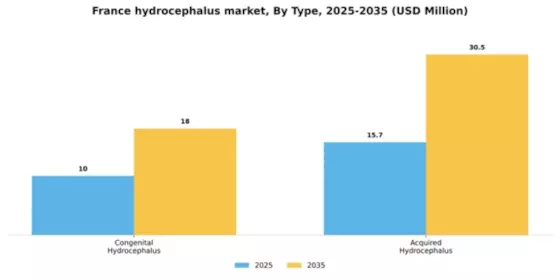
In the France hydrocephalus market, Congenital Hydrocephalus holds the largest share, significantly impacting the overall market. Its prevalence among infants and children has made it a focal point for healthcare providers and researchers alike. In contrast, Acquired Hydrocephalus is emerging rapidly, capturing attention due to its link with neurodegenerative diseases and traumatic injuries. This duality between the two segments underlines the diverse demographic challenges associated with hydrocephalus. Growth trends in this segment indicate a shift towards advanced diagnostic and therapeutic techniques, propelling both Congenital and Acquired Hydrocephalus. The increasing awareness and availability of healthcare resources, particularly for Acquired Hydrocephalus, are driving its growth. Additionally, as the population ages and survival rates increase for individuals with congenital forms, the demand for comprehensive care solutions remains robust, influencing market dynamics significantly.
Congenital Hydrocephalus (Dominant) vs. Acquired Hydrocephalus (Emerging)
Congenital Hydrocephalus remains a dominant force within the market due to its established presence, primarily affecting children. This condition demands ongoing medical attention and intervention, ensuring that it stays at the forefront of healthcare priorities. On the other hand, Acquired Hydrocephalus, while currently an emerging segment, is gaining traction due to rising incidences linked to increasing neurotrauma cases and other health conditions in adults. As awareness grows, coupled with advancements in treatment options, this segment is expected to expand significantly. Both segments are crucial as they require tailored treatment protocols; thus, their ongoing evolution is indicative of broader trends in neurological healthcare.
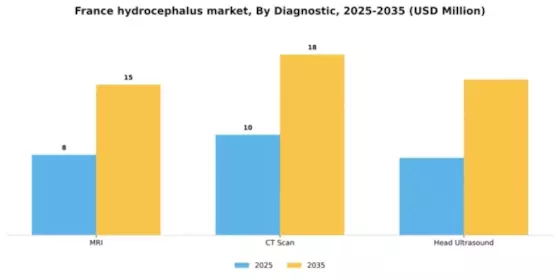
In the France hydrocephalus market, the diagnostic segment is largely driven by MRI, which holds the largest market share among diagnostic methods due to its high accuracy and non-invasive nature. Following MRI, CT Scan and Head Ultrasound are also important but have a comparatively smaller share in the overall market. As healthcare providers seek precise diagnostics for hydrocephalus, MRI is increasingly becoming the preferred choice for clinicians across the nation. The growth trends in this segment highlight a significant shift towards advanced imaging techniques like CT Scans, which are gaining popularity for their speed and efficiency in emergency situations. The demand for Head Ultrasound is emerging steadily as a preferred choice for infants and young children owing to its safety profile. The evolving technological landscape and a growing awareness among healthcare professionals are establishing a robust demand for these diagnostic tools.
MRI (Dominant) vs. Head Ultrasound (Emerging)
MRI and Head Ultrasound serve different market needs in the diagnostic segment. MRI is recognized as the dominant modality due to its unparalleled sensitivity in detecting brain anomalies associated with hydrocephalus, making it indispensable for accurate diagnosis. It offers detailed imaging of soft tissues, and its prevalence in pediatric cases further solidifies its position in the healthcare system. On the other hand, Head Ultrasound is emerging as an effective, safe, and cost-efficient diagnostic tool, particularly in neonatal units. Its non-invasive nature and zero radiation exposure make it increasingly appealing, catering to the unique requirements of pediatric patients, and positioning it as a viable alternative to more invasive imaging methods.
In the surgery segment, the Shunt Insertion Procedure represents the largest share of market activities, demonstrating the established preference among hospitals and clinics for this successful treatment option. Ventriculostomy, while currently holding a smaller but significant share, is rapidly gaining traction due to its advantages in specific patient profiles, driven by increased awareness and referrals from specialists. The growth trends in this segment indicate a shift towards more minimally invasive procedures, with the Shunt Insertion Procedure maintaining its dominance. By contrast, Ventriculostomy is recognized as the fastest-growing option, primarily due to advancements in technology and techniques, which enhance recovery times and reduce complications. The emphasis on patient outcomes and operational efficiency further supports these trends.
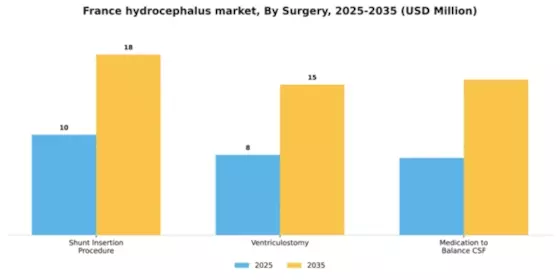
Shunt Insertion Procedure (Dominant) vs. Ventriculostomy (Emerging)
The Shunt Insertion Procedure is well-established within the market, characterized by its robust clinical support and extensive usage in hydrocephalus treatment plans. Its dominant position is underpinned by a proven efficacy in managing cerebrospinal fluid (CSF) dynamics. Conversely, Ventriculostomy is emerging with increased popularity as it presents a less invasive alternative with promising outcomes for certain patient demographics. The rise of Ventriculostomy is attributed to its ability to address hydrocephalus with lower complication rates, alongside growing acceptance in academic and clinical settings. Both procedures cater to the evolving needs of healthcare providers and patients, balancing efficacy with safety.
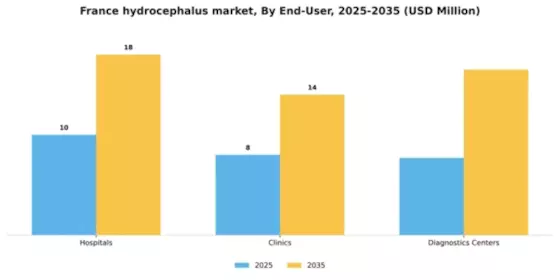
In the France hydrocephalus market, hospitals hold the largest share, providing essential services and advanced treatments for patients with hydrocephalus. The robust infrastructure and comprehensive care capabilities of hospitals allow them to cater to a significant volume of patients, thereby enhancing their market position. In contrast, clinics, while smaller in market share, are rapidly growing due to their accessibility and specialized care, reflecting a shift towards outpatient services. The growth trends in this segment are driven by increasing awareness about hydrocephalus and advancements in diagnostic technologies. As more patients seek timely interventions, clinics are becoming more prominent, providing a cost-effective alternative for diagnosis and management. Additionally, the integration of telemedicine in clinics is enhancing patient access, making them a crucial player in the overall healthcare landscape, thereby contributing to their accelerating growth rate.
Hospitals (Dominant) vs. Clinics (Emerging)
Hospitals are a dominant force in the France hydrocephalus market, characterized by their extensive resources and multidisciplinary teams that ensure comprehensive care for hydrocephalus patients. They typically offer a wide range of services, including surgical interventions, diagnostic imaging, and postoperative management, making them a preferred choice for complex cases. On the other hand, clinics represent an emerging segment, providing targeted care with a focus on early diagnosis and management of hydrocephalus. Their nimble structure allows clinics to adapt quickly to evolving patient needs, often incorporating innovative treatment protocols and technologies. This adaptability, coupled with personalized patient care, positions clinics as formidable competitors in the healthcare sector, aiming to capture a growing share of patients seeking alternatives to hospital-based treatment.
Get more detailed insights about France Hydrocephalus Market Request Free Sample
The hydrocephalus market exhibits a competitive landscape characterized by a blend of innovation, strategic partnerships, and regional expansion. Key players such as Medtronic (US), Johnson & Johnson (US), and Stryker (US) are at the forefront, leveraging their extensive research capabilities and established market presence to drive growth. Medtronic (US) focuses on enhancing its product portfolio through technological advancements, while Johnson & Johnson (US) emphasizes strategic acquisitions to bolster its market share. Stryker (US) appears to be concentrating on expanding its operational footprint in Europe, which may enhance its competitive positioning in the hydrocephalus segment. Collectively, these strategies contribute to a dynamic environment where innovation and strategic alignment are paramount.In terms of business tactics, companies are increasingly localizing manufacturing to reduce costs and improve supply chain efficiency. The hydrocephalus market is moderately fragmented, with several players vying for market share. This fragmentation allows for a diverse range of products and solutions, yet the influence of major players remains significant, as they set industry standards and drive technological advancements.
In October Medtronic (US) announced the launch of a new programmable valve designed to improve patient outcomes in hydrocephalus management. This innovation is expected to enhance the precision of cerebrospinal fluid management, potentially leading to better patient compliance and reduced hospital visits. Such advancements not only reinforce Medtronic's commitment to innovation but also position the company as a leader in the hydrocephalus market.
In September Johnson & Johnson (US) completed the acquisition of a European-based neurotechnology firm specializing in minimally invasive surgical solutions. This strategic move is likely to expand Johnson & Johnson's product offerings and enhance its competitive edge in the hydrocephalus market. By integrating advanced technologies, the company may improve surgical outcomes and patient experiences, thereby solidifying its market position.
In August Stryker (US) entered into a partnership with a leading research institution to develop AI-driven solutions for hydrocephalus diagnosis and treatment. This collaboration aims to harness the power of artificial intelligence to enhance diagnostic accuracy and treatment personalization. Such initiatives reflect a broader trend towards digitalization in the healthcare sector, indicating Stryker's commitment to staying at the forefront of technological advancements.
As of November the hydrocephalus market is increasingly defined by trends such as digitalization, sustainability, and the integration of AI technologies. Strategic alliances among key players are shaping the competitive landscape, fostering innovation and enhancing product offerings. Moving forward, competitive differentiation is likely to evolve from traditional price-based competition to a focus on technological innovation, supply chain reliability, and enhanced patient outcomes. This shift underscores the importance of adaptability and forward-thinking strategies in navigating the complexities of the hydrocephalus market.




Recent developments in the France Hydrocephalus Market indicate a significant focus on technological advancements and product innovation. Companies such as Medtronic and Stryker are expanding their portfolios to include more effective products aimed at treating hydrocephalus, thereby enhancing patient outcomes.
Notable current affairs include the ongoing collaboration among medical institutions and these companies to improve treatment protocols and patient care strategies. In July 2023, Integra LifeSciences announced the acquisition of a specialized hydrocephalus device line, which is expected to strengthen its market presence in France.
Additionally, there has been a notable increase in research funding from the French government aimed at supporting innovative treatments and improving diagnosis techniques for hydrocephalus. The market valuation for major companies like Boston Scientific and Johnson and Johnson has also seen positive growth, reflecting an increased demand for hydrocephalus treatment options.
Moreover, the past couple of years have seen a surge in partnerships among industry stakeholders to develop advanced devices, contributing to an evolving landscape in the French hydrocephalus market. This strategic alignment among key players is vital for addressing the growing prevalence of hydrocephalus in France.
The Hydrocephalus Market in France is projected to grow at a 5.94% CAGR from 2025 to 2035, driven by advancements in treatment technologies and increasing awareness.
New opportunities lie in:
By 2035, the hydrocephalus market is expected to achieve substantial growth and innovation.
| MARKET SIZE 2024 | 25.7(USD Million) |
| MARKET SIZE 2025 | 27.23(USD Million) |
| MARKET SIZE 2035 | 48.5(USD Million) |
| COMPOUND ANNUAL GROWTH RATE (CAGR) | 5.94% (2025 - 2035) |
| REPORT COVERAGE | Revenue Forecast, Competitive Landscape, Growth Factors, and Trends |
| BASE YEAR | 2024 |
| Market Forecast Period | 2025 - 2035 |
| Historical Data | 2019 - 2024 |
| Market Forecast Units | USD Million |
| Key Companies Profiled | Medtronic (US), Johnson & Johnson (US), Stryker (US), B. Braun Melsungen AG (DE), Integra LifeSciences (US), Codman Neuro (US), Natus Medical Incorporated (US), NeuroPace (US) |
| Segments Covered | Type, Diagnostic, Surgery, End-User |
| Key Market Opportunities | Advancements in minimally invasive surgical techniques enhance treatment options in the hydrocephalus market. |
| Key Market Dynamics | Rising demand for innovative treatment options drives competitive dynamics in the hydrocephalus market. |
| Countries Covered | France |
The overall market valuation was $25.7 Million in 2024.
The projected valuation for 2035 is $48.5 Million.
The expected CAGR during the forecast period 2025 - 2035 is 5.94%.
Key players include Medtronic, Johnson & Johnson, Stryker, B. Braun Melsungen AG, Integra LifeSciences, Codman Neuro, Natus Medical Incorporated, and NeuroPace.
The market segments by type include Congenital Hydrocephalus valued at $10.0 - $18.0 Million and Acquired Hydrocephalus valued at $15.7 - $30.5 Million.
Diagnostic methods include MRI valued at $8.0 - $15.0 Million, CT Scan at $10.0 - $18.0 Million, and Head Ultrasound at $7.7 - $15.5 Million.
Surgical procedures include Shunt Insertion valued at $10.0 - $18.0 Million, Ventriculostomy at $8.0 - $15.0 Million, and Medication to Balance CSF at $7.7 - $15.5 Million.
End-user segments include Hospitals valued at $10.0 - $18.0 Million, Clinics at $8.0 - $14.0 Million, and Diagnostics Centers at $7.7 - $16.5 Million.
While specific comparisons are not provided, the growth trajectory in France appears promising with a projected valuation increase.
Factors influencing growth may include advancements in medical technology, increased awareness, and the rising prevalence of hydrocephalus.



Kindly complete the form below to receive a free sample of this Report

“This is really good guys. Excellent work on a tight deadline. I will continue to use you going forward and recommend you to others. Nice job”


“Thanks. It’s been a pleasure working with you, please use me as reference with any other Intel employees.”


“Thanks for sending the report it gives us a good global view of the Betaïne market.”


“Thank you, this will be very helpful for OQS.”


“We found the report very insightful! we found your research firm very helpful. I'm sending this email to secure our future business.”


“I am very pleased with how market segments have been defined in a relevant way for my purposes (such as "Portable Freezers & refrigerators" and "last-mile"). In general the report is well structured. Thanks very much for your efforts.”


“I have been reading the first document or the study, ,the Global HVAC and FP market report 2021 till 2026. Must say, good info! I have not gone in depth at all parts, but got a good indication of the data inside!”


“We got the report in time, we really thank you for your support in this process. I also thank to all of your team as they did a great job.”


“The Automotive 48V ECU Components Procurement Intelligence Study” was a complex project, but the Market Research Future (MRFR) team handled it with quality, agility, and customer-centricity. They delivered all requested data on time and within the agreed scope. The team, including Shubhendra Anand and Rahul Gotadki, was always readily available to clarify questions and swiftly implement necessary adjustments, driving the project to a successful conclusion within a very demanding timeframe.
I would also like to specifically commend Akshay Agarwal for his responsiveness and support at every stage—from our initial inquiry on May 6th through to final delivery on June 18th. His dedication made the entire process seamless.”



