×
Request Free Sample ×

Kindly complete the form below to receive a free sample of this Report

* Please use a valid business email

Leading companies partner with us for data-driven Insights

clients tt-cursor
Hero Background

France Managed Detection Response Market

ID: MRFR/ICT/58973-HCR
200 Pages
Aarti Dhapte
October 2025

France Managed Detection Response Market Research Report By Service Type (Threat Intelligence, Incident Management, Monitoring Services, Vulnerability Management), By Deployment Type (Cloud-based, On-premises), By End User (Small and Medium Enterprises, Large Enterprises, Government Agencies, Financial Institutions) and By Industry Vertical (Healthcare, Retail, Manufacturing, Telecommunications, Information Technology)- Forecast to 2035

Share:
Download PDF ×

We do not share your information with anyone. However, we may send you emails based on your report interest from time to time. You may contact us at any time to opt-out.

France Managed Detection Response Market Infographic
Purchase Options

France Managed Detection Response Market Summary

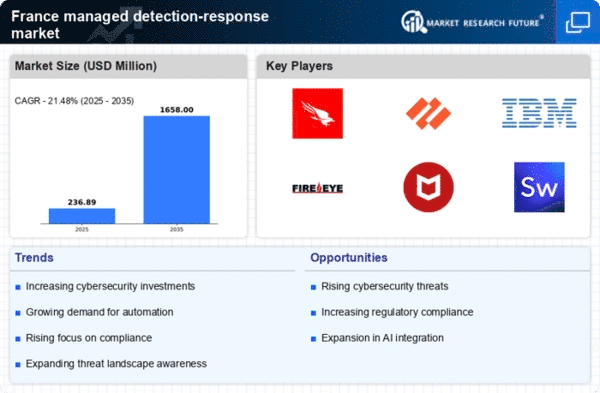
As per MRFR analysis, the managed detection-response market size was estimated at 195.0 USD Million in 2024. The managed detection-response market is projected to grow from 236.89 USD Million in 2025 to 1658.0 USD Million by 2035, exhibiting a compound annual growth rate (CAGR) of 21.48% during the forecast period 2025 - 2035.

Key Market Trends & Highlights

The France managed detection-response market is experiencing robust growth driven by technological advancements and increasing security demands.

  • The market is witnessing increased adoption of AI technologies, enhancing threat detection capabilities.
  • Focus on regulatory compliance is becoming paramount as organizations strive to meet evolving legal requirements.
  • Collaborative security models are on the rise, fostering partnerships between businesses and security providers.
  • Key market drivers include the growing cybersecurity threat landscape and rising awareness of cybersecurity risks.

Market Size & Forecast

2024 Market Size 195.0 (USD Million)
2035 Market Size 1658.0 (USD Million)
CAGR (2025 - 2035) 21.48%

Major Players

CrowdStrike (US), Palo Alto Networks (US), IBM (US), FireEye (US), McAfee (US), Secureworks (US), Rapid7 (US), Sumo Logic (US)

France Managed Detection Response Market Trends

The managed detection-response market in France is currently experiencing a notable evolution, driven by the increasing complexity of cyber threats and the growing need for robust security measures. Organizations across various sectors are recognizing the necessity of proactive threat detection and response capabilities. This shift is largely influenced by the rising frequency of cyber incidents, which has prompted businesses to seek advanced solutions that can effectively mitigate risks. As a result, the demand for managed detection-response services is on the rise, with companies investing in technologies that enhance their security posture and ensure compliance with regulatory requirements. In addition, the landscape of the managed detection-response market is characterized by a heightened focus on automation and artificial intelligence. These technologies are being integrated into security operations to streamline processes and improve response times. Furthermore, the collaboration between service providers and organizations is becoming increasingly vital, as it fosters a shared understanding of threats and enhances overall security strategies. This collaborative approach is expected to shape the future of the managed detection-response market, as businesses strive to stay ahead of evolving cyber threats and safeguard their assets.

Increased Adoption of AI Technologies

The managed detection-response market is witnessing a surge in the adoption of artificial intelligence technologies. Organizations are leveraging AI to enhance threat detection capabilities, automate responses, and analyze vast amounts of data more efficiently. This trend indicates a shift towards more intelligent security solutions that can adapt to emerging threats.

Focus on Regulatory Compliance

There is a growing emphasis on regulatory compliance within the managed detection-response market. Organizations are increasingly required to adhere to stringent data protection regulations, which drives the demand for services that ensure compliance. This trend highlights the importance of integrating security measures with regulatory frameworks.

Rise of Collaborative Security Models

The managed detection-response market is evolving towards collaborative security models. Organizations are recognizing the value of partnerships with service providers to enhance their security posture. This trend suggests a shift from traditional approaches to more integrated strategies that involve sharing threat intelligence and resources.

France Managed Detection Response Market Drivers

Growing Cybersecurity Threat Landscape

The managed detection-response market is experiencing growth due to the increasing frequency and sophistication of cyber threats in France. Organizations are facing a myriad of challenges, including ransomware attacks and data breaches, which have surged by approximately 30% in recent years. This alarming trend compels businesses to invest in advanced security solutions. The managed detection-response market is positioned to address these challenges by providing real-time threat detection and response capabilities. As companies seek to safeguard their sensitive information, the demand for managed detection-response services is likely to rise, indicating a robust market potential. Furthermore, the French government has emphasized the importance of cybersecurity, which may further drive investments in managed detection-response solutions.

Rising Awareness of Cybersecurity Risks

There is a notable increase in awareness regarding cybersecurity risks among organizations in France, which is positively impacting the managed detection-response market. As high-profile cyber incidents make headlines, businesses are becoming more cognizant of the potential repercussions of inadequate security measures. This heightened awareness is prompting organizations to seek comprehensive managed detection-response solutions to protect their assets. The managed detection-response market is thus benefiting from this shift in mindset, as companies recognize the necessity of proactive threat detection and response. Surveys indicate that over 60% of French businesses are now prioritizing cybersecurity in their strategic planning, suggesting a strong market potential for managed detection-response services. This trend is likely to continue as organizations strive to enhance their security postures.

Demand for 24/7 Security Monitoring Services

The managed detection-response market is witnessing a surge in demand for 24/7 security monitoring services in France. As cyber threats can occur at any time, organizations are increasingly recognizing the need for continuous surveillance to detect and respond to incidents promptly. The managed detection-response market is well-positioned to provide these essential services, offering round-the-clock monitoring and rapid incident response capabilities. Recent data suggests that nearly 50% of French companies are now opting for managed detection-response solutions that include 24/7 monitoring, reflecting a shift towards more proactive security measures. This trend indicates a growing reliance on external expertise to manage cybersecurity threats, thereby enhancing the overall resilience of organizations in France.

Increased Investment in Digital Transformation

The ongoing digital transformation across various sectors in France is driving the managed detection-response market. As organizations transition to cloud-based services and adopt new technologies, they inadvertently expose themselves to new vulnerabilities. The managed detection-response market plays a crucial role in helping these organizations navigate the complexities of digital security. Recent studies indicate that approximately 70% of French companies are prioritizing cybersecurity investments as part of their digital transformation strategies. This trend suggests a growing recognition of the need for robust security measures, thereby enhancing the demand for managed detection-response services. As businesses continue to innovate, the managed detection-response market is likely to see sustained growth, reflecting the increasing importance of cybersecurity in the digital age.

Regulatory Pressures and Compliance Requirements

In France, the managed detection-response market is significantly influenced by stringent regulatory frameworks aimed at enhancing data protection and cybersecurity. The General Data Protection Regulation (GDPR) mandates that organizations implement adequate security measures to protect personal data. Non-compliance can result in hefty fines, reaching up to €20 million or 4% of annual global turnover. This regulatory environment compels businesses to adopt managed detection-response services to ensure compliance and mitigate risks associated with data breaches. The managed detection-response market is thus positioned as a critical partner for organizations striving to meet these regulatory demands. As compliance becomes increasingly complex, the reliance on managed detection-response solutions is expected to grow, further solidifying the market's relevance in France.


Market Segment Insights

By Service Type: Incident Management (Largest) vs. Threat Intelligence (Fastest-Growing)

In the France managed detection-response market, Incident Management emerges as the largest segment, capturing significant market share due to its crucial role in resolving security incidents swiftly. Following closely, Threat Intelligence holds a growing position, leveraging data analytics to enhance cybersecurity measures and predict potential threats. Monitoring Services and Vulnerability Management also play essential roles, though they trail behind in terms of market share distribution. The growth trends for these service types are driven by an increasing number of cyber threats and the need for robust security solutions. Organizations are prioritizing Incident Management to ensure rapid response capabilities. Meanwhile, Threat Intelligence is experiencing a surge in demand as businesses recognize its value in proactive security measures. The trend towards remote work further amplifies the need for comprehensive monitoring, fostering growth across all segments.

Incident Management (Dominant) vs. Threat Intelligence (Emerging)

Incident Management stands out as a dominant force in the France managed detection-response market, characterized by its ability to effectively mitigate risks and restore operations after a breach. Organizations prioritize investing in systems that enable rapid response to incidents, making this segment vital for maintaining business continuity. Conversely, Threat Intelligence is an emerging segment, offering valuable insights into potential threats by analyzing trends and data from various sources. This proactive approach to cybersecurity is gaining traction among firms looking to enhance their security posture in a landscape filled with sophisticated cyber threats. The ability to predict and prevent incidents before they occur positions Threat Intelligence as a crucial component of modern security strategies.

By Deployment Type: Cloud-based (Largest) vs. On-premises (Fastest-Growing)

In the France managed detection-response market, cloud-based deployment currently holds the largest share, driven by a surge in demand for scalable and cost-effective solutions. On-premises deployment, while smaller in comparison, is witnessing a significant increase in adoption as companies seek to maintain control over their data security in a more personalized environment. This duality highlights the evolving preferences of organizations in France. The growth trend for cloud-based solutions is fueled by increasing investments in cloud infrastructure and the need for remote access to security services. Conversely, the on-premises segment is growing rapidly as businesses show a preference for tailored security solutions that align with specific operational requirements. This trend indicates a market that is diversifying to accommodate varying customer needs, ensuring continued innovation across both deployment types.

Cloud-based (Dominant) vs. On-premises (Emerging)

Cloud-based solutions in the France managed detection-response market have emerged as the dominant force, offering flexibility, scalability, and reduced operational costs, which appeal to a wide range of businesses. These solutions facilitate easier integration with existing IT ecosystems, making them a preferred choice for organizations focusing on agility. In contrast, on-premises deployments represent an emerging segment, gaining traction among enterprises that prioritize data security and compliance with local regulations. This preference stems from concerns regarding data privacy and the desire for more customizable security measures. Both segments are critical to the market's landscape, reflecting the diverse needs of organizations as they navigate the complexities of cybersecurity.

By End User: Large Enterprises (Largest) vs. Small and Medium Enterprises (Fastest-Growing)

The France managed detection-response market exhibits a clear distribution among its end users, with large enterprises commanding the largest market share. This segment benefits from vast resources, intricate operations, and a heightened need for robust security solutions. In contrast, small and medium enterprises, while currently holding a smaller portion of the market, are rapidly gaining traction due to increased awareness and need for cybersecurity, driven by digital transformation across various sectors. Growth trends indicate that small and medium enterprises are becoming the fastest-growing segment in the France managed detection-response market. Factors fueling this growth include the correlation between rising cyber threats and the urgency for these businesses to protect their digital assets. Moreover, government policies encouraging cybersecurity adoption and scalable solutions growing in accessibility further empower SMEs to invest in managed detection and response services, enhancing their overall market positioning.

Large Enterprises: Dominant vs. Small and Medium Enterprises: Emerging

Large enterprises in the France managed detection-response market showcase a dominant position owing to their established infrastructures and greater financial resources. They typically invest heavily in comprehensive security strategies, engaging advanced detection and response solutions to mitigate risks associated with cyber threats. Meanwhile, small and medium enterprises portray an emerging market force as they acknowledge the necessity for enhanced cybersecurity measures. These businesses, often more agile and adaptable, are seeking tailored solutions that cater specifically to their needs, making them more responsive to market trends and thereby driving significant growth in this segment. The distinctive needs and operational dynamics between these groups illustrate the diverse landscape of the managed detection-response services available.

By Industry Vertical: Healthcare (Largest) vs. Retail (Fastest-Growing)

In the France managed detection-response market, the distribution of market share among industry verticals is diverse. Healthcare leads as the largest segment, driven by the heightened focus on patient data protection and regulatory compliance. Following closely, the retail sector shows promising growth as companies increasingly prioritize cybersecurity measures to safeguard consumer information and transaction processes. The growth trends within these segments are significantly shaped by technological advancements and evolving cyber threats. Healthcare's emphasis on compliance and data privacy drives sustained investments. The retail sector, on the other hand, is experiencing rapid growth, largely due to the increasing incidence of data breaches and the need for advanced security solutions. This dynamic creates a competitive landscape where both sectors are crucial to the overall development of the managed detection-response services.

Healthcare: Dominant vs. Retail: Emerging

The healthcare segment is characterized by its robust regulatory framework and the necessity for stringent data protection protocols, making it a dominant force in the France managed detection-response market. Organizations within this sector prioritize comprehensive security solutions to comply with regulations and protect sensitive patient data. Conversely, the retail sector is an emerging player, experiencing rapid changes due to the surge in e-commerce and digital transactions. Retailers are now investing heavily in managed detection-response services to counteract the increasing sophistication of cyber threats targeting consumer data. Both segments reflect a growing awareness and commitment to cybersecurity, but they operate under different imperatives and priorities, influencing their growth trajectories and market strategies.

Get more detailed insights about France Managed Detection Response Market

Key Players and Competitive Insights

The managed detection-response market in France is characterized by a dynamic competitive landscape, driven by increasing cybersecurity threats and the growing need for advanced threat detection solutions. Key players such as CrowdStrike (US), Palo Alto Networks (US), and IBM (US) are strategically positioned to leverage their technological innovations and extensive service offerings. CrowdStrike (US) focuses on cloud-native solutions, emphasizing rapid deployment and scalability, while Palo Alto Networks (US) integrates AI-driven analytics to enhance threat intelligence. IBM (US), with its robust portfolio, emphasizes partnerships and acquisitions to bolster its capabilities, thereby shaping a competitive environment that is increasingly reliant on technological advancements and strategic collaborations.

The market structure appears moderately fragmented, with several players vying for market share. Key business tactics include localizing services to meet regional compliance requirements and optimizing supply chains to enhance service delivery. The collective influence of these major players fosters a competitive atmosphere where innovation and customer-centric solutions are paramount, allowing them to differentiate themselves in a crowded marketplace.

In October 2025, CrowdStrike (US) announced a strategic partnership with a leading telecommunications provider to enhance its managed detection-response services. This collaboration aims to integrate advanced threat detection capabilities directly into the telecommunications infrastructure, thereby providing customers with real-time insights and faster response times. Such a move underscores CrowdStrike's commitment to expanding its service reach and enhancing its technological offerings in a rapidly evolving market.

In September 2025, Palo Alto Networks (US) launched a new AI-driven threat detection platform designed to streamline incident response processes. This platform utilizes machine learning algorithms to analyze vast amounts of data, enabling organizations to identify and mitigate threats more effectively. The introduction of this platform reflects Palo Alto's focus on innovation and its intent to maintain a competitive edge through cutting-edge technology.

In August 2025, IBM (US) completed the acquisition of a cybersecurity startup specializing in machine learning algorithms for threat detection. This acquisition is expected to enhance IBM's existing capabilities and provide clients with more sophisticated tools for managing cyber threats. By integrating these advanced technologies, IBM aims to solidify its position as a leader in the managed detection-response market, demonstrating the importance of strategic acquisitions in driving growth and innovation.

As of November 2025, current trends in the managed detection-response market include a pronounced shift towards digitalization, sustainability, and the integration of AI technologies. Strategic alliances are increasingly shaping the competitive landscape, as companies recognize the value of collaboration in enhancing service offerings and expanding market reach. Looking ahead, competitive differentiation is likely to evolve from traditional price-based competition to a focus on innovation, technological advancements, and supply chain reliability, suggesting that companies must continuously adapt to maintain their competitive positions.

Key Companies in the France Managed Detection Response Market market include

Industry Developments

Thales introduces a national cyber threat intelligence infrastructure in April 2023. Thales was responsible for the construction of a shared cyber threat intelligence and detection platform in collaboration with ten other French organizations. The objective of this initiative is to enhance France's cyber resilience and sovereignty by centralizing threat data, analytics, and services for government entities and enterprises. It is anticipated that the platform will serve as the foundation for future MDR services in strategic sectors. Cisco Europe announced a rise in investment in cloud-based cybersecurity solutions that were specifically designed for French enterprises throughout 2023.

These encompass the integration of existing Cisco MDR and XDR platforms, secure access service edge (SASE), and extended threat detection capabilities to accommodate the increasing regional demand. Sopra Steria augments its regional support for MDR. Sopra Steria has broadened its managed detection and response services in France, offering localized expertise and compliance-aligned services for sectors including government, finance, and critical infrastructure. Although the company's regional presence growth and employment are noteworthy, its specific service enhancements are indicative of its stronger regional footprint in the delivery of MDR.

Companies are focusing on expanding their portfolios and enhancing their service capabilities in the face of evolving cyber threats.

Future Outlook

France Managed Detection Response Market Future Outlook

The Managed Detection Response Market in France is projected to grow at a 21.48% CAGR from 2024 to 2035, driven by increasing cyber threats and demand for advanced security solutions.

New opportunities lie in:

  • Development of AI-driven threat detection algorithms
  • Expansion of subscription-based managed services
  • Integration of IoT security solutions into existing frameworks

By 2035, the market is expected to achieve substantial growth, reflecting robust demand for enhanced security measures.

Market Segmentation

France Managed Detection Response Market End User Outlook

  • Small and Medium Enterprises
  • Large Enterprises
  • Government Agencies
  • Financial Institutions

France Managed Detection Response Market Service Type Outlook

  • Threat Intelligence
  • Incident Management
  • Monitoring Services
  • Vulnerability Management

France Managed Detection Response Market Deployment Type Outlook

  • Cloud-based
  • On-premises

France Managed Detection Response Market Industry Vertical Outlook

  • Healthcare
  • Retail
  • Manufacturing
  • Telecommunications
  • Information Technology

Report Scope

MARKET SIZE 2024 195.0(USD Million)
MARKET SIZE 2025 236.89(USD Million)
MARKET SIZE 2035 1658.0(USD Million)
COMPOUND ANNUAL GROWTH RATE (CAGR) 21.48% (2024 - 2035)
REPORT COVERAGE Revenue Forecast, Competitive Landscape, Growth Factors, and Trends
BASE YEAR 2024
Market Forecast Period 2025 - 2035
Historical Data 2019 - 2024
Market Forecast Units USD Million
Key Companies Profiled CrowdStrike (US), Palo Alto Networks (US), IBM (US), FireEye (US), McAfee (US), Secureworks (US), Rapid7 (US), Sumo Logic (US)
Segments Covered Service Type, Deployment Type, End User, Industry Vertical
Key Market Opportunities Integration of artificial intelligence enhances threat detection in the managed detection-response market.
Key Market Dynamics Rising demand for advanced threat detection solutions drives competition in the managed detection-response market.
Countries Covered France

Leave a Comment

FAQs

What is the expected market size of the France Managed Detection Response Market in 2024?

The expected market size of the France Managed Detection Response Market in 2024 is valued at 125.62 USD Million.

What will the market size be in 2035?

By 2035, the France Managed Detection Response Market is expected to reach a valuation of 596.25 USD Million.

What is the expected compound annual growth rate (CAGR) for the market from 2025 to 2035?

The expected CAGR for the France Managed Detection Response Market from 2025 to 2035 is 15.209 percent.

Who are the major players in the France Managed Detection Response Market?

Some of the major players include Thales, Cisco, Sopra Steria, Rapid7, CrowdStrike, Palo Alto Networks, and IBM.

What is the market value for the Threat Intelligence segment in 2024?

The Threat Intelligence segment of the France Managed Detection Response Market is valued at 25.0 USD Million in 2024.

What market size is projected for the Vulnerability Management segment in 2035?

The Vulnerability Management segment is projected to reach 169.68 USD Million by 2035.

What is the expected market value for Incident Management services in 2024?

The Incident Management services segment is expected to be valued at 30.0 USD Million in 2024.

Which segment is projected to grow the most between 2025 and 2035?

The Monitoring Services segment is expected to grow significantly, reaching 165.98 USD Million by 2035.

What are the key applications driving growth in the France Managed Detection Response Market?

Key applications driving growth include Threat Intelligence, Incident Management, Monitoring Services, and Vulnerability Management.

How is the current market environment influencing the managed detection response landscape in France?

The current market environment is fostering growth opportunities, particularly in the face of evolving cyber threats and demand for enhanced security measures.

Download Free Sample

Kindly complete the form below to receive a free sample of this Report

Compare Licence

×
Features License Type
Single User Multiuser License Enterprise User
Price $4,950 $5,950 $7,250
Maximum User Access Limit 1 User Upto 10 Users Unrestricted Access Throughout the Organization
Free Customization
Direct Access to Analyst
Deliverable Format
Platform Access
Discount on Next Purchase 10% 15% 15%
Printable Versions