×
Request Free Sample ×

Kindly complete the form below to receive a free sample of this Report

* Please use a valid business email

Leading companies partner with us for data-driven Insights

clients tt-cursor
Hero Background

South Korea Managed Detection Response Market

ID: MRFR/ICT/58970-HCR
200 Pages
Aarti Dhapte
October 2025

South Korea Managed Detection Response Market Research Report By Service Type (Threat Intelligence, Incident Management, Monitoring Services, Vulnerability Management), By Deployment Type (Cloud-based, On-premises), By End User (Small and Medium Enterprises, Large Enterprises, Government Agencies, Financial Institutions) and By Industry Vertical (Healthcare, Retail, Manufacturing, Telecommunications, Information Technology)- Forecast to 2035

Share:
Download PDF ×

We do not share your information with anyone. However, we may send you emails based on your report interest from time to time. You may contact us at any time to opt-out.

South Korea Managed Detection Response Market Infographic
Purchase Options

South Korea Managed Detection Response Market Summary

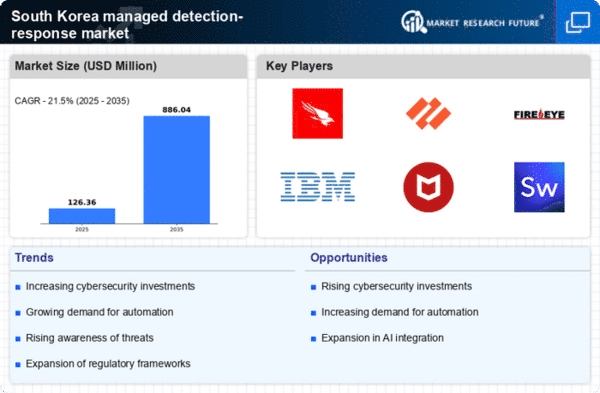
As per MRFR analysis, the South Korea managed detection-response market Size was estimated at 104.0 USD Million in 2024. The South Korea managed detection-response market industry is projected to grow from 126.36 USD Million in 2025 to 886.04 USD Million by 2035, exhibiting a compound annual growth rate (CAGR) of 21.5% during the forecast period 2025 - 2035.

Key Market Trends & Highlights

The South Korea managed detection-response market is experiencing robust growth driven by technological advancements and increasing security demands.

  • The market is witnessing increased investment in cybersecurity solutions, particularly in the largest segment of enterprise security.
  • Integration of AI and machine learning technologies is becoming prevalent, enhancing the efficiency of threat detection and response.
  • Compliance and regulatory requirements are driving organizations to adopt managed detection-response services, especially in the fastest-growing segment of small and medium enterprises.
  • The rising cyber threat landscape and growing awareness of data privacy are key drivers propelling the market forward.

Market Size & Forecast

2024 Market Size 104.0 (USD Million)
2035 Market Size 886.04 (USD Million)
CAGR (2025 - 2035) 21.5%

Major Players

CrowdStrike (US), Palo Alto Networks (US), FireEye (US), IBM (US), McAfee (US), Secureworks (US), Rapid7 (US), Sumo Logic (US)

South Korea Managed Detection Response Market Trends

The managed detection-response market in South Korea is currently experiencing notable growth, driven by an increasing awareness of cybersecurity threats and the need for robust security measures. Organizations across various sectors are recognizing the importance of proactive threat detection and response capabilities. This shift is largely influenced by the rising sophistication of cyberattacks, which necessitates advanced solutions to safeguard sensitive data and maintain operational integrity. As a result, businesses are increasingly investing in managed detection-response services to enhance their security posture and mitigate risks associated with potential breaches. In addition, the regulatory landscape in South Korea is evolving, with government initiatives aimed at strengthening cybersecurity frameworks. These initiatives encourage organizations to adopt comprehensive security strategies, further propelling the demand for managed detection-response services. The market appears poised for continued expansion, as companies seek to leverage advanced technologies and expertise to address emerging threats. Overall, the managed detection-response market is likely to play a crucial role in shaping the future of cybersecurity in South Korea, as organizations prioritize resilience and adaptability in an ever-changing digital landscape.

Increased Investment in Cybersecurity Solutions

Organizations are allocating more resources towards advanced cybersecurity measures, particularly in managed detection-response services. This trend reflects a growing recognition of the need for comprehensive security strategies to combat evolving threats.

Integration of AI and Machine Learning

The incorporation of artificial intelligence and machine learning technologies into managed detection-response services is becoming more prevalent. These innovations enhance threat detection capabilities and streamline response processes, making security operations more efficient.

Focus on Compliance and Regulatory Requirements

As regulatory frameworks become more stringent, businesses are prioritizing compliance in their cybersecurity strategies. Managed detection-response services are increasingly viewed as essential for meeting these requirements and ensuring data protection.

South Korea Managed Detection Response Market Drivers

Increased Regulatory Scrutiny

The managed detection-response market is influenced by increased regulatory scrutiny in South Korea. Regulatory bodies are intensifying their focus on cybersecurity practices, compelling organizations to adopt comprehensive security measures. The Financial Services Commission (FSC) has introduced guidelines that require financial institutions to implement robust cybersecurity frameworks. This regulatory environment is fostering a greater reliance on managed detection-response services, as they offer the expertise and resources necessary to meet compliance requirements. As organizations strive to align with regulatory expectations, the managed detection-response market is expected to experience significant growth.

Rising Cyber Threat Landscape

The managed detection-response market is experiencing growth due to the escalating cyber threat landscape in South Korea. With a notable increase in cyberattacks, organizations are compelled to adopt advanced security measures. Reports indicate that cybercrime costs in South Korea could reach approximately $16 billion annually, prompting businesses to invest in managed detection-response services. This market segment offers real-time monitoring and rapid incident response, which are crucial for mitigating risks associated with data breaches and ransomware attacks. As threats evolve, the demand for sophisticated detection and response capabilities is likely to rise, driving the managed detection-response market forward.

Growing Awareness of Data Privacy

In South Korea, the managed detection-response market is benefiting from heightened awareness regarding data privacy. With the implementation of stringent data protection regulations, organizations are increasingly prioritizing the safeguarding of sensitive information. The Personal Information Protection Act (PIPA) mandates strict compliance, leading to a surge in demand for managed detection-response services that ensure adherence to these regulations. Companies are recognizing that failure to comply can result in substantial fines and reputational damage. Consequently, the managed detection-response market is positioned to grow as businesses seek solutions that not only protect data but also facilitate compliance with evolving legal frameworks.

Demand for 24/7 Security Monitoring

The managed detection-response market is driven by the growing demand for 24/7 security monitoring in South Korea. Organizations are increasingly recognizing that cyber threats can occur at any time, necessitating continuous vigilance. The need for round-the-clock monitoring services is underscored by the fact that many cyber incidents occur outside of regular business hours. Managed detection-response services provide the necessary infrastructure to ensure constant surveillance and rapid response to potential threats. This demand for uninterrupted security monitoring is likely to propel the managed detection-response market, as businesses seek to enhance their security posture and minimize risks.

Shift Towards Cloud-Based Solutions

The managed detection-response market is witnessing a shift towards cloud-based security solutions in South Korea. As organizations migrate to cloud environments, the need for robust security measures becomes paramount. Cloud adoption is projected to grow at a CAGR of 20% in the coming years, which may drive the demand for managed detection-response services tailored for cloud infrastructures. These services provide scalable and flexible security options, enabling businesses to respond swiftly to threats. The integration of cloud technologies with managed detection-response capabilities is likely to enhance overall security posture, making it a key driver for market expansion.


Market Segment Insights

By Service Type: Incident Management (Largest) vs. Monitoring Services (Fastest-Growing)

In the South Korea managed detection-response market, the distribution of service types is dominated by Incident Management, accounting for a significant share of the overall market. This segment thrives due to increasing cyber threats and the necessity for organizations to respond rapidly to incidents, thereby ensuring business continuity and maintaining consumer trust. Monitoring Services is rapidly gaining traction, fueled by the demand for real-time threat detection and response, positioning itself as a game-changer in the present security landscape. The growth trends in these service segments are influenced by various factors including technological advancements, regulatory pressures, and the escalating frequency of cyber-attacks. Incident Management is driven by the need for comprehensive strategies to handle security breaches effectively, while Monitoring Services is experiencing heightened growth due to the increasing adoption of AI and machine learning in threat detection. Together, these trends highlight the evolving dynamics of the South Korea managed detection-response market.

Incident Management (Dominant) vs. Vulnerability Management (Emerging)

Incident Management is recognized as the dominant service type in the South Korea managed detection-response market, characterized by its comprehensive approach to addressing security incidents quickly and efficiently. This service type prioritizes minimizing damage and restoring normal operations, which is critical for organizations facing increasing cybersecurity threats. On the other hand, Vulnerability Management is emerging as a key player, focusing on identifying and mitigating vulnerabilities before they can be exploited. Its growing adoption reflects a shift towards proactive security measures, leveraging automated tools and analytics to enhance overall security posture. Together, these segments illustrate a balanced approach towards both reactive and proactive security strategies in the market.

By Deployment Type: Cloud-based (Largest) vs. On-premises (Fastest-Growing)

In the South Korea managed detection-response market, cloud-based solutions dominate, accounting for a significant share of the overall deployment preferences. Organizations are increasingly gravitating towards cloud-based deployments due to their scalability, flexibility, and cost-effectiveness. On-premises solutions, while traditionally preferred, are now being overshadowed by the rising popularity of cloud services that offer quicker deployment and better resource management. The growth trends indicate a shift in focus towards on-premises deployments, which are becoming the fastest-growing segment due to heightened demand for data sovereignty and enhanced security measures. As organizations express concerns about data privacy and regulatory compliance, they are investing in on-premises solutions that provide greater control over sensitive information. This trend signifies a gradual yet notable transition in the deployment type preferences within the market.

Cloud-based (Dominant) vs. On-premises (Emerging)

Cloud-based deployment in the South Korea managed detection-response market is characterized by its flexibility and ease of integration, making it the dominant choice among organizations. It offers advantages such as lower upfront costs, quick scalability, and access to advanced technologies without the need for extensive infrastructure. Conversely, on-premises deployment is emerging as a viable option for organizations requiring strict compliance with data regulations. Though currently less favored, it provides enhanced data security and operational control, appealing to sectors like government and finance. The divergence in adoption reflects businesses' balancing act between embracing innovative solutions and adhering to stringent data governance policies.

By End User: Large Enterprises (Largest) vs. Small and Medium Enterprises (Fastest-Growing)

In the South Korea managed detection-response market, large enterprises hold the largest share due to their extensive security requirements and resources allocated for cybersecurity. This segment benefits from significant investments in advanced detection and response technologies, allowing them to proactively manage threats and breaches, thus ensuring robust protection against cyber risks. On the other hand, small and medium enterprises are emerging rapidly, driven by increasing awareness of cybersecurity threats and the need for affordable protection solutions. Their share is growing as more SMEs recognize the necessity to implement managed services to safeguard their operations. The growth trends in both segments highlight different drivers. For large enterprises, the ongoing rise in sophisticated cyber threats and regulatory requirements necessitate advanced managed detection and response services. In contrast, small and medium enterprises are motivated by the desire to enhance security posture without the hefty expenditure typically associated with in-house solutions. This segment experiences rapid adoption of managed services as they seek scalability and effectiveness in their cybersecurity strategies, making it a vibrant area of growth in the market.

Large Enterprises: Dominant vs. Small and Medium Enterprises: Emerging

Large enterprises dominate the South Korea managed detection-response market due to their substantial budgets and critical infrastructure needs. Their extensive organizational structures lead to complex security challenges, necessitating sophisticated solutions for effective threat mitigation. These organizations often adopt comprehensive, layered security protocols to defend against a spectrum of cyber threats. Conversely, small and medium enterprises, while smaller in scale, are emerging as a crucial segment as they increasingly seek to implement cost-effective managed services. Their growth is fueled by rising cybersecurity awareness and the need for agile security solutions without extensive resources. SMEs are more likely to opt for tailored services that allow for high adaptability, fostering resilience against cyber threats without overwhelming their operational budgets.

By Industry Vertical: Healthcare (Largest) vs. Retail (Fastest-Growing)

In the South Korea managed detection-response market, the industry vertical segment demonstrates notable diversity in market share. Healthcare holds the largest share, driven by an increasing need for robust cybersecurity solutions to protect sensitive patient data and comply with regulations. Meanwhile, the retail sector is emerging as a rapidly expanding segment, as digital transformation accelerates and retailers bolster their defenses against cyber threats. Growth trends within this segment are largely influenced by technological advancements and an increased focus on data protection across various industries. The rising trend of remote healthcare services and e-commerce continues to drive demand in these sectors. Moreover, manufacturers in information technology and telecommunications are prioritizing managed detection and response services to safeguard their operations, catalyzing growth and innovation in the overall market.

Healthcare: Dominant vs. Retail: Emerging

The healthcare segment stands out as the dominant player within the South Korea managed detection-response market, characterized by its stringent regulatory requirements and the need for high-level data security. Organizations in this vertical are increasingly investing in managed detection-response solutions to mitigate risks associated with data breaches and enhance patient trust. On the other hand, the retail segment is classified as emerging, rapidly adapting to the evolving threat landscape as e-commerce transactions increase. Retailers seek to implement strong cybersecurity measures to protect customer data, boost operational resilience, and maintain competitive advantage. The dynamic nature of both segments highlights unique requirements and significant growth opportunities in managed detection-response services.

Get more detailed insights about South Korea Managed Detection Response Market

Key Players and Competitive Insights

The managed detection-response market in South Korea is characterized by a dynamic competitive landscape, driven by increasing cybersecurity threats and the growing need for advanced threat detection solutions. Major players such as CrowdStrike (US), Palo Alto Networks (US), and IBM (US) are strategically positioned to leverage their technological innovations and extensive service offerings. CrowdStrike (US) focuses on cloud-native solutions, emphasizing rapid deployment and scalability, while Palo Alto Networks (US) integrates AI-driven analytics to enhance threat intelligence. IBM (US) continues to invest in its security operations center capabilities, aiming to provide comprehensive managed services that address the evolving needs of enterprises. Collectively, these strategies foster a competitive environment that prioritizes innovation and responsiveness to market demands.

In terms of business tactics, companies are increasingly localizing their operations to better serve the South Korean market. This includes optimizing supply chains and establishing regional partnerships to enhance service delivery. The market structure appears moderately fragmented, with several key players competing for market share. However, the influence of major companies is substantial, as they set industry standards and drive technological advancements that smaller firms often follow.

In October 2025, CrowdStrike (US) announced a strategic partnership with a leading South Korean telecommunications provider to enhance its managed detection-response offerings. This collaboration aims to integrate advanced threat detection capabilities into the telecom's existing infrastructure, thereby expanding CrowdStrike's footprint in the region. The strategic importance of this partnership lies in its potential to provide localized solutions that cater to the specific cybersecurity needs of South Korean enterprises, thereby strengthening CrowdStrike's competitive position.

In September 2025, Palo Alto Networks (US) launched a new AI-driven threat detection platform tailored for the South Korean market. This platform is designed to provide real-time insights and automated responses to emerging threats. The introduction of this technology signifies Palo Alto's commitment to innovation and its understanding of the unique challenges faced by organizations in South Korea, potentially enhancing its market share and customer loyalty.

In August 2025, IBM (US) expanded its managed detection-response services by acquiring a local cybersecurity firm specializing in threat intelligence. This acquisition is expected to bolster IBM's capabilities in delivering tailored solutions to South Korean clients, reflecting a strategic move to enhance its service portfolio. The integration of local expertise is likely to improve IBM's responsiveness to regional threats, thereby solidifying its position as a leader in the market.

As of November 2025, current trends in the managed detection-response market include a pronounced shift towards digitalization, AI integration, and sustainability. Companies are increasingly forming strategic alliances to enhance their service offerings and improve operational efficiencies. The competitive landscape is evolving, with a noticeable transition from price-based competition to a focus on innovation, technology, and supply chain reliability. This shift suggests that future differentiation will hinge on the ability to deliver cutting-edge solutions that address the complex cybersecurity challenges faced by organizations in South Korea.

Key Companies in the South Korea Managed Detection Response Market market include

Industry Developments

The South Korea Managed Detection Response Market is experiencing significant growth, driven by an increasing need for advanced cybersecurity solutions to combat rising cyber threats. At the IDC Security Summit in May 2025, SK Infosec unveiled its next-generation security control platform, Secudium, which integrates real-time MDR services with AI-based detection.

The system utilizes a subscription model to safeguard customers across industries by predicting and intercepting threats from reconnaissance to account usurpation. This is achieved by integrating AI log analysis, SOAR automation, and expert response teams. In September 2023, Trend Micro enhanced its collaboration with South Korea's cybersecurity authorities, including the NISC and KISA, to enhance the detection of malware and share real-time threat intelligence in both public and private sectors. 

SK Telecom was fined and required to implement quarterly audits, expand security headcount, and invest ₩700 billion in security infrastructure over a five-year period in response to a significant malware-driven data compromise that affected 27 million users between May and July 2025. This incident has sparked a more extensive demand for MDR in the infrastructure and telecommunications sectors of South Korea.

Future Outlook

South Korea Managed Detection Response Market Future Outlook

The Managed Detection Response Market in South Korea is projected to grow at a 21.5% CAGR from 2024 to 2035, driven by increasing cyber threats and demand for advanced security solutions.

New opportunities lie in:

  • Development of AI-driven threat detection algorithms
  • Expansion of subscription-based managed services
  • Integration of IoT security solutions into existing frameworks

By 2035, the market is expected to achieve substantial growth, positioning itself as a leader in cybersecurity solutions.

Market Segmentation

South Korea Managed Detection Response Market End User Outlook

  • Small and Medium Enterprises
  • Large Enterprises
  • Government Agencies
  • Financial Institutions

South Korea Managed Detection Response Market Service Type Outlook

  • Threat Intelligence
  • Incident Management
  • Monitoring Services
  • Vulnerability Management

South Korea Managed Detection Response Market Deployment Type Outlook

  • Cloud-based
  • On-premises

South Korea Managed Detection Response Market Industry Vertical Outlook

  • Healthcare
  • Retail
  • Manufacturing
  • Telecommunications
  • Information Technology

Report Scope

MARKET SIZE 2024 104.0(USD Million)
MARKET SIZE 2025 126.36(USD Million)
MARKET SIZE 2035 886.04(USD Million)
COMPOUND ANNUAL GROWTH RATE (CAGR) 21.5% (2024 - 2035)
REPORT COVERAGE Revenue Forecast, Competitive Landscape, Growth Factors, and Trends
BASE YEAR 2024
Market Forecast Period 2025 - 2035
Historical Data 2019 - 2024
Market Forecast Units USD Million
Key Companies Profiled CrowdStrike (US), Palo Alto Networks (US), FireEye (US), IBM (US), McAfee (US), Secureworks (US), Rapid7 (US), Sumo Logic (US)
Segments Covered Service Type, Deployment Type, End User, Industry Vertical
Key Market Opportunities Integration of artificial intelligence enhances threat detection in the managed detection-response market.
Key Market Dynamics Rising demand for advanced cybersecurity solutions drives growth in the managed detection-response market.
Countries Covered South Korea

Leave a Comment

FAQs

What is the expected market size of the South Korea Managed Detection Response Market in 2024?

The South Korea Managed Detection Response Market is expected to be valued at 83.75 million USD in 2024.

What will be the projected market size by 2035?

By 2035, the market is anticipated to reach a value of 219.9 million USD.

What is the expected compound annual growth rate (CAGR) for the market from 2025 to 2035?

The expected CAGR for the South Korea Managed Detection Response Market from 2025 to 2035 is 9.172%.

Who are the key players in the South Korea Managed Detection Response Market?

Major players in the market include SK Infosec, SK Telecom, Samsung SDS, and CrowdStrike among others.

What is the market value for Threat Intelligence in 2024?

The market value for Threat Intelligence is projected to be 20.0 million USD in 2024.

What will be the market value of Incident Management by 2035?

Incident Management is expected to grow to 60.0 million USD by 2035.

What is the projected market size for Vulnerability Management in 2024?

Vulnerability Management is expected to be valued at 20.75 million USD in 2024.

What growth opportunity exists for Monitoring Services by 2035?

By 2035, Monitoring Services are projected to reach a market value of 45.0 million USD.

How is the South Korea Managed Detection Response Market impacted by current global trends?

Current global trends drive an increasing demand for enhanced security solutions in the Managed Detection Response Market.

Which service type is expected to dominate the market by 2035?

By 2035, Incident Management is expected to dominate the market with a projected value of 60.0 million USD.

Download Free Sample

Kindly complete the form below to receive a free sample of this Report

Compare Licence

×
Features License Type
Single User Multiuser License Enterprise User
Price $4,950 $5,950 $7,250
Maximum User Access Limit 1 User Upto 10 Users Unrestricted Access Throughout the Organization
Free Customization
Direct Access to Analyst
Deliverable Format
Platform Access
Discount on Next Purchase 10% 15% 15%
Printable Versions