×
Request Free Sample ×

Kindly complete the form below to receive a free sample of this Report

* Please use a valid business email

Leading companies partner with us for data-driven Insights

clients tt-cursor
Hero Background

France Optical Imaging Market

ID: MRFR/MED/54187-HCR
200 Pages
Rahul Gotadki
October 2025

France Optical Imaging Market Research Report By Product Type (Imaging systems, Software, Lenses, Illuminations systems, Cameras, Others), By Techniques (Optical coherence tomography (OCT), Photoacoustic imaging, Diffused optical tomography, Cardiology, Near infrared spectroscopy, Super-resolution microscopy), By Therapeutic area (Neurology, Oncology, Opthalmology, Cardiology, Dentistry, Dermatology), By Application (Pre-clinical and clinical research, Pathological imaging, Intra-operative imaging) and By End User (Hospitals & Diagnostic... read more

Share:
Download PDF ×

We do not share your information with anyone. However, we may send you emails based on your report interest from time to time. You may contact us at any time to opt-out.

France Optical Imaging Market Infographic
Purchase Options

France Optical Imaging Market Summary

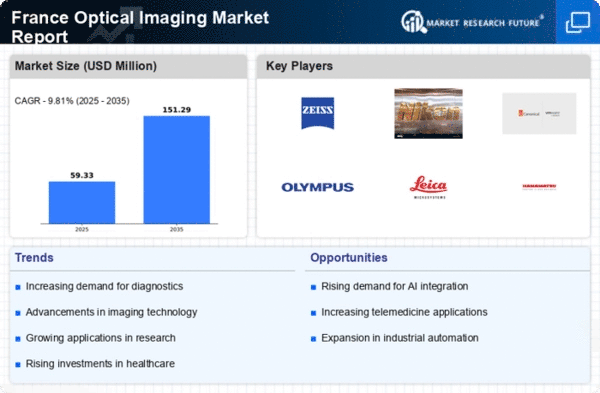
As per MRFR analysis, the France optical imaging market size was estimated at 54.03 USD Million in 2024.. The France optical imaging market is projected to grow from 59.33 USD Million in 2025 to 151.29 USD Million by 2035, exhibiting a compound annual growth rate (CAGR) of 9.81% during the forecast period 2025 - 2035.

Key Market Trends & Highlights

The France optical imaging market is experiencing robust growth driven by technological advancements and increased healthcare adoption.

  • Technological advancements are enhancing the capabilities of optical imaging systems, leading to improved diagnostic accuracy.
  • The healthcare segment remains the largest, with a notable increase in the adoption of optical imaging for non-invasive procedures.
  • Miniaturization trends are driving the development of portable optical imaging devices, particularly in the fastest-growing segment of point-of-care diagnostics.
  • Rising demand for non-invasive procedures and government initiatives are key drivers propelling market expansion.

Market Size & Forecast

2024 Market Size 54.03 (USD Million)
2035 Market Size 151.29 (USD Million)
CAGR (2025 - 2035) 9.81%

Major Players

Carl Zeiss AG (DE), Nikon Corporation (JP), Canon Inc. (JP), Olympus Corporation (JP), Leica Microsystems (DE), Hamamatsu Photonics K.K. (JP), Thorlabs Inc. (US), Edmund Optics Inc. (US), Motic (CN)

France Optical Imaging Market Trends

The optical imaging market in France is currently experiencing a dynamic evolution, driven by advancements in technology and increasing applications across various sectors. The integration of innovative imaging techniques into healthcare, manufacturing, and research is reshaping the landscape. Enhanced imaging capabilities are enabling more precise diagnostics in medical fields, while industries are leveraging optical imaging for quality control and process optimization. This trend suggests a growing reliance on sophisticated imaging solutions, which may lead to increased investments in research and development. Moreover, the demand for portable and user-friendly optical imaging devices appears to be on the rise. As professionals seek efficient tools for data collection and analysis, manufacturers are responding with compact, high-performance systems. This shift towards mobility and ease of use indicates a potential transformation in how optical imaging technologies are utilized in everyday applications. The convergence of these factors is likely to foster a robust environment for growth within the optical imaging market, positioning France as a key player in the advancement of imaging technologies.

Technological Advancements

Recent innovations in optical imaging technologies are significantly enhancing the capabilities of imaging systems. Developments in sensor technology, image processing algorithms, and software integration are enabling higher resolution and faster imaging. This trend is particularly evident in medical diagnostics, where improved imaging techniques facilitate earlier detection and better treatment planning.

Increased Adoption in Healthcare

The healthcare sector is increasingly adopting optical imaging solutions for various applications, including diagnostics, surgical guidance, and patient monitoring. The growing emphasis on non-invasive procedures and real-time imaging is driving demand for advanced optical systems. This trend reflects a broader shift towards precision medicine and personalized healthcare.

Focus on Miniaturization

There is a notable trend towards the miniaturization of optical imaging devices, making them more accessible and user-friendly. Compact imaging systems are becoming essential tools in various fields, including field research and point-of-care diagnostics. This shift towards smaller, portable devices indicates a potential for widespread adoption across diverse applications.

France Optical Imaging Market Drivers

Growing Aging Population

The demographic shift towards an aging population in France significantly impacts the optical imaging market. As the population ages, there is an increased prevalence of chronic diseases that require regular monitoring and accurate diagnosis. Optical imaging technologies are particularly well-suited for detecting conditions such as cancer, cardiovascular diseases, and neurological disorders, which are more common in older adults. This demographic trend is expected to drive the optical imaging market, with projections indicating a potential market value increase of €500 million by 2030. Healthcare providers are increasingly adopting optical imaging solutions to meet the diagnostic needs of this growing patient demographic. Consequently, the aging population serves as a vital driver for the optical imaging market, emphasizing the need for advanced imaging technologies in the healthcare sector.

Government Initiatives and Funding

Government initiatives in France play a crucial role in propelling the optical imaging market forward. The French government has been actively investing in healthcare innovation, allocating substantial funds to research and development in medical imaging technologies. For instance, recent funding programs have earmarked over €100 million for advancing optical imaging techniques, which are expected to enhance diagnostic capabilities in hospitals and clinics. These initiatives not only foster technological advancements but also encourage collaboration between public institutions and private companies. As a result, the optical imaging market is likely to benefit from increased innovation and improved access to cutting-edge imaging solutions. The support from governmental bodies is essential for driving growth and ensuring that France remains at the forefront of medical imaging advancements.

Integration of Artificial Intelligence

The integration of artificial intelligence (AI) into optical imaging technologies is transforming the landscape of the optical imaging market in France. AI algorithms enhance image analysis, enabling faster and more accurate diagnoses. This technological synergy is particularly beneficial in fields such as oncology and cardiology, where precision is paramount. the optical imaging market witnessed a surge in AI-driven solutions., with estimates suggesting that AI applications could increase diagnostic accuracy by up to 30%. As healthcare providers in France increasingly adopt these advanced technologies, the demand for AI-integrated optical imaging systems is expected to rise. This trend not only improves patient outcomes but also streamlines workflows in clinical settings, making AI a pivotal driver for the optical imaging market.

Rising Awareness of Preventive Healthcare

There is a growing awareness of preventive healthcare among the French population, which significantly influences the optical imaging market. As individuals become more proactive about their health, the demand for early detection and preventive diagnostics rises. Optical imaging technologies are increasingly recognized for their role in identifying health issues before they escalate, leading to better health outcomes. This shift in mindset is reflected in the increasing utilization of optical imaging in routine health check-ups and screenings. Market analysts project that the optical imaging market could expand by approximately 15% over the next five years, driven by this heightened focus on preventive care. Consequently, the rising awareness of preventive healthcare is a key driver for the optical imaging market, aligning with broader public health initiatives in France.

Rising Demand for Non-Invasive Procedures

the optical imaging market in France experienced a notable increase in demand for non-invasive diagnostic procedures.. This trend is driven by a growing awareness among patients and healthcare providers regarding the benefits of non-invasive techniques, which minimize patient discomfort and recovery time. As a result, the optical imaging market was projected to grow at a CAGR of approximately 8% over the next five years.. The French healthcare system is increasingly integrating optical imaging technologies into routine diagnostics, enhancing the accuracy of disease detection and monitoring. This shift not only improves patient outcomes but also reduces healthcare costs associated with invasive procedures. Consequently, the rising demand for non-invasive solutions is a significant driver for the optical imaging market, as it aligns with the broader trend of patient-centered care in France.


Market Segment Insights

By Imaging Technique: Optical Coherence Tomography (Largest) vs. Fluorescence Imaging (Fastest-Growing)

Among the various imaging techniques in the France optical imaging market, Optical Coherence Tomography holds the largest market share due to its extensive applications in ophthalmology and cardiology. Fluorescence Imaging, while smaller in share, is rapidly gaining traction owing to its enhanced capabilities in biological imaging and cellular analysis, leading to a growing interest in research institutions and clinical diagnostics. The growth trend in the optical imaging segment is primarily driven by advancements in technology and increasing investment in healthcare imaging solutions. The rising prevalence of chronic diseases necessitates effective imaging solutions, positioning Fluorescence Imaging as the fastest-growing technique. Moreover, the demand for non-invasive diagnostic tools and the integration of AI with imaging technologies further support the expansion of these segments in the market.

Optical Coherence Tomography (Dominant) vs. Fluorescence Imaging (Emerging)

Optical Coherence Tomography (OCT) is a dominant player in the France optical imaging market, renowned for its precision and ability to provide high-resolution cross-sectional images of biological tissues. This technique is primarily utilized in ophthalmology to monitor retinal diseases and is integral in various cardiovascular applications, enhancing its foothold in medical diagnostics. Conversely, Fluorescence Imaging is an emerging technique characterized by its capability to visualize specific cellular processes and structures. This method leverages fluorescent markers to detect and analyze cellular activity, making it invaluable in research laboratories and clinical settings. The increasing emphasis on personalized medicine and targeted therapies further enhances the attractiveness of both OCT and Fluorescence Imaging.

By Application: Diagnostics (Largest) vs. Therapeutic Guidance (Fastest-Growing)

In the France optical imaging market, the distribution of market share among various applications displays Diagnostics as the largest segment, commanding a significant portion of the market due to its critical role in disease detection and monitoring. Following Diagnostics, Therapeutic Guidance has emerged as a vital component of the market, showing robust growth as healthcare providers increasingly rely on precise imaging techniques for enhanced treatment outcomes. The growth trends in this segment are driven by advancements in imaging technology and a rising demand for non-invasive diagnostic approaches. The continuous innovations in optics, coupled with an increasing awareness of early disease detection among patients, are propelling the growth of the Therapeutic Guidance segment, which is focusing on integrated imaging solutions to facilitate better clinical decisions and treatment planning.

Diagnostics (Dominant) vs. Preclinical Imaging (Emerging)

Diagnostics remains the dominant application in the France optical imaging market, characterized by its extensive utilization across hospitals and medical facilities for the early detection of diseases, including cancer and cardiovascular conditions. The significant advances in imaging methodologies, such as MRI and CT scans, enhance its applicability and reliability. On the other hand, Preclinical Imaging, while considered an emerging sector, is gaining traction in research and innovation environments, particularly in drug development and safety assessments. This segment leverages advanced imaging techniques to provide insights into biological processes, thus supporting the pharmaceutical industry in expediting the development of effective therapeutics.

By End User: Hospitals (Largest) vs. Research Laboratories (Fastest-Growing)

In the France optical imaging market, hospitals represent the largest segment, accounting for a significant portion of the overall market share. With advanced imaging technologies being integral to patient care, this segment has established itself as the primary contributor to market growth. Following closely, research laboratories are gaining traction, fueled by increasing investments in medical research and technological advancements that enhance imaging capabilities. The growth trends within the end-user segment are influenced by several key factors. The rising demand for early diagnosis and improved imaging solutions in hospitals drives the adoption of optical imaging technologies. Meanwhile, research laboratories are witnessing rapid expansion due to a surge in innovation and collaborations aimed at developing new imaging techniques. This combination of factors is positioning research laboratories as the fastest-growing segment in the optical imaging landscape.

Hospitals (Dominant) vs. Research Laboratories (Emerging)

Hospitals, as a dominant force in the France optical imaging market, are characterized by their widespread use of advanced imaging systems for diagnostics, treatment planning, and patient monitoring. They benefit from substantial infrastructure investments and a continuous demand for enhanced imaging techniques. In contrast, research laboratories represent an emerging segment, driven by innovative research and development initiatives. These labs focus on pioneering imaging technologies and methodologies, often collaborating with academic institutions to push the boundaries of optical imaging. Their agility in adopting new technologies and methodologies positions them well in a dynamic market, appealing to both funders and industry collaborators looking to innovate.

By Product Type: Imaging Systems (Largest) vs. Imaging Software (Fastest-Growing)

In the France optical imaging market, the distribution of market share among the product types reveals that Imaging Systems holds a significant portion of the market, marking it as the largest segment in this sector. This dominance is attributed to the widespread usage of imaging technologies across various industries, and their essential role in both consumer and medical applications. Imaging Software, while smaller in comparison, is rapidly gaining traction as more businesses integrate software solutions to enhance imaging capabilities, improving efficiency and user experience. The growth trends within this segment are influenced by several key drivers, including technological advancements, increasing investments in R&D, and a rising demand for high-quality imaging solutions across healthcare and industrial applications. The shift towards digital imaging and automation further propels the software segment forward, with innovative developments leading to enhanced functionality and performance. As a result, Imaging Software is positioned for substantial growth in the coming years, with industry players focusing on expanding their software offerings to capture emerging market opportunities.

Imaging Systems (Dominant) vs. Accessories (Emerging)

Imaging Systems are characterized by their advanced imaging technologies that play a crucial role in various applications such as medical diagnostics, security, and research. These systems are integral to achieving high-quality imaging results and are relied upon by numerous industries, establishing their dominant presence in the market. In contrast, Accessories are considered an emerging segment, encompassing various tools and enhancements that complement imaging systems. While Accessories currently hold a smaller market share, they are gaining importance as users seek to optimize their imaging capabilities. This includes lenses, mounts, and lighting solutions that improve the performance and usability of imaging systems. As the demand for comprehensive imaging solutions increases, Accessories are expected to experience growth, reflecting the market's evolving needs.

Get more detailed insights about France Optical Imaging Market

Key Players and Competitive Insights

The optical imaging market in France exhibits a dynamic competitive landscape characterized by rapid technological advancements and a growing demand for high-resolution imaging solutions across various sectors, including healthcare, industrial, and scientific research. Key players such as Carl Zeiss AG (DE), Nikon Corporation (JP), and Canon Inc. (JP) are at the forefront, leveraging innovation and strategic partnerships to enhance their market positions. These companies focus on developing cutting-edge imaging technologies, which not only cater to existing customer needs but also anticipate future demands, thereby shaping the competitive environment.

In terms of business tactics, companies are increasingly localizing manufacturing and optimizing supply chains to enhance operational efficiency and reduce costs. The market structure appears moderately fragmented, with several players competing for market share. However, the collective influence of major companies like Olympus Corporation (JP) and Leica Microsystems (DE) is significant, as they drive trends in product development and customer engagement strategies.

In October 2025, Nikon Corporation (JP) announced a strategic partnership with a leading French research institution to develop advanced imaging solutions tailored for biomedical applications. This collaboration is poised to enhance Nikon's product offerings and strengthen its foothold in the healthcare sector, reflecting a broader trend of companies aligning with research entities to foster innovation.

In September 2025, Canon Inc. (JP) launched a new line of high-resolution imaging systems designed for industrial applications, emphasizing automation and AI integration. This move not only showcases Canon's commitment to technological advancement but also positions the company to capture a larger share of the industrial imaging market, which is increasingly reliant on precision and efficiency.

In August 2025, Carl Zeiss AG (DE) expanded its product portfolio by introducing a series of compact imaging devices aimed at educational institutions. This strategic decision appears to be a response to the growing demand for accessible imaging technology in educational settings, thereby broadening Zeiss's market reach and reinforcing its reputation as a leader in optical solutions.

As of November 2025, the competitive trends in the optical imaging market are increasingly defined by digitalization, sustainability, and the integration of AI technologies. Strategic alliances among key players are shaping the landscape, fostering innovation and enhancing product offerings. The shift from price-based competition to a focus on technological differentiation and supply chain reliability is evident, suggesting that future competitive advantages will hinge on the ability to innovate and adapt to evolving market demands.

Key Companies in the France Optical Imaging Market market include

Industry Developments

The France Optical Imaging Market has seen notable developments recently, with significant growth impacting various companies. Thales announced innovations in imaging technologies to enhance security solutions, while Safran has been advancing its optical systems for aerospace applications. Companies like Canon and Nikon are expanding their product lines, focusing on high-resolution imaging sensors.

In terms of mergers and acquisitions, EssilorLuxottica has completed the acquisition of a French eyewear startup to strengthen its position in the digital eye care sector, as reported in September 2023. Additionally, in July 2023, Parrot announced a collaboration with Airbus to advance drone imaging technologies. Noteworthy growth in the optical imaging sector includes Lynred's expansion in semiconductor manufacturing, which has enhanced its market valuation and competitive edge in advanced imaging solutions.

Historical context shows that in November 2021, Stereoclip secured additional funding to develop its optical 3D scanning technologies further. These developments reflect France's commitment to maintaining a leading role in optical imaging innovations while enhancing technological capabilities across various industries.


Future Outlook

France Optical Imaging Market Future Outlook

The Optical Imaging Market in France is projected to grow at a 9.81% CAGR from 2024 to 2035, driven by technological advancements and increasing healthcare demands.

New opportunities lie in:

  • Development of AI-driven imaging software solutions
  • Expansion of portable imaging devices for remote diagnostics
  • Investment in advanced imaging technologies for personalized medicine

By 2035, the optical imaging market was expected to achieve substantial growth and innovation..

Market Segmentation

France Optical Imaging Market End User Outlook

  • Hospitals
  • Research Laboratories
  • Academic Institutions
  • Diagnostic Centers

France Optical Imaging Market Application Outlook

  • Diagnostics
  • Therapeutic Guidance
  • Surgical Planning
  • Research Development
  • Preclinical Imaging

France Optical Imaging Market Product Type Outlook

  • Imaging Systems
  • Imaging Software
  • Accessories

France Optical Imaging Market Imaging Technique Outlook

  • Fluorescence Imaging
  • Phase Contrast Imaging
  • Near-Infrared Imaging
  • Optical Coherence Tomography
  • Diffuse Optical Imaging

Report Scope

MARKET SIZE 2024 54.03(USD Million)
MARKET SIZE 2025 59.33(USD Million)
MARKET SIZE 2035 151.29(USD Million)
COMPOUND ANNUAL GROWTH RATE (CAGR) 9.81% (2024 - 2035)
REPORT COVERAGE Revenue Forecast, Competitive Landscape, Growth Factors, and Trends
BASE YEAR 2024
Market Forecast Period 2025 - 2035
Historical Data 2019 - 2024
Market Forecast Units USD Million
Key Companies Profiled Carl Zeiss AG (DE), Nikon Corporation (JP), Canon Inc. (JP), Olympus Corporation (JP), Leica Microsystems (DE), Hamamatsu Photonics K.K. (JP), Thorlabs Inc. (US), Edmund Optics Inc. (US), Motic (CN)
Segments Covered Imaging Technique, Application, End User, Product Type
Key Market Opportunities Advancements in artificial intelligence enhance diagnostic capabilities in the optical imaging market.
Key Market Dynamics Technological advancements drive innovation in optical imaging, enhancing applications across healthcare and industrial sectors.
Countries Covered France

Leave a Comment

FAQs

What is the expected market size of the France Optical Imaging Market in 2024?

The France Optical Imaging Market is anticipated to be valued at 54.0 million USD in 2024.

What is the projected market size for the France Optical Imaging Market by 2035?

By 2035, the France Optical Imaging Market is projected to reach 135.0 million USD.

What is the expected compound annual growth rate (CAGR) for the France Optical Imaging Market from 2025 to 2035?

The expected CAGR for the France Optical Imaging Market from 2025 to 2035 is 8.687%.

Which product type holds the largest market share within the France Optical Imaging Market by 2035?

Imaging systems will hold the largest share, valued at 47.0 million USD by 2035.

What is the market size for software in the France Optical Imaging Market in 2024?

The market size for software in the France Optical Imaging Market is valued at 15.0 million USD in 2024.

Who are the key players in the France Optical Imaging Market?

Key players include Thales, Safran, Parrot, NexVision, and Canon among others.

How much is the camera segment expected to be worth in 2035?

The camera segment is expected to be valued at 12.0 million USD by 2035.

What challenges might the France Optical Imaging Market face in the coming years?

Challenges may include rapid technological advancements and competition among key players.

What growth opportunities exist for the France Optical Imaging Market?

The growth opportunities lie in the increasing demand for advanced imaging technologies and applications.

What is the expected market value of illumination systems in 2035?

Illumination systems are expected to reach a market value of 15.0 million USD in 2035.

Download Free Sample

Kindly complete the form below to receive a free sample of this Report

Compare Licence

×
Features License Type
Single User Multiuser License Enterprise User
Price $4,950 $5,950 $7,250
Maximum User Access Limit 1 User Upto 10 Users Unrestricted Access Throughout the Organization
Free Customization
Direct Access to Analyst
Deliverable Format
Platform Access
Discount on Next Purchase 10% 15% 15%
Printable Versions