Government Initiatives and Funding
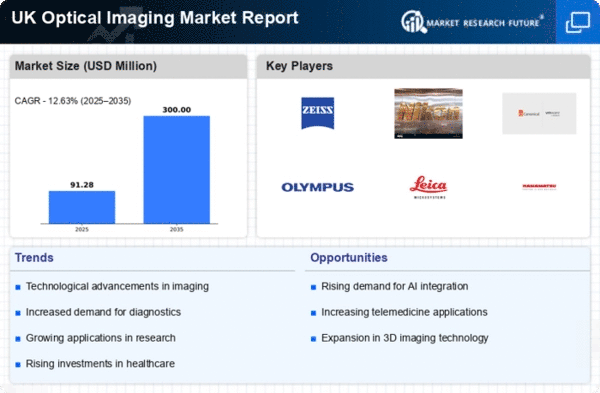
Government initiatives aimed at enhancing healthcare infrastructure are playing a crucial role in the growth of the optical imaging market. In the UK, various funding programs have been established to support the integration of advanced imaging technologies in hospitals and clinics. For instance, the National Health Service (NHS) has allocated substantial budgets for upgrading imaging equipment, which is anticipated to boost the optical imaging market. The UK government has also been promoting research and development in medical imaging technologies, which could lead to innovative solutions and improved patient outcomes. As a result, the optical imaging market is likely to benefit from increased investments and support from public health authorities, fostering a conducive environment for market expansion.
Integration of Artificial Intelligence
The integration of artificial intelligence (AI) in imaging technologies is emerging as a transformative driver for the optical imaging market. AI algorithms are being developed to enhance image analysis, improve diagnostic accuracy, and reduce the time required for interpretation. In the UK, healthcare providers are increasingly adopting AI-driven optical imaging solutions, which are expected to streamline workflows and enhance patient care. The market for AI in medical imaging is projected to grow significantly, with estimates suggesting a potential increase of over 20% annually. This technological advancement not only improves the efficiency of imaging processes but also positions the optical imaging market as a leader in innovative healthcare solutions, attracting further investment and interest from stakeholders.
Increased Focus on Personalized Medicine
The optical imaging market is being significantly influenced by the growing emphasis on personalized medicine. As healthcare shifts towards tailored treatment approaches, the demand for precise imaging techniques that can provide detailed insights into individual patient conditions is rising. In the UK, healthcare providers are increasingly adopting optical imaging technologies to support personalized treatment plans, particularly in oncology and cardiology. This trend is likely to enhance the optical imaging market, as practitioners seek advanced imaging solutions that can aid in the early detection and monitoring of diseases. The potential for improved patient outcomes through personalized approaches may drive further investments in optical imaging technologies, solidifying their role in modern healthcare.
Rising Demand for Non-Invasive Procedures
The optical imaging market is experiencing a notable increase in demand for non-invasive diagnostic procedures. This trend is largely driven by the growing awareness among patients and healthcare providers regarding the benefits of non-invasive techniques, which minimize patient discomfort and reduce recovery times. In the UK, the market for non-invasive imaging technologies is projected to grow at a CAGR of approximately 8% over the next five years. This shift towards non-invasive methods is likely to enhance the adoption of optical imaging technologies, as they provide high-resolution images without the need for surgical interventions. Consequently, the optical imaging market is expected to expand significantly, as healthcare facilities invest in advanced imaging systems to meet patient expectations and improve diagnostic accuracy.
Growing Applications in Research and Development
The optical imaging market is witnessing a surge in applications within research and development sectors, particularly in life sciences and material sciences. Researchers are increasingly utilizing optical imaging techniques for various applications, including cellular imaging, drug discovery, and materials characterization. In the UK, academic institutions and research organizations are investing in advanced optical imaging systems to facilitate groundbreaking studies. This trend is likely to drive the optical imaging market, as the demand for high-resolution imaging solutions continues to rise. Furthermore, collaborations between academia and industry are expected to foster innovation, leading to the development of novel imaging technologies that could further expand the market's reach and capabilities.




















Leave a Comment