Enhanced Focus on Personalized Medicine
The optical imaging market in Germany is increasingly influenced by the enhanced focus on personalized medicine. As healthcare shifts towards tailored treatment approaches, optical imaging technologies are becoming essential for precise diagnostics and monitoring of individual patient responses. The integration of imaging techniques with genomic and proteomic data is expected to provide deeper insights into disease mechanisms, thereby facilitating more effective treatment plans. Market analysis indicates that the personalized medicine segment is anticipated to account for approximately 25% of the optical imaging market by 2026. This trend is likely to drive the development of advanced imaging systems that can deliver real-time data, enabling healthcare providers to make informed decisions based on individual patient profiles. As a result, the optical imaging market is poised for growth, aligning with the broader movement towards personalized healthcare solutions.
Rising Investment in Research and Development
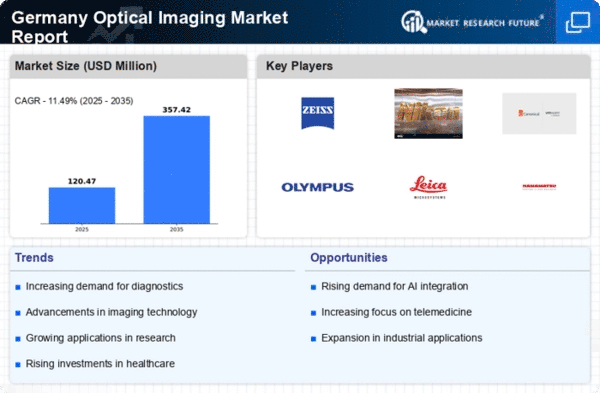
The optical imaging market in Germany is experiencing a notable surge in investment directed towards research and development. This trend is primarily driven by the increasing need for advanced imaging technologies in various sectors, including healthcare and industrial applications. In 2025, the German government allocated approximately €1.5 billion to support innovation in imaging technologies, which is expected to enhance the capabilities of optical imaging systems. This influx of funding is likely to foster collaborations between academic institutions and private enterprises, leading to the development of cutting-edge optical imaging solutions. As a result, the optical imaging market is poised for substantial growth, with projections indicating a compound annual growth rate (CAGR) of around 8% over the next five years. Such advancements may significantly improve diagnostic accuracy and operational efficiency across multiple industries.
Growing Demand for Non-Invasive Diagnostic Techniques
In Germany, there is a marked increase in the demand for non-invasive diagnostic techniques, which is significantly impacting the optical imaging market. Healthcare providers are increasingly favoring optical imaging modalities such as optical coherence tomography (OCT) and fluorescence imaging due to their ability to provide detailed images without the need for invasive procedures. This shift is reflected in market data, indicating that the healthcare segment is projected to grow at a CAGR of 9% from 2025 to 2030. The rising prevalence of chronic diseases and the aging population are further fueling this demand, as healthcare professionals seek efficient and patient-friendly diagnostic options. Consequently, the optical imaging market is likely to see a surge in the development and adoption of innovative imaging technologies that cater to these healthcare needs.
Strengthening of Academic and Industry Collaborations
The optical imaging market is benefiting from the strengthening of collaborations between academic institutions and industry players in Germany. These partnerships are fostering innovation and accelerating the development of new optical imaging technologies. Universities and research centers are increasingly engaging with companies to translate scientific discoveries into practical applications. In 2025, it is estimated that collaborative projects accounted for nearly 40% of the total research output in the optical imaging sector. This collaborative environment is likely to enhance the competitiveness of the optical imaging market, as it encourages the sharing of knowledge, resources, and expertise. Furthermore, such partnerships may lead to the establishment of specialized research hubs focused on optical imaging, driving further advancements and commercialization of new technologies.
Increasing Adoption of Optical Imaging in Industrial Applications
The optical imaging market is witnessing a growing adoption of imaging technologies in industrial applications across Germany. Industries such as manufacturing, automotive, and electronics are increasingly utilizing optical imaging systems for quality control, process monitoring, and automation. The market data suggests that the industrial segment accounted for approximately 35% of the total optical imaging market share in 2025. This trend is driven by the need for enhanced precision and efficiency in production processes. Furthermore, the integration of optical imaging with artificial intelligence and machine learning is expected to revolutionize industrial operations, enabling real-time analysis and decision-making. As industries continue to embrace these technologies, the optical imaging market is likely to expand, providing innovative solutions that meet the evolving demands of the manufacturing sector.


















Leave a Comment