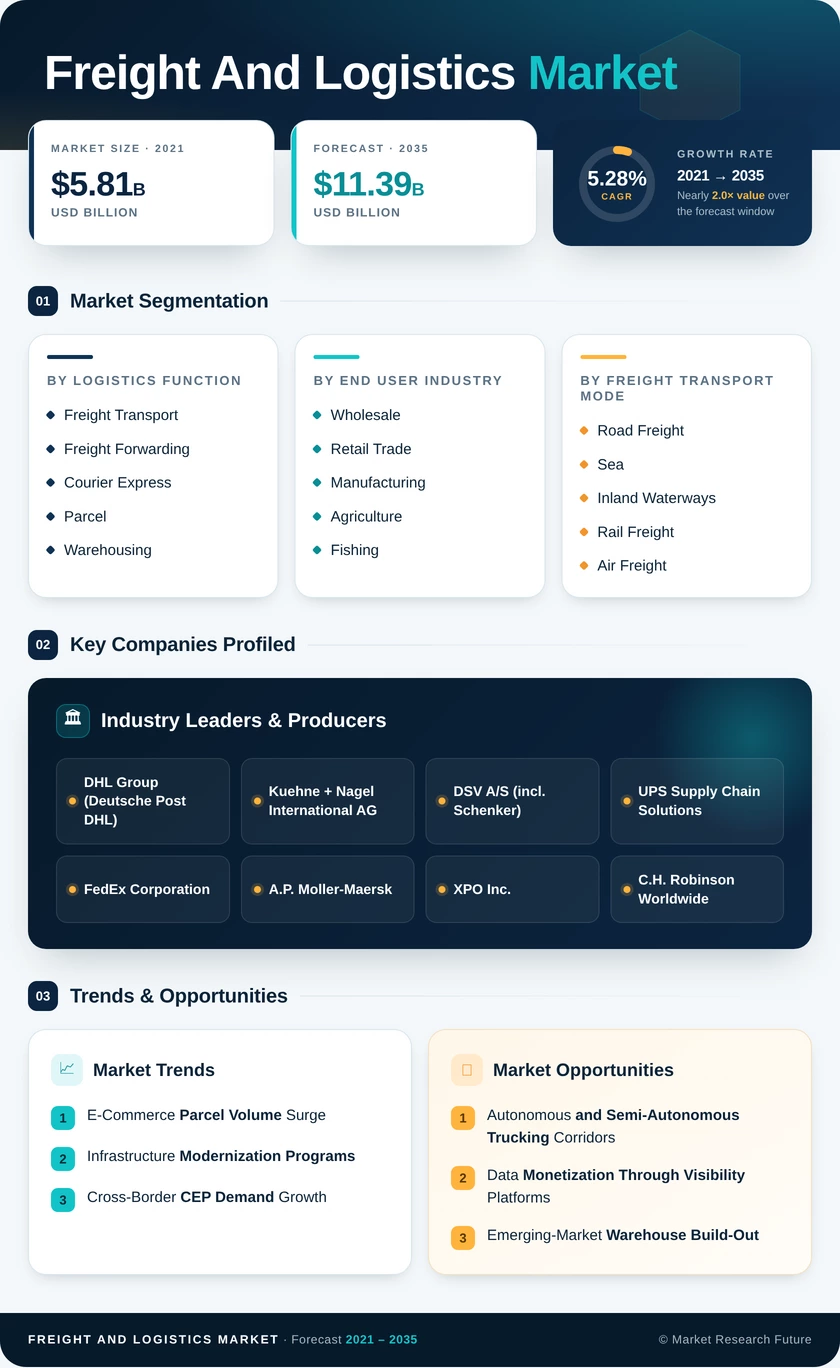
Freight and Logistics Market (2026 - 2035)

ID: MRFR/PCM/7226-HCR
107 Pages
Snehal Singh
Last Updated: July 06, 2026
Freight and Logistics Market Research Report Information by Shipping Type (Airways, Railways, Roadways, and Waterways), Service (Inventory Management, Packaging, Warehousing, Transportation, Distribution, Customs Clearance, and other), End-Use Industry (Energy & Utilities, Trade and Transportation, Government and Public Utilities, Healthcare, Manufacturing & Construction, Retail, Media and Entertainment, Banking and Financial Services and Telecommunication & Information Technology) And By Region – Market Forecast Till 2035.
Freight and Logistics Market
Market Size
Forecast Period2026-2035
CAGR (2026-2035)5.28%
2025 Market SizeUSD 6.81 Trillion
2035 Market SizeUSD 11.39 Trillion
Key Players
DHL Group
Kuehne + Nagel International AG
DSV A/S
UPS Supply Chain Solutions
FedEx Corporation
A.P. Moller-Maersk
Opportunities
  • Autonomous and Semi-Autonomous Trucking Corridors
  • Data Monetization Through Visibility Platforms
  • Emerging-Market Warehouse Build-Out
  1. 1 Market Overview |
    1. 1.1 Study Assumptions & Market Definition |
    2. 1.2 Scope of the Study |
    3. 1.3 Research Methodology
  2. 2 Market Summary & Key Takeaways
  3. 3 Market Dynamics |
    1. 3.1 Market Drivers Analysis | |
      1. 3.1.1 E-Commerce Parcel Volume Surge | |
      2. 3.1.2 Infrastructure Modernization Programs | |
      3. 3.1.3 Cross-Border CEP Demand Growth | |
      4. 3.1.4 Cold-Chain Expansion for Pharma and Food | |
      5. 3.1.5 Digital Freight Matching Platforms | |
      6. 3.1.6 Nearshoring and Friend-Shoring Trade Realignment | |
      7. 3.1.7 Public-Private Logistics Park Investments |
    2. 3.2 Market Restraints Analysis | |
      1. 3.2.1 Chronic Driver and Labor Shortages | |
      2. 3.2.2 Fuel Price Volatility and Energy Transition Costs | |
      3. 3.2.3 Regulatory Fragmentation Across Borders | |
      4. 3.2.4 Cybersecurity Risks to Digital Freight Platforms | |
      5. 3.2.5 Port Congestion and Capacity Bottlenecks |
    3. 3.3 Market Opportunity Analysis | |
      1. 3.3.1 Autonomous and Semi-Autonomous Trucking Corridors | |
      2. 3.3.2 Data Monetization Through Visibility Platforms | |
      3. 3.3.3 Emerging-Market Warehouse Build-Out | |
      4. 3.3.4 Green Freight Financing Instruments | |
      5. 3.3.5 Micro-Fulfillment and Urban Logistics Hubs |
    4. 3.4 Industry Value Chain Analysis |
    5. 3.5 Porter's Five Forces Analysis
  4. 4 Global Freight and Logistics Market Size & Forecast (2021–2035) |
    1. 4.1 Historical Market Size (2021–2025) |
    2. 4.2 Current & Forecast Market Size (2026–2035) |
    3. 4.3 Market Size by Revenue (USD Trillion) |
    4. 4.4 Year-over-Year Growth Analysis
  5. 5 Segmentation Analysis |
    1. 5.1 By Logistics Function | |
      1. 5.1.1 Freight Transport | |
      2. 5.1.2 Freight Forwarding | |
      3. 5.1.3 Courier, Express, and Parcel | |
      4. 5.1.4 Warehousing and Storage | |
      5. 5.1.5 Other Services |
    2. 5.2 By End User Industry | |
      1. 5.2.1 Wholesale and Retail Trade | |
      2. 5.2.2 Manufacturing | |
      3. 5.2.3 Agriculture, Fishing, and Forestry | |
      4. 5.2.4 Construction | |
      5. 5.2.5 Other Industries |
    3. 5.3 By Freight Transport Mode | |
      1. 5.3.1 Road Freight | |
      2. 5.3.2 Sea and Inland Waterways | |
      3. 5.3.3 Rail Freight | |
      4. 5.3.4 Air Freight
  6. 6 Regional Analysis |
    1. 6.1 North America | |
      1. 6.1.1 United States | |
      2. 6.1.2 Canada | |
      3. 6.1.3 Mexico |
    2. 6.2 Europe | |
      1. 6.2.1 Germany | |
      2. 6.2.2 United Kingdom | |
      3. 6.2.3 France | |
      4. 6.2.4 Italy | |
      5. 6.2.5 Spain | |
      6. 6.2.6 Nordic Countries | |
      7. 6.2.7 Russia | |
      8. 6.2.8 Rest of Europe |
    3. 6.3 Asia-Pacific | |
      1. 6.3.1 China | |
      2. 6.3.2 India | |
      3. 6.3.3 Japan | |
      4. 6.3.4 South Korea | |
      5. 6.3.5 ASEAN | |
      6. 6.3.6 Rest of Asia-Pacific |
    4. 6.4 South America | |
      1. 6.4.1 Brazil | |
      2. 6.4.2 Argentina | |
      3. 6.4.3 Rest of South America |
    5. 6.5 Middle East & Africa | |
      1. 6.5.1 Saudi Arabia | |
      2. 6.5.2 UAE | |
      3. 6.5.3 South Africa | |
      4. 6.5.4 Egypt | |
      5. 6.5.5 Rest of MEA
  7. 7 Competitive Landscape |
    1. 7.1 Market Share Analysis (2025) |
    2. 7.2 Competitive Benchmarking Matrix |
    3. 7.3 Company Profiles | |
      1. 7.3.1 DHL Group (Deutsche Post DHL) | |
      2. 7.3.2 Kuehne + Nagel International AG | |
      3. 7.3.3 DSV A/S (incl. Schenker) | |
      4. 7.3.4 UPS Supply Chain Solutions | |
      5. 7.3.5 FedEx Corporation | |
      6. 7.3.6 A.P. Moller-Maersk | |
      7. 7.3.7 XPO Inc. | |
      8. 7.3.8 C.H. Robinson Worldwide | |
      9. 7.3.9 Nippon Express Holdings | |
      10. 7.3.10 J.B. Hunt Transport Services
  8. 8 Future Outlook & Strategic Recommendations (2026–2035) |
    1. 8.1 AI-Orchestrated Supply Networks |
    2. 8.2 Platform Economics and Freight Marketplaces |
    3. 8.3 Fleet Electrification and Alternative Fuels |
    4. 8.4 ESG Reporting and Scope-3 Transparency
  9. 9 Recent Developments & News
  10. 10 Frequently Asked Questions (FAQs)
  11. 11 Report Scope & Methodology |
    1. 11.1 Study Period & Base Year |
    2. 11.2 Data Sources & Citations |
    3. 11.3 Abbreviations
  12. 12 LIST OF TABLES |
  13. TABLE 1 Global Freight and Logistics Market Size & Forecast, by Revenue (USD Trillion), 2021–2035 |
  14. TABLE 2 Global Freight and Logistics Market – Year-over-Year Growth Analysis, 2021–2035 |
  15. TABLE 3 Global Freight and Logistics Market – Driver Impact Analysis |
  16. TABLE 4 Global Freight and Logistics Market – Restraints Impact Analysis |
  17. TABLE 5 Global Freight and Logistics Market Size, by Logistics Function, 2021–2035 (USD Trillion) |
  18. TABLE 6 Global Freight and Logistics Market Size, by End User Industry, 2021–2035 (USD Trillion) |
  19. TABLE 7 Global Freight and Logistics Market Size, by Freight Transport Mode, 2021–2035 (USD Trillion) |
  20. TABLE 8 Global Freight and Logistics Market Size, by Region, 2021–2035 (USD Trillion) |
  21. TABLE 9 North America Freight and Logistics Market Size, by Country, 2021–2035 (USD Trillion) |
  22. TABLE 10 Europe Freight and Logistics Market Size, by Country, 2021–2035 (USD Trillion) |
  23. TABLE 11 Asia-Pacific Freight and Logistics Market Size, by Country, 2021–2035 (USD Trillion) |
  24. TABLE 12 South America Freight and Logistics Market Size, by Country, 2021–2035 (USD Trillion) |
  25. TABLE 13 Middle East & Africa Freight and Logistics Market Size, by Country, 2021–2035 (USD Trillion) |
  26. TABLE 14 Competitive Benchmarking Matrix – Global Freight and Logistics Market, 2025 |
  27. TABLE 15 Company Profiles – Key Players, Global Freight and Logistics Market |
  28. TABLE 16 Recent Developments & Strategic Announcements, 2023–2025 |
  29. TABLE 17 Report Scope & Methodology Summary |
  30. TABLE 18 Detailed Sources and Citations
  31. 13 LIST OF FIGURES |
  32. FIGURE 1 Freight and Logistics Market Dynamics — Drivers, Restraints, Opportunities |
  33. FIGURE 2 Industry Value Chain Analysis — Freight and Logistics Market |
  34. FIGURE 3 Porter's Five Forces Analysis — Freight and Logistics Market |
  35. FIGURE 4 Global Freight and Logistics Market Size Trend (USD Trillion), 2021–2035 |
  36. FIGURE 5 Freight and Logistics Market Share, by Logistics Function, 2025 (%) |
  37. FIGURE 6 Freight and Logistics Market Share, by End User Industry, 2025 (%) |
  38. FIGURE 7 Freight and Logistics Market Share, by Freight Transport Mode, 2025 (%) |
  39. FIGURE 8 Freight and Logistics Market Share, by Region, 2025 (%) |
  40. FIGURE 9 North America Freight and Logistics Market — Country Share, 2025 (%) |
  41. FIGURE 10 Europe Freight and Logistics Market — Country Share, 2025 (%) |
  42. FIGURE 11 Asia-Pacific Freight and Logistics Market — Country Share, 2025 (%) |
  43. FIGURE 12 South America Freight and Logistics Market — Country Share, 2025 (%) |
  44. FIGURE 13 Middle East & Africa Freight and Logistics Market — Country Share, 2025 (%) |
  45. FIGURE 14 Competitive Landscape — Top 10 Players Market Share, 2025

Segmentation Quick Reference

DimensionSub-SegmentsDominant SegmentFastest Growing Segment
By Logistics FunctionFreight Transport, Freight Forwarding, Courier Express and Parcel, Warehousing and Storage, Other ServicesFreight Transport (56.8% share, 2025)Freight Forwarding (5.58% CAGR)
By End User IndustryWholesale and Retail Trade, Manufacturing, Agriculture, Fishing and Forestry, Freight and Logistics Market, Other IndustriesWholesale and Retail Trade (30.8% share, 2025)Manufacturing (5.55% CAGR)
By Freight Transport ModeRoad Freight, Sea and Inland Waterways, Rail Freight, Air FreightRoad Freight (~59% share, 2025)Sea and Inland Waterways (5.78% CAGR)
By GeographyNorth America, Europe, Asia-Pacific, South America, Middle East & AfricaAsia-Pacific (~43% share, 2025)Asia-Pacific (5.92% CAGR)


Market Segmentation Overview

By Logistics Function

Sub-SegmentKey Trend
Freight TransportRoad dominance persists, but intermodal shift accelerates on key inland corridors.
Freight ForwardingDigital forwarding platforms compress quote-to-book cycles and drive margin transparency.
Courier, Express, and ParcelSame-day and next-day delivery expectations expand automated sortation investments.
Warehousing and StorageTemperature-controlled facilities scale rapidly to serve pharma and fresh-food chains.
Other ServicesCustoms brokerage and value-added packaging grow alongside cross-border complexity.


Freight Transport retains the largest revenue share, yet the competitive frontier is shifting toward high-growth functions like CEP and Warehousing as shippers demand integrated, end-to-end service bundles rather than discrete point solutions.

By End User Industry

Sub-SegmentKey Trend
Wholesale and Retail TradeOmnichannel fulfillment and direct-to-consumer models intensify last-mile requirements.
ManufacturingNearshoring reconfigures inbound supply routes and increases demand for bonded warehousing.
Agriculture, Fishing, and ForestryPerishable cold-chain and bulk commodity corridors drive seasonal freight peaks.
Freight and Logistics MarketMega-infrastructure projects in Asia and the Middle East sustain heavy-haul and project cargo demand.
Other IndustriesHealthcare, energy, and defense logistics grow as specialized handling requirements tighten.


Wholesale and Retail Trade leads by share, but Manufacturing is closing the gap as global production networks reorganize around regional resilience rather than lowest-cost sourcing.

By Freight Transport Mode

Sub-SegmentKey Trend
Road FreightElectrification of urban delivery fleets accelerates while long-haul autonomous pilots expand.
Sea and Inland WaterwaysMega-vessel ordering cycles and inland barge investment lift containerized trade capacity
Rail FreightDedicated freight corridors in India and intermodal terminals in Europe attract public capital.
Air FreightE-commerce express and high-value cargo sustain premium pricing above pre-pandemic levels.


Road Freight dominates overall mode share, while Sea and Inland Waterways register the fastest growth rate thanks to expanding trans-Pacific and intra-Asian container volumes.

By Geography

Sub-SegmentKey Trend
Asia-PacificBelt and Road corridors, e-commerce density, and manufacturing FDI inflows sustain regional leadership.
EuropeGreen corridor initiatives and intermodal policy mandates drive a structural shift from road to rail.
North AmericaNearshoring and U.S.–Mexico cross-border integration elevate freight complexity and technology adoption
South AmericaAgri-commodity exports and trade facilitation reforms underpin above-average growth.
Middle East & AfricaFree-zone logistics hubs and mining freight corridors attract international operator expansion.


Asia-Pacific holds the dual distinction of largest and fastest-growing region, underpinned by China's logistics modernization push and India's dedicated freight corridor investments that together anchor more than two-fifths of global freight and logistics activity.


 

Download PDF ×

We do not share your information with anyone. However, we may send you emails based on your report interest from time to time. You may contact us at any time to opt-out.