Frozen Bakery Market (2026 - 2035)

Frozen Bakery Market Size, Share, Industry Trend & Analysis Research Report Information By Product Type (Bread, Pizza Crust, Cakes and Pastries, Morning Goods, Others), By Form (Ready to Cook, Ready to Bake, Ready to Proof, Ready to Eat), By Distribution Channel (Off-Trade Retail, On-Trade HoReCa), By Geography (North America, Europe, Asia-Pacific, South America, Middle East & Africa) – Forecast Till 2035
ID: MRFR/FnB/1292-HCR
112 Pages
Pradeep Nandi
Last Updated: July 12, 2026
Frozen Bakery Market
Market Size
Forecast Period2026-2035
CAGR (2026-2035)5.4%
2025 Market SizeUSD 36.20 Billion
2035 Market SizeUSD 61.25 Billion
Key Players
Grupo Bimbo
Aryzta AG
Lantmännen Unibake
General Mills Inc.
Europastry S.A.
Flowers Foods Inc.
Opportunities
  • Gluten-Free and Functional Frozen Bakery Expansion
  • QSR and Ghost-Kitchen Frozen Dough Programs
  • E-Commerce Direct-to-Consumer Frozen Delivery

Frozen Bakery Market Summary

The Frozen Bakery Market reached a valuation of USD 36.20 Billion in 2025 and is projected to grow from USD 38.15 Billion in 2026 to USD 61.25 Billion by 2035, registering a CAGR of 5.4% during the forecast period (2026–2035). Accelerating urbanization, dual-income household proliferation, and sustained investment in cold-chain infrastructure are the primary catalysts propelling this expansion. Government food-safety modernization programs — including the EU's Farm-to-Fork strategy, which has earmarked over EUR 10 Billion for sustainable food-system upgrades — are reinforcing supply-chain resilience and creating a favorable regulatory backdrop for the Frozen Bakery Market [1].

A significant technological shift is underway as legacy batch-baking facilities give way to automated, energy-efficient production lines equipped with cryogenic freezing tunnels and AI-driven quality inspection. Capital expenditure in smart bakery automation exceeded USD 2.8 Billion globally in 2024, according to industry estimates, reflecting manufacturers' urgency to reduce waste and improve throughput [2]. Advances in modified-atmosphere packaging and rapid-freeze technology are extending product shelf life while preserving artisanal taste profiles, a combination that appeals equally to retail consumers and foodservice operators.

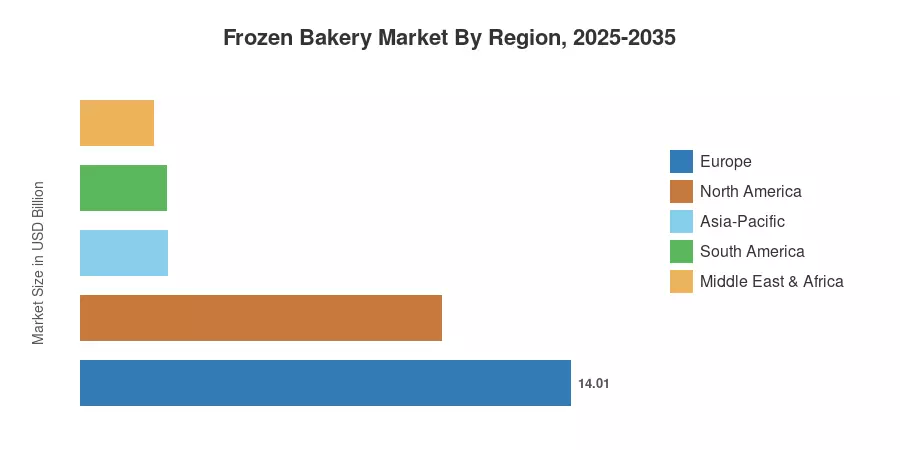
Europe commands the largest share of the Frozen Bakery Market at approximately 38.7% of global revenue in 2025, anchored by strong artisanal traditions in France, Germany, and the Nordic countries. Asia-Pacific is the fastest-growing region, projected to expand at a 6.9% CAGR through 2035, fueled by rapid modern-retail penetration and shifting dietary preferences toward Western-style baked goods. North America holds the second-largest position, driven by robust private-label frozen bakery programs across major grocery chains. The next decade will reward companies that balance scale-driven efficiency with localized product innovation.


Key Report Takeaways

• By Product Type

  • Bread accounted for the dominant share of the Frozen Bakery Market in 2025, reflecting the category's role as a daily staple across both retail and foodservice channels.
  • Pizza Crust is forecast to register the highest CAGR of 6.7% through 2035, propelled by at-home meal-kit trends and QSR expansion.
  • Cakes and Pastries generated an estimated USD 7.96 Billion in 2025, supported by premiumization in celebration and indulgence occasions.

• By Form

  • Ready-to-Bake products commanded approximately 42.4% of the Frozen Bakery Market in 2025, favored by in-store bakery operators seeking consistency with minimal labor.
  • Ready-to-Proof formats are projected to grow at a 5.6% CAGR through 2035 as artisan-quality positioning gains traction.

• By Distribution Channel

  • Off-Trade Retail held 63.3% of global Frozen Bakery Market revenue in 2025, led by hypermarket and supermarket frozen-aisle expansions.
  • On-Trade HoReCa is advancing at a 6.1% CAGR through 2035, driven by post-pandemic foodservice recovery and labor-cost mitigation.

• By Region

  • Europe led the Frozen Bakery Market with a 38.7% revenue share in 2025, underpinned by mature cold-chain networks and regulatory support.
  • Asia-Pacific records the highest projected CAGR at 6.9% during 2026–2035, powered by urbanization and rising disposable incomes.


Market Size and Forecast (2021–2035)

Market Research Future's sizing methodology combines top-down revenue analysis from company filings and trade-body data with bottom-up demand modeling across product types, forms, and distribution channels. Historical figures (2021–2024) are calibrated against customs data, retail scanner datasets, and foodservice procurement surveys. Forecast values (2026–2035) incorporate macroeconomic inputs, consumer-trend trajectories, and planned capacity expansions disclosed by leading manufacturers[4].
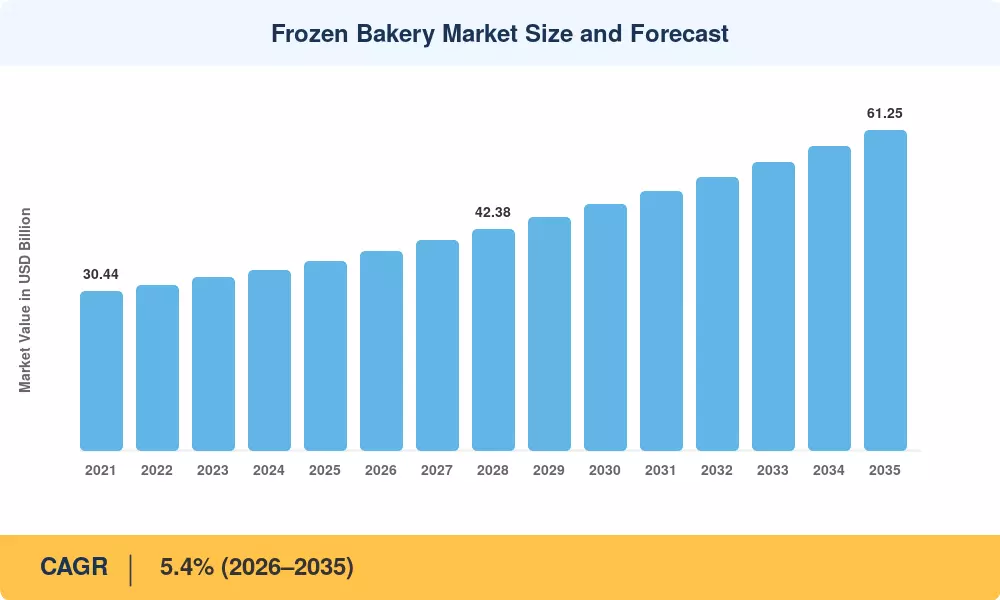
Frozen Bakery Market Size and Forecast
Our Impact
Enabled $4.3B Revenue Impact for Fortune 500 and Leading Multinationals
Partnering with 2000+ Global Organizations Each Year
30K+ Citations by Top-Tier Firms in the Industry

Driver Impact Analysis

Driver ~% Impact on CAGR Geographic Relevance Impact Timeline
Urbanization and dual-income household growth +0.9% Global Long-term (≥4 yr)
Cold-chain infrastructure expansion +0.8% Asia-Pacific, MEA Medium-term (2–4 yr)
In-store bakery conversion to frozen par-bake +0.7% Europe, North America Short-term (≤2 yr)
Clean-label and health-oriented reformulation +0.6% North America, Europe Medium-term (2–4 yr)
QSR and foodservice labor-cost mitigation +0.5% Global Short-term (≤2 yr)
E-commerce and direct-to-consumer frozen logistics +0.4% North America, Asia-Pacific Medium-term (2–4 yr)
Government food-safety and traceability mandates +0.3% Europe, Asia-Pacific Long-term (≥4 yr)


Urbanization and Dual-Income Household Growth

According to UN estimates, 68% of the world's population will live in cities by 2050, up from 56% in 2024 [4]. The frozen bakery market directly benefits from the fact that urban consumers routinely spend 15–20% more on convenience food categories than their rural counterparts. As modern retail footprints spread into tier-2 and tier-3 cities, per-capita consumption of frozen baked goods increased by a projected 12% in China alone between 2022 and 2024.


Cold-Chain Infrastructure Expansion

A multibillion-dollar cold chain expansion is currently underway across the Middle East and Asia-Pacific. According to projections from India's National Centre for Cold-chain Development, the nation installed more than 8 million metric tons of cold storage capacity between 2021 and 2024, which would have reduced spoiling rates for products that are sensitive to temperature by almost 9 percentage points [7]. In areas that previously relied on ambient-shelf substitutes, this expansion directly reduces distribution hurdles for frozen bread goods.


In-Store Bakery Conversion to Frozen Par-Bake

Labor shortages and wage inflation are accelerating the shift from scratch-bake to frozen par-bake models in supermarket in-store bakeries across Europe and North America. A 2024 Federation of Bakers survey found that 62% of UK grocery retailers plan to increase their par-bake SKU counts by 2027, citing a 25–30% reduction in bakery labor hours [6]. This structural shift widens addressable demand for the Frozen Bakery Market at the retail level.

Clean-Label and Health-Oriented Reformulation

Consumer demand for shorter ingredient lists and functional attributes is reshaping the Frozen Bakery Market product mix. A 2024 IFIC Foundation survey indicated that 47% of U.S. consumers actively seek whole-grain or high-fiber options when purchasing frozen baked goods [9]. Manufacturers are responding with protein-enriched doughs, reduced-sodium formulations, and certified organic lines — innovations that carry 10–15% price premiums and improve category margin profiles.


Restraints Impact Analysis

The restraint impacts below represent estimated drags on market growth and are directional rather than precisely additive. Real-world interactions between restraints and countervailing drivers produce a net effect reflected in the overall CAGR.

Restraint ~% Impact on CAGR Geographic Relevance Impact Timeline
Energy and commodity-cost volatility –0.5% Global Short-term (≤2 yr)
Cold-chain fragmentation in emerging markets –0.4% South America, MEA, parts of Asia-Pacific Medium-term (2–4 yr)
Consumer perception of freshness vs. frozen –0.3% Europe (artisanal markets) Long-term (≥4 yr)
Regulatory complexity for cross-border frozen-food trade –0.3% Global Medium-term (2–4 yr)
Private-label margin pressure on branded players –0.2% North America, Europe Short-term (≤2 yr)


Energy and Commodity-Cost Volatility

Production of frozen baked goods requires a lot of energy; 30–35% of overall manufacturing expenses can be attributed to blast-freezing, cold storage, and refrigerated transportation [13]. Aryzta AG and Lantmännen Unibake both reported mid-single-digit cost-of-goods increases for 2022–2023 as a result of the severe jump in European natural gas prices. Even though the energy markets have since steadied, the Frozen Bakery Market's profitability is nonetheless consistently hampered by its structural vulnerability to changes in wheat prices and power.


Cold-Chain Fragmentation in Emerging Markets

Cold-chain reliability in several regions of South Asia and Sub-Saharan Africa is far behind developed markets despite continuous investment. According to World Bank estimates, post-harvest food losses for temperature-sensitive categories in these areas continue to surpass 20% [7]. Infrastructure deficiencies rather than demand constraints will continue to hinder the spread of frozen bakeries in high-growth population centers until last-mile refrigerated logistics achieve critical mass.


5.3 Consumer Perception of Freshness vs. Frozen

In markets with deep artisanal baking traditions — particularly France, Italy, and parts of Germany — a segment of consumers continues to associate frozen products with inferior quality [14]. Overcoming this perception requires sustained investment in sensory-quality R&D and transparent communication about flash-freezing's ability to preserve taste and texture. Brands that fail to close this perception gap risk losing shelf space to in-store scratch-bake programs.


Frozen Bakery Market Opportunities

Gluten-Free and Functional Frozen Bakery Expansion

The global gluten-free food market surpassed USD 9.5 Billion in 2024 and is growing at roughly double the rate of conventional bakery [9]. Frozen formats are ideally suited to gluten-free production because blast-freezing locks in texture that gluten-free doughs typically lose within hours at ambient temperature. Manufacturers that build dedicated gluten-free frozen lines can capture premium pricing while tapping an underserved segment of the Frozen Bakery Market.

QSR and Ghost-Kitchen Frozen Dough Programs

Quick-service restaurants and ghost kitchens operated over 120,000 outlets across the U.S. alone by end-2024, with labor costs representing 30–33% of revenue [10]. Pre-portioned frozen dough programs reduce kitchen-labor requirements by up to 40%, making them an attractive proposition for operators focused on unit economics. This channel represents a largely untapped distribution pathway for the Frozen Bakery Market, particularly in emerging QSR segments across Asia-Pacific.

E-Commerce Direct-to-Consumer Frozen Delivery

Online grocery penetration for frozen foods reached approximately 14% of total category sales in the U.S. in 2024, up from 9% in 2021 [5]. Companies that invest in insulated last-mile packaging and subscription-based delivery models can bypass traditional retail gatekeepers and capture higher margins. This opportunity is especially pronounced for artisan-positioned brands seeking national distribution without the cost of retailer slotting fees.

Emerging-Market Premiumization in Asia-Pacific and Latin America

Rising middle-class populations in India, Indonesia, Brazil, and Vietnam are driving demand for Western-style bakery products at price points 20–30% above local staples. Frozen formats solve the shelf-life challenge inherent in tropical and subtropical climates, giving multinational bakery firms a logistics advantage over local scratch-bake competitors. The Frozen Bakery Market stands to benefit from this premiumization wave as modern-retail chains expand into secondary and tertiary cities.

Data-Driven Demand Forecasting and Waste Reduction

Advances in AI-powered demand sensing allow frozen bakery producers to match production volumes more closely to actual consumption patterns, reducing overproduction waste by an estimated 12–18% [12]. Retailers integrating real-time POS data with supplier replenishment algorithms can cut frozen-bakery shrinkage costs significantly, improving the economics of the Frozen Bakery Market for both manufacturers and distributors.


Frozen Bakery Market Future Outlook

AI-Driven Production Optimization

Artificial intelligence is set to transform frozen bakery manufacturing over the next decade. Predictive-maintenance algorithms, machine-vision quality inspection, and AI-based demand forecasting are expected to reduce production waste by 15–20% and improve line utilization by 10–12% across large-scale operations by 2030 [12]. Companies that invest early in digital-twin factory models will gain a structural cost advantage in the Frozen Bakery Market.

Sustainability and Carbon-Neutral Cold Chains

Environmental pressures are intensifying across the frozen-food value chain. The International Institute of Refrigeration estimates that refrigeration accounts for roughly 7.8% of global greenhouse-gas emissions [17]. Over the forecast period, the Frozen Bakery Market will see accelerated adoption of natural refrigerants (CO₂, ammonia), solar-powered cold rooms, and electric refrigerated vehicles. EU Green Deal packaging regulations, expected to take full effect by 2030, will additionally push manufacturers toward recyclable and compostable wrapping solutions.

Premiumization and Artisanal-Quality Positioning

Consumer willingness to pay for premium frozen bakery items continues to rise. Retail data indicates that premium-tier frozen bakery SKUs grew at 2.4 times the rate of value-tier equivalents in 2024 across Western Europe and North America [18]. Over the next decade, the Frozen Bakery Market will see further premiumization through sourdough-fermentation techniques, heritage-grain formulations, and transparent supply-chain storytelling that bridges the gap between artisanal perception and industrial-scale production.

Personalized Nutrition and Functional Ingredients

The convergence of nutrigenomics, clean-label demand, and food technology is opening a new frontier for the Frozen Bakery Market. Ingredient suppliers are developing protein-fortified dough systems, prebiotic-fiber inclusions, and micronutrient-enriched flour blends tailored to demographic-specific health goals [9]. By 2032, Market Research Future anticipates that functional frozen bakery products will represent approximately 8–10% of total category revenue in developed markets, supported by regulatory frameworks that permit structured health claims on frozen-food packaging.


Frozen Bakery Market Segmentation

By Product Type

Segment Key Metric Primary Demand Driver
Bread 44.8% share (2025) Daily-staple consumption; in-store bakery par-bake conversion
Pizza Crust 6.7% CAGR (2026–2035) At-home meal-kit trends; QSR menu expansion
Cakes and Pastries USD 7.96 Billion (2025) Celebration and indulgence occasions; premiumization
Morning Goods 5.2% CAGR (2026–2035) Breakfast convenience; hotel and café foodservice
Others USD 2.24 Billion (2025) Ethnic specialty items; private-label variety packs


Bread remains the dominant product segment within the Frozen Bakery Market, driven by its universal role as a dietary staple and the rapid conversion of in-store supermarket bakeries from scratch production to frozen par-bake models. White bread and multigrain loaves account for the bulk of volume, but whole-grain and seeded varieties are gaining share as health-conscious consumers seek fiber-rich alternatives. The Frozen Bakery Market bread segment benefits from extremely high repurchase frequency, making it a critical traffic driver for retailers' frozen aisles.

Pizza Crust is the standout growth segment, propelled by the global expansion of pizza QSR chains and the rising popularity of at-home pizza-making kits. Thin-crust and Neapolitan-style frozen bases command higher price points and are increasingly displacing commodity-grade options. The Frozen Bakery Market is also seeing innovation in cauliflower-crust and gluten-free pizza bases, which cater to dietary-restriction consumers while delivering improved taste profiles compared to early-generation alternatives.

By Form

Segment Key Metric Primary Demand Driver
Ready to Cook USD 6.52 Billion (2025) Consumer home-baking convenience
Ready to Bake 42.4% share (2025) In-store bakery and foodservice labor savings
Ready to Proof 5.6% CAGR (2026–2035) Artisanal-quality positioning in HoReCa
Ready to Eat 4.9% CAGR (2026–2035) Grab-and-go retail snacking occasions


Ready-to-Bake products lead the Frozen Bakery Market by form, prized by in-store bakeries and foodservice operators for their ability to deliver consistent quality with minimal skilled labor. Operators simply transfer products from freezer to oven, eliminating proofing time and reducing bakery staffing requirements by 25–30% compared to scratch methods [6]. Ready-to-Proof formats, while smaller in absolute terms, are growing rapidly because they allow operators to control the final proofing stage, producing a differentiated artisanal appearance that justifies premium pricing at the point of sale.

By Distribution Channel

Segment Key Metric Primary Demand Driver
Off-Trade Retail 63.3% share (2025) Supermarket frozen-aisle expansion; private-label growth
On-Trade HoReCa 6.1% CAGR (2026–2035) Foodservice recovery; ghost-kitchen adoption


Off-Trade Retail dominates the Frozen Bakery Market distribution landscape, with hypermarkets, supermarkets, and convenience stores collectively handling over 63% of global sales. Private-label frozen bakery is a particularly dynamic subsegment, with retailers leveraging co-manufacturing partnerships to offer quality-competitive products at 20–25% price discounts relative to branded alternatives. On-Trade HoReCa, meanwhile, is the faster-growing channel as hotels, restaurants, and catering operators increasingly replace scratch bakery operations with frozen-supply models to manage labor shortages and food-waste costs [10].


Regional Market Share Analysis

Region Key Metric (2025) Primary Investment Themes
Europe 38.7% revenue share In-store bakery automation; organic and clean-label expansion
North America USD 10.32 Billion Private-label growth; QSR frozen-dough supply contracts
Asia-Pacific 6.9% CAGR (2026–2035) Cold-chain build-out; modern-retail penetration
South America USD 2.46 Billion Western-bakery premiumization; urbanization
Middle East & Africa 5.8% CAGR (2026–2035) Tourism-driven HoReCa demand; cold-storage investment
Total USD 36.20 Billion

The Frozen Bakery Market exhibits distinct regional dynamics shaped by dietary culture, cold-chain maturity, retail structure, and income levels. Europe's dominance reflects decades of frozen par-bake adoption, while Asia-Pacific's rapid growth trajectory is fueled by infrastructure modernization and shifting consumption patterns.


North America

Country Key Metric Key Driver
United States 78.4% of regional revenue Private-label frozen bakery expansion across mass grocers
Canada 5.2% CAGR (2026–2035) Multicultural demand for diverse frozen baked goods
Mexico USD 0.72 Billion (2025) Modern-trade retail growth and QSR proliferation


The United States dominates North America's Frozen Bakery Market, with major retailers including Walmart, Kroger, and Costco expanding private-label frozen bakery assortments by 18–22% between 2022 and 2024 [6]. Canada's multicultural consumer base is driving demand for ethnically diverse frozen flatbreads, naan, and croissant varieties, while Mexico's organized retail sector is experiencing a rapid conversion from artisanal panaderías to frozen-supply models in urban centers.

Europe

Country Key Metric Key Driver
Germany 22.5% of regional revenue Industrial bakery automation and discounter channel
United Kingdom 5.3% CAGR (2026–2035) In-store bakery par-bake conversion
France USD 2.18 Billion (2025) Artisanal-quality frozen viennoiserie demand
Italy 4.8% CAGR (2026–2035) Frozen pizza-base adoption in foodservice
Spain USD 1.12 Billion (2025) Tourism-driven HoReCa consumption
Nordic Countries 8.6% of regional revenue Clean-label and organic frozen bakery penetration
Russia 4.5% CAGR (2026–2035) Modern-retail expansion outside Moscow and St. Petersburg
Rest of Europe USD 1.85 Billion (2025) Eastern European cold-chain modernization


Europe's leadership in the Frozen Bakery Market is underpinned by the EU's rigorous food-safety framework, which standardizes frozen-product labeling, traceability, and temperature-control requirements across 27 member states [1]. Germany's strength lies in its discounter-led retail model — Aldi and Lidl collectively stock over 40 frozen bakery SKUs per store — while France remains the global benchmark for frozen viennoiserie quality, with producers like Bridor and Europastry investing heavily in flash-freeze technology to replicate artisanal lamination.

Asia-Pacific

Country Key Metric Key Driver
China 32.8% of regional revenue Tier-2/3 city modern-retail expansion
India 7.8% CAGR (2026–2035) Cold-chain infrastructure build-out and urbanization
Japan USD 1.62 Billion (2025) Convenience-store frozen bakery innovation
South Korea 6.4% CAGR (2026–2035) K-food fusion bakery trends
ASEAN USD 0.95 Billion (2025) Tourism-driven foodservice and hotel demand
Rest of Asia-Pacific 6.1% CAGR (2026–2035) Emerging modern-trade infrastructure


Asia-Pacific represents the fastest-growing region in the Frozen Bakery Market, with China's bakery industry alone valued at over USD 45 Billion in 2024 and frozen penetration still below 15%. Japan's convenience-store chains — Seven-Eleven, Lawson, and FamilyMart — have become powerful distribution channels for single-serve frozen bakery items, while India's National Centre for Cold-chain Development projects that refrigerated warehouse capacity will double between 2024 and 2030, removing a key bottleneck for frozen-food distribution.

South America

Country Key Metric Key Driver
Brazil 62.3% of regional revenue Organized retail and frozen pão de queijo demand
Argentina 5.0% CAGR (2026–2035) Frozen medialunas adoption in foodservice
Rest of South America USD 0.42 Billion (2025) Urbanization and supermarket chain expansion


Brazil anchors South America's Frozen Bakery Market, where frozen pão de queijo (cheese bread) has become one of the highest-velocity frozen bakery SKUs in the country's hypermarket channel [15]. Argentine bakeries are increasingly supplementing traditional scratch production with frozen croissant formats to manage labor costs, a trend that is gradually expanding into Chile, Colombia, and Peru as cold-chain reliability improves.

Middle East & Africa

Country Key Metric Key Driver
Saudi Arabia 28.5% of regional revenue Vision 2030 hospitality and tourism investment
UAE 6.3% CAGR (2026–2035) Luxury hotel and airline catering demand
South Africa USD 0.32 Billion (2025) Retail modernization and frozen bread adoption
Egypt 5.5% CAGR (2026–2035) Population growth and urbanization
Rest of MEA USD 0.38 Billion (2025) Expanding cold-chain in East and West Africa


The Middle East & Africa region presents a high-growth opportunity for the Frozen Bakery Market, with Saudi Arabia's Vision 2030 program driving massive hotel, entertainment, and catering infrastructure investment [16]. The UAE serves as a regional distribution hub, with Dubai's free-zone cold-storage facilities handling a significant share of imported frozen bakery goods destined for GCC markets. In Sub-Saharan Africa, cold-chain gaps remain a barrier, but South Africa's established retail infrastructure provides a proof-of-concept for frozen bakery penetration in the broader continent.


Frozen Bakery Market By Region, 2025-2035

Competitive Benchmarking

The Frozen Bakery Market is characterized by low-to-moderate concentration, with an estimated HHI below 800 and the top five players collectively holding approximately 28–34% of global revenue. The competitive field blends multinational conglomerates with regional specialists, creating a fragmented landscape where scale advantages in procurement and cold-chain logistics coexist with niche expertise in artisanal-quality frozen products. Strategic M&A activity has intensified since 2022 as larger players seek geographic and category expansion.

Company Est. Revenue Share Range Key Offerings for Frozen Bakery Market Strategic Positioning
Grupo Bimbo ~7–10% Frozen breads, buns, tortillas, and sweet rolls Global scale; vertically integrated supply chain
Aryzta AG ~5–8% Frozen artisanal breads, croissants, and sweet pastries Premium foodservice and QSR specialist
Lantmännen Unibake ~4–7% Frozen breads, pastries, and morning goods European market leader; cooperative ownership model
General Mills Inc. ~4–6% Frozen dough, pizza crusts, and refrigerated baked goods Brand strength (Pillsbury); North American retail anchor
Europastry S.A. ~3–5% Frozen viennoiserie, breads, and sweet goods Innovation-led; artisanal positioning
Flowers Foods Inc. ~3–5% Frozen breads, buns, and snack cakes U.S. retail distribution breadth
Vandemoortele NV ~2–4% Frozen pastries, breads, and patisserie items Benelux and Western European focus; B2B expertise
Conagra Brands Inc. ~2–4% Frozen garlic bread, Texas Toast, and pizza products Strong branded retail presence in North America
Rich Products Corporation ~2–3% Frozen dough, cakes, and toppings for foodservice Foodservice and in-store bakery supply chain
Cole's Quality Foods ~1–2% Frozen garlic bread and breadsticks Niche branded leader in U.S. frozen garlic bread


Recent News & Developments


  • Europastry S.A. (October 2023): Opened a state-of-the-art R&D center in Barcelona focused on sourdough fermentation technology for frozen applications, aiming to replicate artisanal bread quality at industrial scale [23].
  • Edita Food Industries (May 2025): Edita Food Industries, owned by Hani Berzi, launched a high-end frozen bread line in Egypt. With an emphasis on cafés, hotels, and restaurants, this new product line offers simple-to-use ready-to-bake pastry solutions for the nation's food service industry.
  • Bikaji Foods (December 2024): Bikaji Foods launches Bikaji Bakes, a new division that will manufacture high-end frozen baked items. A wholly-owned subsidiary of Bikaji Foods, Bikaji Bakes Pvt Ltd is dedicated to producing and distributing upscale baked goods, such as cakes and croissants.
  • Evirth (September 2024): Evirth, a major participant in China's quickly growing cake and pastry business, was purchased by Mondelēz International. With this action, Mondelēz's investment in frozen-to-chilled cakes and pastries in China has significantly increased.


Frozen Bakery Market Report Scope

Parameter Detail
Market Scope Global Frozen Bakery Market — production, distribution, and consumption of frozen bread, pizza crust, cakes and pastries, morning goods, and related products
Study Period 2021–2035
CAGR 5.4% (2026–2035)
Base Year Market Size USD 36.20 Billion (2025)
Forecast End-Year Market Size USD 61.25 Billion (2035)
Fastest Growing Segment Pizza Crust (by product type); Ready to Proof (by form)
Companies Profiled 10 (Grupo Bimbo, Aryzta AG, Lantmännen Unibake, General Mills, Europastry, Flowers Foods, Vandemoortele, Conagra Brands, Rich Products, Cole's Quality Foods)
Valuation Currency USD Billion


FAQs

What minimum cold-chain temperature must operators maintain for frozen bakery distribution?
Most frozen bakery products require continuous storage at –18 °C (0 °F) or below to preserve texture and safety. Any break in this chain above –12 °C risks starch retrogradation and microbial growth [13].
How do frozen bakery procurement contracts typically structure pricing for large foodservice buyers?
Large HoReCa buyers usually negotiate annual fixed-price contracts with quarterly commodity-adjustment clauses tied to wheat and energy indices. Volume rebates of 5–8% are standard above minimum order thresholds [10].
What shelf-life advantage does cryogenic freezing offer over mechanical blast freezing for the Frozen Bakery Market?
Cryogenic freezing achieves core temperature in roughly one-third the time, producing smaller ice crystals that better preserve crumb structure. Shelf life can extend to 12–15 months versus 8–10 months for mechanical methods [12].
How are sustainability certifications influencing retailer listing decisions in the Frozen Bakery Market?
Major European retailers now require suppliers to hold at least one recognized sustainability certification for shelf placement. Non-certified SKUs face delisting risk as chains pursue Scope 3 emissions-reduction targets [11].
What role does modified-atmosphere packaging play in the Frozen Bakery Market value chain?
MAP replaces headspace air with inert gas blends, suppressing oxidation and mold during transit. It is increasingly paired with resealable consumer packs to extend at-home usability after initial thawing [14].
How are private-label strategies reshaping competitive dynamics in the Frozen Bakery Market?
Retailers are investing in co-manufactured private-label lines that match branded quality at 20–25% lower price points. This pressures branded margins and forces differentiation through innovation [6].
What integration challenges do small bakeries face when switching from scratch to frozen Frozen Bakery Market supply models?
Small operators often lack walk-in freezer capacity and must invest USD 15,000–40,000 in equipment upgrades. Staff retraining on thaw-proof-bake protocols typically requires two to four weeks [6].    
Author
Author
Author Profile
Pradeep Nandi LinkedIn
Senior Research Analyst
I have a bachelor's degree in mechanical engineering and an MBA. I have more than two years of expertise in the retail, food, and beverage, chemical, and material industries, and hence have developed a sound cross-domain expertise. A firm believer in lifelong learning and sharing of knowledge. Having a proclivity for hatching ideas and trying to absorb as much information as possible in a short amount of time. Introducing corporates to the data and insight, which enables them to move from probability to possibility, has been my key areas of interest. 

Research Approach


Secondary Research

The secondary research process involved comprehensive analysis of food industry databases, regulatory filings, agricultural commodity reports, and authoritative food service publications. Key sources included the US Food and Drug Administration (FDA), US Department of Agriculture (USDA), European Food Safety Authority (EFSA), Food Standards Agency (UK), Health Canada, Food Safety and Standards Authority of India (FSSAI), National Agricultural Statistics Service (NASS), Food and Agriculture Organization (FAO) of the United Nations, International Grains Council (IGC), American Bakers Association (ABA), Retail Bakers of America (RBA), European Federation of Food Science and Technology (EFFoST), Grocery Manufacturers Association (GMA), National Restaurant Association (NRA), International Foodservice Manufacturers Association (IFMA), Eurostat Food Industry Database, US Census Bureau Retail Trade Data, NielsenIQ Retail Measurement Services, IRI Worldwide Market Data, Euromonitor International Packaged Food Database, and Mintel Global New Products Database (GNPD). These sources were utilized to collect production volume statistics, cold chain logistics data, wheat and commodity pricing trends, gluten-free certification standards, retail scanner data, foodservice distribution volumes, import/export trade flows, and regulatory compliance frameworks for frozen dough, par-baked goods, and fully baked frozen products.


Primary Research

To gather qualitative and quantitative insights unique to frozen bakery value chains, the primary research process involved interviewing players from both the supply and demand sides. Executives from frozen bakery companies, industrial bakeries, and private label suppliers were among the supply-side sources. They included VPs of frozen operations, directors of research and development for dough technology, heads of cold chain logistics, and quality assurance managers. Supply chain managers from institutional catering companies, buyers from convenience store operators, bakery department heads from hypermarkets, category managers from supermarket chains, and foodservice procurement directors from QSRs and casual dining chains made up the demand-side sources. Product segmentation by ready-to-bake and ready-to-thaw categories was confirmed through primary research. In addition, timelines for freezer-to-oven technology adoption were confirmed. Clean-label ingredient transitions, shelf-life extension technologies, and the dynamics of private label versus branded in retail and foodservice channels were also gathered.

Primary Respondent Breakdown:

By Designation: C-level Primaries (28%), Director Level (35%), Others (37%)

By Region: North America (30%), Europe (35%), Asia-Pacific (25%), Rest of World (10%)


Market Size Estimation

Global market valuation was derived through revenue triangulation and volume analysis across retail and foodservice channels. The methodology included:

Identification of 60+ key manufacturers and private label suppliers across North America, Europe, Asia-Pacific, Latin America, and the Middle East

Product mapping across frozen breads & rolls, pizza crusts, cakes & pastries, cookies & biscuits, and specialty gluten-free formulations

Analysis of reported annual revenues and estimated frozen bakery-specific portfolio sales from publicly traded companies and industry disclosures

Coverage of manufacturers and co-packers representing 75-80% of global market share in 2024

Extrapolation using bottom-up (unit volume × average selling price by SKU across supermarkets, hypermarkets, convenience stores, and foodservice distributors) and top-down (manufacturer revenue validation against retail audit data) approaches to derive segment-specific valuations for conventional and gluten-free categories, while accounting for cold storage logistics costs and regional trade flow variations

Download Free Sample

Kindly complete the form below to receive a free sample of this Report

Download PDF ×

We do not share your information with anyone. However, we may send you emails based on your report interest from time to time. You may contact us at any time to opt-out.
















